Custom WordPress Development for UK Businesses
When standard WordPress themes, plugins or editing tools no longer fit the way your business works, custom development lets you change the part that is creating the limitation. Prime Lion Digital provides custom WordPress development for businesses that need bespoke website architecture, themes, functionality, Gutenberg components or administration workflows without rebuilding parts of WordPress that already work well.
Discuss Your Custom WordPress Requirement | Explore Custom Development Services
Custom Development Should Solve a Real WordPress Limitation
Tell us a little about what you’re looking for, and our team will be in touch to discuss how we can help.
Not every WordPress requirement needs custom code. If established WordPress functionality can meet the requirement cleanly, adding bespoke development may introduce complexity without enough practical benefit.
Custom development becomes more relevant when the available setup starts forcing compromises: a theme cannot support the required interface, plugins do not match the business logic, editors repeatedly work around the CMS, or several parts of the website need to operate as one coordinated system.
The important question is therefore not simply “Can this be custom-built?” It is “Which part actually needs to be custom, and what is the most maintainable place to implement it?”
Custom WordPress Development Services
Custom WordPress Website Development
A broader route for projects where several parts of the website need to be planned and developed together. This is typically more appropriate when the requirement involves the overall site architecture, templates, functionality, content structure and user experience rather than one isolated feature.
If the main requirement is limited to a particular technical layer, a custom theme, plugin, Gutenberg block or backend solution may be the more focused route.
Custom WordPress Theme Development
For projects where the main requirement sits in the presentation layer: templates, layouts, responsive behaviour and how WordPress content is rendered on the front end.
Theme development is different from plugin development because the primary concern is how content is presented rather than adding standalone business logic or functionality.
Custom WordPress Plugin Development
When a business needs functionality that standard plugins cannot provide cleanly, custom plugin development can place that logic in a dedicated part of WordPress rather than forcing it into a theme or assembling multiple overlapping plugins.
This route is typically better suited to bespoke functionality and business rules that should remain separate from the site’s visual presentation.
Custom Gutenberg Block Development
Custom Gutenberg blocks are useful when editors repeatedly need the same structured component but still require control over its content. The objective is not simply another visual element; it is a reusable editing component that fits the website’s content system.
This can be a more focused option than changing an entire theme or building a plugin when the requirement mainly concerns reusable content creation.
WordPress Backend Customisation
Backend customisation focuses on how people manage the website: administration screens, content entry, internal workflows and the organisation of information inside WordPress.
It may be relevant when the public-facing website works correctly but routine administration has become unnecessarily difficult or does not reflect the way the organisation manages its content.
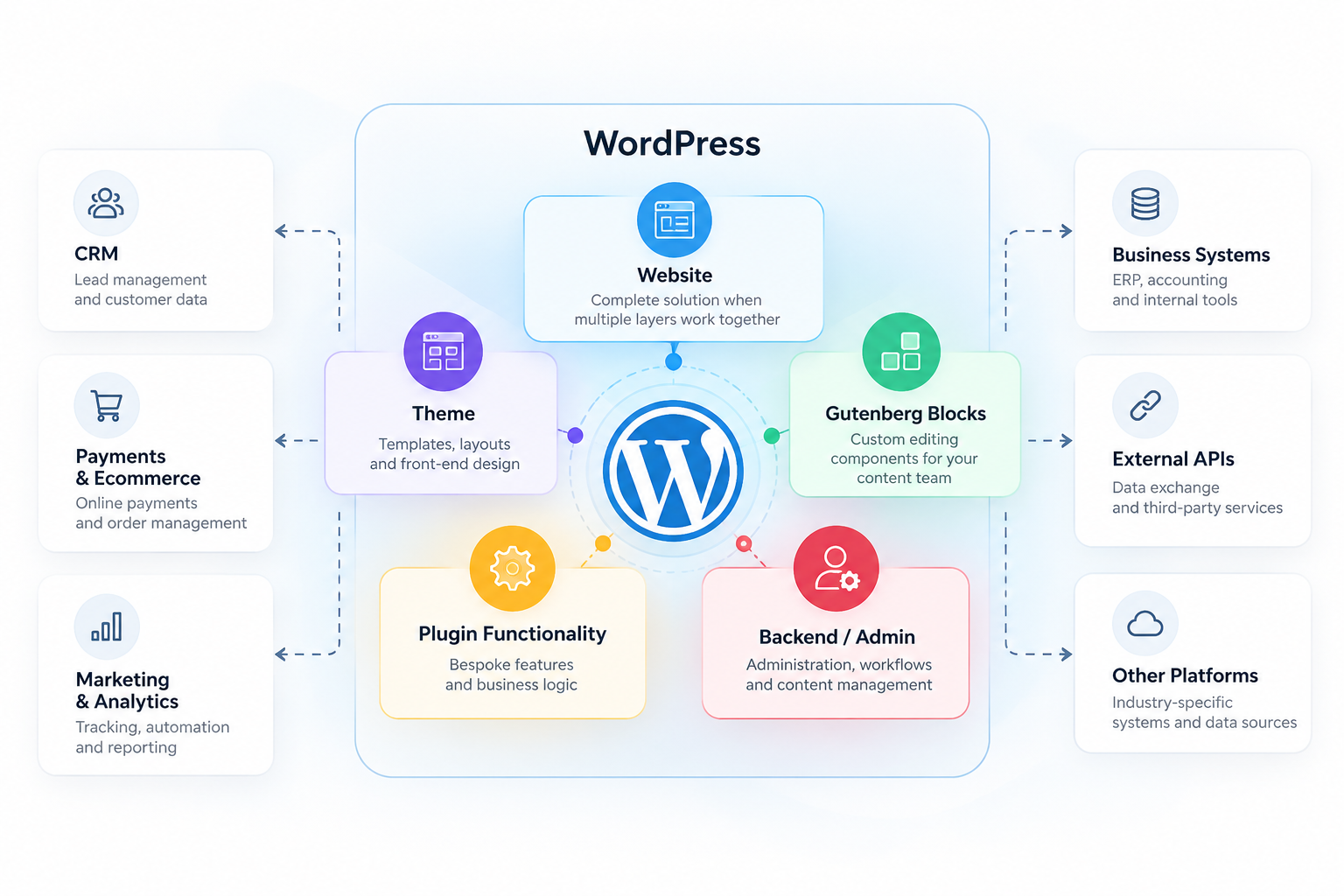
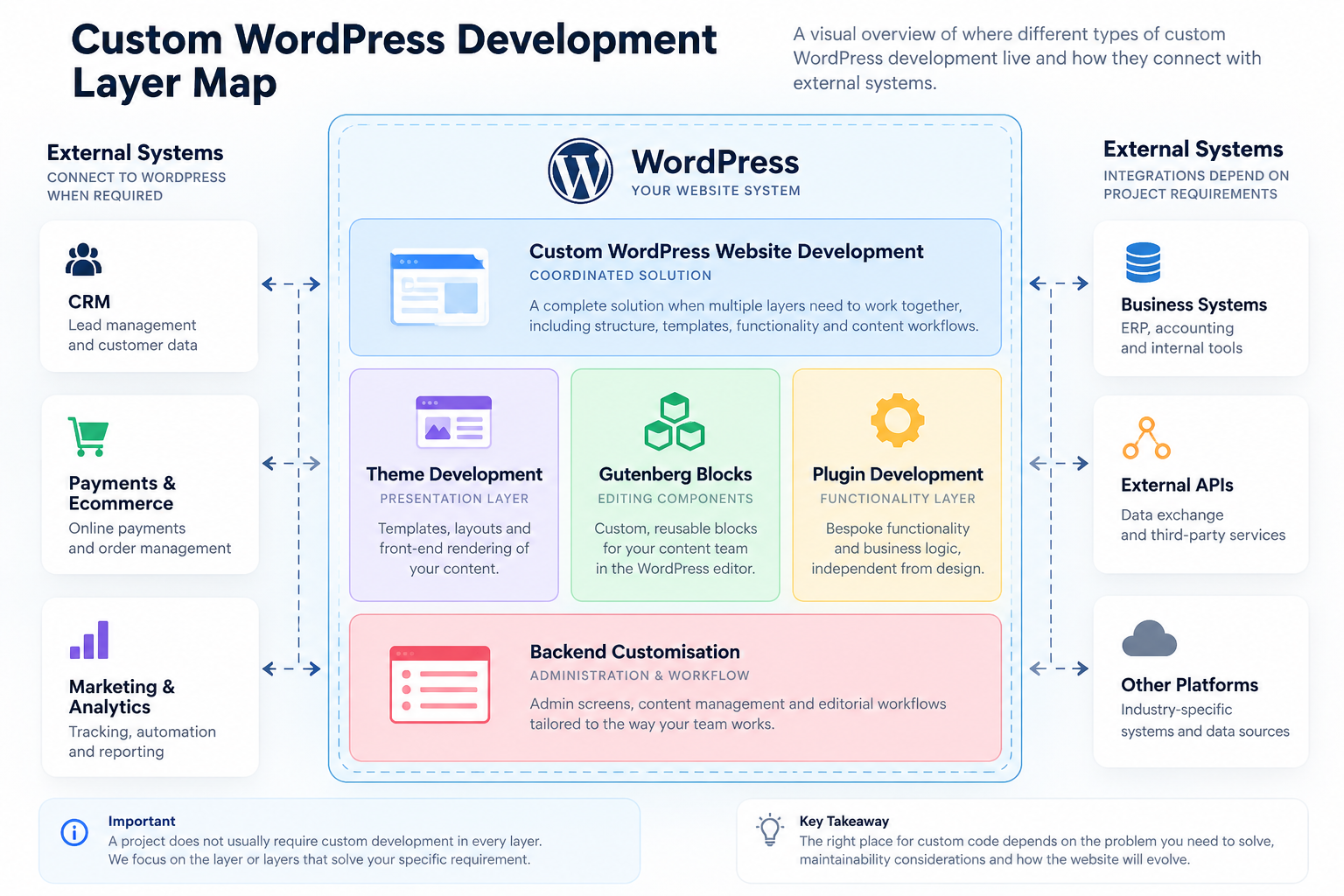
Where Should Custom WordPress Development Live?
- Website: choose this route when several layers need to be designed and developed together as one coordinated solution.
- Theme: owns presentation, templates and front-end rendering.
- Gutenberg blocks: provide structured, reusable components for content editors.
- Plugin: is generally the stronger location for independent functionality and business logic.
- Backend: concerns administration, content management and internal WordPress workflows.
- External systems: connect to WordPress where the project requires data or functionality to move between platforms.
Which Custom WordPress Development Route Fits Your Requirement?
Start with the problem the website needs to solve. The technical route should follow from that requirement rather than the other way around.
| Requirement | Typical Route | Why | Alternative to Consider |
|---|---|---|---|
| Several parts of a new or existing website need to work differently | Custom WordPress Website Development | Multiple development layers need to be planned together | A more focused service may be sufficient if the limitation sits in only one layer |
| The required templates, layouts or front-end behaviour cannot be handled cleanly by the existing theme | Custom WordPress Theme Development | The main requirement concerns presentation and rendering | Custom Gutenberg blocks if the issue is primarily reusable editorial components |
| The website needs bespoke functionality or business rules | Custom WordPress Plugin Development | The requirement is functional rather than primarily visual | An established plugin may still be more appropriate if it meets the requirement cleanly |
| Editors repeatedly need the same structured content component | Custom Gutenberg Block Development | The requirement sits in the editing experience and reusable content system | Theme development if the limitation is primarily template-level presentation |
| The public website works, but managing content or administration is inefficient | WordPress Backend Customisation | The limitation sits in administration or editorial workflow | A simpler configuration change may be sufficient before bespoke development is considered |
| WordPress needs to exchange information with another business system | Scope the integration first | The correct implementation depends on the systems, data and required direction of exchange | The integration may form part of a plugin, website or broader development project |
Custom WordPress Development in Practice
Custom development decisions make more sense when they are connected to real website requirements rather than presented as a list of technical capabilities.
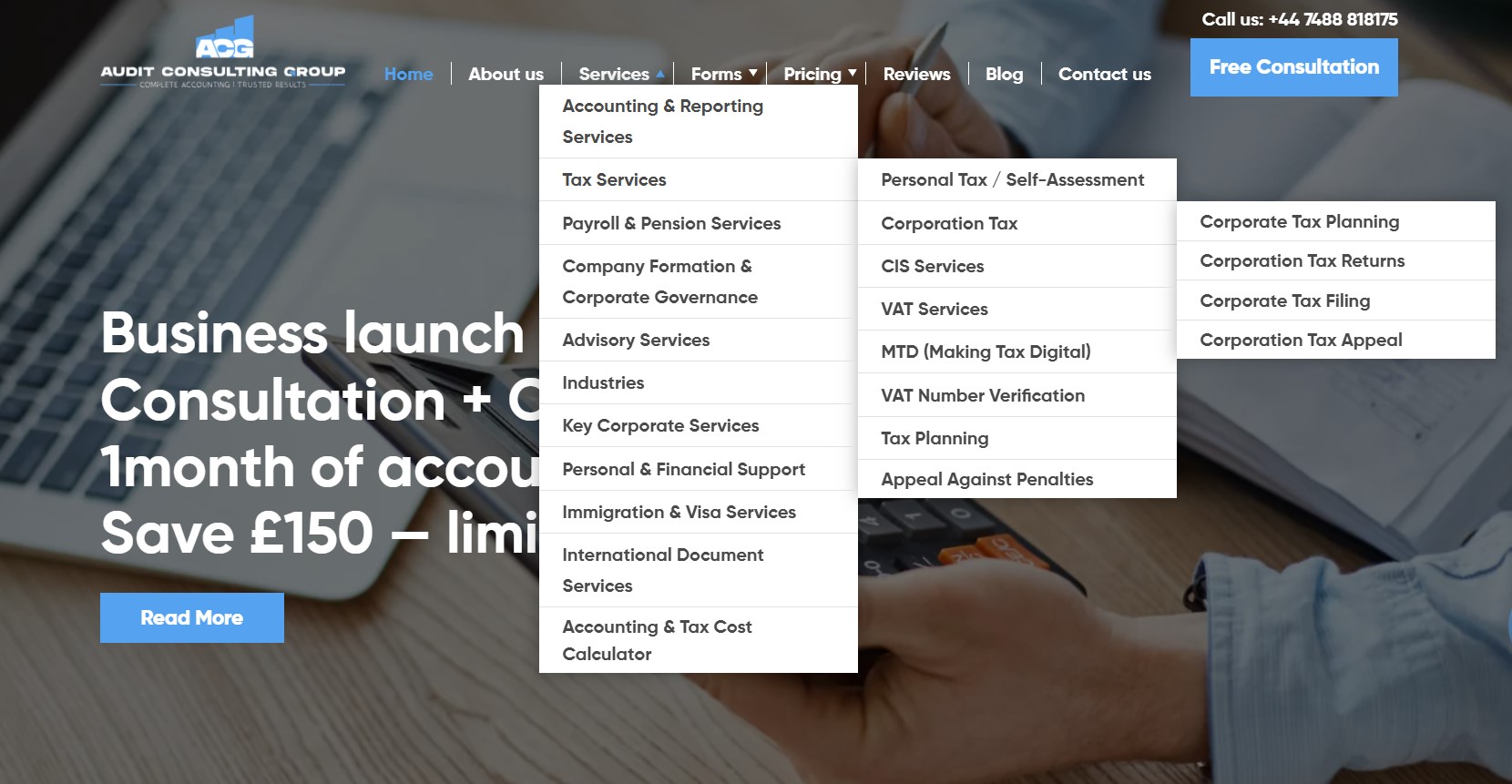
Audit Consulting Group — Architecture for a Growing Service and Content Platform
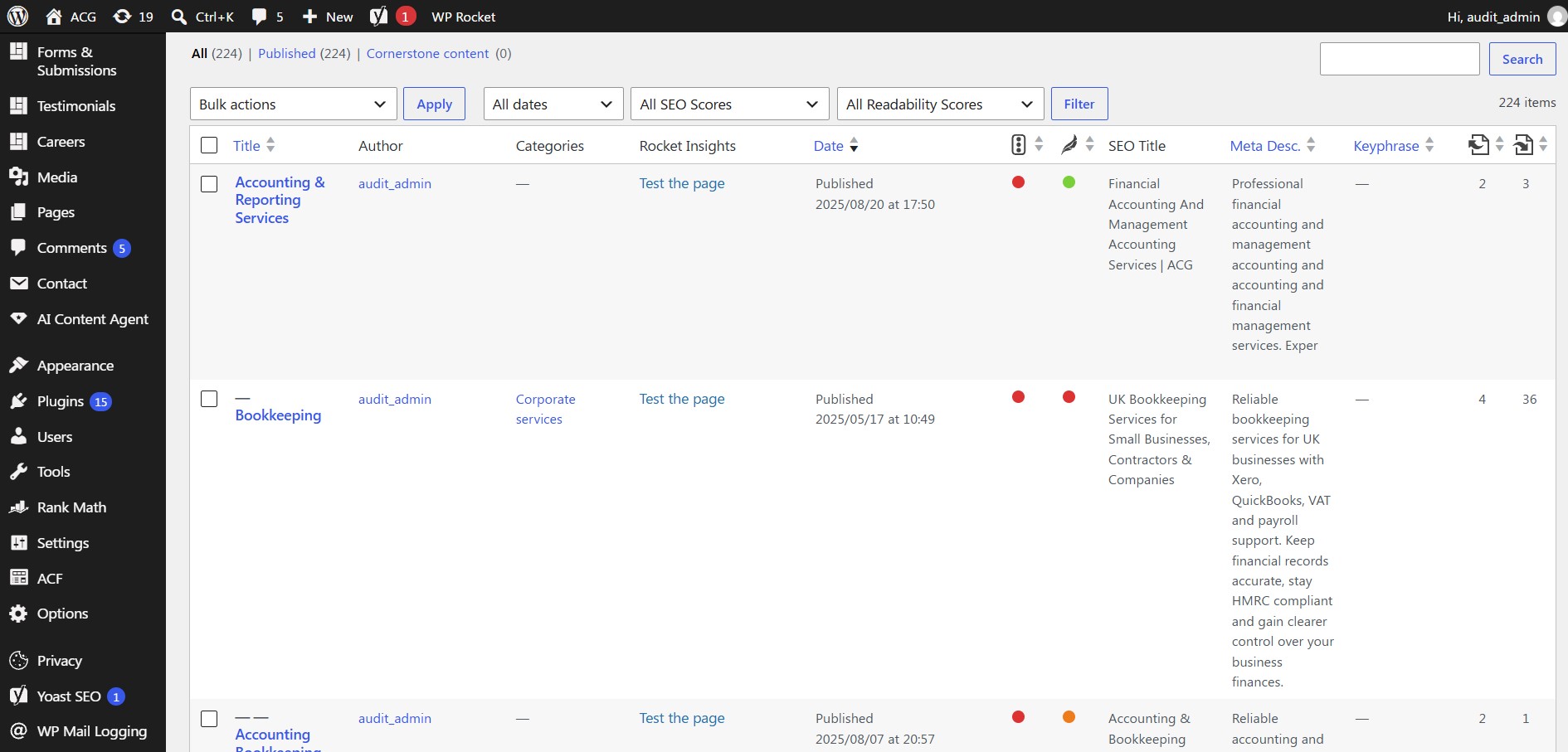
Prime Lion Digital’s work for Audit Consulting Group included website development alongside a large service and content architecture. The website needed to support an expanding accounting and tax service structure, educational content, enquiry journeys and organic search activity without allowing the content estate to become disconnected.
This project is useful evidence of why WordPress architecture matters when a website needs to grow beyond a small collection of pages. It demonstrates development, content architecture and SEO being considered as connected parts of the platform.
View the Audit Consulting Group project
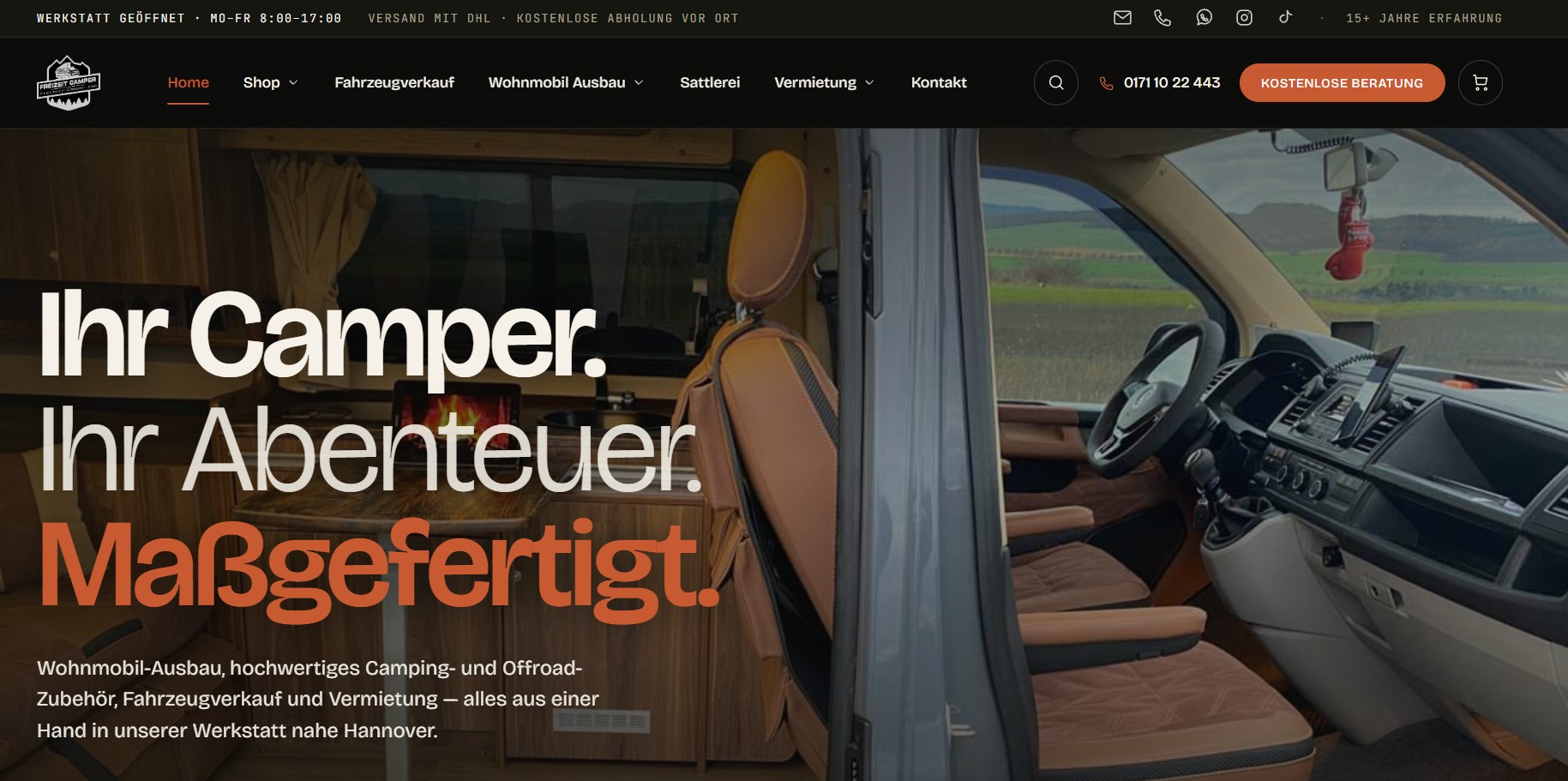
Freizeit Camper — WooCommerce, Services and Content in One Platform
For Freizeit Camper, Prime Lion Digital planned a website combining an online shop with camper conversions, rentals, specialist services and supporting content. The project included website strategy, architecture, UX/UI design and WooCommerce development, with analytics and search considerations forming part of the wider implementation.
It demonstrates a different type of WordPress requirement: several commercial journeys and content types operating within one website rather than a standalone brochure site.
View the Freizeit Camper project
Not Sure Which Part of WordPress Needs Custom Development?
You do not need to diagnose the technical solution before speaking to us. Explain what the website needs to do, what is currently preventing it and how the requirement fits into your wider website or business process. We can then assess whether the stronger route is configuration, targeted custom development or a broader WordPress project.
When Custom WordPress Development Makes Sense
Your Existing Website Has Reached the Limits of Its Current Setup
A website may have grown around a theme, page builder or collection of plugins that worked well at the beginning but now makes new requirements increasingly difficult to implement. The useful question is whether the limitation can be resolved cleanly within the existing setup or whether targeted custom development would reduce the workaround.
You Need Functionality That Does Not Fit an Existing Plugin
Installing another plugin is not automatically the safest or simplest answer. Where available products do not match the required business logic, custom functionality may be worth evaluating against the maintenance implications of adding more dependencies.
Your Content Team Repeats the Same Manual Work
If editors repeatedly rebuild the same content pattern, work around inconsistent fields or depend on developers for routine publishing, the problem may sit in the Gutenberg or backend layer rather than the public-facing design.
Several WordPress Requirements Need to Work Together
Some projects cannot be separated neatly into design, functionality and content management. A broader custom WordPress website project may be the stronger route when several layers have to be planned together.
Compare the Main Custom Development Layers
This comparison focuses on technical ownership rather than telling you which service to buy. A real project may involve more than one layer.
| Concern | Website | Theme | Plugin | Gutenberg | Backend |
|---|---|---|---|---|---|
| Primary role | Coordinate several layers into one website solution | Control presentation and templates | Provide independent functionality or business logic | Provide reusable editorial components | Improve administration and content-management workflows |
| Main user affected | Visitors and internal teams | Website visitors | Depends on the functionality | Content editors and visitors | Administrators and editors |
| Typical trigger | Several requirements need to work together | Existing presentation layer cannot support the required experience | Existing functionality does not meet the business requirement | Editors need repeatable structured components | Routine management is inefficient or poorly organised |
| Relationship to design | May include substantial UX/UI work | Closely connected to front-end design | Can operate independently of the visual theme | Needs both editing and front-end presentation decisions | May have little or no effect on public-facing design |
| Scope | Usually broader | Focused on the theme layer | Focused on defined functionality | Focused on defined content components | Focused on administration and workflow |
Connecting WordPress With Other Business Systems
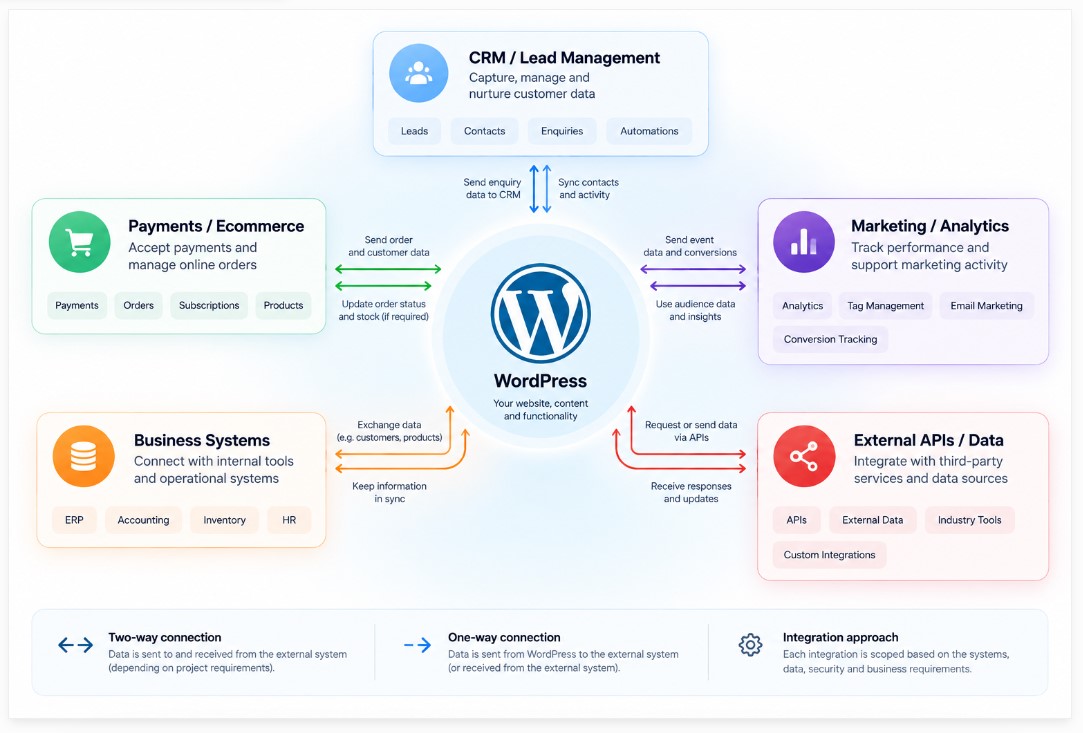
Some custom WordPress projects involve systems outside WordPress. The development decision then depends on what information needs to move, which system owns the data, how frequently it needs to change and what should happen if an external service becomes unavailable.
Depending on scope, this can include connections involving:
- CRM and lead-management systems;
- payment and ecommerce services;
- marketing and analytics platforms;
- business administration systems;
- external APIs and data sources.
The specific platform and implementation should be assessed during scoping. A list of integration logos is less useful than understanding the data flow and the role WordPress needs to perform.
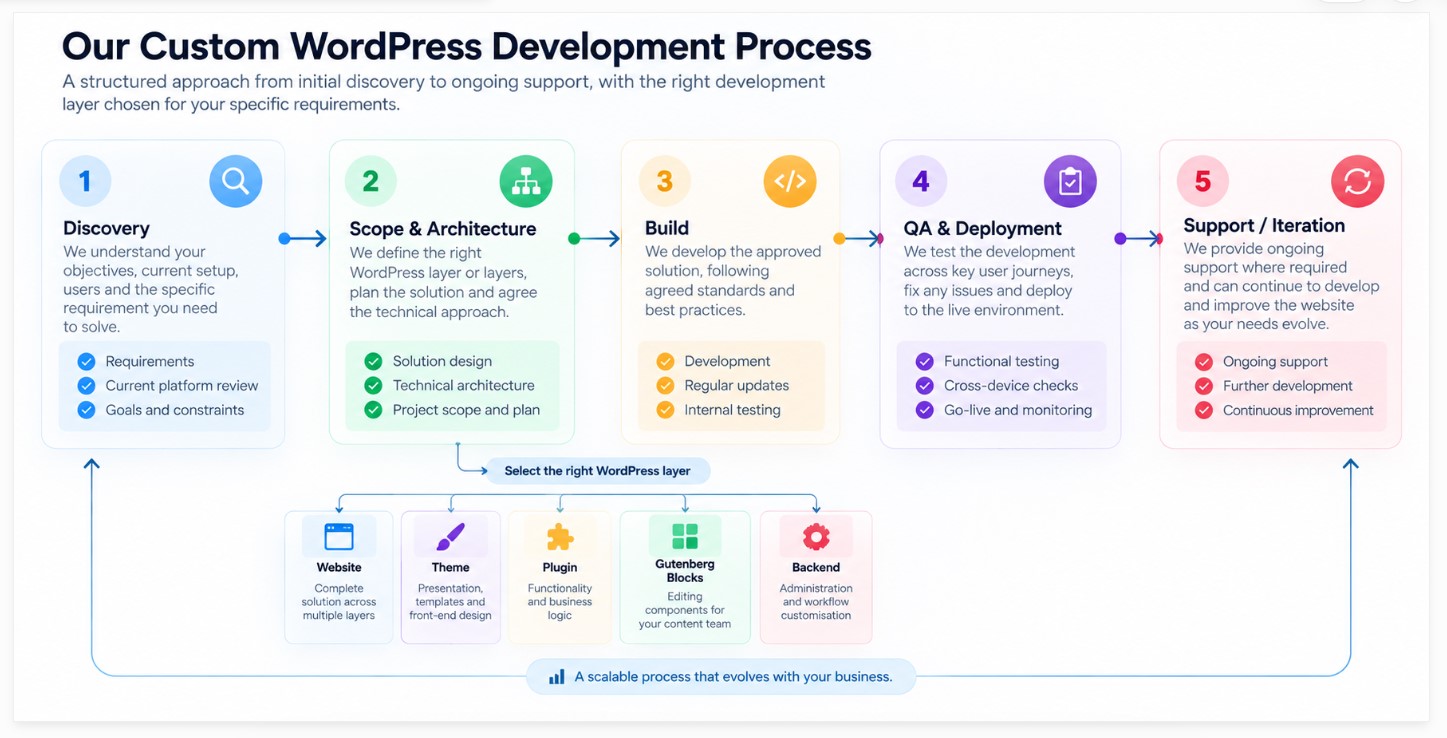
How We Approach a Custom WordPress Development Project
1. Discovery
We start with the requirement rather than assuming that bespoke development is necessary. The objective is to understand what needs to change, who will use it, what currently limits the website and which wider systems or content processes may be affected.
2. Scope & Architecture
The requirement is mapped to the appropriate WordPress layer. This is where we determine whether the project is primarily a website, theme, plugin, Gutenberg, backend or integration problem and identify dependencies that affect implementation.
3. Build
The approved solution is developed around the agreed scope. For projects involving several layers, implementation is coordinated so that presentation, functionality and content management do not become disconnected decisions.
4. QA & Deployment
The relevant functionality and user journeys are checked before release. The exact QA requirement depends on the project, but the objective is to identify issues before the new development becomes part of the live operational environment.
5. Support & Iteration
Where ongoing work forms part of the agreed scope, development can continue after deployment as requirements evolve or additional improvements are identified.
What Your Custom WordPress Project Can Include
The exact deliverables depend on the requirement, but separating core project outputs from scope-dependent work makes it easier to understand what is being commissioned.
Core Project Outputs
- Requirement and scope definition: a clear understanding of what is being changed and the problem the development needs to solve.
- Technical solution: the agreed implementation route and relevant WordPress layer.
- Custom development: the functionality, component, template, workflow or wider website work defined in the approved scope.
- Testing and deployment: checks appropriate to the implementation before the agreed work is released.
Scope-Dependent Outputs
- UX/UI design and page or component design;
- third-party or API integrations;
- content architecture and structured content configuration;
- documentation or team guidance;
- migration or restructuring of existing content;
- ongoing development, support or optimisation.
The final deliverables should be agreed during scoping rather than assumed from a generic development package.
What Affects Custom WordPress Development Cost?
| Cost Factor | Typically Simpler | Typically More Complex | Why It Matters |
|---|---|---|---|
| Project scope | One clearly defined change | Several connected development layers | Broader scope creates more dependencies and coordination |
| Existing vs new website | Clean environment with known architecture | Existing website with legacy code or overlapping systems | Existing constraints may need investigation before development |
| Functionality | Defined, isolated requirement | Complex business rules or multiple user states | More logic normally requires more implementation and testing |
| Integrations | Limited dependency on external systems | Multiple systems, data flows or external APIs | External dependencies increase technical and testing requirements |
| Content and editing | Existing content model remains suitable | New structures, reusable components or workflows are required | The CMS experience may need development as well as the front end |
| Migration | No significant existing data or content changes | Content, fields, users or structured data need migration | Existing information must be mapped and validated |
| Testing | Limited number of interactions and dependencies | Multiple workflows, roles, devices or external services | More possible states increase QA requirements |
Custom WordPress Development from £800
Have a specific WordPress requirement? We’ll review what needs to be customised, identify the appropriate development route and provide a clear scope and quote before work begins.
Why Prime Lion Digital for Custom WordPress Development?
Prime Lion Digital’s existing WordPress work demonstrates this broader perspective. For Audit Consulting Group, website development was connected with service architecture, content growth and SEO from the beginning. For Freizeit Camper, website architecture, UX/UI, WooCommerce, services and supporting content needed to work within the same digital platform.
That is relevant to custom development because the objective is not simply to make a requested feature function. The implementation also needs to fit the wider website.
Our approach is therefore to identify the actual constraint first, decide which WordPress layer should own the solution, and avoid introducing bespoke development where a simpler maintainable route is sufficient.
Expert Insight: Decide Where the Requirement Belongs Before Deciding What to Build
A better starting point is the constraint. First ask whether WordPress already supports the requirement cleanly. If it does not, check whether configuration or an established solution can handle it without creating unnecessary dependency or maintenance problems. Only then decide which layer should own the custom work.
Presentation usually belongs in the theme. Reusable editorial components belong in the editing system. Independent business logic is generally better separated from presentation. Administration problems should be addressed where editors actually encounter them.
The aim is not to maximise the amount of custom code. It is to use custom development where it creates enough practical value to justify the additional responsibility of maintaining it.
Related WordPress Expertise
- WordPress Services — explore the wider range of WordPress design, development and support options.
- WordPress Web Design — for projects where UX, visual design and the overall website experience are the primary requirement.
- WordPress Development Services — for broader WordPress development requirements that are not specifically driven by bespoke functionality.
Custom WordPress Development FAQs
What is custom WordPress development?
Custom WordPress development means creating or modifying parts of WordPress specifically for a project’s requirements rather than relying entirely on standard themes, plugins or default editing behaviour. It can involve a complete website, theme, plugin, Gutenberg components, backend workflows or integrations. The appropriate level of customisation depends on the limitation being solved.
When do I need custom development instead of standard WordPress?
Custom development is worth considering when established WordPress functionality cannot meet the requirement cleanly, when repeated workarounds are creating operational problems, or when several existing tools would need to be combined simply to approximate the required functionality. If a standard solution meets the requirement well, custom code may not add enough value to justify it.
Do I need a custom website, theme, plugin, Gutenberg blocks or backend customisation?
It depends on where the requirement sits. A theme primarily controls presentation; a plugin can contain independent functionality or business logic; Gutenberg blocks support reusable content editing; backend customisation changes administration or editorial workflows. A broader custom website project is more appropriate when several of these layers need to work together.
Can you customise an existing WordPress website?
Potentially, yes. The first step is understanding the existing architecture and whether the required change can be introduced without creating unnecessary conflicts or technical debt. In some cases targeted development is sufficient; in others, existing constraints may make a broader restructuring more appropriate.
Can custom WordPress development integrate with our existing systems?
WordPress can connect with external systems through suitable integration methods, but the correct approach depends on the platforms, available interfaces, data ownership and required workflow. The integration should therefore be scoped before a specific technical solution is proposed.
What affects the cost of custom WordPress development?
The main factors include the breadth of the scope, complexity of the functionality, condition of an existing website, integrations, content structures, migration requirements and testing. A focused component and a multi-layer website can therefore have very different development requirements even if the visible change appears similar.
Will our team be able to manage the website after development?
That should be considered during architecture rather than after launch. Where internal editing is important, the content model, reusable components and administration experience should be planned around the people who will manage the website. Documentation, guidance and ongoing support depend on the agreed project scope.