
Leave your details and our team will get back to you shortly to discuss your website, SEO or digital growth project.
Frontend Development Services for Fast, Scalable and Commercially Effective Digital Interfaces in UK
Frontend development is often the part of a digital platform users notice only when something starts to feel wrong.
Pages become slower as the website grows. Mobile layouts behave inconsistently. New features take longer to release. Internal teams struggle to update content without breaking layouts. API-connected interfaces become fragile. The platform may still look acceptable on the surface, but underneath it becomes harder to maintain, optimise and scale.
For many businesses, this is the point where frontend quality stops being a design issue and becomes a commercial issue.
At Prime Lion Digital, we provide frontend development services for businesses that need responsive, scalable and user-friendly digital interfaces built around real operational requirements. Our work covers responsive websites, React and Next.js frontend development, API-connected platforms, web application interfaces, dashboards, frontend optimisation and rebuild projects where performance, usability and long-term maintainability matter.
Some projects start from a blank canvas. Others begin when an existing frontend has become too slow, too fragmented or too restrictive for the business it now needs to support.
Frontend systems built for usability, performance, scalability and long-term commercial growth.
What Frontend Development Actually Involves
Frontend development is sometimes described as “building the visible part of a website”. That definition is technically true, but commercially incomplete.
The frontend layer affects how users experience a platform, how quickly pages respond, how clearly information is presented, how reliably interfaces behave across devices and how easily the business can continue improving the platform after launch.
A strong frontend is not just about making a website look modern. It is about creating an interface that remains usable, fast and stable when real content, real users, real integrations and real business requirements are introduced.
Our frontend web development services typically involve responsive UI implementation, frontend architecture planning, reusable component systems, React and Next.js development, API integration, interface optimisation, accessibility considerations, performance improvement and structured testing across devices and browsers.
Not every business needs a complex application environment. Sometimes the priority is much more practical: improving an existing frontend that has become slow, inconsistent or difficult to manage after years of updates, plugins, redesigns or disconnected technical decisions.
Who Our Frontend Development Services Are For
Frontend development requirements vary depending on the maturity of the platform, the business model and the level of operational complexity behind the interface.
We commonly support businesses that are launching new digital products, rebuilding outdated frontend systems, improving website performance, moving towards React or Next.js, developing web application interfaces, connecting frontend environments to APIs or modernising user journeys that no longer support conversion properly.
This service is particularly relevant for businesses where the frontend has become a bottleneck. That may mean slow mobile performance, inconsistent design systems, difficult content updates, unstable filtering or search functionality, poor Core Web Vitals, disconnected customer portals or internal teams relying on workarounds because the current interface no longer supports how the business actually operates.
In practice, frontend issues often become commercially visible long before the root cause is understood. A drop in enquiries, weaker mobile engagement, higher bounce rates or lower confidence in the platform can all begin with frontend decisions that seemed minor at the time.
Where Frontend Problems Usually Start Appearing
 Frontend issues rarely appear overnight.
More often, the platform becomes gradually harder to work with. A business adds new pages, features, integrations, marketing tools, scripts, content blocks or user flows, but the frontend structure was never designed to absorb that growth efficiently.
Eventually, small changes begin creating larger problems.
Responsive layouts become inconsistent.
A website may look fine on a few standard desktop screens but become awkward on mobile devices, tablets or less common viewport sizes. Spacing breaks, buttons become harder to use, forms feel clumsy and user journeys become less predictable.
Frontend performance starts to deteriorate.
As scripts, plugins, animations, tracking tools and third-party integrations accumulate, loading behaviour becomes slower. This can affect Core Web Vitals, mobile usability and user confidence, especially on service pages and conversion-focused journeys.
Frontend updates become slow and expensive.
When components are not planned systematically, even small interface changes may require unnecessary redevelopment work. Over time, internal teams become cautious about making improvements because every change feels risky.
API-connected interfaces become unreliable.
Customer portals, dashboards, ecommerce systems, CRMs and reporting interfaces need careful frontend data handling. Without proper planning, loading states, error states, authentication flows and dynamic content can quickly become unstable.
The frontend stops reflecting the business.
This is common in growing companies. The business has evolved, but the interface still reflects earlier positioning, outdated UX decisions or technical shortcuts made when the platform was smaller.
Where relevant, frontend projects may also connect with broader website performance optimisation work to stabilise speed, usability and loading behaviour across larger platforms.
Frontend Solutions We Commonly Build
Frontend development should never be treated as one fixed package. The right solution depends on how the platform needs to function commercially, technically and operationally over time.
React Frontend Development
React is often suitable for platforms that require reusable interface components, dynamic user interactions and scalable frontend structures. It works well for web applications, dashboards, portals, account areas and platforms where the interface is expected to evolve after launch.
Many businesses move towards React when traditional frontend structures become difficult to maintain once content, features and user journeys become more complex.
Next.js Development
Next.js is often selected when frontend performance, SEO visibility and scalability need to work together.
For larger websites, content-heavy platforms and commercially important service environments, Next.js can provide strong flexibility while supporting cleaner rendering behaviour, improved performance opportunities and a more structured development workflow.
Custom Frontend Development Services
Some projects require bespoke frontend systems built around specific workflows, user journeys or integrations.
These may include customer dashboards, reporting interfaces, internal portals, API-driven platforms, booking environments, ecommerce interfaces or frontend application layers designed around highly specific business requirements.
Frontend Optimisation and Rebuild Projects
Not every project requires a full rebuild.
In many cases, an existing platform can be improved through frontend optimisation, responsive restructuring, component clean-up, performance improvements, UI refinement, accessibility improvements or selective redevelopment of problem areas.
The correct approach depends on whether the current frontend can realistically support future growth or whether the underlying structure is already creating too much technical debt.
Typical Frontend Development Investment Expectations

Frontend development pricing depends less on the visible size of a website and more on the complexity behind the interface.
A smaller platform with advanced API integrations, dashboard logic, dynamic content states and detailed responsive behaviour may require more frontend engineering than a larger but structurally simple marketing website.
Investment is usually influenced by frontend architecture complexity, the number of templates or interface states, responsive requirements, API integrations, animations, content management needs, testing depth, accessibility requirements, performance expectations and future scalability planning.
One of the more expensive mistakes businesses make is treating frontend implementation as purely visual delivery. Short-term shortcuts may reduce initial cost, but they often create larger redevelopment costs later when the platform becomes difficult to extend, optimise or maintain.
A well-planned frontend should reduce future friction, not create a dependency on constant patching.
Project Timelines and Delivery Realities
Frontend development timelines vary depending on the technical environment, integration requirements and level of interface complexity involved.
A responsive marketing website and a frontend application connected to several external systems are very different delivery environments. Page count alone rarely tells the full story. Complexity usually sits inside component behaviour, responsive logic, API states, content variation, performance requirements and testing rather than the number of visible screens.
Projects can also evolve once frontend discovery begins properly. Businesses often realise that existing workflows, content structures or UX assumptions no longer match how the platform needs to operate commercially.
That is normal.
The frontend layer often exposes operational friction that was previously hidden inside disconnected systems, inconsistent content management or fragmented user journeys.
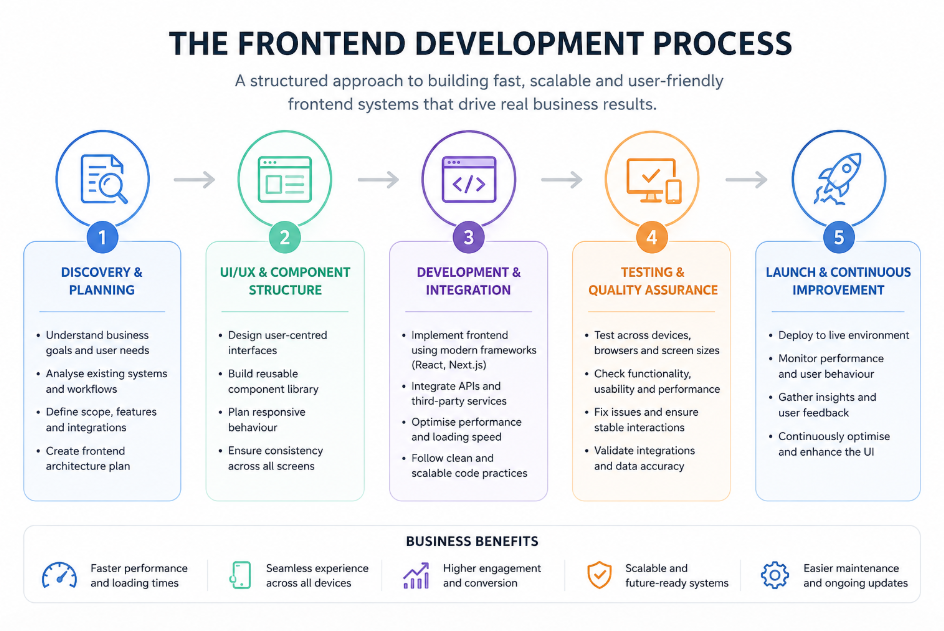
How the Frontend Development Process Usually Works
Strong frontend delivery does not usually begin with coding immediately.
The early stages are focused on understanding what the interface needs to achieve, how users will interact with it, how the platform will be managed internally and how future changes should be supported without unnecessary redevelopment.
Discovery and Frontend Planning
We begin by reviewing user journeys, responsive requirements, platform goals, integrations, existing technical constraints and the commercial role of the frontend.
This stage helps identify where the current interface is creating friction and what structure is needed to support the platform properly.
Component and UI Structure
Frontend systems become easier to scale when layouts, components and interface behaviour are planned systematically rather than page by page.
This is especially important for businesses expecting future growth, new features, ongoing content development or more advanced user journeys.
Frontend Development and Integration
The frontend is then developed around the agreed architecture, design direction, integrations and user experience requirements.
Depending on the project, this may include React development, Next.js implementation, API integration, responsive optimisation, frontend performance improvements and structured component development.
Where projects involve larger platform ecosystems, frontend work may also connect with web application development environments handling authentication systems, customer portals, reporting layers and operational workflows.
Testing and Frontend QA
Frontend testing is often more important than businesses initially expect.
Different browsers, devices, screen sizes, content lengths, API responses, user roles and third-party scripts can all affect interface behaviour. Some issues only appear under realistic usage conditions rather than isolated design previews.
Good frontend QA is designed to catch those problems before they become visible to customers.
Launch and Post-Launch Refinement
After deployment, frontend environments usually continue evolving as businesses collect user feedback, behavioural data and operational insights.
This post-launch refinement phase can reveal opportunities to improve conversion flow, mobile usability, content hierarchy, performance and interface clarity.
The People Involved in Frontend Projects
Frontend projects usually require more collaboration than many businesses initially expect.
Depending on the complexity of the platform, the process may involve frontend developers, UX designers, project managers, SEO specialists, backend developers and QA support working together throughout delivery.
One of the most common frontend risks is poor alignment between design decisions and technical implementation. An interface may look strong in a static design file but become difficult to manage once responsive behaviour, real content, API states and user interaction patterns are introduced.
That is why frontend planning needs both design judgement and technical realism.
Technologies, Frameworks and Integrations
Our frontend development company works across modern frontend frameworks, responsive UI systems and API-connected environments depending on the needs of the project.
Projects commonly involve React, Next.js, JavaScript, TypeScript, reusable component systems, headless CMS structures, CRM-connected interfaces, ecommerce platforms, analytics environments and operational business tools.
Many frontend environments also require carefully planned API integration services to ensure customer-facing interfaces remain stable while exchanging data across wider business systems.
That said, selecting a frontend stack should never become trend-driven.
The right architecture depends on how the business intends to use the platform, how flexible the frontend needs to remain, how content will be managed, how integrations will behave and how future growth is expected to affect the interface.
Industries and Business Types We Support
Frontend priorities change depending on the business model.
A SaaS platform handling regular user interaction has different requirements from a professional services website focused on lead generation. An ecommerce business needs different frontend decisions from an internal reporting dashboard or customer portal.
We support frontend projects for ecommerce companies, professional service firms, SaaS businesses, operational platforms, education providers, healthcare organisations and businesses managing more complex digital user journeys across multiple services, departments or locations.
The industries may differ, but the underlying frontend challenges are often similar once usability, scalability, maintainability and conversion quality become important.
What Businesses Commonly Underestimate About Frontend Development
Many businesses initially assume frontend development is mainly about visual presentation.
Usually, they only discover the operational importance of frontend architecture later, once the platform starts growing, internal teams begin relying on it more heavily or new features become harder to release.
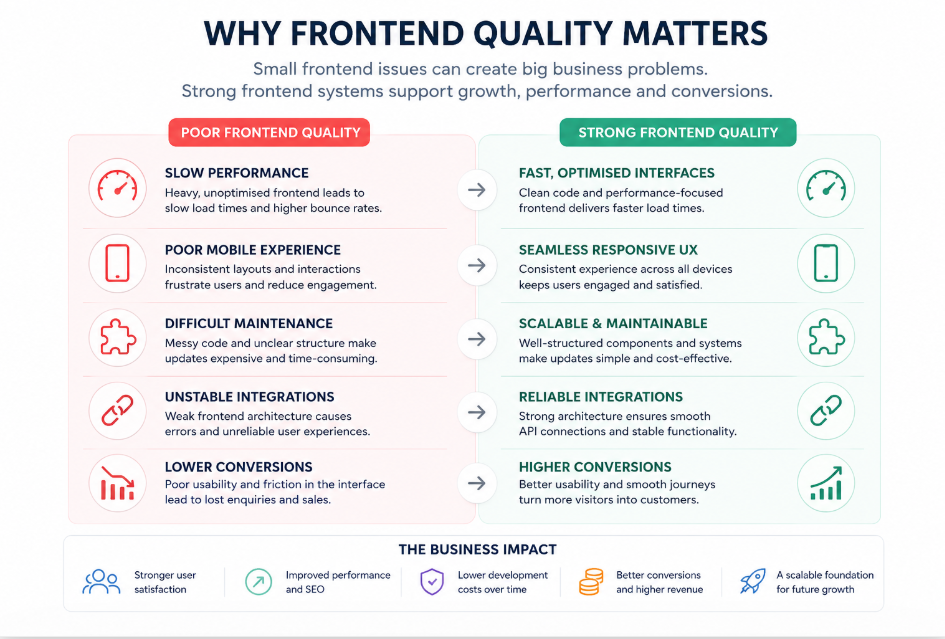
Frontend decisions directly affect scalability, performance, conversion quality, operational flexibility and long-term development cost.
Poor frontend structure becomes harder to maintain as the platform expands. Frontend complexity affects loading behaviour and responsiveness. Small UX inconsistencies can reduce enquiry quality and user confidence. Internal teams may struggle to launch new content or features efficiently because the frontend was not designed around reusable component systems.
This is why frontend systems need to be planned beyond launch day.
Why Similar Frontend Projects Often Struggle
Most frontend projects do not struggle because the chosen framework was technically wrong.
More often, the problem is that the frontend was treated as isolated visual implementation rather than part of a wider business and platform system.
We regularly see projects becoming difficult because responsive behaviour was not planned properly, component systems became inconsistent, frontend and backend teams worked separately, API handling became unstable, performance was left too late, design decisions ignored real content behaviour or frontend scalability was underestimated early in the project.
These issues may remain manageable at first. The real difficulty appears later when the business grows and the frontend environment needs to evolve quickly under commercial pressure.
At that stage, businesses are not simply fixing design issues. They are dealing with accumulated frontend debt.
Choosing the Right Frontend Development Partner
Choosing a frontend development agency should involve more than reviewing visuals or comparing frameworks.
The more important question is whether the frontend system will remain commercially usable and technically maintainable once the platform begins evolving beyond the initial launch phase.
A strong frontend partner should be able to explain how scalability will be handled, how responsive behaviour will be tested, how integrations will remain stable, how performance will be protected and how the frontend will support future growth without requiring constant redevelopment.
This is especially important for businesses investing in React development, Next.js development, frontend rebuilds, web application interfaces or API-connected platforms where the frontend has to support both user experience and operational reliability.
The best frontend decision is not always the most complex one. It is the one that supports how the business actually needs to operate.
Frontend Development Compared With Wider Web Development

Frontend development focuses specifically on the visible and interactive layer users engage with directly.
Broader web development services may also involve backend systems, server infrastructure, databases, authentication environments, security, hosting, CMS logic and wider platform engineering.
Some businesses only need frontend improvements or responsive UI development. Others need full web application development involving both frontend and backend architecture.
The correct approach depends on whether the priority is improving user-facing experience, rebuilding frontend systems or developing a wider platform environment entirely.
For businesses reviewing interface usability and customer journeys earlier in the process, related responsive web design considerations can also influence frontend planning decisions significantly.
The Commercial Impact of Strong Frontend Development
Well-structured frontend systems can improve far more than appearance.
Businesses commonly see stronger usability, cleaner customer journeys, better mobile engagement, improved conversion flow and more stable platform scalability once frontend architecture becomes properly aligned with operational requirements.
In performance-focused projects, frontend optimisation can also support better loading behaviour, Core Web Vitals, search visibility and user retention. In operational projects, the biggest improvement may be internal: teams find the platform easier to manage, extend and work with day to day.
That commercial stability is often more valuable than a visual redesign alone.
A strong frontend should help users trust the platform, help teams manage it confidently and help the business grow without repeatedly fighting the same technical limitations.
Examples of Frontend Project Outcomes
Frontend outcomes vary depending on the starting point, platform type and business objective.
Some projects focus on improving responsive UX and frontend conversion flow. Others involve rebuilding unstable frontend environments that have gradually become difficult to scale after years of fragmented updates, plugins or integrations.
Typical outcomes can include faster mobile journeys, more consistent layouts, cleaner component systems, improved content management flexibility, reduced frontend maintenance friction, stronger Core Web Vitals foundations and more reliable API-connected interfaces.
We have also supported businesses where frontend restructuring helped reduce bounce-related friction, improve mobile usability, simplify internal content updates and create more stable foundations for future platform growth.
The visible frontend changes are often only one part of the wider operational improvement happening underneath.
What Happens After Launch
Most frontend environments continue evolving after launch.
Once real users begin interacting with the platform daily, businesses usually identify additional optimisation opportunities that were difficult to predict during planning. These may involve performance refinement, interface improvements, new frontend functionality, responsive adjustments, content hierarchy changes or integration updates.
The strongest frontend systems are rarely static. They are built with enough structure to remain stable while still allowing the business to adapt.
This is where scalable frontend architecture becomes especially valuable. It gives the business room to improve without turning every future change into a major redevelopment task.
Communication and Delivery Visibility
Frontend projects run more smoothly when communication remains structured and transparent throughout delivery.
Businesses generally need visibility into progress, testing stages, technical decisions and delivery timelines without having to manage every technical detail themselves.
That balance matters.
Too little visibility creates uncertainty. Too much fragmented communication slows delivery and distracts teams from the work that actually moves the project forward.
Our process is designed to keep frontend projects commercially focused while giving clients clear visibility into planning, staging reviews, testing phases, implementation decisions and launch preparation.
Why Businesses Choose Prime Lion Digital
Businesses choose Prime Lion Digital when they need frontend development that balances usability, scalability, performance and commercial practicality rather than isolated visual implementation alone.
Many frontend projects require coordination across UX, development, SEO, integrations, content structure and operational workflows. That broader understanding becomes increasingly important as platforms grow more complex.
We work across responsive websites, scalable frontend systems, React and Next.js environments, frontend optimisation projects and API-connected digital platforms designed around long-term maintainability and real business use.
The goal is not simply to launch a frontend interface. It is to build an environment that remains commercially effective, technically stable and operationally manageable long after launch itself.
Examples of Frontend Project Outcomes
Frontend results depend on the starting point, technical environment and commercial objective of each project. In many cases, the most valuable improvements are not only visual. They come from faster interfaces, cleaner user journeys, easier content management and a frontend structure that is no longer holding the business back.
Case Example 1: Service Website Frontend Rebuild
A UK service business came to us with a website that looked acceptable visually but was underperforming on mobile. Key service pages were slow, layouts were inconsistent across devices and users were dropping out before reaching enquiry points.
After restructuring the frontend layout, simplifying page components and improving responsive behaviour, the website became noticeably easier to use across mobile and desktop.
The project helped achieve:
- page load time improved by approximately 63%;
- bounce rate reduced by more than 30%;
- average session duration increased by over 40%;
- service-page journeys became clearer and easier to navigate.
The biggest improvement was not just speed. The frontend began supporting the commercial journey properly, helping users understand the service and reach enquiry actions with less friction.
Case Example 2: Frontend Structure for SEO and Lead Generation Growth
For a professional services business, the frontend was part of a wider growth project involving website structure, content hierarchy, SEO architecture and conversion-focused service pages.
The original website lacked clear service journeys and did not give users enough confidence to move from information gathering to enquiry. We rebuilt the frontend structure around clearer page hierarchy, stronger calls to action, improved internal navigation and more commercially useful service-page layouts.
Within the wider project, the business grew from roughly 300 monthly organic visitors to around 3,000 monthly organic visitors over approximately six months, with more than 100 monthly website enquiries and over 30 monthly phone enquiries generated from the improved digital presence.
The frontend work helped support that growth by making the site easier to navigate, easier to understand and more commercially focused for users arriving from search.
Case Example 3: Frontend and Platform Improvements for Operational Scalability
Another project involved a growing business where the website and internal digital systems were becoming harder to manage as operations expanded. The frontend needed to support clearer customer-facing journeys while also connecting more logically with internal processes, reporting and management visibility.
We worked on the digital structure, frontend usability, content flow and supporting system logic so the platform could operate more effectively as the business scaled.
The wider digital project included more than 6,500 targeted industry keyword opportunities mapped into a structured SEO and content strategy, a redesigned website foundation, improved frontend presentation and custom CRM/internal business management support.
Within four months, the business reached more than 3,500 monthly visitors with a modest budget, while also gaining a cleaner digital structure that supported marketing, enquiries and internal management more effectively.
This type of project shows why frontend development should not be treated as isolated visual work. When the interface, SEO structure, user journey and operational systems work together, the frontend becomes part of the business growth infrastructure.
Frequently Asked Questions
What are frontend development services?
Frontend development services involve building the visible and interactive layer of websites, web applications and digital platforms that users engage with directly. This includes responsive layouts, user interface development, frontend architecture, performance optimisation, React or Next.js development and API-connected interface work.
Do you work with React and Next.js?
Yes. We regularly develop frontend systems using React and Next.js where scalability, performance, responsive UX and long-term maintainability are important.
Can you improve an existing frontend rather than rebuilding everything?
Yes. Some businesses only require frontend optimisation, responsive improvements, component restructuring or selected frontend redevelopment rather than a complete rebuild.
Do frontend systems affect SEO and performance?
Yes. Frontend structure can directly influence loading behaviour, mobile usability, Core Web Vitals, crawlability, rendering quality and wider user experience factors connected to search visibility.
How long do frontend development projects usually take?
Timelines vary depending on complexity, integrations, responsive requirements, testing depth and the scale of the frontend environment being developed.
Can you integrate APIs into frontend platforms?
Yes. Many frontend systems involve API integrations connected to CRMs, portals, ecommerce environments, analytics systems, dashboards and operational business tools.
Is frontend development only for large platforms?
No. Frontend development can support smaller service websites, ecommerce sites, web applications, dashboards and growing platforms. The important factor is whether the user-facing interface needs to become faster, clearer, more scalable or easier to manage.
Discuss Your Frontend Development Requirements
If your business needs frontend development services for a responsive website, scalable platform, React application, Next.js environment, API-connected interface or frontend optimisation project, we can help you plan and build a frontend system designed around long-term usability, performance, scalability and commercial practicality.