Tell us a little about what you’re looking for, and our team will be in touch to discuss how we can help.
Customer Testimonial Filming Services in London & Across the UK
A convincing customer testimonial does more than tell prospective buyers that a company provides a good service. It gives them the opportunity to hear directly from someone who has experienced the work, understand the problem they needed to solve and judge whether the outcome is relevant to their own situation.
Prime Lion Digital offers customer testimonial filming for UK businesses that want to capture genuine client experiences in a professional video format. Whether you are preparing a B2B customer success story, recording feedback about a professional service or documenting a customer’s experience with a product, the filming approach should make the contributor feel comfortable while producing clear, usable material.
Our customer testimonial filming services start from £800, with quotations based on the location, contributors, filming requirements and agreed deliverables. Filming-only and edited video production can be discussed according to your brief.
Tell us who you would like to interview, where filming would take place and how you intend to use the finished material. We can help you establish a suitable production scope before you commit to a filming date.
Why Customer Testimonial Videos Matter for Business
Potential customers often want to understand what working with a business is actually like. Service descriptions explain what a company offers, while a genuine customer testimonial provides another perspective: the experience of someone who has already made the decision to buy.
Well-structured customer testimonial videos can help prospective buyers understand the original challenge, the reasons behind a purchasing decision, how the working relationship developed and what happened afterwards. They may be particularly useful when a service is complex, expensive or difficult to evaluate before purchase.
The value comes from the substance of the story rather than simply the presence of a satisfied customer on camera. A testimonial that says a company was excellent may sound positive, but it tells the viewer relatively little. A customer who explains a specific problem, describes how a service was delivered and gives a concrete example of the experience provides more useful information.
That distinction matters for professional services, software, construction, manufacturing and other sectors where buyers need reassurance about practical delivery. The video should help viewers form their own judgement, not pressure them towards a conclusion.
Customer testimonial filming can support several commercial activities:
- Website service pages: give visitors a relevant customer perspective alongside the company’s own explanation.
- B2B sales conversations: provide an example of how another organisation approached a comparable problem.
- Case studies: add a human account to written project information, with factual outcomes where these can be substantiated.
- LinkedIn and social media: introduce short customer insights to an audience that may not yet be ready for a detailed case study.
- Presentations and proposals: help decision-makers hear from an actual customer rather than relying solely on promotional claims.
Video is not automatically more persuasive than a written review. Its usefulness depends on the credibility of the contributor, the relevance of the experience, the quality of the questions and how accurately the final edit represents what was said.
Customer Testimonial Filming Services
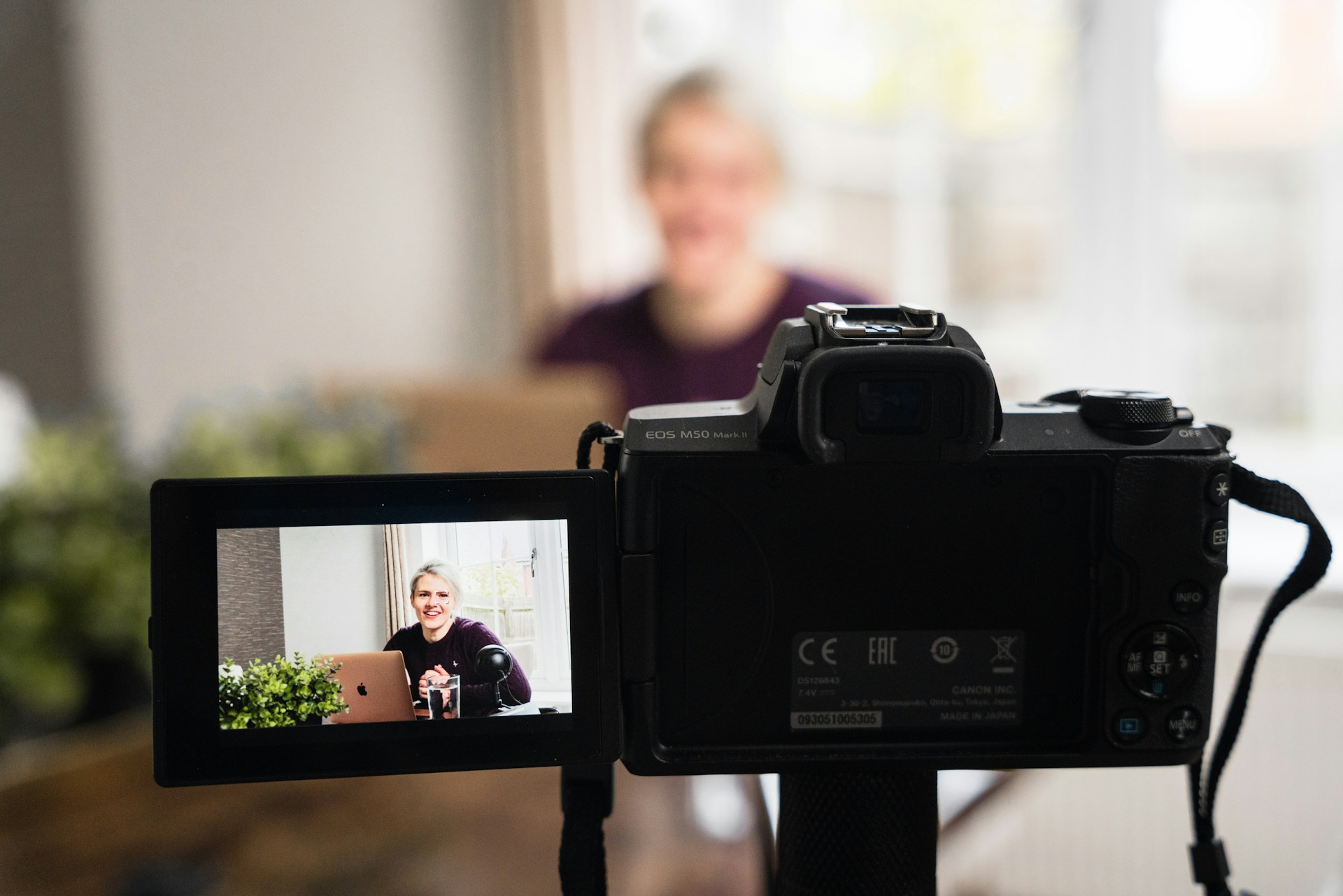 Different businesses need different kinds of customer stories. A short account of a local service experience requires a different production approach from an in-depth B2B interview about a lengthy implementation project.
Prime Lion Digital can discuss testimonial filming around the purpose of the story, the people involved and the intended use of the footage. The following formats provide a practical starting point for choosing the right scope.
Customer Interview Filming
A guided customer interview gives the contributor space to explain their experience in their own words. Rather than asking someone to memorise a script, the interviewer works through a planned set of open questions that encourage specific examples and complete answers.
The filming setup needs to support a natural conversation. Camera position, the interviewer’s location, background distractions and microphone placement all influence how relaxed and understandable the final recording feels.
This format is suitable for service reviews, client feedback and straightforward customer stories. For a broader explanation of interview recording as a production service, see our Interview Filming page.
B2B Customer Testimonials
 Customer testimonials for B2B audiences often need to explain more than personal satisfaction. The viewer may want to know why a supplier was selected, what implementation involved, how communication worked and whether the solution was appropriate for the organisation.
Interviews with business customers may involve a company director, project sponsor, operational manager or end user. Each person can offer a different perspective, but including multiple contributors should be a deliberate editorial decision rather than an automatic production requirement.
When the story contains commercial figures, performance claims or references to a client’s internal operations, these details should be checked and approved before publication.
Customer Experience Films
A customer experience film follows the wider journey of using a product or service. It may combine an interview with relevant footage of a location, product, workplace or activity to help viewers understand the context.
For example, a customer discussing a workplace improvement may be easier to understand when the viewer can see the relevant environment. A service customer might describe the process while supporting footage illustrates the type of work involved.
The supporting images must be relevant and accurately presented. Generic footage should not be used to imply that a particular customer, product or result appears in the recording when that is not the case.
Customer Success Stories and Video Case Studies
A customer success story generally has a stronger narrative structure than a brief testimonial video review. It explores the situation before the engagement, the decision to proceed, the experience of delivery and the resulting changes.
Video case studies may also require interviews with the supplier’s team, project documentation or additional filming. These elements can make the story more informative, but they increase planning, filming and editing requirements.
The best format depends on what the audience needs to understand. A short testimonial can answer a straightforward trust question; a detailed case study can help explain a complex purchase or service relationship.
Customer Testimonial Video Styles and Formats
There is no single testimonial video style that works for every organisation. The appropriate format depends on the contributor’s confidence, the complexity of the subject, the intended platform and the amount of supporting material available.
| Video style | Best suited to | Key consideration |
|---|---|---|
| Direct-to-camera testimonial | Short personal recommendations and straightforward experiences | Some contributors may feel uncomfortable addressing the lens directly. |
| Guided interview | Professional services and considered purchasing decisions | Questions and editing must preserve the contributor’s intended meaning. |
| Documentary-style customer story | Experiences that benefit from real-world context | Additional footage, locations and permissions may be required. |
| B2B video case study | Complex services, implementations and procurement decisions | Claims, contributors and client approvals require careful coordination. |
| Short social testimonial | LinkedIn, social feeds and campaign extracts | A short edit must remain understandable without removing essential context. |
Direct-to-Camera or Off-Camera Interview?
In a direct-to-camera testimonial, the contributor addresses the viewer. This can feel immediate and personal, particularly when the message is short. However, not everyone is comfortable speaking to a camera without another person guiding the conversation.
With an off-camera interviewer, the contributor responds to questions while looking towards the person conducting the interview. This often makes it easier to explore a complicated experience naturally. The finished video can then be structured around the contributor’s answers.
Neither approach is inherently more authentic. The important issue is whether the filming arrangement helps the customer communicate accurately and comfortably.
Single-Camera and Multi-Camera Approaches
A straightforward interview may be filmed from one carefully composed camera position. A second camera angle can provide additional editing flexibility, particularly when longer answers need to be shortened or when the production calls for varied framing.
Multi-camera filming is not a requirement for a credible testimonial. It may introduce additional equipment, crew or post-production work, so the decision should be based on the intended result rather than the assumption that more cameras always mean a better video.
Natural Interviews Versus Scripted Testimonials
A customer may appreciate receiving the interview topics in advance, especially if the subject involves a technical product or a detailed business project. Preparation helps contributors recall facts and identify examples.
That is different from giving someone a promotional script and asking them to perform it as though it were spontaneous feedback. Scripted praise can make the finished film feel less credible and may misrepresent the customer’s actual experience.
A better approach is to prepare the structure, agree the factual subjects and allow the contributor to choose their own words.
Customer Testimonial Video Examples and What to Look For
When reviewing examples from video testimonial creators or a potential production company, look beyond image quality. A relevant example should show whether the customer speaks naturally, whether their experience is understandable and whether the film provides enough context to support the claims being made.
Consider the opening: does the viewer know who is speaking and why their experience matters? Listen to the sound: can every answer be understood without struggling? Examine the edit: do transitions preserve the meaning of the customer’s comments? Finally, consider whether the story answers questions a prospective buyer would genuinely have.
A customer testimonial should be identified as such only when it features an actual customer describing their experience. Promotional films, company profiles and general brand videos can demonstrate production approaches, but they are not substitutes for genuine testimonial evidence.
For a business planning its first testimonial project, the most useful portfolio discussion is often about the type of customer story required rather than the number of videos in a showreel. Ask for examples relevant to your sector, intended audience and preferred filming format.
Questions for a Video Testimonial
The questions for a video testimonial determine how much useful information the interview produces. Asking only whether a customer is happy is unlikely to generate a detailed story. Stronger questions encourage the contributor to explain circumstances, decisions, experiences and outcomes.
Questions should be open, understandable and relevant to the customer’s actual relationship with the business. They should not presume that the customer achieved a particular result or felt a particular way.
Before the Customer Chose the Service
- What challenge were you facing before you started looking for a solution? This establishes the context and gives viewers a reason to care about the story.
- How was that challenge affecting your work or everyday experience? This can reveal practical consequences without inventing commercial figures.
- What were you looking for in a provider or product? This explains the customer’s decision criteria.
During the Decision and Delivery Process
- What made you decide to work with this company? This allows the customer to describe their genuine reasons for choosing the supplier.
- What was the process of getting started like? This explores onboarding, communication or implementation.
- Can you describe a specific moment or experience that stood out? A concrete example is often more informative than a general compliment.
After the Service or Project
- What has changed since you started using the service? This invites the customer to describe an outcome without suggesting what it should be.
- Can you give an example of the difference it made? This encourages detail and gives the production team a possible narrative focus.
- What would you tell someone considering a similar service? This allows the customer to offer advice or a recommendation in their own words.
For customer testimonials B2B teams intend to use in sales, additional questions may be appropriate: Who was involved in the decision? What requirements mattered most? What concerns needed resolving? How was the solution adopted internally? Which results can the organisation substantiate?
It is important to avoid leading questions such as “How much better was our service than everyone else’s?” or “Why would you recommend us to every business?” Such wording assumes a positive conclusion before the contributor has answered.
Interviewers should also allow follow-up questions. If a customer says the project was easier than expected, asking what specifically made it easier may produce the most useful part of the interview.
A practical filming consideration is answer structure. A response such as “Because they were helpful” may be difficult to use without the original question. Encouraging the contributor to answer in a complete sentence can make the finished video easier to understand without changing the substance of what they say.
Customer Testimonials for B2B Marketing
In B2B purchasing, the person who discovers a supplier may not be the person who approves the budget or manages the implementation. A customer testimonial therefore needs to address the concerns of more than one potential viewer.
A marketing manager may be interested in positioning and campaign relevance. A procurement specialist may want to understand supplier reliability. An operational manager may be concerned about implementation, disruption and support. A senior decision-maker may need a clear explanation of the business problem and the outcome.
Not every video needs to answer all these questions. Instead, the filming brief should identify the primary audience and select contributors who can speak credibly about the relevant experience.
| B2B use case | Useful customer perspective | Recommended editorial focus |
|---|---|---|
| Website service page | Customer who used the specific service | Problem, experience and relevance to similar buyers |
| Sales presentation | Decision-maker or project sponsor | Selection criteria, concerns and decision process |
| Technical case study | Implementation lead or operational user | Requirements, practical challenges and adoption |
| LinkedIn campaign | Customer with a concise, specific insight | One understandable message supported by context |
| Proposal or tender support | Relevant client representative | Experience of delivery and appropriately evidenced outcomes |
Business customers may need permission from their employer before participating. The organisation may also wish to approve the use of its name, logo, location, staff images or commercial information. These requirements should be established before the filming date rather than discovered during final editing.
Where a customer success story includes a claimed reduction in costs, faster delivery or increased productivity, the production brief should identify the evidence and the person authorised to approve that statement. If a figure cannot be verified or released publicly, a truthful qualitative description may be more appropriate.
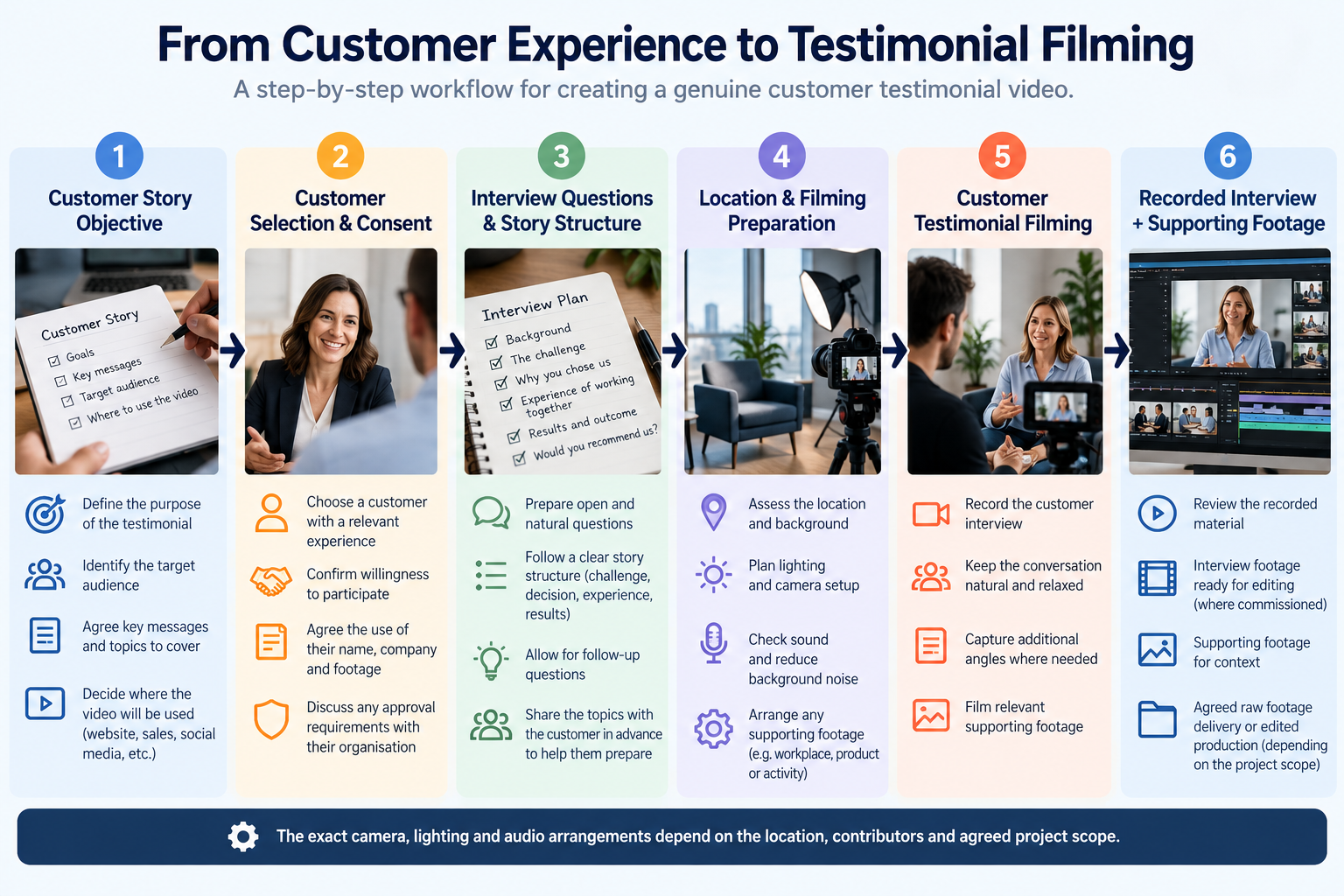
Our Customer Testimonial Filming Process
A useful customer testimonial video production process begins before anyone turns on a camera. The aim is to identify the story, prepare the contributor and capture material that can be used accurately for the intended audience.
1. Define the Purpose and Audience
The first decision is what the film needs to explain. A website testimonial, B2B sales case study and short social media review have different requirements. Identifying the intended viewer helps determine the interview topics, approximate scope and whether additional footage would be useful.
2. Select the Customer and Agree Permissions
Choose someone with genuine experience of the product or service and a perspective relevant to the intended audience. Confirm their willingness to participate, discuss the intended distribution channels and establish any company approval requirements.
Permission to record an interview should not automatically be treated as unrestricted permission to use the footage in every future advertisement. The agreed use of identifiable footage, names and logos should be documented appropriately.
3. Prepare the Interview Brief
A practical brief covers the story objective, key topics, likely questions, location, contributors and any factual claims that require checking. Sharing the topics in advance can help the customer prepare without asking them to rehearse promotional statements.
4. Plan the Location and Filming Setup
Consider background noise, available space, lighting conditions, access, power and the visual relevance of the location. A familiar workplace can provide useful context, but an unsuitable room may make sound recording or filming unnecessarily difficult.
If the story requires supporting footage, decide what genuinely needs to be shown and whether the location, staff or products can be filmed with the necessary permissions.
5. Record the Customer Interview
The interview should give the contributor time to explain their experience. Questions can follow the agreed structure while allowing relevant follow-ups. Clear sound is particularly important: an emotionally convincing answer is of limited practical use if the audience cannot understand it.
Where appropriate, additional footage can establish context or illustrate the service being discussed. The filming plan should distinguish essential material from optional visual coverage.
6. Review the Footage and Agreed Production Scope
After filming, the next stage depends on the commissioned service. A filming-only arrangement may involve supplying agreed recorded material, while a full production brief may include selecting interview extracts, assembling the story, editing supporting footage and preparing export versions.
Any factual claims, sensitive information or customer quotations should be reviewed as appropriate before publication. The finished video should retain the meaning of the contributor’s account.
Filming Locations, Contributors and Production Planning
Customer testimonial filming can take place at an office, workplace, customer premises or another suitable location. The choice should support both the contributor’s comfort and the story’s purpose.
Filming in the customer’s own environment may add relevant context, particularly for B2B services, facilities, products or workplace improvements. However, it also introduces practical considerations: access permissions, confidential information, other people appearing in the background and activities that cannot be interrupted.
Choosing a Suitable Filming Location
A location does not need to look like a television studio. It does need to allow a clear recording. Consider whether nearby traffic, machinery, ventilation or conversations could interfere with the interview. Reflective rooms may create distracting echoes, while windows and changing daylight can affect visual consistency.
Before confirming a location, identify who controls access and whether filming requires approval. If several interviews are planned, consider whether contributors can use the same room or whether moving between locations will require additional setup time.
Preparing the Customer for the Interview
Most customers are not professional presenters. Give them a clear explanation of the filming purpose, the likely questions and the expected process. Let them know they can ask for clarification or pause when necessary.
Preparation should make participation easier, not create pressure to deliver a predetermined endorsement. A contributor should be free to describe their experience honestly and to correct factual errors.
Filming Multiple Contributors
Recording several customers in one session can be efficient when the location and scheduling requirements are compatible. However, every contributor still needs sufficient time to explain their own experience.
It may be better to record fewer complete interviews than to rush a larger number of contributors and end up with material that lacks context. The appropriate schedule depends on the number of people, the complexity of the questions, location changes and supporting footage requirements.
What You Receive from a Testimonial Video Project
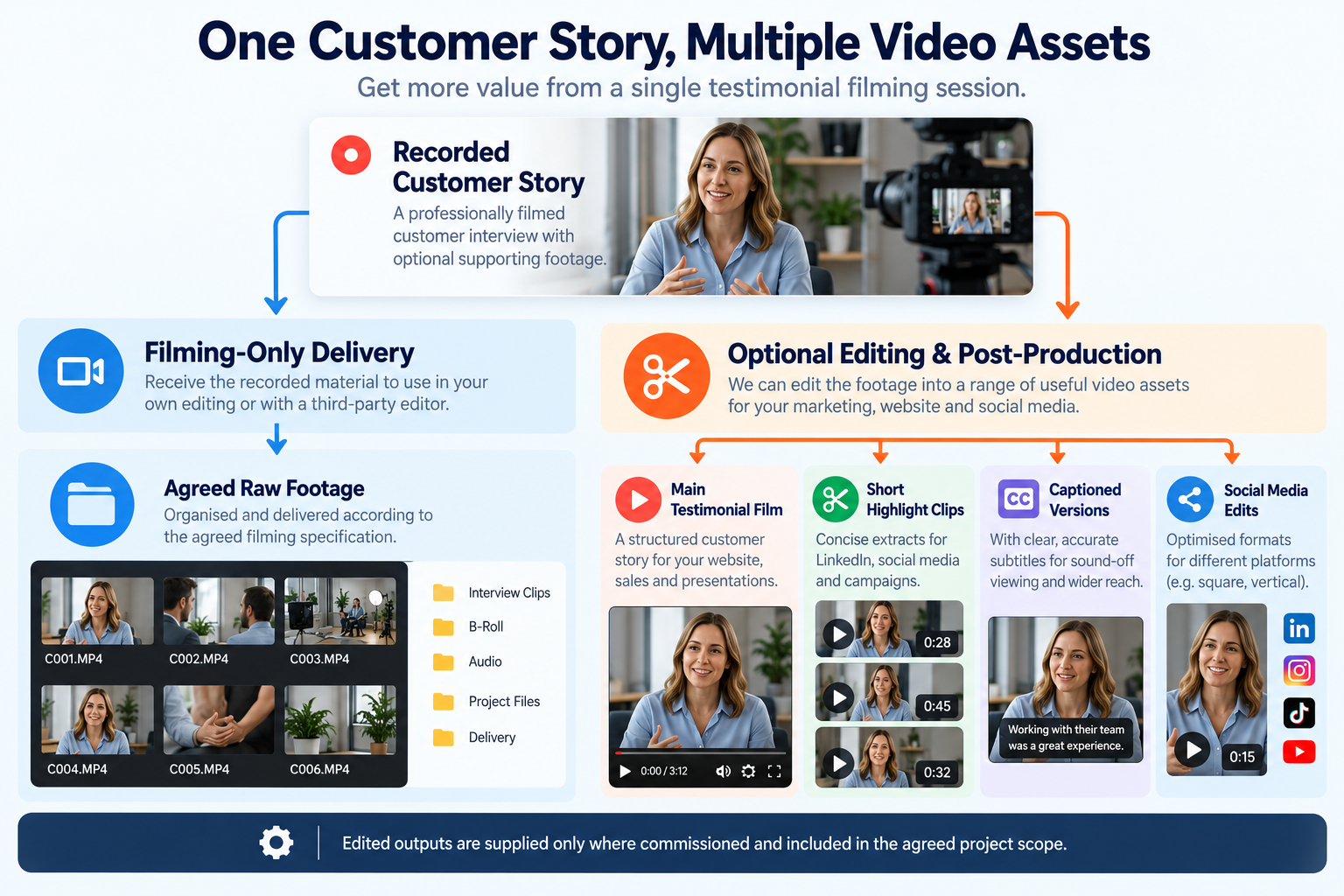
The deliverables for customer testimonial filming should be agreed before production. Some organisations need recorded interview material for an internal editing team. Others need a complete film prepared for publication, with shorter versions for different channels.
These are different scopes of work. The starting price should not be interpreted as automatically including every possible output.
| Potential deliverable | Purpose | Scope or approval consideration |
|---|---|---|
| Recorded interview footage | Provides the original customer responses for subsequent production | File format, transfer method and footage selection should be agreed. |
| Main edited testimonial film | Presents a structured customer story for a defined audience | Editing, duration and review arrangements require an agreed brief. |
| Short testimonial extracts | Highlights individual customer insights for specific uses | Each extract must preserve the original context and meaning. |
| Captioned version | Supports viewing without sound and improves access to spoken content | Caption preparation and accuracy checking should be included in scope. |
| Alternative aspect ratios | Adapts suitable footage for different platforms | Reframing may affect composition and require additional editing. |
| Supporting footage | Illustrates the customer, location, product or relevant activity | Requires filming time, access and appropriate permissions. |
Filming-Only Versus Full Testimonial Video Production
Filming-only may suit a company with its own editor or a marketing agency coordinating a larger campaign. The immediate objective is to capture suitable source material according to an agreed recording specification.
Full testimonial video production extends beyond the filming session. It may include editorial selection, story assembly, picture and sound editing, captions, graphics, review stages and delivery of agreed versions.
Before requesting a quotation, decide whether you need the original footage, a publication-ready video or both. That decision has a significant effect on the work involved.
Customer Testimonial Filming Costs in the UK
Customer testimonial filming at Prime Lion Digital starts from £800. This is a starting price rather than a fixed all-inclusive package. The final quotation depends on the production requirements and the outputs agreed for the project.
A single interview in an accessible location may involve a different amount of work from a multi-location B2B customer experience film. Similarly, recording footage for an existing editing team is not the same scope as producing a finished testimonial with several approved versions.
| Pricing factor | Why it affects the quotation | Information to provide |
|---|---|---|
| Filming location | Travel, access, logistics and setup requirements vary. | Town, postcode area and type of premises |
| Number of contributors | Each interview requires preparation, recording and coordination. | Number of customers and any additional speakers |
| Filming complexity | Multiple camera positions, specialist requirements or challenging environments may increase production work. | Preferred style and relevant location constraints |
| Supporting footage | Additional activities or locations require planning and filming time. | Products, workplaces or processes to be shown |
| Editing requirements | Story assembly, captions, graphics and multiple versions involve post-production. | Whether raw footage or a finished film is required |
| Approval requirements | Several stakeholders may require an agreed review process. | Who will review factual claims and approve the film |
What Is Included in the £800 Starting Price?
The precise inclusions must be confirmed in the quotation. Do not assume that a starting filming price includes a full day on location, multiple cameras, travel to every UK destination, edited videos, subtitles, graphics or unlimited revisions.
A useful quotation should specify the filming location, number of contributors, agreed production work, intended outputs and any separately priced options. This allows you to compare proposals on the actual scope rather than on the headline amount alone.
How to Request an Accurate Quote
Provide a short description of your business, the number of customers you want to film, their approximate locations, your preferred filming date and where the video will be published. If you have a reference video or an existing written case study, include it to explain the desired style and level of detail.
It is also helpful to say whether the customer has already agreed to participate and whether their employer needs to approve the finished material.
How to Choose Video Testimonial Creators
When comparing video testimonial creators, focus on their ability to capture a useful customer story rather than simply produce attractive footage. A technically polished video can still fail to answer the questions that matter to your audience.
Ask potential providers how they approach interview preparation, whether they can adapt to contributors who are uncomfortable on camera and how they distinguish factual statements from promotional claims.
Review the sound quality in their examples, not just the visuals. Customer testimonials rely heavily on spoken information, so distracting noise or unclear dialogue can undermine the entire piece.
Clarify the production scope. Does the quotation cover testimonial filming only, or does it include editing and post-production? Who selects the interview extracts? What versions are required? Who is responsible for obtaining permissions? How are customer and company approvals handled?
A provider should be able to explain the trade-offs between a short testimonial, a longer customer experience film and a full video case study. The right choice is the one that gives your intended audience enough useful information without adding unnecessary production complexity.
Expert Insight: Authenticity Is More Valuable Than Scripted Praise
One of the most important editorial decisions in film production testimonials is deciding what not to force into the story.
A customer who says a service was helpful may genuinely mean it. But if the interview asks only for compliments, the viewer learns very little. A more informative film explores the customer’s original expectations, what actually happened and which parts of the experience mattered most.
Specificity makes the story useful. A customer describing how a project was organised, how a difficult question was resolved or why a particular feature mattered gives viewers something they can compare with their own needs.
That does not mean every answer should be included. Editing is necessary to remove repetition, improve clarity and create a manageable running time. The ethical boundary is that the final edit must not change the meaning of the customer’s comments or imply results they did not describe.
For example, combining two separate statements can accidentally create a stronger claim than either statement supports. Removing a qualification may turn a cautious observation into an absolute endorsement. These issues matter particularly in regulated sectors and B2B projects involving financial or operational claims.
The best customer testimonial videos are not necessarily the ones with the most enthusiastic language. They are the ones where a relevant customer explains a real experience clearly enough for the audience to make an informed judgement.
Healthcare Brand Film — Clinic Video Production
ARTIchoke Café — Hospitality Brand Film
The Turkish Touch — Barbershop Brand Film
The Swan — Interior Showcase Film
Frequently Asked Questions About Customer Testimonial Filming
What is a video testimonial?
A video testimonial is a recorded account in which a real customer describes their experience of a product, service or organisation. It may be a short personal recommendation or a longer interview covering the customer’s original challenge, decision and experience. Unlike a general promotional video, its central evidence comes from the customer’s own account. The content should be genuine, accurately edited and used with appropriate permission.
How much does customer testimonial filming cost in the UK?
Prime Lion Digital offers customer testimonial filming from £800. The final price depends on the filming location, number of contributors, production complexity, supporting footage and agreed deliverables. Editing and additional versions should be confirmed in the quotation rather than assumed to be included in the starting price. Providing the intended use, location and number of interviews will help establish an appropriate scope.
What questions should I ask in a video testimonial?
Start with the customer’s original problem, what they were looking for and why they selected the provider. Ask about the experience of working together, any difficulties encountered and what changed afterwards. Follow up with requests for specific examples. Avoid questions that presume a positive answer, and allow the contributor to describe their experience in their own words.
How long should a customer testimonial video be?
There is no single ideal length. A short social media extract may focus on one useful observation, while a website testimonial can provide more context. A B2B video case study may need additional time to explain the challenge, decision and implementation. The appropriate duration depends on the audience, distribution channel and amount of relevant information. Clarity and substance matter more than reaching a predetermined running time.
What is the best testimonial video style?
A guided interview is often suitable when the customer needs to explain a detailed experience. Direct-to-camera filming can work for concise personal recommendations. Documentary-style filming adds context through relevant supporting footage, while a video case study may combine several perspectives. The best style is the one that suits the contributor, the subject and the intended audience without making the experience appear staged.
Can you film customer testimonials at our client’s premises?
Customer premises can be considered as a filming location, subject to the agreed project scope, access and practical requirements. Before filming, confirm who can authorise the use of the location and whether there are restrictions involving staff, customers, confidential material or business operations. Background noise, available space and lighting should also be considered when planning the interview.
Can one filming session produce several testimonials?
It may be possible to record several contributors during one session, particularly when they are available at the same location. The schedule should still allow enough time for individual interviews, setup changes and any required supporting footage. The number of usable testimonials depends on the quality and substance of the interviews, not simply how many people can be recorded within a given period.
Can testimonial videos be used for B2B marketing?
Yes. Genuine customer experiences can support B2B service pages, sales presentations, proposals, LinkedIn content and video case studies. The most useful approach is to match the story to the audience’s questions. Procurement teams, senior decision-makers and operational users may each need different information. Any commercial results or performance claims included in the film should be supported and approved.
Is video editing included in the £800 starting price?
The £800 figure is the verified starting price for customer testimonial filming, not confirmation of a particular editing package. Whether editing, captions, graphics, shorter versions or other post-production services are included must be specified in the individual quotation. If you already have an editing team, filming-only may be an appropriate option. If you need a publication-ready film, describe the required outputs when requesting a quote.
Who approves the finished testimonial video?
Approval arrangements should be agreed before production. The commissioning business will usually need to review the film against the brief, while the featured customer or their organisation may need to approve identifiable content, quotations, branding or commercially sensitive statements. The exact responsibilities depend on the project and the permissions agreed. Establishing the approval route early can help prevent delays and disputes.
Request a Customer Testimonial Filming Quote
If you are planning customer testimonial filming in London or elsewhere in the UK, Prime Lion Digital can discuss the type of story you want to capture and the production requirements involved.
To get started, tell us:
- What your business does and who the testimonial should help you reach.
- How many customers or other contributors you would like to interview.
- Where filming would take place and your preferred dates.
- Whether you need interview footage, supporting visuals or a complete edited film.
- Where you plan to publish the material and whether alternative versions are required.
- Whether customer participation and any necessary company permissions have already been arranged.
Customer testimonial filming starts from £800. Share your requirements through the enquiry form and we can discuss a suitable scope and quotation for your project.