
Leave your details and our team will get back to you shortly to discuss your website, SEO or digital growth project.
Web Application Development Services in UK
Custom web application development for UK businesses that need more than a standard website — from client portals and operational dashboards to scalable business systems and integrated digital platforms.
At Prime Lion Digital, we develop web applications designed around real workflows, reporting visibility, user experience and long-term scalability. Our focus is not simply building software that functions technically, but creating systems that improve how businesses operate day-to-day.
Whether you are replacing spreadsheets, connecting disconnected systems or planning a scalable operational platform, we help businesses assess the technical, commercial and operational requirements before development begins.
When Businesses Usually Need Web Application Development
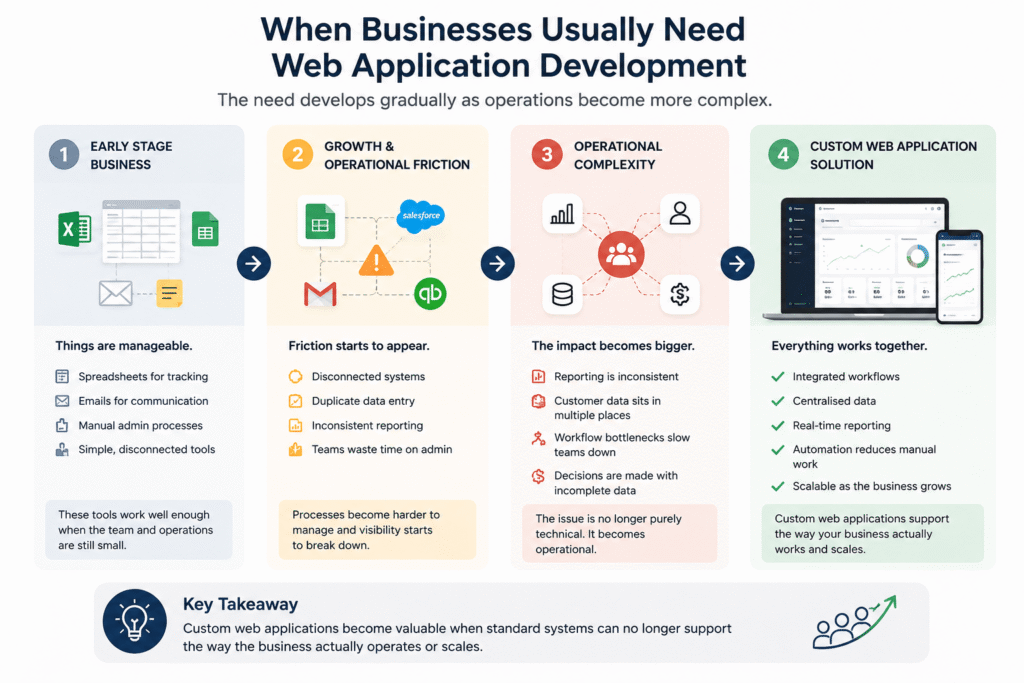
Most businesses do not suddenly decide they need a custom web application.
The need usually develops gradually as operations become more complex. Spreadsheets, disconnected tools and manual admin processes that once worked adequately begin creating friction. Reporting becomes inconsistent, customer information sits across multiple systems and teams duplicate work because platforms no longer communicate properly.
At that point, the issue is no longer purely technical. It becomes operational.
Custom web applications become valuable when standard systems can no longer support the way the business actually works or scales.
What Our Web Application Development Services Include
Web application development can involve customer-facing systems, internal operational platforms or a combination of both.
Some businesses require secure client portals where customers can manage accounts, upload documents or track projects online. Others need internal systems for workflow management, reporting, scheduling, automation or operational visibility.
Depending on the project, development may include workflow architecture, operational dashboards, reporting systems, CRM integrations, API connectivity, automation logic, ecommerce functionality, analytics implementation, permissions structures and performance optimisation.
One of the most valuable stages often happens before development itself begins.
During discovery, businesses frequently uncover operational inconsistencies hidden behind manual workarounds. Different departments may follow different versions of the same process internally, while reporting expectations often conflict between leadership, sales and operations teams. Legacy systems may also contain unreliable data structures that later affect integrations and reporting accuracy.
Identifying these issues early usually prevents significantly larger operational problems after launch.
Who This Service Is For
 Custom web application development is generally most suitable for businesses that have outgrown standard tools or require more control over workflows, reporting and integrations.
We commonly support growing service businesses, ecommerce brands, multi-location companies, membership organisations, subscription-based platforms, professional services firms and operationally complex SMEs.
This service is particularly relevant for businesses struggling with disconnected systems, reporting gaps, CRM limitations, manual admin pressure or workflows that no longer scale efficiently.
Not every organisation requires custom development. In some situations, a properly configured CMS, CRM or ecommerce platform may be entirely suitable. Custom development becomes valuable when standard platforms begin limiting operational efficiency or forcing businesses into processes that no longer fit how they actually operate.
Common Business Problems Web Applications Help Solve
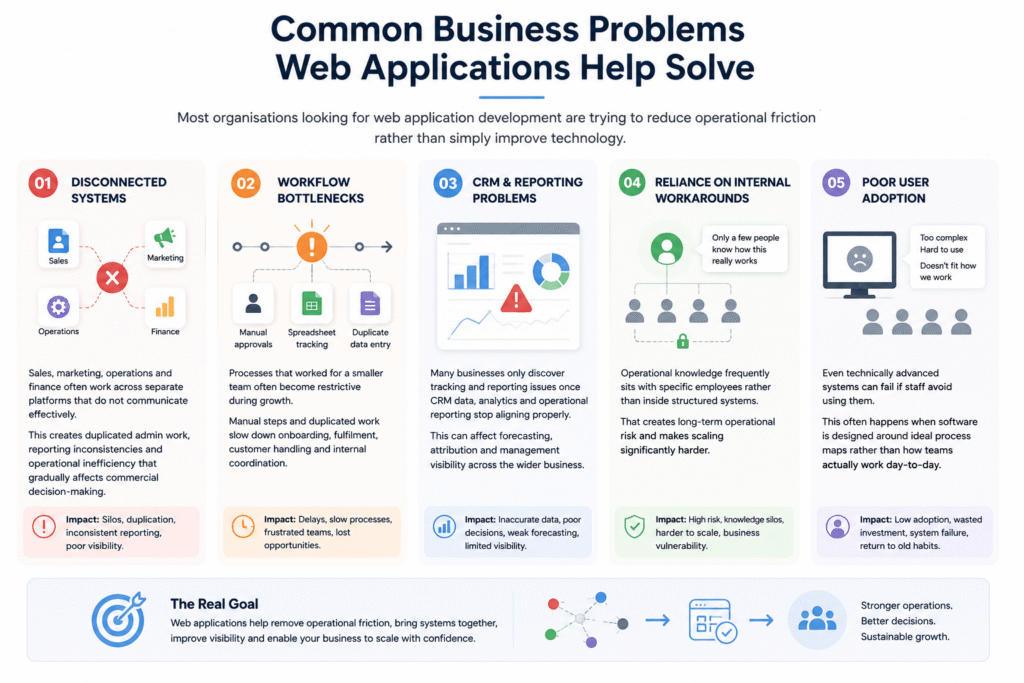
Most organisations looking for web application development are trying to reduce operational friction rather than simply improve technology.
Disconnected Systems
Sales, marketing, operations and finance often work across separate platforms that do not communicate effectively. Over time this creates duplicated admin work, reporting inconsistencies and operational inefficiency that gradually affects commercial decision-making.
Workflow Bottlenecks
Processes that worked for a smaller team often become restrictive during growth. Manual approvals, spreadsheet tracking and duplicated data entry can eventually slow onboarding, fulfilment, customer handling and internal coordination.
CRM & Reporting Problems
Many businesses only discover tracking and reporting issues once CRM data, analytics and operational reporting stop aligning properly. This can affect forecasting, attribution and management visibility across the wider business.
Reliance on Internal Workarounds
Operational knowledge frequently sits with specific employees rather than inside structured systems. That creates long-term operational risk and makes scaling significantly harder.
Poor User Adoption
Even technically advanced systems can fail if staff avoid using them. This often happens when software is designed around ideal process maps rather than how teams actually work day-to-day.
Types of Web Applications We Develop
Every project depends on the operational structure of the business.
Some applications focus heavily on customer experience, while others are designed around internal workflows, reporting or automation.
Client Portals & Customer Platforms
Secure portals allowing customers to manage accounts, upload information, track progress or communicate with internal teams.
Internal Business Systems
Platforms designed to centralise workflows, reduce admin pressure and improve operational visibility.
SaaS Platforms
Subscription-based systems involving user management, permissions, payment functionality and scalable infrastructure.
Reporting & Analytics Dashboards
Custom dashboards designed to improve visibility across sales, operations, marketing or customer activity.
Booking & Scheduling Systems
Platforms supporting appointments, staff scheduling, resource allocation and operational coordination.
Ecommerce & Operational Integrations
Applications connecting ecommerce systems with CRMs, fulfilment tools, inventory management and reporting environments.
Many businesses underestimate how much operational instability originates from disconnected systems behind the scenes rather than visible interface issues alone.
Typical Investment Expectations
Web application development costs depend primarily on operational complexity rather than visual scope alone.
A relatively small internal platform with advanced workflows and integrations may require more planning than a larger but technically simpler website.
Investment levels are commonly influenced by workflow complexity, integrations, reporting requirements, automation logic, user permissions, scalability planning, analytics implementation and support requirements.
One of the most underestimated areas is discovery and workflow planning. Businesses often uncover undocumented processes, inconsistent reporting expectations or integration limitations only once architecture planning begins properly.
Project Timelines & Delivery Expectations
Timelines depend heavily on operational complexity.
A small internal system with advanced integrations and permissions logic may require significantly more planning than a visually larger marketing website.
Most projects move through operational discovery, workflow mapping, architecture planning, UX design, development, integrations, testing, deployment and post-launch refinement.
One of the biggest causes of delays is stakeholder misalignment. Leadership, operations and customer-facing teams often expect the platform to solve different problems simultaneously. Without clear prioritisation, projects can gradually become commercially inefficient or operationally unstable.
How Our Development Process Works
 Our process starts with understanding how the business actually operates.
Before development begins, we review workflows, reporting requirements, integrations, operational bottlenecks, user behaviour and long-term scalability expectations. Only once these areas are properly understood does technical architecture begin.
Depending on project requirements, development may involve React, Next.js, Node.js, Laravel, WordPress integrations, headless CMS environments, API connectivity, ecommerce systems, analytics implementation and cloud infrastructure.
Technology decisions are based on operational suitability rather than trend-driven stack selection.
In many cases, the strongest solution is not the most technically complicated one, but the one that remains stable, maintainable and commercially useful over time.
Who Works on Web Application Projects
Successful web application projects often require more than developers alone.
Depending on scope, projects may involve strategists, UX specialists, frontend developers, backend developers, analytics specialists, technical SEO specialists and operational stakeholders.
This multidisciplinary approach helps ensure the platform works across business logic, user experience, technical performance, reporting accuracy, integrations and long-term maintainability simultaneously.
For larger projects, separating operational requirements, commercial goals and technical architecture early in the process usually prevents significant inefficiencies later.
Technologies, Platforms & Integrations
Projects may involve frontend frameworks, backend systems, CMS integrations, ecommerce platforms, APIs, payment gateways, CRM systems, analytics tools and automation platforms.
Common technologies include React, Next.js, Node.js, Laravel, WordPress, Shopify, WooCommerce, REST APIs, GA4, Google Tag Manager and cloud infrastructure environments.
The most important factor is not which technology appears most advanced, but whether it supports the operational requirements and long-term direction of the business.
Industries & Business Types We Work With
We commonly work with professional services firms, ecommerce businesses, logistics companies, property businesses, education providers, healthcare-related organisations, membership businesses and operationally complex SMEs.
Although industries vary significantly, the underlying operational problems are often very similar: fragmented workflows, disconnected systems, reporting inconsistencies and manual admin pressure.
What Businesses Often Underestimate
Businesses often focus heavily on features while underestimating governance, workflow ownership, permissions structures, reporting consistency and long-term maintenance.
Another common challenge is requirement expansion during development. Once teams begin seeing operational possibilities, additional requests naturally emerge. Departments identify missing workflows, management requests deeper reporting visibility and priorities evolve as system architecture becomes clearer.
Without structured prioritisation, projects can gradually become bloated or commercially inefficient before launch.
Why Web Application Projects Often Fail
Many projects fail long before development itself becomes the problem.
Common causes include poorly defined workflows, rushed architecture decisions, fragmented stakeholder priorities, unstable integrations, weak analytics planning, inadequate testing and unrealistic expectations around timelines or budgets.
We also regularly see businesses selecting providers primarily on upfront cost rather than operational capability.
Unfortunately, rebuilding unstable systems later is usually far more expensive than investing properly in architecture and implementation from the beginning.
Custom Development vs Off-The-Shelf Platforms
Not every business requires a fully custom-built application.
In many situations, a properly configured CRM, CMS or ecommerce platform may solve operational problems effectively.
Custom development usually becomes necessary when workflows are highly specific, integrations are essential, reporting visibility becomes fragmented or businesses constantly rely on manual workarounds.
For many organisations, phased development is commercially more effective than attempting to build every possible feature immediately.
Operational & Commercial Impact
A well-planned web application can improve operational efficiency, workflow visibility and customer experience significantly.
Businesses often experience clearer reporting, reduced admin pressure, faster workflows, improved customer handling and better operational coordination once disconnected systems are brought into a more structured environment.
The operational impact is usually felt internally before it becomes externally visible. Teams typically notice workflow clarity and reporting improvements long before customers see the wider commercial effects.
Example Project Outcomes
A professional services business replaced spreadsheet-based onboarding and fragmented task management with a centralised operational platform integrating enquiries, workflows and reporting dashboards. Administrative handling time reduced by approximately 40% while management visibility improved significantly.
An ecommerce business integrated inventory systems, CRM reporting and fulfilment workflows after repeated inconsistencies between systems created operational delays during growth. Manual reconciliation work reduced substantially while customer handling became more consistent.
A consultancy organisation introduced a secure client portal for document management, automated updates and workflow visibility. The platform reduced communication delays and improved consistency across onboarding and internal case handling.
What Happens After Launch
Launch is usually the beginning of operational refinement rather than the end of development.
As businesses evolve, workflows change, reporting expectations expand and additional integration opportunities emerge.
Post-launch support may include feature refinement, analytics improvements, scalability optimisation, workflow updates, integrations, UX improvements, security updates and performance optimisation.
Businesses often achieve stronger long-term results when development is approached as an ongoing operational improvement process rather than a one-off build.
Communication & Reporting
Web application development requires structured communication because priorities often evolve during the project.
We maintain clear communication processes covering timelines, approvals, integrations, testing, deployment planning and operational changes.
Where appropriate, projects may also include analytics reviews, tracking validation, reporting analysis and scalability recommendations.
Why Businesses Choose Prime Lion Digital
Businesses choose Prime Lion Digital when they need a development partner who understands more than the technical build.
A web application does not sit separately from the rest of the business. It affects how enquiries are handled, how teams work, how customers move through a process, how reporting is trusted and how easily the company can scale later.
That is why our work combines operational analysis, UX thinking, technical development, analytics planning and long-term maintainability. The aim is not simply to create software that works on launch day, but to build a system that remains useful, manageable and commercially valuable as the business grows.
This broader perspective is often what separates technically functional software from an operational platform that genuinely improves how a business works.
Frequently Asked Questions
How long does a web application project usually take?
Timelines depend on complexity, integrations and workflow requirements. Smaller systems may take several weeks, while larger platforms may require several months of phased development.
Do all businesses need custom development?
No. Many businesses achieve excellent results with properly configured CMS, CRM or ecommerce platforms. Custom development becomes more relevant when workflows or integrations exceed standard platform capabilities.
Can web applications integrate with existing systems?
Yes. Many projects involve integrations with CRMs, ecommerce platforms, payment gateways, analytics systems and operational software.
Can you improve an existing platform instead of rebuilding it?
In many cases, yes. Existing systems can often be improved, integrated or restructured without requiring a full rebuild.
Can analytics and conversion tracking be included?
Yes. Depending on the project, GA4, Google Tag Manager, event tracking and conversion reporting environments can be integrated into the platform.
What happens after launch?
Post-launch support may include refinements, integrations, analytics improvements, performance optimisation and ongoing feature development.
Discuss Your Web Application Project
If your business is relying on disconnected systems, spreadsheet-driven workflows or operational processes that no longer scale effectively, a custom web application may help create a more reliable and scalable operational structure.
Prime Lion Digital can help you assess what should be built, what should be integrated and what will deliver the strongest long-term operational value before development begins.