
Leave your details and our team will get back to you shortly to discuss your website, SEO or digital growth project.
Ecommerce Conversion Optimisation Services in UK
Prime Lion Digital helps ecommerce businesses improve the commercial performance of their websites through structured, evidence-led ecommerce conversion optimisation. The work is not about guesswork, cosmetic tweaks or vanity metrics. It is about understanding where revenue is being lost across product discovery, product detail pages, basket, checkout and post-click experience, then improving the parts that have a measurable effect on conversion rate, average order value and margin.
For UK brands, retailers and growth-focused ecommerce teams, that usually means better research, clearer priorities and more disciplined rollout. If you want a serious view of what is holding your store back, we can review the site, identify the friction points and map out a sensible optimisation programme.
What this service actually includes
Our ecommerce conversion rate optimisation work usually covers the full buying journey rather than a single page type in isolation. In practice, performance issues often sit between stages: search results that do not help people narrow choice, category pages that create dead ends, PDPs that leave buying questions unanswered, baskets that introduce doubt, or checkout flows that ask for too much too soon.
Depending on the brief, the service can include product discovery analysis, category and filter improvement, ecommerce product optimisation, ecommerce PDP optimisation, basket and ecommerce checkout optimisation, mobile UX review, tracking validation and implementation planning. We look at user behaviour, analytics, event tracking, on-site search, merchandising logic, device-specific friction, page speed, trust signals, UX copy, form design and where testing is useful versus where an obvious fix should simply be implemented.
- Conversion research and diagnostic audits
- Category, collection and product page improvement
- Basket and checkout flow optimisation
- Mobile UX and speed friction review
- GA4 and conversion tracking checks
- Prioritised roadmap and implementation guidance
The aim is straightforward: remove uncertainty and make buying easier.
Who this is for
This service is usually right for ecommerce businesses that already have traffic and demand, but are not converting that demand as efficiently as they should. Some clients come to us after paid media costs rise and the economics tighten. Others have recently migrated platform, launched a redesign, changed theme architecture or expanded their catalogue and seen conversion soften without a clear explanation.
 It is also a good fit for in-house ecommerce teams who need an external view. That is often useful when internal teams are close to the platform, reporting and day-to-day trading decisions, but need independent analysis and a firmer order of priority.
We are typically most useful where there is enough trading volume to analyse behaviour properly and enough operational capacity to act on the findings. If a business is still pre-product-market fit, has almost no traffic or has more serious offer and fulfilment issues, the better investment may sit elsewhere first.
Common business problems we are usually asked to fix
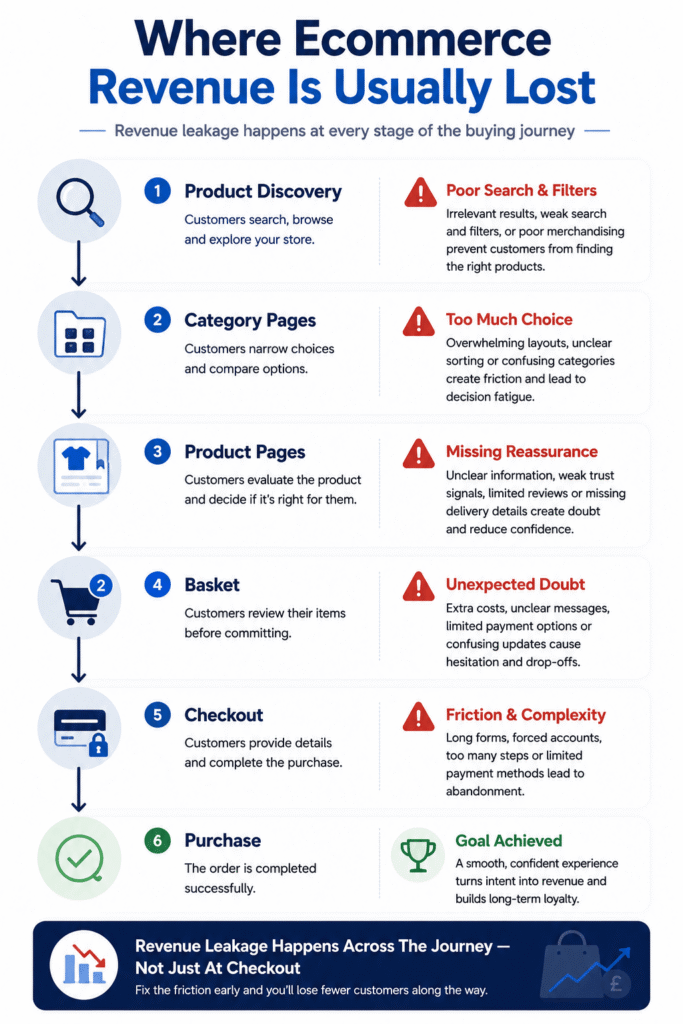
The visible symptom is often simple: plenty of sessions, disappointing revenue. The underlying causes rarely are. We regularly see stores with respectable traffic acquisition and a reasonable product range, but with avoidable friction layered throughout the journey.
Common issues include weak product detail pages, confusing variant selection, poor mobile usability, thin or inconsistent trust cues, search that fails on real-world queries, bloated checkout flows, unclear delivery information and analytics setups that make diagnosis harder than it should be.
Another recurring problem is false certainty. Teams often assume the issue is checkout when the real leak starts on category pages, or assume the answer is more tests when the first job is fixing tracking and cleaning up the data. Good conversion rate optimisation ecommerce work starts with honest diagnosis.
How we diagnose and prioritise opportunities
We begin with the trading context: product mix, margin pressure, customer behaviour, acquisition mix, device split, platform constraints and internal delivery capacity. The right optimisation decision for a high-AOV considered purchase is not the same as the right decision for a low-friction repeat-purchase store.
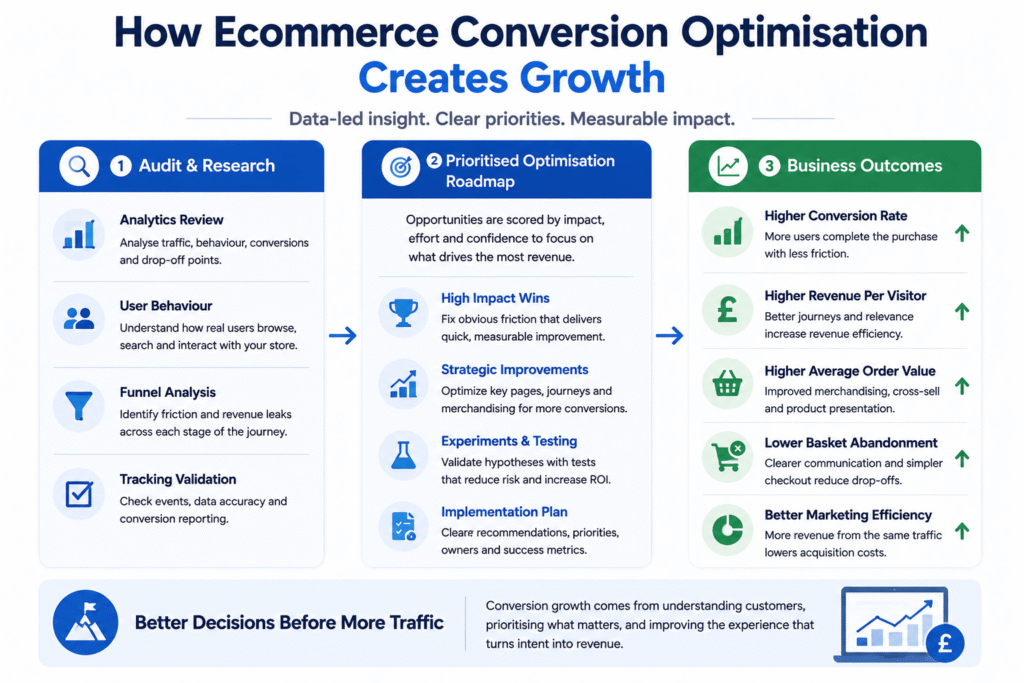
From there, we review the site and the data together. That often includes GA4 ecommerce performance, add-to-basket rate, checkout step completion, revenue per visitor, mobile versus desktop behaviour, search usage, PDP engagement and funnel drop-off. If tracking quality is weak, we say so early, because unreliable data leads to weak decisions. Where deeper measurement work is needed, our SEO analytics services can support cleaner reporting and more dependable diagnosis.
A useful output is not a long list of generic CRO ideas. It should show what appears to be wrong, the evidence behind it, what is likely to matter first, what effort is involved, what dependencies exist and how results should be judged. In practical terms, clients usually receive a prioritised audit, a roadmap of recommended fixes, KPI guidance and implementation notes that an in-house team or delivery partner can actually use.
Not every issue needs a test. If a checkout field is unnecessary, shipping information is hidden or mobile variant selection is clearly awkward, the better move is often to fix the obvious friction first and reserve testing for questions where there is real uncertainty.
Types of optimisation work we carry out
Conversion audits and opportunity mapping
This is often the starting point. We review analytics, user flow, search behaviour, device split, checkout abandonment and page-level performance to identify where the best opportunities are likely to sit. The output is a prioritised action plan rather than a deck full of fashionable CRO talking points.
Product and PDP improvement
Ecommerce PDP optimisation usually involves improving information hierarchy, media, variant clarity, size or specification guidance, stock messaging, delivery and returns visibility, reassurance content, review placement, cross-sell logic and mobile usability. A good product page reduces hesitation. It does not simply add more content.
Category, navigation and search improvement
Many stores lose performance before a customer even reaches a product page. We review collection logic, filters, sort options, internal search behaviour, merchandising rules, category content and dead-end journeys. In larger catalogues, discovery problems can suppress conversion long before checkout abandonment becomes visible.
Basket and checkout optimisation
Ecommerce checkout optimisation focuses on reducing friction at the point of purchase. That can include guest checkout logic, field reduction, error handling, payment method presentation, address lookup, shipping clarity, mobile form behaviour and removal of avoidable distractions.
Tracking and measurement support
Tracking belongs in the conversion discussion because poor measurement distorts priorities. This page focuses on how data supports ecommerce conversion strategy rather than acting as a standalone analytics service. If the broader requirement is measurement infrastructure, attribution and reporting depth, that sits more naturally within SEO analytics.
Platforms, technologies and implementation realities
 We can support ecommerce site optimisation across common platforms and modern stacks, including Shopify, WooCommerce and more bespoke environments. Shopify conversion rate optimisation is a frequent requirement, especially where theme choices, app bloat, mobile friction or checkout constraints are affecting performance.
Platform matters because some problems are UX issues, some are tracking issues and some are baked into the stack. A credible partner should be honest about that. If a checkout limitation is platform-level, the recommendation should reflect reality rather than pretend every problem can be solved with a few content edits.
Implementation matters as well. Good recommendations still need design input, developer time, QA and ownership. Where delivery support is needed, our ecommerce development services can help turn validated recommendations into workable site changes. If the business needs broader structural change rather than a focused conversion brief, that may be better handled through website design. If the requirement is wider trading efficiency across merchandising, UX and store performance, a broader ecommerce optimisation programme may be the better fit.
Typical investment and pricing expectations
Pricing depends on the scale of the site, the quality of the current data, whether research is already in place and how much delivery support is required. A focused review and action plan for a smaller store is very different from an ongoing ecommerce conversion optimisation programme for a trading business with multiple workstreams and more involved stakeholder input.
As a rough guide, a defined audit and prioritised roadmap may sit in the low thousands. A broader monthly engagement is usually a more substantial investment. Scope is shaped by catalogue complexity, checkout dependencies, the quality of event tracking, developer availability and how quickly the business wants to move from review into rollout.
If needed, work can be phased so the business can address high-confidence issues first, then move into testing and iteration once the baseline experience is stronger.
Project timelines and delivery expectations
A diagnostic phase often takes a couple of weeks, assuming access to analytics, platform data and decision-makers is available. Implementation timing depends on internal resource, platform flexibility, approval cycles and the quality of the existing setup.
Some issues can be identified and resolved quickly. Others involve tracking clean-up, design work, checkout dependencies, app conflicts or a longer validation period. The first worthwhile changes can often happen fast, but stronger ecommerce conversion rate optimisation is rarely a one-off exercise.
How the process works in practice
We usually start by understanding the trading picture and the business constraints. That includes what the store sells, where the margin pressure sits, how customers buy, which devices matter most and what internal resource is available. That context changes what good looks like.
Next comes the review itself. We look at where users drop off, where intent weakens, where uncertainty appears and where the commercial risk sits. Findings are then ordered by likely impact, confidence and delivery effort. That balance matters. There is little value in spotting a possible uplift if the change is operationally unrealistic for the client to deliver.
Once priorities are agreed, we support implementation, measurement and refinement. Some businesses need hands-on guidance with design and development teams. Others need a clear roadmap their in-house team can execute. Reporting is kept simple: what was found, what matters, what has changed and what the early signals suggest.
What clients often underestimate
Many businesses underestimate how much revenue is lost before checkout. Product discovery, category structure, search relevance and PDP clarity often have more influence than teams expect. Mobile is another common blind spot. A journey that feels acceptable on desktop can underperform badly on mobile because of thumb reach, field friction, sticky elements, slow interactions or poor content hierarchy.
Measurement is often underestimated too. Conversion rate alone can mislead if average order value, margin, traffic quality and device mix are moving at the same time. We look at conversion metrics in context rather than treating one number as the whole story.
Delivery dependency is the other missed piece. Good ideas still need design resource, development time, QA and reporting discipline. If those pieces are missing, even a strong roadmap can stall.
Why similar projects often fail
They usually fail for ordinary reasons rather than dramatic ones. Teams jump straight to redesign ideas without understanding the leak. Tracking gets trusted despite obvious gaps. Search, filters or product-page clarity get ignored because checkout abandonment looks more visible in reporting. Nobody properly owns rollout.
Expectations can also be wrong. Not every test produces a dramatic uplift. Not every store needs the same benchmark or the same best practice. Ecommerce conversion rate benchmark figures can be useful for context, but they are a poor substitute for understanding your own device mix, traffic quality, catalogue type and margin model.
Strategic buyer guidance before choosing a conversion partner
If you are comparing agencies or consultants, ask how they decide what to prioritise. Ask what they need from your data. Ask how they distinguish between a research finding, a recommendation and a validated result. Ask how often they have seen performance held back by platform constraints rather than page copy or button colour. Those answers tell you more than a polished proposal.
You should also look for judgement. A provider can recommend twenty improvements, but if they cannot tell you which three are most worth doing first, the work may not be mature enough.
In-house team, freelancer or agency?
 There is no universal answer. An in-house team may be best placed to move quickly if it already has strong analytics, UX and development capacity. A freelancer can work well for narrower problems. An agency tends to make more sense when the business needs broader diagnostic capability, cross-functional thinking and a more structured optimisation programme.
What matters is fit. If your store needs search and merchandising input, checkout review, measurement sense-checking and implementation guidance, a single-specialism resource may struggle. If you only need a short independent review before internal rollout, a lighter engagement may be the right call.
Examples of project outcomes
Shopify apparel retailer
A growing fashion brand came to us after paid acquisition costs had risen sharply. Traffic was healthy, but mobile revenue per visitor was lagging and size selection was creating hesitation. The first review showed cluttered PDPs, weak fit guidance and delivery information that was easy to miss on smaller screens. After revising product-page hierarchy, variant clarity and reassurance messaging, product-page to basket rate improved by around 18% over the following quarter. The practical effect was better efficiency from traffic the brand was already paying for.
UK home and lifestyle store
This business believed checkout abandonment was mainly a pricing issue. The closer review showed something more practical: delayed shipping information, unnecessary field friction and awkward payment presentation on smaller screens. Following a staged ecommerce checkout optimisation project, checkout completion rate increased by just over 11% within three months, and delivery-related customer service queries dropped as well. That meant more completed orders and less operational noise for the team handling support.
Multi-category ecommerce retailer
An established retailer with a large catalogue was struggling with product discovery. Search results were inconsistent, filters were unhelpful and category journeys pushed users into dead ends. We mapped the main discovery issues first, refined search behaviour, adjusted parts of the collection experience and reviewed how users narrowed choice on mobile. Over several months, search-assisted sessions converted at a stronger rate, with revenue from those journeys increasing by approximately 24%. For the business, that meant a better return from existing catalogue depth rather than relying solely on more traffic.
What happens after implementation
Once priority changes go live, the work shifts to measurement and refinement. Some recommendations perform as expected. Others reveal a second-order issue or a segment-specific behaviour that was not fully visible beforehand. That is normal.
We help clients review the early performance, sense-check the data and decide what comes next. In some cases the right move is further iteration. In others, it is stepping back because the evidence does not yet support more change. Sensible optimisation includes knowing when not to force activity for the sake of it.
What better conversion performance actually means for the business
Improved conversion is not just about headline revenue. It can affect acquisition efficiency, margin resilience, stock movement, repeat purchase economics and the confidence of future investment decisions. Even a modest uplift can materially improve performance when applied across meaningful traffic volume.
It also gives management teams a clearer view of what is really happening. When the site converts more cleanly, it becomes easier to judge the value of media spend, promotions, product launches and retention activity.
Why businesses choose Prime Lion Digital
Businesses usually come to us because they want sharper thinking and a more grounded approach to ecommerce conversion optimisation. They do not need inflated CRO language. They need a partner who can examine a trading journey properly, challenge assumptions and focus on the changes that are commercially worth making.
Our work is shaped by buyer behaviour, analytics, UX logic and delivery reality. We are clear about where the evidence is strong, where it is incomplete and where platform or resourcing constraints affect what is realistic. That tends to produce a better engagement than an audit full of generic advice with no practical route to implementation.
We can work as a diagnostic partner, a roadmap lead or a support layer alongside in-house ecommerce, design and development teams. The reporting stays straightforward, and the recommendations are written so they can be acted on.
Frequently asked questions
Is ecommerce conversion optimisation the same as CRO?
It sits within CRO, but ecommerce conversion optimisation is more specific to online retail trading. It usually involves product discovery, merchandising, PDP quality, basket and checkout behaviour, mobile UX and measurement, not just generic landing-page testing.
Can you help with Shopify conversion rate optimisation?
Yes. Shopify is a common platform for this work. We regularly review theme decisions, app friction, PDP structure, mobile UX and checkout-related constraints in Shopify environments.
Do you only work on checkout issues?
No. Checkout matters, but many stores lose performance earlier in the funnel. Search, filtering, category UX, product pages and tracking quality are often part of the real problem.
Do we need GA4 and tracking cleaned up first?
Not always first, but tracking needs to be reliable enough to support decisions. If ecommerce events, basket steps or revenue attribution are clearly wrong, that usually needs attention early.
How do you prioritise what to fix first?
We weigh likely business impact, confidence in the evidence, implementation effort and dependency risk. The goal is not the longest list of recommendations. It is to identify the changes most worth making first.
Do we need a redesign to improve conversion rate?
Usually not. Many gains come from clearer hierarchy, better product information, less friction and cleaner measurement rather than a full redesign. If the underlying structure is the real problem, we will say so.
How much traffic do we need for this to be worthwhile?
There is no universal threshold, but there does need to be enough demand and enough data to diagnose behaviour with some confidence. If traffic is very low, the better investment may be elsewhere first.
Do you guarantee uplifts?
No credible partner should. We can improve the quality of the analysis, decisions and rollout, but conversion performance is still influenced by product-market fit, traffic quality, pricing, operations and seasonality.
Talk to us about your ecommerce conversion challenges
If you suspect your store is leaking revenue through product discovery, PDP friction, basket drop-off, checkout abandonment or unreliable tracking, we can help you understand where the problems are and what is realistically worth fixing first.
Whether you need a focused audit or a broader ecommerce conversion rate optimisation programme, the work stays practical, commercially grounded and clear enough for real implementation. To discuss the next step, speak to Prime Lion Digital, call +44 7488 818286 or email enquiries@primeliondigital.co.uk.