WooCommerce Development Experts for Complex UK Ecommerce Stores
Leave your details and our team will get back to you shortly to discuss your website, SEO or digital growth project.
When WooCommerce Has Become Too Important for Quick Fixes
WooCommerce can support serious ecommerce businesses, but technical decisions that work for a small store do not always survive larger catalogues, heavier traffic, more integrations or more complicated commercial workflows.
A store may continue taking orders while becoming progressively harder to operate. Updates start to feel risky. Checkout performance becomes inconsistent. Plugins overlap. Product data grows messy. Admin tasks take longer. An integration fails and nobody is quite sure which system owns the problem.
At that point, the issue is rarely that WooCommerce itself has suddenly become unsuitable. More often, the store has outgrown some of the decisions made when the platform was simpler.
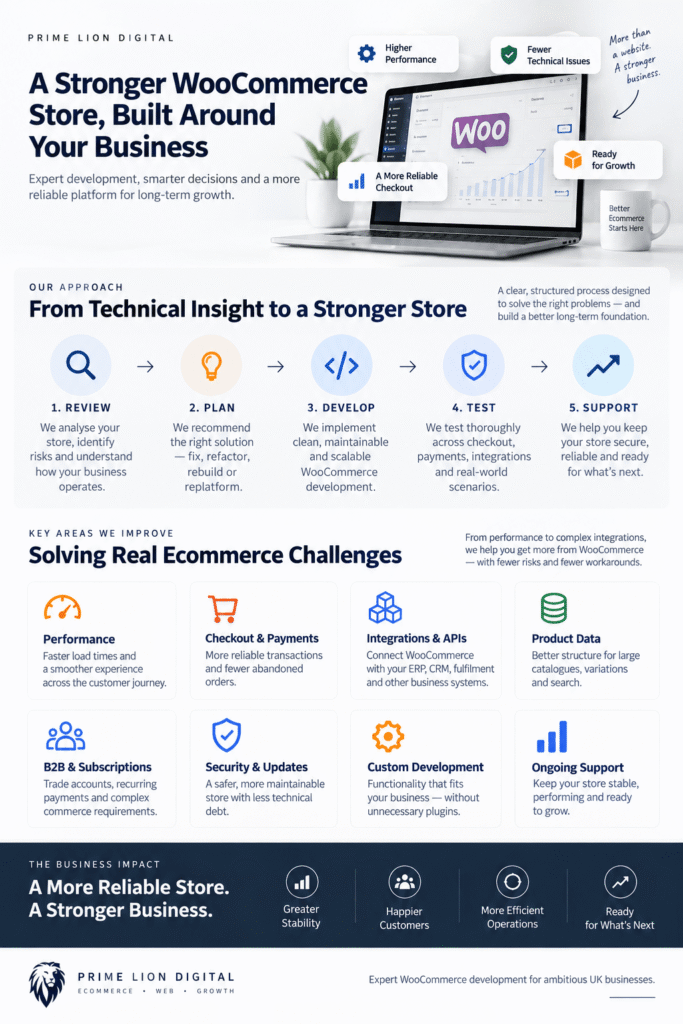
Prime Lion Digital provides expert WooCommerce development for UK ecommerce businesses that need to diagnose, improve, rebuild or scale commercially important stores. Our work covers architecture, custom functionality, performance, checkout reliability, integrations, product data, technical SEO, security and the operational systems behind the customer-facing website.
For businesses looking for WooCommerce development experts, the important question is not simply who can make a requested change. It is who can establish what is actually creating risk, decide how much needs changing and implement that work without introducing another layer of complexity.
What Makes a WooCommerce Development Expert Different?

A general WordPress developer can often make small changes to a WooCommerce store. A specialist has to think about the wider consequences of those changes.
Adding a plugin, for example, may solve the requirement visible on the screen. On a more complex store, that same plugin might add expensive database queries, load unnecessary scripts, interfere with caching, duplicate existing functionality or behave unpredictably during checkout and scheduled tasks.
The decision is therefore not simply whether a feature can be added. It is whether that feature should be configured, extended, custom-built, simplified or avoided altogether.
That judgement becomes more important as the store grows. A business with subscriptions, trade accounts, complex pricing, thousands of SKUs, ERP connections or high-volume campaigns needs a different level of technical thinking from a store selling a small number of straightforward products.
A capable WooCommerce developer in the UK should understand both the platform and the commercial system surrounding it.
When Your WooCommerce Store Needs Expert Help
Most businesses do not contact WooCommerce experts in the UK because everything has suddenly stopped working. More often, the warning signs accumulate gradually.
- Updates regularly create compatibility problems.
- Checkout speed or reliability varies unexpectedly.
- Product filtering slows down as the catalogue grows.
- Admin screens become frustratingly slow.
- Plugins are added repeatedly because nobody is comfortable changing the underlying implementation.
- Payment or shipping issues appear only under certain conditions.
- Stock data does not consistently match another business system.
- Scheduled actions or subscription tasks begin failing.
- Marketing campaigns expose performance problems that are difficult to reproduce at quieter times.
- Developers fix visible symptoms but the same category of issue keeps returning.
These are often signs that the store needs a structured technical review rather than another isolated repair.
In many cases the right answer is not to abandon WooCommerce. The platform may simply need to be cleaned up, restructured or developed around the way the business now operates.
If you are not sure whether the problem is performance, plugins, hosting, checkout or the underlying implementation, a technical review is often the safest place to start.
WooCommerce Expert vs General WordPress Developer
The difference tends to become obvious once a store has enough complexity for changes to interact with one another.
If checkout is slow, for example, the checkout page itself may not be the root cause. The delay may come from shipping calculations, external payment requests, cart fragments, subscription logic, third-party tracking scripts, overloaded webhooks, database queries or caching rules that have to be bypassed during the transaction.
A developer focused only on the visible page may optimise the wrong part of the system.
A WordPress WooCommerce expert should instead trace what happens across the complete transaction, understand the dependencies and identify whether the problem is local, structural or external.
The same applies to integrations, product data, stock, subscriptions and customer accounts. Ecommerce problems frequently cross boundaries between WordPress, WooCommerce, hosting, databases, plugins and third-party systems.
The strongest WooCommerce developers in the UK should be able to explain both what they intend to change and why that approach is preferable to the realistic alternatives.
Before We Change a WooCommerce Store

We do not start by assuming that the store needs rebuilding.
Before recommending substantial development work, we establish which parts of the current platform are genuinely creating commercial or technical risk.
An expert review may include:
- plugin and theme structure;
- hosting capacity and PHP configuration;
- database health and query behaviour;
- WooCommerce HPOS compatibility and implementation;
- product attributes, variations and catalogue structure;
- checkout and payment behaviour;
- shipping and tax logic;
- Action Scheduler and cron activity;
- REST API and webhook behaviour;
- ERP, CRM, fulfilment and stock integrations;
- caching and CDN configuration;
- Core Web Vitals and mobile performance;
- security configuration and administrative access;
- technical SEO considerations;
- admin usability and internal workflows.
We also need to understand how the business uses the store.
A B2B platform with customer-specific pricing creates different pressure from a direct-to-consumer retailer. A subscription store depends heavily on scheduled processes and recurring payment behaviour. A catalogue with twenty thousand SKUs behaves differently from one with eighty products.
The purpose of the review is not to produce the longest possible list of faults. It is to decide which issues affect revenue, customer experience, operational workload, search visibility and the store’s ability to change safely.
Problems We Commonly Find During WooCommerce Reviews
The most expensive WooCommerce problems are not always the most obvious ones. Some stores look perfectly normal to customers while carrying operational weaknesses that surface only during updates, campaigns, catalogue growth or integration failures.
Several Plugins Solving Parts of the Same Requirement
We often find stores where one business need has gradually been spread across several plugins. Pricing rules, account logic, filtering or checkout behaviour may work, but nobody has a clear picture of which extension is responsible for what.
The immediate problem is not necessarily the number of plugins. It is the dependency chain and the difficulty of predicting what an update will affect.
Custom Code Nobody Wants to Touch
Another common situation is functionality that works but has become effectively untouchable because documentation is missing, the original developer has left or the code is tightly connected to the theme.
The correct response is not automatically to delete it. First we establish what it does, whether the business still needs it and what depends on it.
Integrations That Work Until Something Goes Wrong
An ERP, CRM or fulfilment connection may operate for months without obvious problems. The real weakness appears when one system is unavailable, a webhook is delayed or a request fails silently.
That is where reliable error handling, retries, logging and operational visibility become more important than the initial API connection itself.
Admin Performance That Slows the Business Down
Frontend speed gets most of the attention, but slow product editing, order management or reporting can create real staff cost. A store should be usable by the people operating it as well as the customers buying from it.
Technical Red Flags We Look For
Some WooCommerce problems appear repeatedly, but individual symptoms should not be treated as diagnoses on their own.
Plugin Dependency
A high plugin count can be a warning sign, but the number itself does not tell the whole story.
A store with seventy well-chosen plugins may be more stable than a store with twenty-five poorly maintained or heavily overlapping ones.
The useful questions are what each plugin does, how much code it loads, how well it is maintained, whether functionality overlaps and what will happen during future updates.
Product and Variation Structure
Large numbers of poorly structured attributes, duplicated terms and unnecessarily complicated variations can create problems across filtering, search, imports, feeds, administration and performance.
Product architecture often starts as a merchandising decision and later becomes a technical issue.
Checkout Bottlenecks
Checkout should be assessed as a transaction rather than just another page.
Payment gateways, shipping calculations, tax logic, account creation, fraud services, subscription functions, scripts and external APIs may all need to respond before an order completes.
Scheduled Processes
Failed or overloaded scheduled actions can affect subscriptions, emails, stock updates, webhooks and background processing without producing an obvious frontend error.
Database Growth
Bloated postmeta, expired transients, historical plugin data and inefficient queries can gradually affect both customer-facing performance and the speed of everyday administration.
Integrations Without Clear Failure Handling
An API connection is not complete simply because data moves successfully during normal conditions.
The more important question is what happens when the receiving system becomes unavailable, responds slowly or rejects data unexpectedly.
Patch, Refactor, Rebuild or Replatform?
This is one of the most important decisions in advanced WooCommerce development. Not every technical problem deserves a rebuild, and rebuilding is not automatically the more sophisticated option.
Patch
Best suited to: an isolated fault where the surrounding implementation remains healthy.
A focused fix can be entirely appropriate when the problem has a clear cause, the change does not create another dependency and the rest of the store remains maintainable.
Refactor
Best suited to: useful functionality that has become fragile or unnecessarily complicated.
This may involve replacing duplicated plugin logic, restructuring custom code, cleaning database behaviour or separating responsibilities that have gradually become tangled together.
Partial Rebuild
Best suited to: a store where one important area has clearly outgrown the original setup.
Checkout, product filtering, subscriptions, B2B account logic or an integration layer may justify redevelopment while most of the store remains intact.
Full Rebuild
Best suited to: widespread technical debt, an ageing theme and plugin structure, major catalogue problems or a platform where every new requirement creates disproportionate risk.
A rebuild should solve identifiable structural problems rather than become an expensive way of reproducing the same weaknesses with a newer design.
Replatform
Best suited to: businesses whose operational model or future requirements genuinely no longer fit WooCommerce.
A credible WooCommerce development agency in the UK should be prepared to recommend another platform when that is the better long-term decision.
The goal is not to protect WooCommerce at all costs. It is to protect the business from an expensive technical decision that fails to solve the underlying problem.
WooCommerce Architecture and Custom Development
Good WooCommerce architecture is usually simpler than bad architecture.
Complex businesses may need sophisticated functionality, but that does not mean every requirement should result in another dependency.
Depending on the project, our work may involve custom plugin development, checkout or account functionality, product and catalogue restructuring, advanced pricing rules, B2B account logic, subscription workflows, database optimisation, API and webhook development, payment-flow improvements, search and filtering or performance work.
We avoid custom code where a reliable, lightweight and well-supported solution already meets the requirement.
We also avoid forcing unusual business processes into plugin limitations when well-structured custom ecommerce development would be easier to understand and maintain.
The important skill is not writing custom code for its own sake. It is choosing the least fragile way to meet the business requirement.
Performance Across the Whole Ecommerce Journey
WooCommerce performance cannot be judged accurately from the homepage alone.
A store may achieve an acceptable speed score on a cached landing page while performing poorly where customers actually interact with ecommerce functionality.
Depending on the store, testing may include product and category pages, search and filtering, large variation selectors, basket updates, checkout, logged-in accounts, subscription management, mobile journeys, admin screens and background processes.
Optimisation can involve database work, caching configuration, image delivery, script reduction, CDN configuration, server-side changes, plugin review and frontend improvements.
Where performance is the primary problem rather than part of a wider redevelopment, our ecommerce performance optimisation work focuses more deeply on speed, Core Web Vitals and platform behaviour.
The objective is not simply a better test score. The store needs to respond consistently under real customer behaviour and operational load.
Checkout and Payment Reliability
Checkout sits close enough to revenue that uncertainty here deserves special attention.
Problems may be caused by frontend scripts, payment-gateway responses, shipping logic, tax calculations, session behaviour, subscriptions, fraud tools or integrations that need to complete during the transaction.
A reliable checkout therefore needs to be tested across realistic scenarios, including different devices, payment methods, customer types, shipping rules and account states.
Failure paths matter too.
If a payment request times out, does the order state remain understandable? If the gateway confirms payment after the browser has stopped waiting, can the system reconcile the transaction? If a webhook is delayed, does that create duplicate processing or leave an order in the wrong status?
Those situations rarely appear in a design mock-up, but they matter to the business once the store is live.
WooCommerce Integrations, APIs and Failure Handling
Growing WooCommerce stores rarely operate on their own.
They may need to exchange information with ERP platforms, CRM systems, fulfilment providers, accounting software, warehouse systems, payment gateways, subscription services, email tools, analytics platforms or internal applications.
An integration can remove large amounts of manual work. It can also create a new operational dependency.
The planning therefore needs to go beyond whether the API technically connects.
- Which system is the source of truth for stock, pricing or customer data?
- What triggers synchronisation?
- How quickly does data need to move?
- What happens when an API fails?
- Are failed requests retried?
- How are errors surfaced to staff?
- How is duplicate processing prevented?
- What happens to an order when another platform is temporarily unavailable?
For projects where connectivity between business systems is the main requirement, our API integration services cover the wider planning and implementation involved.
For many established ecommerce businesses, reliable integration behaviour is just as important as the storefront itself.
Product Data, Large Catalogues and Search
Catalogue growth creates problems that are easy to underestimate.
A store with thousands of products may need a more deliberate approach to categories, attributes, variations, filtering, search, imports and feeds than a smaller catalogue.
Poor product structure affects more than performance. It can make merchandising harder, create inconsistent customer journeys and increase the risk of errors when data is synchronised with another platform.
Before adding more advanced search or filtering technology, we first look at the information being searched.
Technology cannot completely compensate for product data that has no consistent structure. Where the wider buying journey also needs restructuring, ecommerce website design should be considered alongside the underlying technical work rather than treated as a separate cosmetic exercise.
B2B, Subscription and Complex Commerce Requirements
WooCommerce is frequently extended beyond conventional consumer retail.
A B2B store may need account approval, customer-specific pricing, private catalogues, purchasing roles, credit terms, order approvals or connections to sales systems.
Subscription businesses depend on reliable recurring payments, scheduled actions, account management and exception handling when renewals fail.
Other stores may combine retail, wholesale, subscriptions or marketplace-style functionality in the same environment.
These projects need more than a capable WooCommerce web developer. They need someone who understands how technical decisions affect customers, internal staff and downstream systems.
Who This Service Is — and Is Not — For
This service is not only for enterprise retailers or stores with enormous catalogues.
It can also be appropriate for a smaller ecommerce business when the store has become commercially important and the consequences of a poor technical decision are no longer small.
Typical triggers include recurring checkout issues, increasing plugin conflicts, expensive manual processes, unreliable integrations, catalogue growth, performance problems during campaigns or a development backlog that becomes harder to deliver safely.
On the other hand, a new store with a straightforward product range, standard checkout and no unusual integrations may not need this level of technical involvement. A simpler WooCommerce build can be entirely appropriate.
Complexity should justify expertise. Expertise should not be used to manufacture complexity.
How We Work Safely on a Live WooCommerce Store
Development on a trading ecommerce site needs a different level of control from work on a brochure website.
A technically correct change can still create commercial disruption if it is deployed without considering orders, payments, customer sessions or integrations.
Depending on the project, a safer workflow may include:
- a staging environment that reflects the live store closely enough for meaningful testing;
- current database and file backups;
- a documented rollback approach for significant releases;
- test transactions across important payment methods;
- shipping, tax and account checks;
- regression testing around existing functionality;
- integration testing;
- controlled deployment timing;
- post-release monitoring.
Not every small update needs an enterprise release process. The level of control should match the risk of the change.
What matters is that business-critical development is not treated casually simply because WordPress makes publishing changes easy.
Security, Updates and Technical Debt
Technical debt does not always appear as a dramatic failure. More often, it gradually makes the business slower.
A campaign takes longer to launch because the required landing-page functionality conflicts with the theme. A payment integration cannot be updated without breaking custom code. Staff avoid a useful product change because administration has become cumbersome. Developers spend hours investigating dependencies before making a relatively small adjustment.
Those are commercial consequences of an increasingly difficult implementation.
Updates, security and maintenance therefore need to be considered alongside new functionality.
Good maintenance does not mean installing every available update immediately. It means understanding dependencies, testing appropriately and keeping the store in a condition where routine changes do not become high-risk events.
Who We Help
Our WooCommerce work is primarily suited to businesses that have moved beyond basic store requirements.
- Growing ecommerce retailers whose existing setup is struggling to keep pace.
- Stores with large or complicated catalogues.
- B2B and wholesale businesses.
- Subscription ecommerce companies.
- Businesses with ERP, CRM or fulfilment integrations.
- Stores exposed to significant promotional or seasonal traffic.
- Businesses dealing with recurring performance or checkout issues.
- Companies preparing for redevelopment or migration.
- Businesses taking over a WooCommerce platform from another developer or agency.
- Teams spending too much time on manual work because systems do not connect reliably.
We are particularly useful where the store has become important enough that repeated quick fixes are no longer an acceptable development strategy.
Taking Over a WooCommerce Store From Another Developer
Changing developer does not mean the existing implementation needs to be criticised or discarded.
WooCommerce stores evolve over years, often through several phases of growth and several different development teams. A decision that was completely reasonable when the business was smaller may no longer fit the current operation.
When taking over an existing project, the first priority is understanding what is there.
That may involve reviewing custom plugins, theme modifications, integration credentials, scheduled tasks, third-party licences, hosting, deployment practices and any documentation left by previous developers.
Where documentation is missing, that becomes part of the discovery work rather than an excuse to start rebuilding everything.
What We Need From You Before We Start
Technical access is important, but good WooCommerce work also depends on operational context.
Depending on the project, we may need access to WordPress and WooCommerce administration, hosting, staging, source code repositories, analytics, payment gateways, integrations, plugin licences and relevant error logs.
We also need somebody who can explain how orders are supposed to move through the business.
That matters because a technical workflow may look unusual in the code while being essential to how the organisation handles stock, finance, fulfilment or customer service.
Pricing for Expert WooCommerce Development
Expert WooCommerce development pricing depends on the condition of the current platform and the level of technical change required.
Important cost factors include technical discovery, custom functionality, checkout and payment complexity, integrations, catalogue size, performance issues, B2B or subscription requirements, migration work and testing depth.
Small expert review or improvement projects may begin from approximately £1,600–£3,000.
More involved projects combining custom functionality, performance work, checkout improvements, API integrations or redevelopment often range from approximately £3,500–£9,000+.
Larger WooCommerce projects involving complex B2B architecture, subscription systems, ERP integrations, large catalogue optimisation, custom plugins or substantial migration work may require a higher investment depending on scope.
Comparing proposals only by price can be misleading when one scope includes proper discovery, testing and migration planning while another assumes those elements will somehow be resolved during development.
If you already have a store and need clarity before committing to a larger redevelopment, we can begin with a technical review and define the sensible next step from there.
Typical Expert WooCommerce Project Timeline
Most substantial projects should begin with discovery or technical review before major development decisions are finalised.
A focused optimisation or issue-resolution project may take around two to four weeks. A structured redevelopment or more involved custom functionality project may take six to ten weeks.
Larger projects involving migrations, B2B logic, subscriptions, several integrations or substantial testing can require twelve weeks or more.
Those ranges are only useful as guidance. Access, third-party systems, testing requirements and the condition of the existing store can materially affect delivery.
For ecommerce work, a faster launch is not automatically a better launch if the time has been saved by reducing testing around payment and operational workflows.
What Better WooCommerce Engineering Changes for the Business
The value of stabilising a WooCommerce platform is not limited to technical cleanliness.
A healthier implementation can make everyday development more predictable, reduce the amount of time spent investigating recurring faults, make product administration easier and give the business more confidence when launching campaigns or new functionality.
For internal teams, that can mean fewer workarounds and clearer ownership of problems. For customers, it can mean a more consistent experience across product discovery, basket, checkout and account management.
The exact business outcome depends on the starting point. We do not use generic conversion-uplift percentages because the effect of technical work varies significantly between stores.
Typical WooCommerce Project Scenarios
The scenarios below represent the types of problems expert WooCommerce development may need to solve. Where project-specific performance data has not been verified for publication, we do not invent conversion figures or present illustrative outcomes as measured client results.
Growing Retailer With a Large, Plugin-Heavy Catalogue
Business type: Established UK ecommerce retailer with a growing product range.
Starting problem: Increasing catalogue complexity, slower product management, plugin overlap and inconsistent performance during promotional activity.
Typical work: Technical audit, plugin rationalisation, product attribute review, database optimisation, caching improvements and checkout testing.
Useful measures: Product-page performance, checkout completion, admin response time, database behaviour, plugin dependency and stability during traffic peaks.
Commercial meaning: The store becomes easier to operate and less risky to change as the catalogue and marketing activity grow.
Subscription Store With Unreliable Renewals
Business type: Ecommerce business using recurring billing.
Starting problem: Failed renewals, delayed scheduled actions and increasing manual support around subscription accounts.
Typical work: Review payment and renewal logic, Action Scheduler behaviour, cron configuration, customer account UX and plugin dependencies.
Useful measures: Failed renewal rate, recurring payment success, scheduled-action backlog and subscription-related support requests.
Commercial meaning: More predictable recurring revenue operations and less manual intervention when subscriptions are processed.
B2B Store Moving Away From Manual Ordering
Business type: Wholesale or distribution company.
Starting problem: Trade pricing, quotations and customer ordering depend heavily on spreadsheets, email and manual internal processes.
Typical work: Account-based pricing, customer permissions, private catalogue access, ordering workflows and CRM or ERP integration.
Useful measures: Manual order-processing time, digital order adoption, order accuracy, internal support workload and usage of trade accounts.
Commercial meaning: Ecommerce begins supporting the sales operation rather than simply displaying products to existing trade customers.
Why Prime Lion Digital Can Be the Right WooCommerce Partner
Prime Lion Digital combines WooCommerce development with ecommerce strategy, UX, technical SEO, performance and integration experience.
That combination matters because a complex WooCommerce store rarely has purely technical problems.
A change to product structure can affect SEO and merchandising. A checkout decision can affect marketing measurement. A CRM integration can affect customer service. A performance problem may originate in database behaviour rather than frontend design.
We therefore approach WooCommerce as a commercial platform rather than simply a WordPress website with products added to it.
We also try to avoid unnecessary work. We do not assume that every slow store needs rebuilding, that every unusual requirement needs custom code or that every technical limitation means WooCommerce should be replaced.
For businesses comparing providers and looking for the best WooCommerce development company for a complex project, technical judgement is usually more valuable than the ability to promise the fastest implementation.
The right direction is the one that solves the current problem while leaving the platform easier, not harder, to operate afterwards.
Common Mistakes Businesses Make When Hiring WooCommerce Help
Hiring Only on Price
A lower development rate can be excellent value when the work is straightforward. It becomes more dangerous when a business-critical store needs discovery, testing and integration knowledge that is not included in the scope.
Treating Every Problem as an Isolated Task
A broken filter, slow checkout or unreliable stock update may be a symptom of a deeper structural problem.
Fixing symptoms repeatedly can eventually cost more than understanding the root cause.
Adding Plugins Before Understanding the Existing Stack
Another plugin may be the right answer. It should not be the automatic answer.
Underestimating Testing
Ecommerce changes need to be tested around payment, shipping, accounts, emails, stock and integrations as well as visual appearance.
Ignoring What Happens After Launch
A technically ambitious development is less useful if nobody knows how it will be maintained, monitored or safely updated six months later.
Frequently Asked Questions
What does a WooCommerce development expert actually do?
A WooCommerce development expert plans, diagnoses, builds and improves ecommerce stores where performance, custom functionality, checkout reliability, integrations, product data and maintainability require deeper technical understanding than routine WordPress development.
When should I use a WooCommerce specialist rather than a general WordPress developer?
A general developer can be entirely suitable for straightforward content or visual changes. Specialist WooCommerce experience becomes more valuable when the work involves checkout, payments, subscriptions, large catalogues, performance, complex pricing, APIs, integrations or substantial technical debt.
Can you fix an existing WooCommerce store without rebuilding it?
Yes. In many cases, targeted optimisation or refactoring is preferable to a full rebuild. We first establish which parts of the current implementation are genuinely causing problems and what can safely be preserved.
How do you decide whether to refactor or rebuild WooCommerce?
We look at the condition of the existing implementation, maintainability, catalogue structure, integrations, performance, future requirements and how much useful functionality can be retained. The decision should be based on risk and long-term practicality rather than a preference for new development.
Can WooCommerce support large ecommerce stores?
Yes. Catalogue size alone does not determine whether WooCommerce can scale. Hosting, database behaviour, product structure, caching, plugins, search, integrations and operational workflows all influence how successfully a larger store performs.
Can you improve a slow WooCommerce checkout?
Yes. Checkout optimisation may involve frontend scripts, database activity, shipping rules, payment gateways, subscriptions, external APIs and caching behaviour. We look at the complete transaction rather than assuming the visible checkout page is the root cause.
Can you reduce WooCommerce plugin dependency?
Yes, where that improves maintainability. The objective is not to reach an arbitrary plugin number but to remove unnecessary overlap, replace fragile dependencies and keep useful well-supported functionality where it makes sense.
Do you develop custom WooCommerce plugins?
Yes. Custom plugins or functionality can be appropriate where standard solutions create important limitations or require multiple overlapping extensions. We avoid custom development when a simpler reliable option already solves the requirement properly.
Can you integrate WooCommerce with ERP or CRM systems?
Yes. WooCommerce can be connected to ERP, CRM, fulfilment, stock, accounting, payment and other operational systems. The integration should include consideration of data ownership, retries, error handling and what happens when an external platform becomes unavailable.
Can you work safely on a live WooCommerce store?
Yes. The exact process depends on the risk of the work, but substantial changes may involve staging, backups, test transactions, regression testing, controlled deployment and post-release monitoring before they are considered complete.
Can you take over WooCommerce development from another agency?
Yes. We can review an existing store, understand custom development and dependencies, identify undocumented areas and recommend the safest way to continue development without automatically discarding previous work.
Can WooCommerce support B2B ecommerce?
Yes. WooCommerce can support trade accounts, customer-specific pricing, private catalogues, approval workflows and other B2B requirements when those features are planned around the business model rather than assembled as disconnected extensions.
How much does expert WooCommerce development cost in the UK?
Pricing depends on the store, complexity and project risk. Smaller reviews or improvements may begin around £1,600–£3,000, while advanced custom development, integrations or redevelopment commonly require a larger project budget.
How long does expert WooCommerce development take?
A focused improvement project may take a few weeks. More substantial redevelopment, integration or complex ecommerce work often takes six to twelve weeks or more depending on scope and testing requirements.
Do you provide ongoing WooCommerce support?
Yes. Ongoing support can include maintenance, monitoring, performance improvement, technical troubleshooting, updates and future development as the store evolves.
Need Expert Help With a Slow, Unstable or Overgrown WooCommerce Store?
If your WooCommerce store has become difficult to manage, risky to update, slow under pressure or limited by earlier development decisions, the next step does not have to be a complete rebuild.
We can first establish what is actually going wrong, what remains worth keeping and whether the right intervention is a focused fix, refactor, partial redevelopment or broader rebuild.
Prime Lion Digital works with UK ecommerce businesses that need experienced WooCommerce developers, stronger architecture, custom functionality, integration support and more reliable long-term operation.
Tell us what is happening with your WooCommerce store and what the business needs it to do next. We can then recommend a sensible technical starting point.