
Digital Services for Bookkeepers and Bookkeeping Firms
Leave your details and our team will get back to you shortly to discuss your website, SEO or digital growth project.
A bookkeeping business can have a professional website and still struggle to attract the right clients. It can appear in search without explaining its services clearly, generate enquiries that are poorly matched to the work it wants, or bring new opportunities into a process that becomes difficult to manage once several people are involved.
Prime Lion Digital works with UK bookkeepers and bookkeeping firms across that wider digital ecosystem. Website design and development, branding, SEO, digital marketing and CRM solve different problems, but they all influence the same commercial journey: how somebody discovers the business, decides whether to trust it, makes contact and eventually becomes a client.
The useful question is not which digital services a bookkeeper can buy. It is where the journey from visibility to client is actually underperforming.
Digital Growth Built Around a Bookkeeping Business
A sole bookkeeper building a local client base has different priorities from an established firm with several employees, multiple service lines and clients across the UK. The technology and marketing should reflect that difference.
One business may need stronger visibility when local companies search for bookkeeping support. Another already receives enough traffic but has an outdated website that makes its services difficult to understand. A growing firm may have healthy enquiry volumes but no consistent way to qualify, assign and follow them up.
Rebuilding a website will not solve weak market reach on its own. Increasing traffic is of limited value if the wrong people arrive. A CRM will not create demand where there is none. Identifying the constraint first usually produces a more sensible investment plan.
What Digital Services for Bookkeepers Actually Cover
The digital journey normally begins before somebody reaches the website and continues after they make contact.
A prospective client might discover a bookkeeping firm through Google, local search, advertising, a recommendation or useful content. They then need to understand what the firm does, whether it works with businesses like theirs and whether it appears credible enough to contact.
Once an enquiry arrives, the emphasis changes. Someone needs to respond, understand what the prospect requires, decide whether the work is suitable, follow up where necessary and move an accepted client into onboarding and service delivery.
Bookkeeping Business → Services → Ideal Clients → Website → Visibility → Trust → Enquiry → Follow-Up → Client
Web design, development, branding, SEO, marketing and CRM each sit somewhere within that journey. Their value depends partly on how well they connect with the stages around them.
Why Bookkeeping Firms Need a Connected Digital Approach
Individual digital improvements can underperform when the surrounding journey is ignored. SEO may increase search visibility, only for prospective clients to arrive on service pages that give them little reason to enquire. Paid advertising can reach people quickly, but weak landing pages can make that traffic unnecessarily expensive. A visually strong website contributes less to growth if nobody has considered how prospective clients will find it.
The same disconnect can happen after contact. Analytics may record a conversion while the business has no clear view of whether the enquiry was suitable, who responded or what happened next.
A connected approach does not mean building a complicated technology stack. For many UK bookkeeping firms, a relatively simple setup is enough. The objective is to make the important stages work together without adding systems, channels or processes that the business does not need.
Where Is Your Current Digital Setup Holding the Practice Back?
If prospective clients rarely find the business, search visibility or market reach may be the constraint. If people arrive but rarely make contact, service presentation, positioning or the enquiry journey deserves closer attention. Poor enquiry quality can point towards targeting rather than traffic. Missed opportunities after contact are usually a process problem rather than an acquisition problem.
There can be more than one issue at the same time, particularly in a growing practice. Even so, treating every weakness as a reason to add another marketing channel tends to create activity rather than clarity.
This distinction is useful when deciding where the next budget should go. Sometimes the highest-impact change is not the most visible one.
| Current Situation | Example Monthly Volume | Example Conversion | What the Numbers May Suggest | Likely Area to Review First |
|---|---|---|---|---|
| Very little relevant website traffic | 150 visits | 5% = 8 enquiries | The website converts reasonably, but too few relevant prospects are finding it | SEO, local visibility or targeted marketing |
| Healthy traffic but few enquiries | 1,000 visits | 1% = 10 enquiries | Visibility exists, but service presentation, trust or the enquiry journey may be limiting results | Website structure, UX and conversion |
| Good enquiry volume but weak fit | 40 enquiries | 25% suitable = 10 | The issue may be targeting or messaging rather than total lead volume | Marketing targeting and service positioning |
| Relevant enquiries but inconsistent follow-up | 30 enquiries | 70% followed up = 21 | 9 opportunities may receive incomplete or delayed follow-up | CRM, ownership and enquiry workflow |
| Strong acquisition and organised follow-up | 50 enquiries | 90% followed up = 45 | The next priority may be optimisation rather than another major rebuild | Measurement, refinement and selective growth |
Illustrative examples only. These figures are not UK bookkeeping industry benchmarks. Actual performance varies by service, market, traffic source, website and client profile.
Web Design for Bookkeepers
A bookkeeping website needs to establish credibility, explain services in language prospective clients understand and help people decide whether the firm may be suitable for them.
That becomes more important as the service mix grows. Monthly bookkeeping, catch-up work, VAT support, payroll, management accounts and accounting software support may address quite different client needs even when they sit within the same practice.
Our web design work looks more closely at information architecture, UX, service presentation and conversion. Within the wider ecosystem, the important point is that design supports the client-acquisition journey rather than existing as a visual exercise in isolation.
Website Development and Technical Foundations
Behind the design sits the technical foundation: the CMS, reusable page structures, enquiry forms, analytics, performance, security and any connections required between the website and other systems.
Website development for bookkeepers does not need to be technically elaborate to be effective. A smaller practice may simply need a dependable platform that staff can update without developer support. More complex firms may require structured content, several enquiry routes or integrations with existing systems.
The balance matters. Unnecessary functionality creates maintenance overhead, while an inflexible website can make future services, content and SEO work harder than they need to be.
SEO for Bookkeepers
Prospective clients often search for a problem or service before they search for a particular firm. That can include general bookkeeping support, catch-up work, VAT records, payroll or a bookkeeper serving a particular area.
SEO therefore needs to connect search demand with the services the business actually wants to grow. Service architecture, local relevance, supporting content, internal linking and technical foundations all contribute to that visibility.
Traffic alone is a poor measure of success. A modest number of searches closely connected to valuable services can matter more commercially than much larger volumes of loosely relevant informational traffic.
Digital Marketing for Bookkeepers
Digital marketing for bookkeepers is the broader decision about which channels can realistically reach prospective clients, what each channel is expected to achieve and how its contribution will be measured.
Organic search may provide the strongest long-term opportunity for one practice. Another may use paid search to reach businesses looking for immediate help. Content can support search visibility and more complex buying decisions. Email can be useful where existing relationships or longer decision cycles matter.
Social media can play a role too, but regular posting is not a strategy by itself. The same applies to advertising: buying more clicks does not fix unclear positioning, weak service pages or a poor enquiry journey.
The economics should shape the channel mix. A small one-off bookkeeping job and a recurring relationship worth several thousand pounds over time should not automatically have the same acquisition model.
Branding for Bookkeepers and Bookkeeping Firms
Branding for bookkeepers is often discussed in terms of logos and colours, but for a professional service business the more important issue is consistency. The website, proposals, emails, documents and other client-facing material should feel as though they belong to the same business.
Positioning matters as well. A sole practitioner working closely with local owner-managed businesses may deliberately feel personal and accessible. A growing bookkeeping firm targeting larger SMEs may need a more structured presentation.
Good bookkeeping branding does not make a small business pretend to be a large accountancy practice. It makes the business look credible for what it actually is and for the clients it wants to serve.
CRM Systems for Bookkeepers
CRM becomes useful when an inbox or spreadsheet no longer gives the business enough visibility over prospective clients.
As enquiries begin arriving through the website, telephone, email, referrals and marketing campaigns, several people may become involved in responding, quoting or onboarding. A CRM can provide clearer ownership, status and follow-up across that process.
It should not duplicate bookkeeping or practice-management software without a practical reason. For some firms, an existing platform can already cover the requirement. For others, the gap between acquisition and client management becomes large enough to justify a more focused CRM workflow.
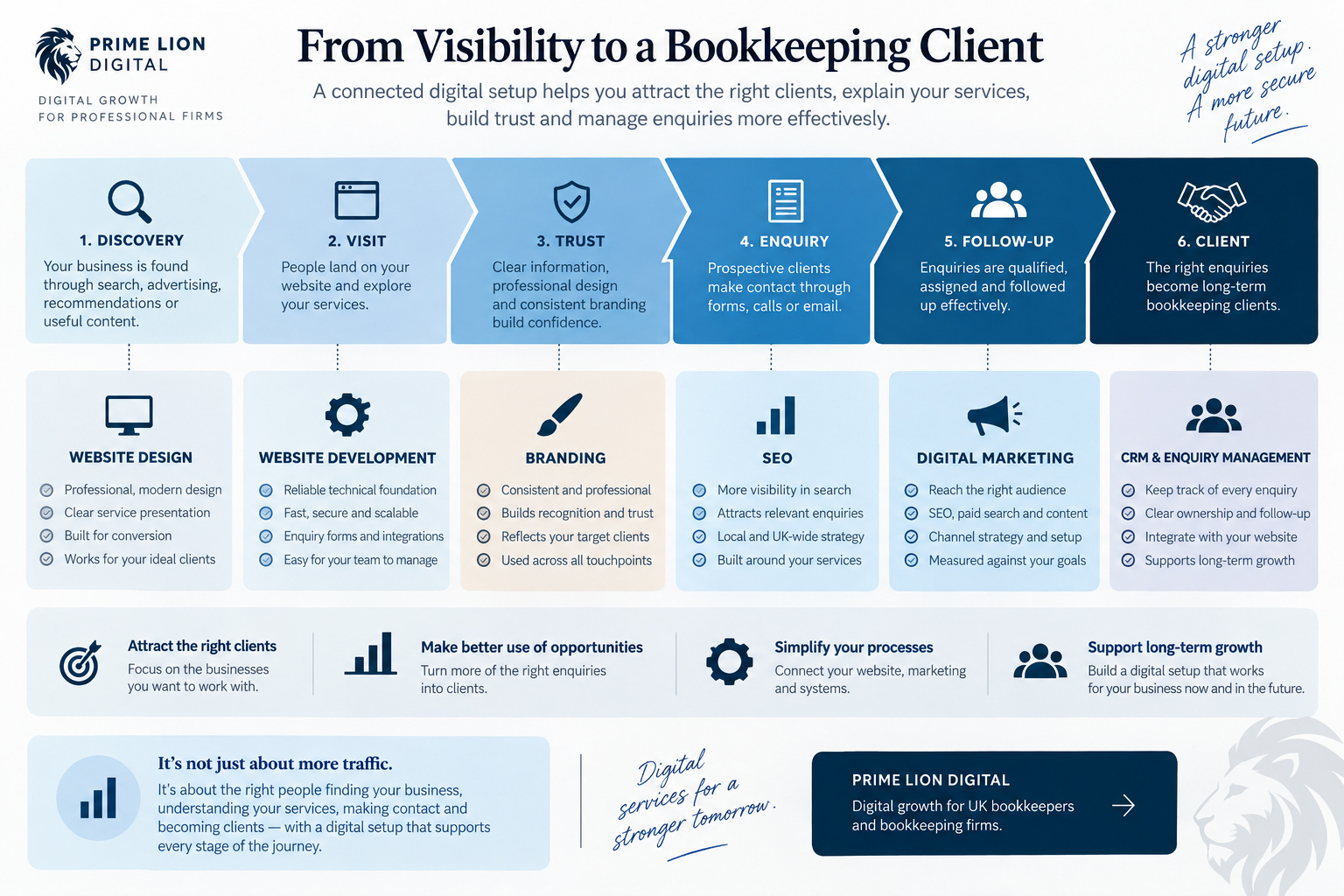
From Online Visibility to a New Bookkeeping Client
Search rankings sit in one report. Website traffic appears in another. Advertising platforms have their own dashboards, while enquiries arrive through forms, calls and email. The business itself experiences something much simpler: one client journey.
Visibility → Relevant Visit → Service Understanding → Trust → Enquiry → Qualification → Follow-Up → Client
A weakness at one stage changes the value of the stages before it. More visibility only helps when the right people are being reached. More enquiries only help when enough of them fit the firm’s services and preferred client profile. Even a strong opportunity can be lost through inconsistent follow-up.
This is why useful measurement eventually needs to move beyond traffic and conversions towards the quality and commercial outcome of the opportunities being created.
Choosing the Right Marketing Channels for a Bookkeeping Business
There is no standard channel mix that every bookkeeping firm should copy.
Search marketing is particularly relevant where prospective clients are already looking for help. SEO can build access to that demand over time, while paid search can provide more immediate visibility at a direct acquisition cost. Content can support both search and more considered buying decisions. Social activity may strengthen familiarity or distribute useful material, but its role should be defined rather than assumed.
Before deciding where to advertise as a bookkeeper, it is more useful to understand where the intended clients look for help, what a new relationship may be worth and how much consideration takes place before somebody makes contact.
A channel is useful because of the commercial role it plays, not because another bookkeeping firm happens to use it.
| Example Service | Example Fee | Example Relationship | Illustrative Client Value | 10% Acquisition Budget | 20% Acquisition Budget |
|---|---|---|---|---|---|
| One-off catch-up bookkeeping | £350 | One project | £350 | £35 | £70 |
| Monthly bookkeeping | £200 per month | 12 months | £2,400 | £240 | £480 |
| Bookkeeping + VAT support | £300 per month | 12 months | £3,600 | £360 | £720 |
| Bookkeeping + payroll + VAT | £450 per month | 12 months | £5,400 | £540 | £1,080 |
| Outsourced bookkeeping support | £750 per month | 12 months | £9,000 | £900 | £1,800 |
Illustrative commercial scenarios only, not recommended bookkeeping fees or acquisition targets. Client value, retention, margins and acceptable acquisition costs vary considerably between firms.
Local Visibility and Client Acquisition
Many bookkeeping businesses continue to grow within a defined geographic market even when much of the work can be delivered remotely. Prospective clients may still prefer somebody nearby, particularly when choosing financial support for the first time or looking for an ongoing professional relationship.
Google Business Profile, accurate business information, locally relevant website content and genuine reputation signals can support that visibility. Location pages can also be useful where the firm genuinely serves distinct areas and has something meaningful to say about them.
What rarely helps users is a collection of near-identical town pages created only to expand keyword coverage. Local relevance is more convincing when it reflects the market the business actually serves.
Connecting Website, Marketing and CRM
The hand-off between marketing and operations is where useful context often disappears.
A website enquiry might contain the requested service, business type and contact information. Marketing data may also show which search, page or campaign led to it. If only a name and email address are copied into a spreadsheet, part of that context has already been lost.
For a growing firm, connecting the stages can make reporting more commercially useful. Instead of asking only which channel generated the most enquiries, management can begin asking which channels generated suitable opportunities, which services those prospects wanted and what happened afterwards.
That does not mean every platform needs an integration. A connection is worthwhile when it removes meaningful repetitive work, preserves useful information or improves a decision. Technical complexity without an operational benefit is still complexity.
What Bookkeeping Firms Often Overinvest In — and Underinvest In
Digital budgets are not always wasted on obviously bad ideas. Quite often the individual activity is reasonable, but the sequence is wrong.
A firm may increase advertising spend before fixing service pages that confuse prospective clients. It may commission a visual redesign while leaving poor information architecture untouched. Another may pay for frequent social activity even though most prospective clients are actively searching for help elsewhere.
Less visible work is easier to postpone. Service structure, technical maintenance, conversion tracking, enquiry handling and follow-up are rarely as noticeable as a new campaign, yet weaknesses there can reduce the value of everything driving people towards the business.
The correct balance depends on what already works. An established site with useful organic visibility should not be treated like a new bookkeeping business starting without search presence, content or an established brand.
How We Approach Digital Projects for Bookkeeping Firms
Prime Lion Digital starts with the business rather than assuming the answer is a particular channel or technology. We need to understand what the firm offers, which services matter commercially, who it wants to work with and how new business currently arrives.
That context makes the priorities easier to separate. A website problem can be addressed as a website problem. Weak organic visibility needs a search strategy. Poor enquiry handling may require workflow changes rather than another campaign.
Where several areas genuinely interact, they can be planned together so that design, development, marketing and internal systems support the same client journey. Where something already works, there should be a reason before replacing it.
Investment and Project Scope
Project scope varies considerably because the starting point matters. Improving an established bookkeeping website is different from designing and developing a new one. Building local organic visibility has a different workload from competing across the UK. A straightforward enquiry process is not comparable with a CRM involving several users, integrations and data migration.
Ongoing activity needs to be considered differently from project work as well. SEO, content and paid campaigns generate information over time, whereas a website build, technical project or branding exercise usually has a more defined delivery scope.
For smaller firms, doing the most restrictive work first can be more sensible than committing to a large package. The next investment can then be informed by what actually changed rather than by a predetermined agency plan.
Real-World Digital Growth and Operational Examples
Professional Services Growth Across Website, SEO and Enquiry Management
In a related UK accounting and tax project, the challenge extended across acquisition and operations. The website needed a clearer structure around services prospective clients were searching for, while the business also needed a more organised way to manage the enquiries created as visibility increased.
Work across website architecture, service content, SEO and supporting digital acquisition helped the site reach around 3,000 monthly organic visitors. In a recorded month, the business received more than 100 website enquiries and over 30 telephone enquiries.
These are acquisition results from an accounting and tax business, not a bookkeeping-specific project and not results generated by a CRM. Their relevance here is operational: once inbound activity grows, qualification, ownership and follow-up become increasingly important. The wider project demonstrates why acquisition and the systems behind it cannot always be considered separately.
| Digital Indicator | Recorded Level | Approx. Weekly Equivalent | Approx. Daily Equivalent | Operational Significance |
|---|---|---|---|---|
| Monthly organic visitors | ~3,000 | ~690 | ~99 | Established flow of prospective visitors arriving through organic search |
| Website enquiries | 100+ | 23+ | 3.3+ | Regular inbound opportunities requiring review and qualification |
| Telephone enquiries | 30+ | ~7+ | ~1+ | Additional enquiry volume outside website form tracking |
| Recorded website + telephone enquiries | 130+ | 30+ | 4.3+ | Creates a practical need for clear ownership, status and follow-up |
| Core CRM workflow statuses | 6 | — | — | Provides a structured route from new enquiry through delivery and support |
Figures relate to a recorded period within a related UK accounting and tax project. Weekly and daily equivalents are mathematical approximations for context. They are not bookkeeping-industry benchmarks, and the acquisition figures should not be attributed to the CRM itself.
You can see more of the related work in our accounting and consulting digital project case study.
A Bookkeeping Business With a Credible Website but Little Search Visibility
Consider a smaller bookkeeping business that receives most new work through recommendations. Its website performs adequately when somebody already knows the firm’s name, but it has little visibility for service-led or local searches.
A complete redesign may add cost without addressing the main constraint. The more useful project could begin with search demand, service architecture, technical foundations and local relevance, preserving the parts of the existing website that already work.
This is an implementation scenario rather than a claimed client result. It illustrates a common scoping decision: sometimes the right digital project is narrower than a full rebuild.
A Growing Firm Where Acquisition Has Moved Ahead of the Internal Process
A different bookkeeping firm might have a healthy website, paid activity and a steady flow of referrals, while new opportunities are still tracked through individual inboxes and a shared spreadsheet.
Increasing marketing spend at that point may simply put more pressure on the weakest part of the process. Mapping qualification, responsibility and follow-up first can show whether the answer is a better internal process, configuration of an existing platform or a focused CRM.
This is also an implementation scenario, not a claimed case study. The practical point is that client acquisition and the process behind it eventually have to meet.
Client Experience Across Digital Projects
“We had been talking about improving the website for quite a while, but kept putting it off because the existing one technically worked. The new structure is much clearer and does a better job of explaining the different services without making everything feel complicated.”
“We originally thought the main issue was simply that we needed more SEO. Once the existing pages and structure were reviewed, it became clear there were a few things to sort out before pushing harder on search. That made the project feel considered rather than just adding more marketing activity.”
“We had looked at several different changes before speaking to Prime Lion Digital and assumed most of the existing setup would probably need replacing. They took a more practical view. Some parts were kept, others were reorganised, and the work focused on where the process was actually causing problems. It took a little time to work through properly, but the end result made much more sense for how we operate.”
Frequently Asked Questions
What digital services are useful for bookkeepers?
Depending on the business, useful digital services can include website design and development, branding, SEO, paid marketing, content, analytics and CRM or enquiry-management systems. The priorities should reflect how the firm currently attracts clients and where that journey is underperforming.
What is digital marketing for bookkeepers?
Digital marketing for bookkeepers covers the channels and digital activity used to reach prospective clients and generate relevant enquiries. This can include SEO, paid search, content, selected social activity, landing pages and measurement. The channel mix should follow commercial objectives rather than a standard package.
How should a bookkeeper advertise their services?
It depends on the clients being targeted and how they look for help. Search marketing can be effective where people already have clear intent, while local visibility and referrals may be particularly important for smaller practices. Paid advertising can reach demand more quickly, but its cost needs to make sense against client value and enquiry quality.
Where should a bookkeeping firm invest in digital marketing first?
Start with the main constraint. Limited visibility may point towards search and market reach. Existing traffic with few enquiries suggests a website or positioning issue. Healthy enquiry volumes combined with inconsistent follow-up may mean the next priority sits outside marketing.
Does a bookkeeping business need a new website for SEO?
Not necessarily. An existing website may have a suitable technical foundation and only require improvements to service structure, content, internal linking or local relevance. A rebuild becomes more relevant where the current platform materially restricts usability, performance, content management or future development.
Is branding important for a bookkeeping firm?
Yes, particularly where credibility and consistency influence the decision to make contact. Branding should support how the firm wants to be perceived across its website, documents and communications rather than exist only as a visual identity exercise.
Does a small bookkeeping firm need a CRM?
Often it does not. Email, existing practice software or a simple structured process may be enough when enquiry volumes are manageable. CRM becomes more useful when several channels or people are involved and the firm needs clearer ownership, follow-up and pipeline visibility.
Can SEO and paid advertising be used together?
Yes. Paid search can provide visibility while organic rankings are developing, while SEO can build longer-term access to relevant demand. Whether both are commercially justified depends on competition, budget, client value and the services being promoted.
How long does digital marketing take to work for a bookkeeping business?
The timescale depends on the channel. Paid campaigns can begin producing data relatively quickly, whereas SEO generally requires longer to build meaningful visibility. Website, branding and CRM projects have separate delivery timescales determined by scope and technical complexity.
Should a bookkeeping firm target local clients or the whole UK?
That depends on the service model and competitive position. Remote bookkeeping can support a wider market, but local positioning may offer stronger trust and more focused search opportunities. Competing nationally usually requires a broader content, authority and acquisition strategy.
Build the Right Digital Setup for Your Bookkeeping Business
A bookkeeping firm does not become stronger digitally simply by accumulating more channels, software and marketing activity. The useful setup is the one that supports how the business wants to attract clients and what needs to happen once those clients make contact.
For some firms, the priority is a better website. For others it is search visibility, clearer branding, more focused digital marketing or a better process behind incoming enquiries. As the business grows, several of those areas may need to work together.
Prime Lion Digital can help assess that wider picture and determine where design, development, SEO, marketing or CRM has a practical role without assuming that everything needs to be replaced at once.
Discuss the digital priorities for your bookkeeping business with Prime Lion Digital.