Tell us a little about what you’re looking for, and our team will be in touch to discuss how we can help.
Testimonial Video Production Services for UK Businesses
A genuine customer explaining their experience can answer questions that a sales page alone cannot. Professional testimonial video production turns that first-hand perspective into a clear, engaging film that prospective customers can watch while evaluating your business.
Prime Lion Digital provides customer testimonial video production for UK businesses looking to communicate real customer experiences through professionally presented video. The service centres on the people behind the story: what they needed, how they made their decision, what working with your business was like and what they can genuinely say about the experience.
Effective testimonial videos require more than placing a camera in front of a satisfied customer. The interview needs a useful direction, the participant needs to feel comfortable, the recording must be technically sound and the finished edit must preserve the meaning of what was said. The right approach depends on your audience, filming environment, intended distribution channels and agreed project scope.
Testimonial video production starts from £1,500. The final quotation depends on the number of interviews, filming arrangements, supporting footage, editing requirements and deliverables.
Planning a customer interview? Use the enquiry form above to tell us about your business, the customers you would like to feature and how you intend to use the finished video.
Customer Testimonial Videos That Help Buyers Evaluate Your Business
Most prospective customers want to understand more than what a company promises. They may be interested in how a service works in practice, whether communication is straightforward, what the buying process involves or how a product performs in a particular situation. A customer testimonial can provide a first-hand perspective on these questions.
The most useful testimonials are specific. A customer saying that a company was “excellent” expresses satisfaction, but gives a new buyer relatively little information. A customer explaining what prompted them to seek help, what mattered during their decision and what they experienced afterwards offers a more informative account.
That distinction shapes the production. Instead of building the entire film around a collection of compliments, a well-considered interview explores a relevant customer experience and identifies the details that will help the intended audience understand it.
Customer testimonial videos can support different stages of a buying journey:
- Initial research: introduce a recognisable customer situation and explain the context behind a decision.
- Supplier comparison: give viewers a customer’s perspective on communication, service or practical experience.
- Final evaluation: help address specific concerns that may remain before an enquiry or purchase.
- Sales conversations: provide a relevant customer account that complements a proposal, presentation or demonstration.
The video should not be expected to prove every claim about your business or guarantee more enquiries. Its value lies in making a genuine experience accessible, understandable and relevant to people considering a similar decision.
What Our Testimonial Video Production Services Cover
 Customer testimonial production combines interview planning, filming and post-production. Each stage serves a different purpose, and the work required will vary according to the customer, the story and the final assets you want to commission.
Interview Planning and Story Development
Before filming, it is useful to establish who the video is intended for and which customer questions it should address. A testimonial aimed at business owners comparing service providers may require a different conversation from one intended for technical buyers evaluating a specialist product.
Planning can involve identifying the participant, reviewing the background of their experience, agreeing interview topics and considering what supporting footage would make the account easier to follow. This preparation should guide the conversation without determining the customer’s answers.
Testimonial Filming and Supporting Footage
The interview is the centre of the production. Clear speech, appropriate lighting, considered framing and a suitable environment help the viewer concentrate on the person speaking.
Depending on the story, supporting footage may provide context. Relevant premises, products, working environments or activities can help viewers understand what the customer is describing. Such footage should support the interview rather than imply events or outcomes that have not been established.
Editing and Final Delivery
Post-production involves selecting useful interview material, organising it into a coherent narrative and preparing the agreed finished video. Depending on the brief, additional work may involve sound refinement, colour adjustments, captions, graphics or separate edits for particular channels.
Not every production includes every possible activity or output. The quotation should distinguish the work involved from the files you will receive.
| Production element | Why it matters | What to clarify in the quotation |
|---|---|---|
| Interview planning | Aligns the conversation with the intended audience and story. | Who prepares the questions, briefing and filming plan? |
| Customer testimonial filming | Captures the participant’s account with suitable picture and sound. | How many participants, locations and filming sessions are required? |
| Supporting footage | Adds relevant context to the customer’s explanation. | Which activities or locations need to be recorded? |
| Main video edit | Creates a coherent, usable version of the interview. | What approximate format, length and review process are agreed? |
| Captions and graphics | Can improve clarity, accessibility and presentation. | Which caption, branding or graphic requirements are included? |
| Alternative versions | Adapt the material for different channels and audiences. | How many separate edits and aspect ratios are required? |
| Final delivery | Provides files suitable for the intended use. | Which file specifications, permissions and delivery arrangements apply? |
A clear scope helps prevent assumptions. For example, commissioning one main testimonial does not automatically mean that several social-media edits, raw footage or unlimited revisions are included. These details should be agreed before production begins.
Choosing the Right Customer and Story
 A successful testimonial begins with the choice of participant. The most recognisable customer is not necessarily the person who can provide the most useful interview. What matters is whether they have relevant first-hand experience and can explain it in a way that helps the intended audience.
Selecting a Customer Your Audience Can Relate To
Start with the people you want the video to reach. If prospective buyers are concerned about onboarding, a customer who can discuss their experience of getting started may be more useful than someone who can offer only general praise. If the service involves a complex decision, a participant who understands the original challenge may provide more helpful context.
Consider the customer’s relationship with your business, the recency of their experience, their willingness to participate and any confidentiality restrictions. A positive relationship alone does not establish that every detail can be discussed publicly.
Finding the Story Behind the Recommendation
A customer interview does not need a dramatic transformation to be worthwhile. A clear account of an ordinary but relevant experience can be useful when it addresses genuine buyer uncertainty.
A practical starting point is to explore four areas:
- Situation: What was happening before the customer approached the business?
- Decision: What information or considerations influenced their choice?
- Experience: What actually happened while using the service or product?
- Perspective: What does the customer think a prospective buyer should understand?
These topics provide structure without requiring a predetermined endorsement. They also help identify which parts of the story may need clarification or supporting footage.
Checking Facts Before They Become Video Claims
Customer statements sometimes include figures, comparisons or claims about results. These require particular care. A participant’s recollection of an improvement may be sincere without being sufficient evidence for a precise numerical claim.
Before including measurable outcomes, technical assertions or references to third parties, determine whether the information can be substantiated and whether the relevant parties have approved its publication. Where evidence is incomplete, it may be more appropriate to retain the customer’s personal experience without presenting an unsupported result as established fact.
The goal is not to make every story sound extraordinary. It is to communicate a credible experience accurately.
Preparing Customers for a Natural Interview
People who agree to appear in a testimonial video are usually customers, not trained presenters. They may know their experience very well but feel unfamiliar with cameras, microphones and the idea of speaking publicly on behalf of a business.
Good preparation reduces uncertainty while protecting the natural character of the interview. It should help the participant understand the purpose, practical arrangements and broad discussion topics without instructing them to deliver particular answers.
Share Topics Rather Than Promotional Scripts
It can be useful to tell a participant that the conversation will cover their original requirements, their decision-making process and their experience. Giving them a complete script that praises the company, however, risks producing language they would not normally use.
Open-ended questions are generally more useful than questions that suggest the desired response. For example, “What was important to you when choosing a provider?” gives the participant more freedom than “How much did our outstanding service impress you?”
Follow-up questions also matter. If a customer says communication was helpful, asking what made it helpful may reveal a specific experience that is more meaningful to viewers.
Make the Filming Experience Manageable
Explain where filming will take place, how long the participant may need to allow, who is likely to attend and whether any supporting activity will be recorded. Make space for breaks, clarification and questions.
A nervous participant does not necessarily need to memorise answers. A conversational approach, a calm setting and time to become familiar with the recording environment may help. Equally, some people may decide that appearing on camera is not appropriate for them; their consent and comfort should remain central.
| Preparation decision | Useful approach | Problem it helps avoid |
|---|---|---|
| Choosing interview topics | Focus on the participant’s real experience and buyer-relevant questions. | Generic praise without useful detail. |
| Sharing questions in advance | Provide themes and practical context without prescribing answers. | Over-rehearsed or unnatural responses. |
| Arranging the schedule | Allow for arrival, preparation, conversation and possible interruptions. | Rushed recording and participant frustration. |
| Preparing the location | Check noise, access, background activity and privacy. | A recording environment that distracts from the interview. |
| Agreeing participation | Clarify recording, intended publication and relevant permissions. | Uncertainty about how the person’s contribution may be used. |
| Handling sensitive topics | Identify confidential information and factual claims before filming. | Unusable footage or avoidable approval disputes. |
It is also sensible to identify who will approve the final material and whether the customer, their employer or another organisation needs to review any statements. This is particularly important for regulated industries, confidential projects and B2B relationships.
Professional Testimonial Filming: Location, Sound and Visuals
The technical quality of a testimonial should make the customer easier to understand, not distract attention from what they are saying. The production environment, audio recording and visual composition all influence whether the finished material feels clear and appropriate for its intended use.
Choosing a Filming Location
A customer’s workplace can provide useful visual context. Viewers may see the environment in which the product or service is used, and the location may make the interview feel connected to a real business situation.
However, working environments can introduce background conversations, machinery, traffic, interruptions or restrictions on what can be shown. A quieter meeting room or controlled interview setting may provide better conditions for speech recording, although it may require additional supporting footage to establish context.
The best location is not automatically the most impressive one. It is the setting that supports the story while allowing a reliable recording.
Why Clear Audio Deserves Particular Attention
In an interview-led video, speech carries the essential information. Viewers can often tolerate a relatively simple background, but distracting echo or inconsistent dialogue levels can make the story difficult to follow.
Room acoustics, background noise, microphone placement and the participant’s movement should therefore influence the filming plan. A busy office with reflective surfaces may require a different approach from a quiet room with soft furnishings.
Audio quality should also be considered during editing, especially when combining interview material with supporting footage, music or captions.
Lighting, Framing and the Customer’s Presence
Lighting should make the participant clearly visible and support an appropriate professional appearance. Framing should account for the subject, background and intended output format. A composition designed exclusively for a wide website video may be difficult to adapt into a narrow vertical clip without losing important visual information.
Eye direction and interview positioning can influence how the conversation feels. Some productions use an interviewer positioned near the camera, while others may require direct-to-camera delivery. The choice should suit the participant and communication objective rather than follow a fixed visual formula.
Supporting Footage That Adds Meaning
Supporting footage, often called B-roll, can show relevant environments, activities or details while the customer continues speaking. It may make a complex account easier to understand and provide visual variety during editing.
Its purpose should remain clear. Generic office shots do not automatically strengthen a customer story, and footage should not be edited in a way that falsely suggests the customer witnessed or achieved something they did not.
| Production choice | Potential advantage | Trade-off | Best-fit consideration |
|---|---|---|---|
| Customer’s workplace | Relevant surroundings and possible supporting footage. | Noise, access and operational interruptions. | Useful when the environment contributes to the story. |
| Quiet meeting room | Greater control over speech and interruptions. | May provide limited visual context. | Useful for a clear interview-led account. |
| Multiple contributors | Different perspectives on the same experience. | More scheduling, recording and editorial complexity. | Useful when one person cannot explain the whole story. |
| Interview with B-roll | More opportunities to illustrate the customer’s account. | Additional planning and filming requirements. | Useful when visual context improves understanding. |
| Wide and vertical outputs | Greater flexibility across distribution channels. | Framing and editing must accommodate both. | Useful when website and social use are planned together. |
These decisions affect the production plan and can influence cost. Discussing the intended use before filming is generally more efficient than discovering afterwards that the footage does not suit a required format.
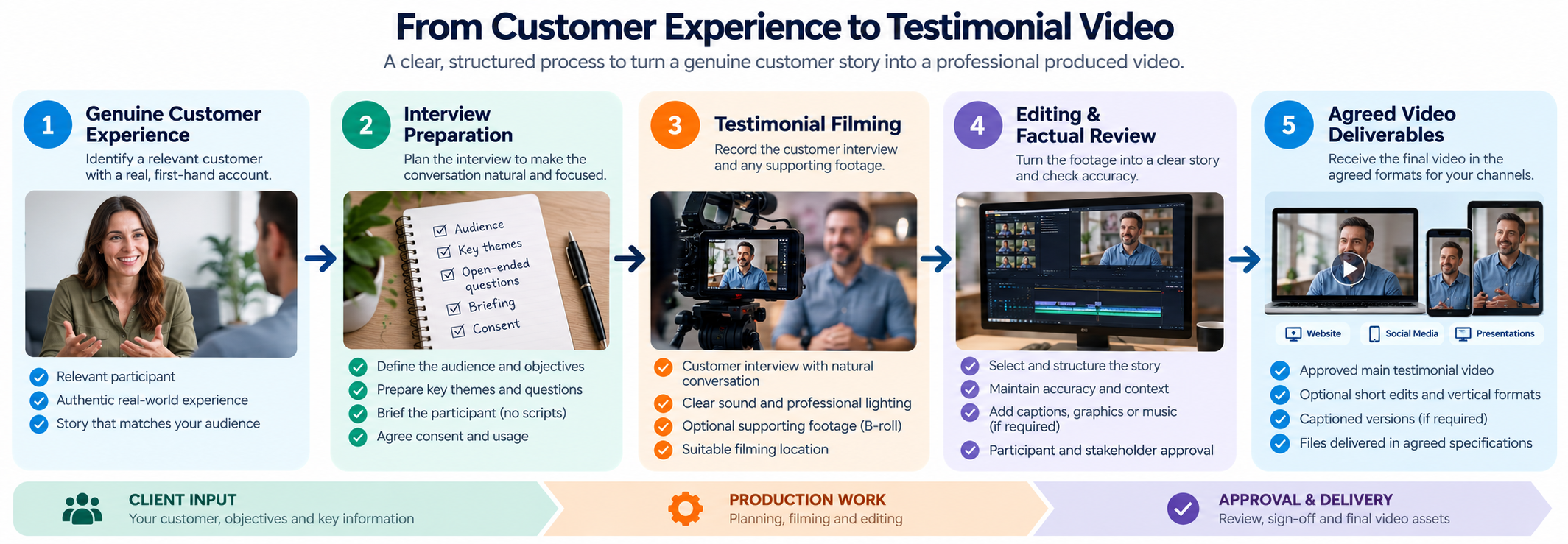
How Testimonial Video Production Works
A well-organised production connects the business objective, the customer’s experience and the final video requirements. The stages below describe a practical framework; the precise activities and responsibilities should be established in the agreed project brief.
1. Define the Audience and Objective
Begin by identifying who will watch the video and what they need to understand. A testimonial for a service landing page may need to address a particular buying concern, while a film for a sales presentation may require more background about the customer’s situation.
Decide which customer experience is relevant, how the video will be distributed and what information is essential. These decisions help avoid collecting large amounts of interview material without a clear editorial purpose.
2. Prepare the Interview and Filming Plan
Confirm the participant, discuss broad interview themes and review practical arrangements. Consider location access, privacy, sound conditions, relevant supporting footage and any restrictions on filming.
Agree which parties need to approve participation, factual statements and publication. If several organisations are involved, a clear approval route can prevent conflicting instructions after editing has started.
3. Record the Customer Interview
The filming stage should give the participant enough room to explain their experience in their own words. Follow-up questions can clarify context or explore details that a viewer may find useful.
Where included in the scope, additional footage can be recorded to support the account. The filming plan should balance visual requirements with the participant’s availability and the practical limitations of the location.
4. Develop the Edit
Post-production turns recorded material into a structured story. The editor considers which statements belong together, what context must be retained and where supporting footage improves comprehension.
Editing should remove unnecessary repetition without distorting meaning. A statement that depends on a qualification should not be presented as an unconditional endorsement simply because the shorter version sounds stronger.
Sound, captions, graphics and alternative versions may then be prepared according to the agreed deliverables.
5. Review, Approve and Deliver
The review stage should check factual accuracy, names, terminology, branding and the intended use of the customer’s statements. Where the participant or their organisation has approval rights, these should be handled through the agreed process.
Once the relevant approvals and revisions are complete, the finished files can be prepared in the specified formats. The quotation should identify what constitutes final delivery and whether any additional assets are included.
Ready to plan your customer interview? Share the number of participants, likely filming locations and intended use through the enquiry form at the top of this page. These details will help define a suitable production brief.
Testimonial Video Formats and Deliverables
A customer interview can provide material for several different types of video, but each version should have a clear purpose. A long-form testimonial, a concise landing-page edit and a vertical social clip are not interchangeable simply because they originate from the same recording.
Main Customer Testimonial Video
The main edit generally provides enough context for a viewer to understand who is speaking, what experience they are describing and why it is relevant. The appropriate length depends on the complexity of the story and the attention required to communicate it clearly.
For a straightforward service experience, a concise film may be sufficient. A technically involved B2B decision may need additional explanation, particularly if the viewer must understand the original requirements before the customer’s comments become meaningful.
Short Testimonial Edits
Shorter versions can focus on one relevant question or experience. They may be suitable for a landing page, campaign or sales communication where viewers already have some context.
The main editorial challenge is retaining enough meaning. A short clip should not remove the conditions or explanations that make the customer’s statement accurate.
Vertical Video for Social Channels
Vertical versions can suit mobile-first distribution, but they benefit from advance planning. Interview framing, supporting footage, text placement and captions all need to remain usable within a narrower composition.
Reframing a wide video after filming may be possible, but it can reduce flexibility. If vertical distribution is important, it should be included in the original brief.
Captioned and Alternative Versions
Captions can make dialogue accessible to more viewers and help people follow a video when audio is unavailable or switched off. Accurate transcription matters, particularly for customer names, specialist terms and technical descriptions.
Alternative versions may also require different opening sequences, aspect ratios, branding or file specifications. Each should be defined as a deliverable rather than assumed to be part of the main edit.
| Video format | Potential use | Editorial consideration | Scope consideration |
|---|---|---|---|
| Main testimonial film | Service pages, customer stories and presentations. | Enough background to understand the experience. | Agree the narrative focus and final file specification. |
| Short testimonial edit | Landing pages, campaigns and sales materials. | One clear point that remains accurate without the full interview. | Confirm the number and purpose of separate edits. |
| Vertical social video | Mobile-first social platforms. | Framing, pace, captions and safe text placement. | Plan the aspect ratio before filming where possible. |
| Captioned version | Accessible and sound-off viewing. | Accurate wording, timing and terminology. | Agree caption format and language requirements. |
| Presentation version | Sales meetings, events and business presentations. | Suitable opening, context and viewing environment. | Confirm resolution, duration and any branding changes. |
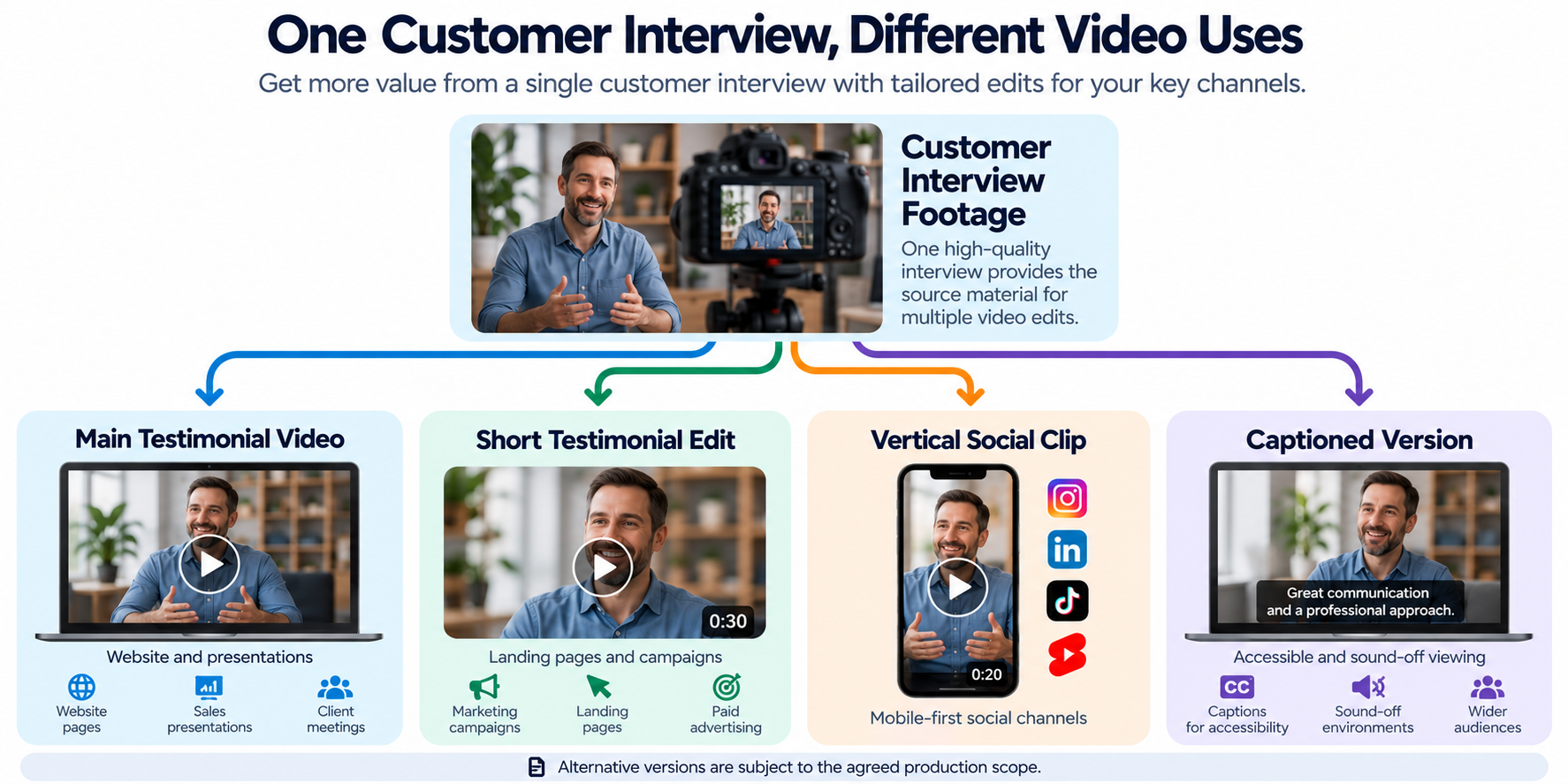
Choosing the right formats at the outset can make the production brief more accurate and reduce the risk of commissioning footage that is difficult to adapt later.
Testimonial Videos vs Customer Case Study Videos
The terms customer testimonial video and customer case study video are sometimes used interchangeably, but they can describe different levels of storytelling.
A testimonial is usually led by the customer’s own perspective. It may focus on why they chose a business, what the relationship was like or how they experienced a particular product or service.
A case study often develops a broader narrative. It may need to explain the original challenge, the work undertaken, relevant technical details and substantiated outcomes. This can involve additional interviews, documents, locations or supporting footage.
For example, a professional services firm might use a short testimonial to explain how a customer experienced its communication and support. A longer case-study film might be more suitable if prospective clients need to understand a complex engagement, the decisions made and the evidence behind its outcome.
The practical choice depends on the viewer’s information needs. If the central question is “What was it like working with this company?”, an interview-led testimonial may be enough. If the question is “How was this complex problem addressed?”, a developed case study may be more appropriate.
The formats can overlap. A strong case study may contain a genuine testimonial, and a testimonial may include useful project context. The production scope should reflect the story rather than the label alone.
Testimonial Video Production Cost in the UK
Prime Lion Digital testimonial video production starts from £1,500. This is a starting price, not a fixed quotation for every interview or a promise that all possible production activities and deliverables are included.
The cost of video testimonial production depends on what must be planned, recorded, edited and delivered. A single participant in one suitable location generally presents a different production requirement from several customer interviews across multiple sites.
What Affects the Price?
Filming arrangements are an important factor. Location access, travel, scheduling and the amount of time required to record interviews or supporting footage all influence the work involved.
Post-production can also vary significantly. A single coherent edit is different from a package of separately structured versions, captioned files, additional graphics or outputs prepared for several distribution channels.
Customer and stakeholder approvals should be considered early. A project involving several organisations may require a more involved review process than one approved by a single decision-maker.
| Cost factor | What can change | Information to provide |
|---|---|---|
| Number of customers | Interview preparation, recording and editing workload. | How many people will appear, and what will each discuss? |
| Filming locations | Travel, access, setup and scheduling requirements. | Where are the participants and relevant environments located? |
| Supporting footage | Additional filming and editorial planning. | Which products, activities or locations should be shown? |
| Story complexity | Interview depth, factual review and narrative development. | Is this a simple experience or a detailed business case? |
| Editing requirements | Amount of material, graphics, sound work and review. | What should the finished video explain and contain? |
| Alternative versions | Separate edits, aspect ratios, captions and exports. | Which channels and formats are required? |
| Approvals and deadlines | Coordination, review stages and scheduling constraints. | Who must approve the content, and when is it needed? |
How to Request an Accurate Quotation
You do not need a completed script to enquire. A useful initial brief should identify the business, the customer experience you want to feature, the likely number of participants, their locations and where you intend to use the video.
It also helps to explain whether you need one main testimonial or several versions, whether supporting footage is important and whether a particular publication date must be considered.
These details allow the proposed scope and final price to be discussed more meaningfully. Any filming arrangements, editing outputs, review stages, usage permissions and additional costs should be confirmed in the quotation and agreed terms.
Choosing a Testimonial Video Production Company
Tell us a little about what you’re looking for, and our team will be in touch to discuss how we can help.
When comparing a testimonial video production company, it is worth looking beyond a polished showreel. A provider may be capable of attractive commercial filming without demonstrating the particular skills required to guide an unscripted customer interview.
The central question is whether the proposed approach will help your customer communicate a genuine experience clearly and accurately.
Useful questions to ask a production provider include:
- Interview approach: How will the conversation be prepared without scripting the customer’s opinion?
- Relevant examples: Can the provider show actual interview-led customer stories, rather than unrelated adverts?
- Production planning: How will location, sound, participant availability and supporting footage be assessed?
- Editorial accuracy: How will statements be reviewed to ensure that the edit preserves their meaning?
- Deliverables: Which final videos, captions, formats and file specifications are included?
- Approvals: Who is responsible for customer consent, factual checks and final sign-off?
- Commercial clarity: What is included in the quotation, and what could lead to additional charges?
A credible quotation should make these responsibilities understandable. It should also explain the difference between a straightforward customer interview and a more complex story involving several contributors, locations or outputs.
For Prime Lion Digital, the starting point is to define the intended audience, the customer’s relevant experience and the production requirements before agreeing the project scope. The objective is a video that communicates the customer’s account effectively, without replacing their own perspective with manufactured praise.
Frequently Asked Questions About Testimonial Video Production
What is customer testimonial video production?
Customer testimonial video production involves creating a film in which a real customer discusses their experience of a business, service or product. The work may include interview planning, filming, supporting footage, editing and preparation of the agreed final video. The strongest testimonials help viewers understand a relevant experience rather than simply presenting general compliments.
How much does testimonial video production cost?
Prime Lion Digital testimonial video production starts from £1,500. The final quotation depends on factors such as the number of customers, filming locations, production arrangements, editing complexity and requested video versions. The starting price should not be interpreted as a fixed all-inclusive package. A project brief is needed to establish the precise scope.
Do customers need to memorise a script?
Not necessarily. A natural customer interview can be organised around discussion topics and open-ended questions rather than a memorised script. Participants may benefit from knowing the broad subjects in advance, but their answers should reflect their own experience. The most appropriate preparation depends on the participant, the story and the intended format.
What if our customer is nervous about appearing on camera?
Some customers are comfortable speaking about their experience but unfamiliar with filming. Explaining the arrangements, allowing time for questions and using a conversational interview approach may help. It is important not to pressure someone into making statements or appearing in a video they do not want to participate in. Consent and practical comfort should be considered during planning.
Can several customer testimonials be filmed on the same day?
It may be possible when participants, locations and recording requirements can be coordinated efficiently. However, each interview still needs adequate preparation and time, and supporting footage or travel may affect the schedule. The feasibility and cost should be assessed against the number of contributors and the complexity of the planned production.
Where can testimonial filming take place?
Possible environments include a customer’s premises, a business office or another suitable interview location. The choice should account for access, privacy, background noise, lighting and the relevance of the surroundings to the story. Geographic coverage and specific filming arrangements should be confirmed when requesting a quotation.
How long does it take to produce a testimonial video?
The overall schedule depends on customer availability, interview preparation, filming arrangements, editing requirements and approvals. A project with one participant and a straightforward deliverable may involve fewer dependencies than a multi-location production requiring several reviews. A realistic timeline should be established once the scope and participants are known.
Can we use the testimonial video on social media?
A customer testimonial may be suitable for social media, provided the content, permissions and format support that use. A separate short or vertical edit may be more effective than uploading a longer website video unchanged. If social distribution is important, include the intended platforms and formats in the original brief so the recording and editing can be planned accordingly.
Who is responsible for customer consent and video approval?
The responsibilities should be agreed before filming. They may involve permission to record the participant, agreement about where the video will be published, rights relating to any supporting material and a process for reviewing factual statements. Where the customer represents another organisation, additional approval may be needed. The specific obligations depend on the project and agreed terms.
What is the difference between a customer testimonial and a case study video?
A testimonial generally focuses on the customer’s first-hand experience and perspective. A case study often explains a wider business situation, the work involved and any substantiated outcomes. Both may feature customer interviews, but a case study can require more research, contributors and supporting evidence. The right format depends on what the intended audience needs to understand.
What information should we provide before requesting a quote?
Start with a short description of your business and the customer story you want to tell. Include the approximate number of participants, likely filming locations, intended audience, where the video will be published and any required formats or deadlines. If you already have a customer willing to participate, mention that as well. The details can be refined during project scoping.
Discuss Your Customer Testimonial Video Project
A useful customer testimonial begins with a real experience and a clear reason for sharing it. The production brief then determines how that experience should be filmed, edited and presented to the people who need to hear it.
Prime Lion Digital offers testimonial video production services from £1,500, with project-specific quotations based on the agreed scope.
To get started, tell us who you would like to interview, what their experience could help prospective customers understand, where filming may take place and which finished video formats you need.
Request a testimonial video production quotation using the enquiry form at the top of this page.