Tell us a little about what you’re looking for, and our team will be in touch to discuss how we can help.
Interview Filming Services in London & Across the UK — From £700
Professional interview filming gives businesses a practical way to capture the people, knowledge and experiences behind their organisation. Whether you need an executive interview, a customer conversation, an employee story or a documentary-style discussion, the way an interview is planned and recorded has a direct influence on how confidently the finished material can be used.
Prime Lion Digital provides interview filming services for businesses and organisations in London and across the UK, with projects starting from £700. We help you consider the filming format, location, contributors and intended use of the footage so that the production approach matches your objectives and budget.
From filming an interview with one camera to planning a multi-camera conversation, the right arrangement depends on the people involved, the available space and the final video you want to create. Interview filming can be arranged as a standalone recording project or as part of a wider video production brief, with editing and additional deliverables defined in the quotation.
Interview filming from £700. Tell us where the interview will take place, how many people will appear and what you need to receive afterwards. We can then discuss a suitable approach and provide a project-specific quote.
Professional Interview Filming for Businesses and Organisations
A well-recorded interview can explain a complex service, introduce a business leader, document professional expertise or let a customer describe an experience in their own words. Unlike a scripted promotional video, an interview often relies on the speaker’s natural language, making careful preparation and unobtrusive filming particularly important.
Businesses commission filmed interviews for different purposes. A managing director might explain the company’s direction, a technical specialist might discuss an industry challenge, or a member of staff might describe what it is like to work within an organisation. The recording can also become part of a longer corporate film, training resource or documentary project.
Common Interview Video Applications
- Executive interviews: Leadership messages, company announcements and thought leadership.
- Employee interviews: Recruitment, workplace culture and internal communications.
- Customer interviews: Experiences, case studies and testimonial-style content, where genuine customer participation is available.
- Expert interviews: Educational content, industry commentary and professional insights.
- Documentary interviews: Personal stories, extended conversations and narrative-led productions.
- Event interviews: Conversations with speakers, organisers and attendees during conferences or business events.
Each application places different demands on the production. A short executive statement may require direct eye contact with the lens, while a documentary conversation may feel more natural when the contributor speaks to an interviewer positioned beside the camera.
Interview Filming Styles: Choosing the Right Approach
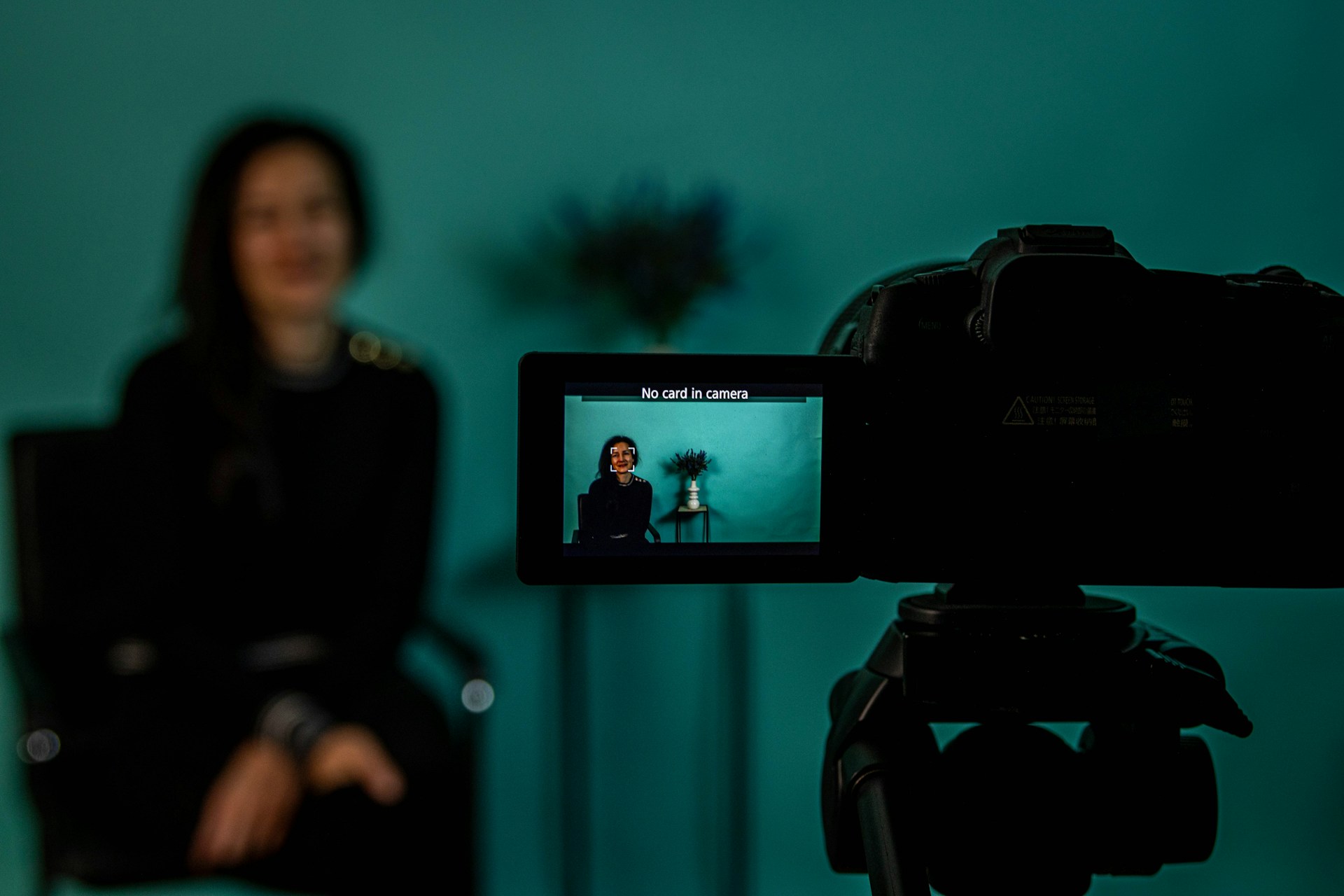 There is no single interview filming style that suits every project. The choice should reflect the intended audience, the personality of the speaker and how the footage will be edited. Understanding different interview filming styles before production helps avoid a recording that looks polished but feels inappropriate for its purpose.
Corporate and Executive Interviews
Corporate interviews often favour a controlled setting, consistent framing and a background that supports the organisation’s identity without distracting from the speaker. A senior executive may address the audience directly or answer questions from someone beside the camera. The first approach can feel authoritative; the second often creates a more conversational tone.
Documentary-Style Interviews
An interview documentary film typically depends on authentic responses and a coherent narrative rather than a sequence of promotional statements. The interviewer may encourage longer answers, follow unexpected details and leave enough time for pauses. Supporting footage can establish context and help connect different parts of the conversation.
Direct-to-Camera and Off-Camera Conversations
Direct-to-camera delivery creates a clear connection with the viewer and can work well for announcements, introductions and training. An off-camera interviewer allows the contributor to concentrate on a person rather than a lens, which may be more comfortable for someone who is not accustomed to filming.
Conversational and Two-Person Formats
Interview style filming can also involve two visible participants. This may suit expert discussions, founder conversations or moderated interviews. These interview shooting styles require additional attention to eyelines, seating positions, sound recording and camera coverage.
| Interview format | Suitable application | Main production consideration |
|---|---|---|
| Direct-to-camera | Leadership messages, announcements and training | Comfort speaking towards the lens |
| Off-camera interview | Executive, customer and employee stories | Interviewer position and natural eyeline |
| Documentary conversation | Personal stories and narrative content | Open-ended answers and editorial continuity |
| Two-person discussion | Expert conversations and moderated interviews | Separate audio and suitable coverage of both speakers |
Interview Filming Examples and Creative Approaches
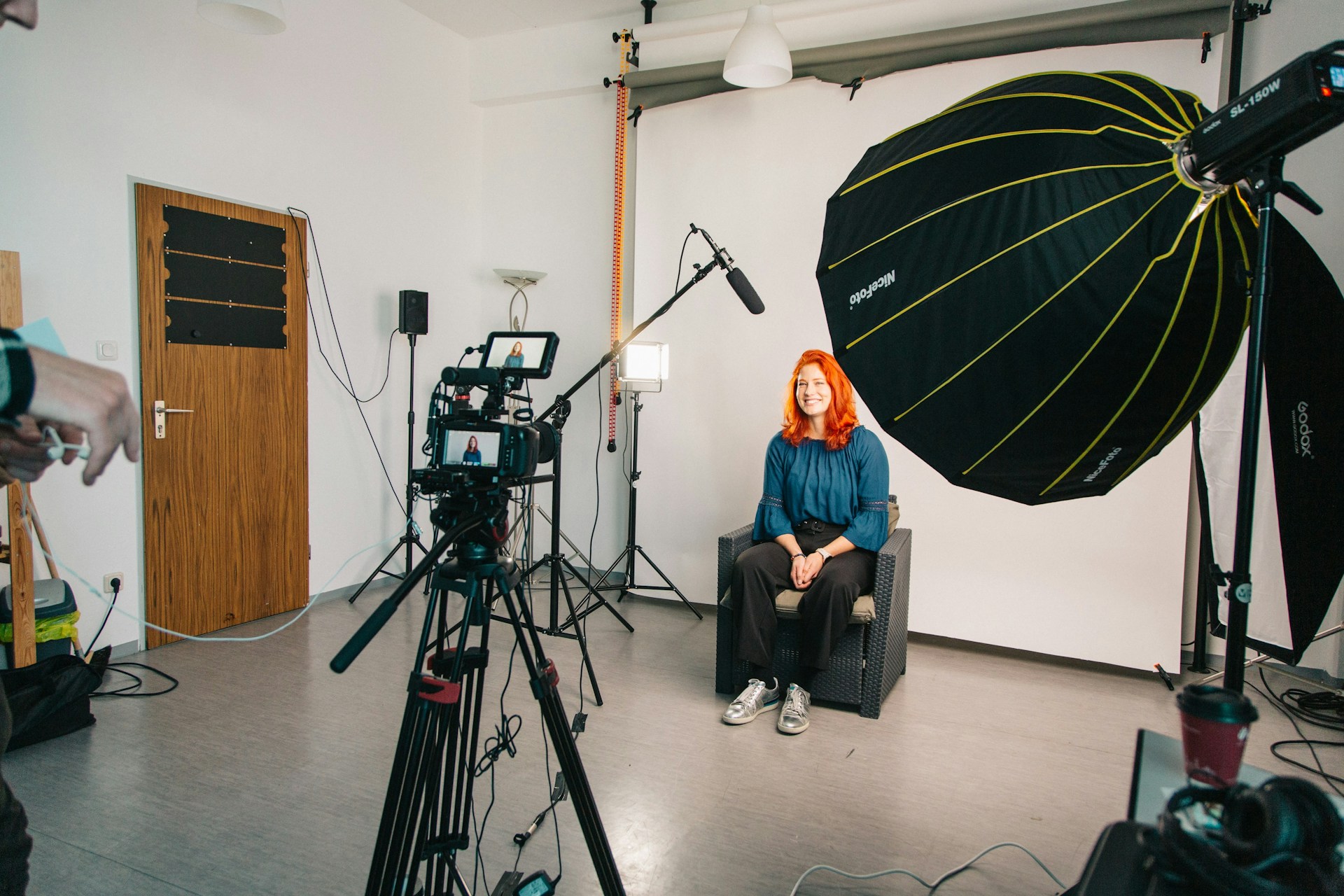 When evaluating interview production, it is useful to look beyond the camera image. A strong example should demonstrate that the speaker can be heard clearly, that the framing remains comfortable throughout the conversation and that any editing preserves the meaning of the answers.
For an executive interview, pay particular attention to the relationship between the speaker and the background. For a customer story, consider whether the conversation feels natural rather than heavily rehearsed. For a documentary-style interview, assess whether the footage allows enough time for a thoughtful answer to develop.
Another important distinction is between a complete interview recording and an edited interview film. A complete recording preserves the conversation, while an edited film may select and arrange responses around a particular message. Both can be useful, but they require different planning and delivery decisions.
One-Camera vs Two-Camera Interview Filming
Camera quantity is one of the most common decisions when arranging professional interview filming. More cameras can provide greater editorial flexibility, but they also affect crew requirements, equipment positioning, lighting and the space needed around the contributor.
Filming an Interview with One Camera
Filming an interview with one camera is often suitable when the brief is straightforward, the location is limited or the client mainly needs a continuous recording. A carefully positioned camera can capture an attractive medium close-up while allowing the contributor to focus on the conversation.
The main limitation is editing flexibility. If an answer needs to be shortened, the cut between two moments recorded from the same position may be noticeable. Supporting footage, graphics or a carefully planned alternative shot can help, but those assets need to be available.
Filming an Interview with Two Cameras
Filming an interview with two cameras makes it possible to capture complementary compositions at the same time. One camera might record a medium shot while the second captures a closer view. This can help the editor move between angles without interrupting the speaker.
A 2 camera set up interview is particularly useful for longer conversations or material that will be condensed into shorter clips. However, it does not automatically solve every coverage problem. Both cameras still need consistent exposure, colour balance and appropriate positioning.
Two-Camera Interview Framing
Good 2 camera interview framing involves more than placing a second camera beside the first. The angles should be sufficiently different to create a meaningful visual change, while remaining consistent with the subject’s eyeline and the direction of the conversation.
Two cameras recording almost identical compositions can add equipment without providing much editing value. In other situations, a second angle may make the difference between a natural-looking edit and a visibly interrupted answer.
| Consideration | One-camera filming | Two-camera filming |
|---|---|---|
| Best suited to | Simple interviews and continuous recordings | Edited interviews and longer conversations |
| Visual coverage | One principal composition | Two simultaneous compositions |
| Editing flexibility | May rely more heavily on B-roll | Allows cuts between complementary angles |
| Location requirements | Generally simpler to accommodate | Requires additional positioning and coordination |
| Production cost | May reduce equipment and crew requirements | May increase equipment, setup or crew costs |
How We Plan an Interview Filming Setup
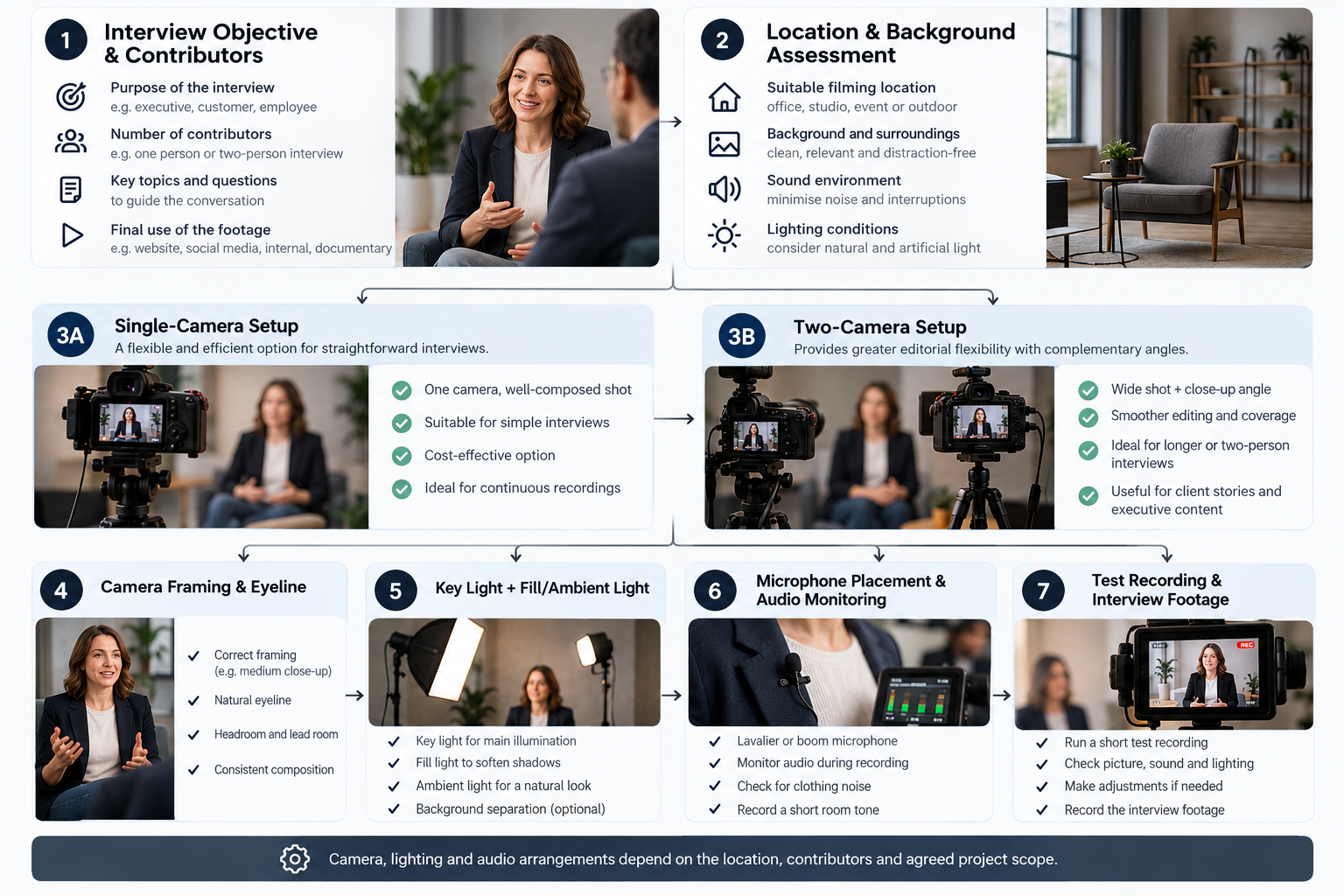
A reliable interview filming setup begins with the purpose of the recording, not with a camera model. The number of contributors, their seating positions, the size of the room and the expected finished video all influence the arrangement.
For a typical interview shoot setup, the camera should provide a comfortable composition while leaving space for the interviewer, lighting and audio equipment. The background should offer visual depth without introducing distracting movement, bright windows or sensitive information.
People searching for an interview filming set up or interview shooting setup often focus on the camera first. In practice, the acoustic environment can be equally important. An attractive meeting room with hard surfaces and loud ventilation may create more production difficulties than a simpler, quieter space.
Preparing the Interview Space
- Identify a quiet area where interruptions can be controlled.
- Check whether windows create strong backlighting or changing exposure.
- Allow enough distance between the speaker and the background.
- Position the interviewer so that the speaker’s eyeline looks natural.
- Check for reflections, confidential documents and distracting branding.
- Test sound and lighting before the main conversation begins.
Interview Filming Angles, Framing and Shot Selection
Interview filming angles affect how a speaker appears to the audience. Eye-level framing is often a practical starting point because it avoids an unnecessarily dominant or diminished perspective. Camera height, distance and lens choice should work together to create a composition that suits the person and the setting.
Interview shooting angles should also respect the direction in which the speaker is looking. When an interviewer sits beside the camera, leaving suitable space in front of the speaker’s face generally produces a more balanced composition.
Common Interview Film Shots
- Medium shot: Shows the speaker with more of the surrounding environment, helping establish context.
- Medium close-up: Places emphasis on facial expression while retaining a comfortable amount of body language.
- Close-up: Can highlight an emotional or particularly important moment when used appropriately.
- Two-shot: Shows both participants and clarifies their relationship within a conversation.
- Cutaway: Provides relevant visual context and may help create smoother edits.
The 180-degree rule is particularly relevant when filming conversations. Maintaining a consistent screen direction helps viewers understand where participants are positioned. Breaking that relationship without a deliberate visual reason can make an otherwise straightforward discussion harder to follow.
Professional Interview Lighting and Sound Recording
Film interview lighting should make the contributor easy to see while preserving the atmosphere appropriate to the project. The most elaborate setup is not necessarily the most suitable. A modest room with controllable lighting can produce a more consistent result than a visually impressive location with rapidly changing daylight.
Key Light, Fill Light and Background Separation
A key light establishes the main direction and character of the illumination. Fill light or ambient light controls how strongly shadows appear. Depending on the location, background or separation lighting may help prevent the speaker from blending into the surroundings.
Mixed colour temperatures can cause difficulties when daylight, ceiling lights and production lights illuminate the same subject. Managing these sources is important for natural skin tones and consistency between camera angles.
Clear Dialogue Is Essential
Professional interview shooting techniques place considerable emphasis on audio. A lavalier microphone can provide discreet dialogue recording, while a boom microphone may be appropriate when the room and framing allow it. The best choice depends on clothing, movement, surrounding noise and the number of speakers.
Microphones should be monitored during recording, not merely checked at the beginning. Clothing noise, mobile phones, ventilation and unexpected interruptions can affect otherwise usable footage. Recording a short sample and listening through headphones is a valuable quality-control step.
Filming a Two-Person Interview
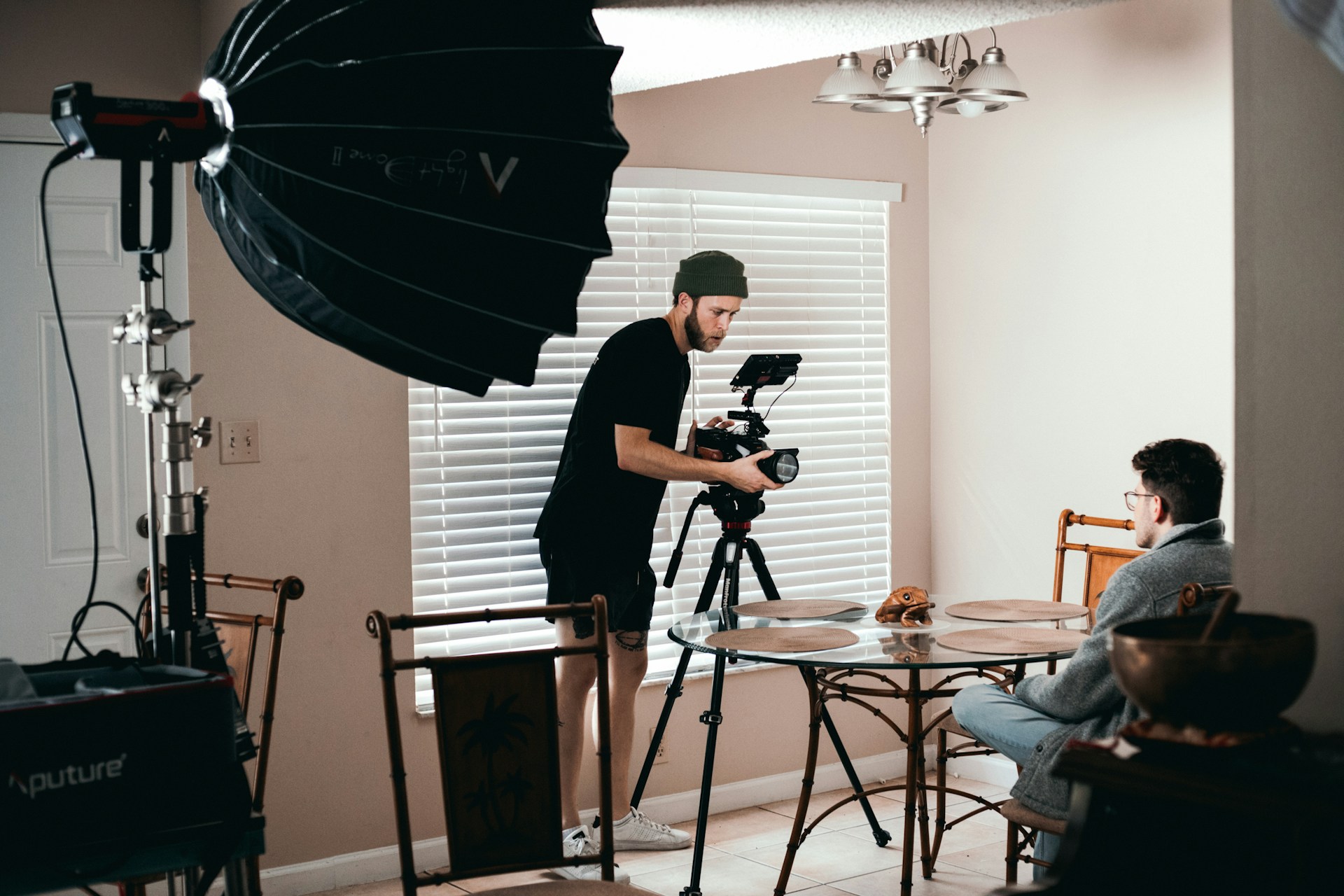 Filming a 2 person interview introduces additional considerations because the viewer needs to understand both participants’ positions and reactions. A conversation may use a shared two-shot, individual views or a combination of both.
For teams considering filming two person interview content, the number of cameras should be selected according to the desired edit. A single wide shot may be enough for an uninterrupted discussion. Two cameras may cover each contributor individually, but capturing both individual close-ups and a simultaneous wide shot can require a third camera or another planned approach.
Each speaker should have suitable audio coverage. Depending on the setup, separate microphones can make it easier to balance dialogue and manage interruptions. Seating positions should also be considered carefully: people need to look comfortable speaking to one another without repeatedly turning away from their microphones or moving outside the planned framing.
Indoor, Outdoor and On-Location Interview Filming
Interview locations influence both the appearance of the footage and the practical work needed to capture it. An office can provide relevant business context, a studio offers greater control, and an outdoor setting may help connect the speaker to a particular place or activity.
Filming interviews outside requires additional planning for wind, traffic, aircraft, changing daylight and weather. A sheltered position, appropriate audio protection and a realistic backup location can be more important than an attractive background alone.
| Location | Advantages | Points to assess |
|---|---|---|
| Office or meeting room | Convenient for contributors and relevant to the business | Noise, reflections, room size and interruptions |
| Production studio | More control over lighting and background | Studio hire, travel and scheduling |
| Outdoor location | Natural environment and location-specific context | Wind, weather, public activity and permissions |
| Conference or event venue | Access to speakers and attendees | Limited time, crowd noise and restricted filming space |
Before booking a location, consider whether the visual setting genuinely helps the message. A quiet, well-prepared room often provides a stronger foundation for an interview than a busy location chosen only for appearance.
Interview Filming Techniques That Improve the Final Video
Effective interview filming techniques help preserve the speaker’s message while making the material easier to edit and watch. They are not simply camera tricks: they involve planning, communication, technical consistency and an understanding of how the footage will be used.
Maintain Consistent Camera and Exposure Settings
When several angles are recorded, matching exposure, white balance and overall colour response makes transitions between shots less distracting. Camera stability and reliable focus are especially important during long answers, when a small technical problem can affect a substantial section of the recording.
Encourage Complete, Self-Contained Answers
One of the most useful filming interview techniques is asking contributors to include the subject of a question in their response. For example, an answer beginning “Our main challenge was…” is easier to use independently than one beginning “Yes, it was.” This matters when questions will not appear in the final edit.
Allow Time for Natural Responses
Good filming interview practice includes allowing the speaker to finish their thought before introducing another question. Short pauses can be valuable, particularly when the interview explores detailed or personal subjects.
Capture Supporting Material with a Clear Purpose
Interview shooting techniques may include relevant workplace scenes, activities, documents or environmental footage. Supporting material should help explain the speaker’s point, rather than merely conceal cuts. A filming plan that identifies likely supporting scenes can make the later edit more coherent.
Our Interview Video Production Process
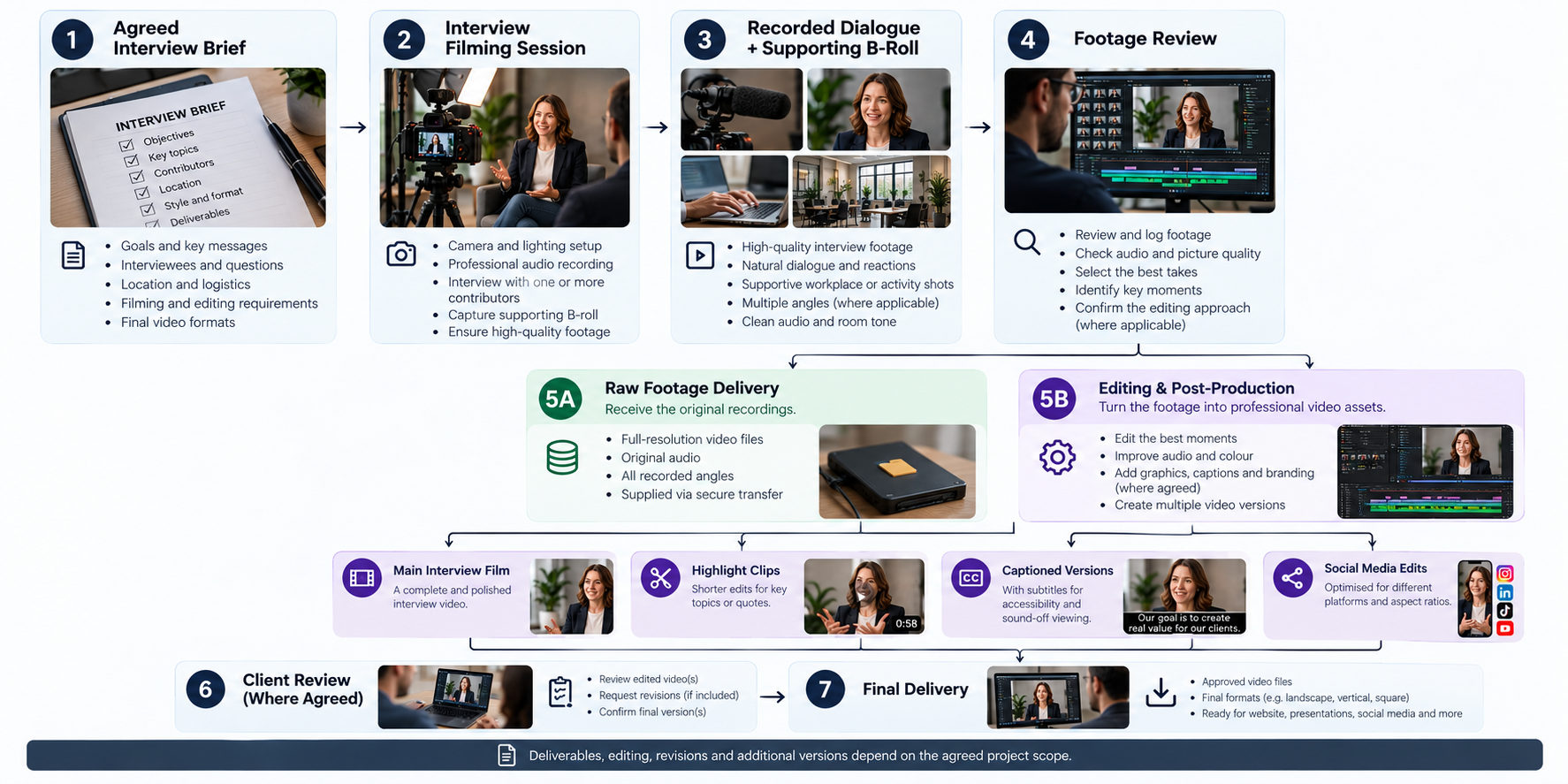
A professional interview project benefits from a defined sequence of decisions, although the exact stages depend on the brief. The following approach illustrates the main production considerations.
1. Objectives and Creative Brief
Establish who will watch the video, what they should understand and where the material will be published. Confirm whether the project requires a full conversation, a concise edited story or several separate pieces of content.
2. Interview and Location Preparation
Identify contributors, discuss questions or themes, assess the proposed space and agree the general visual approach. Preparation should help people feel confident without making their answers sound artificially rehearsed.
3. Camera, Lighting and Audio Planning
Select an appropriate filming configuration based on the location and intended deliverables. This may involve one camera, multiple cameras or specialist arrangements agreed for the project.
4. Interview Filming
Allow time for setup, technical checks, the conversation itself and any supporting footage. A successful filming session should prioritise understandable dialogue, consistent recording quality and the contributor’s ability to speak naturally.
5. Footage Review and Post-Production
Where editing is commissioned, the footage can be reviewed, selected and assembled around the agreed purpose. Audio improvement, colour correction, captions and graphics may be considered according to the required output.
6. Review and Final Delivery
The final files, formats and review arrangements should be defined in the project scope. This helps avoid uncertainty about whether the client is receiving raw recordings, an edited film or additional versions.
Interview Video Editing and Final Deliverables
A filmed interview is a recording asset; a finished interview film is an editorial product. The difference matters when planning a budget and deciding how much material should be captured.
For example, a long conversation may contain several useful topics. An edited version can organise selected responses into a focused narrative, while a shorter social clip may concentrate on one question. Creating those outputs requires decisions about structure, pacing, captions and any supporting visuals.
| Potential deliverable | Purpose | Scope consideration |
|---|---|---|
| Raw interview footage | Retain the original recordings for an agreed use | File format, transfer method and usage rights |
| Full-length edited interview | Present an extended conversation clearly | Camera switching, sound and editorial treatment |
| Interview highlights | Summarise selected points | Content selection and narrative continuity |
| Short social media clips | Focus on individual statements or themes | Separate edits, aspect ratios and captions |
| Captioned versions | Support accessibility and sound-off viewing | Transcription, accuracy review and caption format |
Depending on the agreed project scope, deliverables may include a main interview film, shorter highlights, captioned versions or alternative exports. Additional versions are not automatically included simply because the source footage can support them.
Interview Filming London: Planning Your Shoot
Businesses searching for interview filming london services may need a crew to work at their office, a hired studio, an event venue or another suitable location. London filming requires practical planning around access, travel, building rules, available space and the schedules of contributors.
If you are comparing an interview videographer london service with a larger production arrangement, begin with the outcome rather than the crew size. A simple executive interview may need a relatively compact setup. A multi-person discussion, several locations or a project with substantial supporting footage may justify additional resources.
Office Interview Filming
Office filming can reduce the need for contributors to travel and provide a setting connected to the business. However, meeting rooms are not always designed for recording. Glass walls, air conditioning, open-plan activity and limited space can influence both camera positioning and sound quality.
Studio Interview Filming
A studio may be useful when background consistency, lighting control or repeated interviews are important. Studio hire and any additional facilities should be considered separately when comparing quotations.
Filming Across Greater London and the UK
For projects outside central London, the same principles apply: confirm the location, access arrangements, number of speakers and intended deliverables before finalising the production plan. Travel requirements and the complexity of the filming day may affect the quotation.
Interview Filming Costs in the UK — From £700
Prime Lion Digital interview filming services start from £700. This is a starting price rather than a fixed fee for every interview project. The final quotation depends on the requirements of the recording and the deliverables agreed before production.
A straightforward interview in one location may have different requirements from a multi-camera production involving several contributors, multiple settings or extensive post-production. The cost of editing should be considered alongside filming rather than assumed to be included in every arrangement.
| Cost factor | Why it matters | Information to provide |
|---|---|---|
| Number of contributors | Affects scheduling, audio and filming time | How many people will be interviewed? |
| Camera configuration | Influences coverage, equipment and setup | Is one angle sufficient or are multiple views needed? |
| Location | May affect travel, access and technical preparation | Where will filming take place? |
| Filming duration | Determines how much time is required on location | How many interviews and how long is each expected to last? |
| Editing | Requires footage selection and post-production work | Do you need raw recordings or finished edited videos? |
| Additional versions | May require separate edits, captions and exports | Which platforms and formats will be used? |
To receive an accurate quote, provide the proposed date and location, the number of contributors, an approximate interview duration and examples of the finished style you have in mind. If you need a two-camera setup, supporting footage or multiple edited versions, mention these at the enquiry stage.
How to Film an Interview: Practical Preparation Tips
Understanding how to film an interview can help businesses prepare more effectively, even when they intend to hire a professional videographer. Good preparation reduces avoidable interruptions and allows contributors to concentrate on what they want to say.
Prepare Topics Rather Than Memorised Speeches
One of the most useful interview filming tips is to prepare a small set of themes and questions instead of asking contributors to memorise long answers. People often sound more convincing when they can explain a subject in their own words.
Choose Clothing That Works on Camera
Simple clothing with minimal distracting patterns is often easier to film. Consider how the outfit contrasts with the background and whether accessories might interfere with microphone placement.
Allow Enough Time
Do not schedule the interview so tightly that technical setup, a short rehearsal or a repeated answer becomes a problem. Contributors may need a few minutes to become comfortable speaking on camera.
Reduce Distractions
Turn off unnecessary notifications, check the room for background conversations and arrange for colleagues to avoid entering during recording. These straightforward video interview filming tips can prevent avoidable retakes.
Think About the Finished Edit
Useful tips for filming an interview include asking open questions, allowing complete answers and identifying relevant supporting scenes. The goal is not simply to record a conversation but to capture material that can serve the intended audience.
Frequently Asked Questions About Interview Filming
How much does professional interview filming cost in London?
Prime Lion Digital interview filming starts from £700. The final price depends on the location, number of contributors, camera configuration, filming requirements and whether editing or additional deliverables are commissioned. A project-specific quotation will clarify the agreed scope.
What is included in an interview filming service?
The scope is determined by the quotation. Professional interview filming generally involves planning the recording, preparing the location and capturing the conversation using an appropriate camera and audio arrangement. Editing, raw footage delivery, captions and extra versions should be discussed separately rather than assumed to be included.
Is one camera enough for a professional interview?
Yes. A single camera can be suitable for an executive message, straightforward interview or continuous recording. The main limitation is reduced flexibility when shortening answers. If the finished film requires frequent editorial cuts, a second angle or relevant supporting footage may be useful.
When should we use a two-camera interview setup?
Two cameras are worth considering when the interview will be heavily edited, when a long conversation needs visual variety or when simultaneous wide and close views are important. The decision should also account for room size, equipment positioning and production budget.
Can you film an interview with two people?
A two-person interview can be planned with a shared composition, separate camera angles or a combination of views. The appropriate setup depends on whether both contributors need to appear simultaneously and how the conversation will be edited. Separate audio coverage is also an important consideration.
How much space is needed for an interview filming setup?
There is no universal minimum room size. The required space depends on camera distance, framing, lighting, background separation and the number of people involved. Sharing photographs or a short description of the room before filming can help assess whether the proposed arrangement is practical.
Can interviews be filmed outside?
Yes, but outdoor interviews require attention to wind, surrounding noise, changing daylight, weather and any necessary location permissions. A backup indoor location may be advisable when the recording date is important.
How should we prepare someone who is nervous on camera?
Give the contributor an overview of the topics in advance, allow time for a relaxed introduction and avoid expecting a perfect first answer. An off-camera interviewer and conversational questions can help. Short pauses and repeated answers are normal parts of many interview recordings.
Can a filmed interview be edited into shorter social media videos?
Yes, provided the recording contains suitable material and the required edits are included in the agreed scope. Short clips may need separate selections, captions, framing and export formats. It is helpful to identify the intended platforms before filming.
What information do you need to quote for interview filming?
Share the proposed location and date, number of interviewees, approximate recording duration, preferred visual style and intended use of the finished footage. Explain whether you need filming only, an edited interview or multiple versions. These details help determine a suitable production approach.
Related Video Production Services
Interview footage can also support wider marketing activity. If you are developing promotional content alongside your interview project, explore our video ads production services. For interview-led educational content intended for a channel, our YouTube video production services may also be relevant.
These are distinct production requirements. A corporate interview, a paid advertisement and a YouTube programme may share source footage, but each format needs its own editorial and delivery decisions.
Book Professional Interview Filming in London or Across the UK
Need a professional interview videographer or a filming arrangement for several contributors? Prime Lion Digital can discuss your project, assess the practical requirements and prepare a quotation based on the recording and deliverables you need.
Interview filming starts from £700. To get started, use the enquiry form at the top of this page and tell us your filming location, preferred date, number of speakers and whether you need raw footage, editing or additional video versions.
Clear objectives and a well-defined brief are the starting point for an interview that looks professional, sounds natural and provides material suited to its intended purpose.