
Leave your details and our team will get back to you shortly to discuss your website, SEO or digital growth project.
Custom Ecommerce Development for Businesses That Have Outgrown Standard Platforms
Standard ecommerce platforms are the right choice for many businesses. Problems begin when the business has to keep changing the way it operates simply to accommodate the software.
Prime Lion Digital provides custom ecommerce development for UK businesses that need more control over product logic, pricing, customer accounts, integrations, checkout, order handling or the wider systems behind the storefront. Sometimes that means extending Shopify or WooCommerce. Sometimes it means connecting ecommerce with an ERP, CRM, PIM or fulfilment platform. In more complex cases, it means developing functionality specifically around the way the business works.
The objective is not to make an ecommerce platform bespoke for the sake of it. It is to determine where established functionality remains perfectly suitable, where it can be extended, and where custom engineering solves a genuine commercial or operational constraint.
Tell us what your current ecommerce setup is struggling to handle. We can help determine whether the right answer is configuration, integration, platform extension or custom development.
When Standard Ecommerce Functionality Starts Working Against the Business
The point at which an ecommerce business needs custom development is rarely marked by one dramatic technical failure. More often, friction accumulates gradually.
Staff start exporting orders into spreadsheets because systems do not communicate properly. Trade prices are calculated outside the website. Product information has to be copied between platforms. Stock needs manual checking. An important customer has a purchasing process the ecommerce platform cannot represent without several exceptions.
None of those issues may justify a major development project on its own. Together, they can create a business that is growing commercially while becoming harder to operate.
Manual Workarounds Become Part of the Process
A manual task is not automatically a problem. Some exceptions occur so rarely that automating them would cost more than handling them manually.
The economics change when the same work is repeated every day. If employees are continually moving order data between systems, updating prices in several places or checking information that should already agree, the business is paying for a technology gap through staff time.
Custom ecommerce development can remove that friction where the underlying rules are stable enough to automate.
Apps and Plugins Start Creating Technical Debt
Third-party extensions are often the quickest and most sensible way to add functionality. We use established platform capabilities where they solve the requirement properly.
But stores can reach a point where one plugin modifies pricing, another changes checkout, another controls subscriptions, several inject tracking scripts, and nobody is entirely sure which component is responsible when something stops working.
Adding another extension at that stage can make the immediate problem disappear while increasing the long-term maintenance problem.
Commercial Rules Become More Complex Than the Platform
Real ecommerce businesses do not always fit the simple relationship of one product, one price and one checkout route.
A manufacturer may calculate price from dimensions and materials. A B2B distributor may have customer-specific pricing, volume breaks and different payment terms. Products may have compatibility rules. Certain orders may require approval before they can proceed.
When those rules are important to the way revenue is generated, they should be represented consistently in the ecommerce system rather than reconstructed manually around it.
Growth Exposes Problems That Were Previously Manageable
A workflow that works at 20 orders a day may become painful at 200. The same applies to catalogue management, stock synchronisation, returns, supplier updates and fulfilment.
At that point the question is no longer simply whether the storefront works. It is whether the wider ecommerce operation can continue growing without administration, errors and technical fragility growing with it.
What Custom Ecommerce Development Actually Means
Custom ecommerce development does not necessarily mean building an entire commerce platform from scratch.
In many projects, that would be unnecessary.
A reliable payment provider does not need to be recreated because the business has unusual product logic. WooCommerce does not need replacing because an ERP integration is required. Shopify does not automatically become unsuitable because part of an ordering workflow is specialised.
The more useful architectural question is:
Which parts of the ecommerce environment are standard business requirements, and which parts genuinely need business-specific logic?
That distinction affects cost, development time and long-term technical ownership. Every piece of proprietary functionality creates something the business will need to test, maintain and potentially adapt later. Custom development should earn that responsibility by solving a problem worth owning.
Configure, Extend, Integrate or Build?
Before writing custom code, we usually consider four routes. They are not mutually exclusive; a well-designed ecommerce project may use all four in different parts of the same system.
Configure What Already Exists
If the ecommerce platform already supports a requirement reliably, configuration is normally preferable to rebuilding it. It is usually quicker, less expensive and easier to maintain.
There is little commercial value in recreating a mature standard feature simply so the project can be described as bespoke.
Extend the Platform Where Necessary
The core platform may be suitable while one part of the operation needs additional logic. That can be handled through a custom module, application or carefully scoped extension without replacing the broader ecommerce environment.
This is common with pricing rules, customer accounts, product configuration and operational workflows.
Integrate Systems That Already Perform the Job
If an ERP already controls inventory, a PIM already manages product data or a CRM already owns part of the customer lifecycle, duplicating that functionality inside ecommerce can create conflicting records.
Integration is often the cleaner answer.
Our API integration services can form part of a wider ecommerce project where business systems need to exchange information reliably rather than operate as isolated platforms.
Build the Functionality the Business Cannot Buy Sensibly
Custom development becomes appropriate when an important requirement cannot be handled properly through configuration, an established extension or a dependable integration.
That might be a rules-based product configurator, unusual trade-order workflow, dynamic pricing engine, customer purchasing portal or an operational layer coordinating several systems.
The question is not whether the feature can be developed. Most things can. The question is whether building and owning it is commercially justified.
Where the correct technical direction is not yet clear, our ecommerce consulting work can help clarify platform, architecture and operational priorities before a larger development commitment is made.
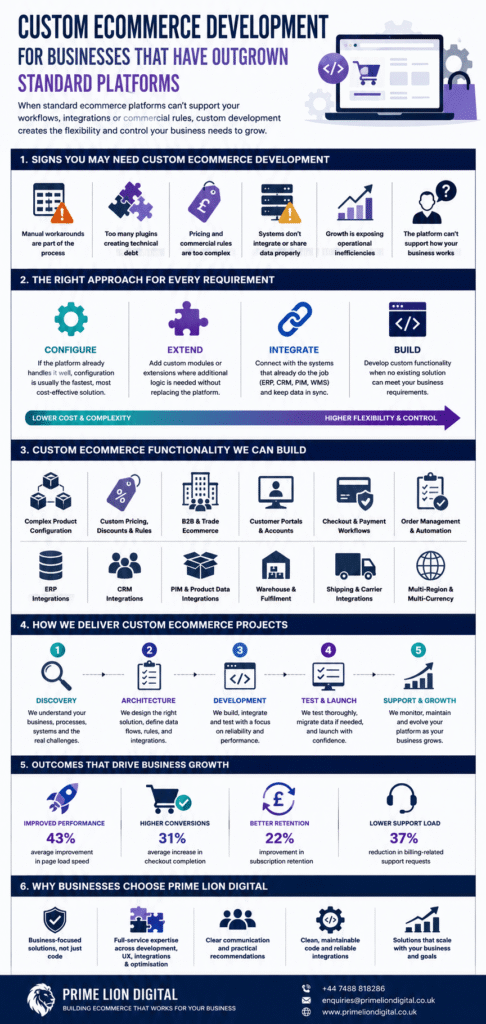
Custom Ecommerce Functionality Built Around Real Business Requirements
The scope of custom ecommerce development services differs considerably between projects because the business logic is usually the part that makes the requirement custom.
Complex Product Configuration
Some products cannot be represented cleanly through conventional variations.
Customers may need to select dimensions, materials, components or options that depend on previous choices. Certain combinations may be invalid. Prices may need to change during configuration.
We can develop rules that guide the customer through those decisions and carry the final configuration into the basket, order and operational workflow. That final part matters. A configurator is of limited value if staff later have to interpret the order manually before it can be fulfilled.
Custom Pricing, Discounts and Commercial Rules
Pricing can depend on customer type, contract terms, quantity, location, configuration or purchasing history.
When several rules can apply to the same transaction, the system also needs a clear hierarchy. If a trade customer qualifies for contract pricing, a volume discount and a campaign promotion simultaneously, someone has to decide which rule wins before a developer can automate it.
B2B and Trade Ecommerce
B2B ecommerce frequently requires more than placing products behind a login.
Company accounts may contain multiple users with different purchasing permissions. Customers can have negotiated price lists, payment terms, approved products, purchase-order requirements or internal approval processes.
The strongest B2B systems reflect those commercial relationships without making them difficult for internal teams to administer.
Customer Portals and Account Functionality
Customer accounts can extend beyond order history and address management. Depending on the business model, users may need access to contract pricing, quotations, previous configurations, invoices, documents, subscriptions or account-specific products.
The important distinction is between functionality customers genuinely need and an account area filled with features simply because they are technically possible.
Checkout and Payment Workflows
Not every ecommerce transaction ends with an immediate card payment.
Some orders need approval. Some customers buy on account. High-value purchases may involve finance or quotation stages. Complex products may need validation before an order can be accepted.
Custom checkout logic can accommodate those requirements while keeping ordinary purchasing routes as simple as possible.
Order Management, Fulfilment and Automation
An order may need to be split between warehouses, routed to a specialist supplier, paused for approval or handled differently according to customer, location or product type.
Where those decisions follow predictable rules, automation can reduce repetitive checks and help teams manage higher order volumes without adding the same proportion of administrative work.
Connecting Ecommerce With the Rest of the Business
 An online store becomes far more complex once it is part of a wider operational environment.
ERP platforms, CRM systems, product databases, warehouse software, accounting platforms, carriers and suppliers may all need information from the same transaction. Simply saying that two systems are “integrated” does not tell you whether the resulting operation will be dependable.
An ERP connection, for example, might provide inventory and customer pricing while receiving orders from the website. The project then has to determine which information is required immediately, what can synchronise in the background and what should happen if the ERP is unavailable.
A PIM integration has different responsibilities. It may control product specifications and catalogue information while the ecommerce platform controls merchandising, customer-facing content and transactional behaviour.
Warehouse and fulfilment integrations introduce another set of questions: whether stock is physically available, reserved, allocated to another channel or held at a different location.
Those distinctions are more important than the fact that an API exists.
The Question Every Integration Should Answer: Which System Owns the Data?
One of the most common causes of integration problems is allowing several systems to behave as though they are all authoritative.
Suppose inventory exists in an ERP, ecommerce platform and warehouse system. If each application can independently change the number, even technically successful synchronisation can produce unreliable stock.
The same issue appears with customer records, prices, product information and order status.
Before connecting systems, we establish where important information originates, where it can legitimately change and which platforms should consume it. Sometimes the answer is straightforward. Sometimes different parts of the same record have different owners.
This is not a glamorous part of ecommerce development, but it has a major influence on how manageable the system remains after launch.
Custom Ecommerce Architecture Has to Handle Failure Too
A system that works only when every external service responds perfectly is not production-ready.
APIs become unavailable. Supplier feeds arrive late. Data is incomplete. The same request is occasionally sent twice. A warehouse system may be offline while customers are still placing orders.
The correct response depends on the commercial consequence.
If an ERP is temporarily unavailable, should checkout stop completely? In some businesses that may be necessary. In others the order can be accepted, queued and synchronised when the connection returns.
Background processing can also prevent customers from waiting for operations that do not need to happen during the request itself. Retry logic can recover from temporary failures, but it has to be designed carefully enough that retrying cannot accidentally create duplicate orders, payments or stock movements.
Validation matters for the same reason. Data arriving through a valid API is not automatically correct data.
And when something does go wrong, useful logging and monitoring should make the failure visible. The commercial benefit is straightforward: less time diagnosing unexplained problems and a lower risk that an important transaction disappears silently between systems.
When Custom Ecommerce Development Is the Wrong Choice
There are plenty of situations where we would not recommend building custom functionality.
If standard Shopify or WooCommerce functionality handles a requirement properly, retaining it normally gives the business a more maintainable solution. A mature third-party product with good support may also make more sense than owning proprietary software for years.
Sometimes the problem is not technical at all. The underlying business process may still be changing, contain too many exceptions or differ between teams. Automating that process too early tends to encode the confusion rather than solve it.
We would rather identify that during discovery than build functionality simply because it appeared in an initial specification.
If the underlying issue is primarily customer journey, product discovery or conversion rather than platform architecture, our ecommerce website design service may be the better starting point.
Different Ecommerce Models Create Different Technical Pressures
A B2C retailer may need stronger merchandising, promotions and fulfilment automation as order volume increases. A B2B operation can have much deeper account, pricing and approval logic. Subscription commerce introduces billing lifecycle, failed-payment and customer self-service requirements.
Multi-vendor models bring seller onboarding, commissions, catalogue governance and order routing into the architecture. Manufacturers often have unusually complex product data or configuration logic. International ecommerce can introduce market-specific catalogues, currencies, fulfilment and commercial rules.
These business models do not automatically require custom software. They do, however, change which parts of the ecommerce environment deserve closer architectural attention.
Building for Scale Without Building for an Imaginary Future
“Scalable” is one of the most overused words in ecommerce development.
A sensible architecture should accommodate credible growth. If a catalogue is expected to move from 1,000 products to 20,000, that affects technical decisions. If additional warehouses are planned, the stock model should not assume there will always be one location. If trade ecommerce is on the commercial roadmap, customer architecture should not make that expansion unnecessarily expensive.
That does not mean every project needs to be engineered for millions of transactions on day one.
Future possibilities with no realistic commercial basis can add development cost and complexity now without ever producing a return. We prefer to preserve sensible routes for growth while keeping the current architecture proportionate to the business it actually serves.
Migrating Existing Ecommerce Systems and Data
Many custom ecommerce projects take place while an existing store is still processing live orders. Migration therefore needs to be treated as part of the development project rather than a final administrative task.
Products, variants, customers, orders, pricing structures and historical records may need to be mapped into a different model. Integrations might change endpoints or responsibilities. Teams can sometimes need a controlled period where old and new processes overlap.
Not every historic record necessarily belongs inside the new operational system. Some data can be archived safely while the new environment begins with a cleaner structure.
Search visibility needs attention as well. If product, collection or category URLs are changing, redirects and technical SEO considerations should be prepared before launch. Migration is much safer when data, operations and search requirements are planned together rather than handled by separate teams at the end.
Security, Performance and Maintainability Are Part of the Architecture
Custom ecommerce functionality becomes part of a commercial system, so maintainability matters just as much as getting the first release working.
Permissions should reflect what users and connected systems genuinely need. Sensitive information should not be exposed simply because an integration requires access to one part of a record. Established payment providers should normally handle payment data rather than increasing the application’s security and compliance responsibility unnecessarily.
Performance also has to be considered beyond the frontend. A beautifully optimised product page can still feel slow if it waits for several external services before anything useful can happen. Where speed or technical instability has become a separate constraint, ecommerce performance optimisation can address bottlenecks across the wider platform.
Maintainable development is often built on less visible decisions: clear code structure, controlled dependencies, useful documentation, sensible logging and an understanding of who owns the custom functionality after launch.
Those decisions rarely feature in a project screenshot. They become much more important a year or two later.
Examples of Ecommerce Development Outcomes
The value of custom ecommerce work should be measured against the commercial or operational constraint it was introduced to remove. The following examples from wider Prime Lion Digital ecommerce development work show the kinds of measurable changes that matter once platform architecture begins affecting day-to-day performance.
Fashion Ecommerce Platform: Catalogue Growth and Inventory Stability
A fashion retailer had expanded from approximately 400 products to more than 3,500 SKUs with multiple colour and size variations. Mobile filtering had become unreliable, inventory synchronisation was failing during promotions and checkout abandonment had increased during seasonal campaigns.
The work included restructuring product architecture, rebuilding filtering logic, optimising database indexing, stabilising inventory API behaviour and introducing more resilient queue handling for stock updates.
Within six months, mobile conversion increased by 34% and checkout abandonment reduced by 27%. Inventory synchronisation became more reliable and the platform handled promotional traffic more consistently. The important outcome was not simply a faster store; the ecommerce operation could support a much larger catalogue without the same level of technical instability.
Electronics Ecommerce: Checkout and Platform Performance Recovery
An electronics ecommerce business was experiencing checkout slowdowns and infrastructure instability when paid campaigns generated traffic spikes.
Prime Lion Digital reduced unnecessary plugin dependency, improved caching logic, introduced Redis object caching, refined checkout AJAX behaviour and optimised database queries.
Over five months, checkout completion improved by 31%, average page load time reduced by 43%, and the active plugin count was reduced from 86 to 44. The platform was also more stable during campaign traffic peaks, reducing the risk that additional marketing spend simply sent more customers into an unreliable checkout.
Subscription Ecommerce: More Reliable Recurring Billing
A subscription ecommerce operation was dealing with recurring billing failures, overloaded queues, delayed webhooks and inconsistent customer-account behaviour.
The subscription architecture was rebuilt, Action Scheduler queues were cleaned up, webhook retry logic was improved and recurring billing workflows were stabilised.
Within five months, successful recurring-payment retention improved by 22% and billing-related customer support requests fell by 37%. Failed renewals also reduced significantly. In commercial terms, improving the underlying technical workflow supported both revenue retention and a lower operational burden on the customer-service team.
Our Custom Ecommerce Development Process
Discovery and Requirements Mapping
We start with the current business process, existing platform and systems involved. Feature requests are useful, but they are not enough on their own. We need to understand why the requirement exists, what happens today and which exceptions the team currently handles manually.
That discovery often identifies requirements that can remain standard, as well as areas where custom work will create genuine value.
Architecture and Technical Specification
Once the problem is understood, we define which responsibilities belong in the ecommerce platform, which remain in existing systems and where custom services or integrations are required.
Data flows, business rules, dependencies and important failure conditions are mapped before significant development starts. The documentation should be proportionate to the project; a small extension does not need enterprise-level ceremony, but complex integrations cannot safely rely on assumptions held in one person’s head.
UX, Development and Integration
Customer-facing functionality needs to make complex business rules understandable without exposing all of the complexity behind them. Product configuration, pricing and B2B workflows should feel clear to the user even when the underlying logic is sophisticated.
Development is then carried out against the agreed requirements, using established platform functionality wherever it remains the stronger choice. External services are connected with appropriate authentication, validation and error handling rather than assuming the ideal API response is the only response that matters.
Testing, Migration and Launch
Testing covers the important customer journeys and the operational journeys behind them. That includes permissions, edge cases, integrations, data exchanges and failure scenarios where relevant.
For replacement or migration projects, launch preparation may also include data validation, redirects, integration switching and rollback planning. A technically complete platform is not ready to launch until the business can operate it safely.
Monitoring and Ongoing Development
Custom functionality needs an owner after launch. APIs change, business rules evolve and new operational requirements appear.
Support can therefore include monitoring, maintenance, optimisation and further ecommerce development as the platform continues to evolve.
How Much Does Custom Ecommerce Development Cost in the UK?
There is no meaningful single price for custom ecommerce development because the phrase can describe projects with completely different levels of technical responsibility.
A focused extension inside an existing ecommerce platform is fundamentally different from developing a customer portal connected to an ERP, inventory environment and complex pricing model.
Cost is usually influenced more by business logic and system complexity than by the number of website pages.
Important factors include the number and quality of integrations, data transformation requirements, custom pricing or product rules, migration, customer-facing UX, permissions, performance expectations, testing depth and the condition of the existing platform.
Technical debt matters too. Adding functionality to a stable, well-structured ecommerce system is different from extending a platform where dependencies are already fragile.
For that reason, we scope custom ecommerce projects after understanding the architecture and operational requirement rather than estimating purely from a feature list.
If you want an initial development estimate, send us the current ecommerce platform, the systems it needs to work with and a description of the process that is causing difficulty.
Why Prime Lion Digital Approaches Custom Ecommerce Differently
Custom ecommerce sits at the intersection of software engineering, customer experience and business operations. Treating only one of those areas seriously tends to create problems elsewhere.
Prime Lion Digital works across ecommerce development services, ecommerce UX, API integration, performance and platform optimisation, which allows us to look at the wider commercial environment before deciding what should be custom.
We want to understand why a workflow exists, which application owns critical information, where staff currently intervene and what the business expects to change over the next few years. Those answers influence architecture far more than a fashionable technology choice.
Just as importantly, we will not recommend proprietary development simply because it increases project scope. Where an established platform feature, dependable extension or simpler integration handles the requirement properly, retaining it can be the better engineering decision.
Custom technology should give a business control where that control has value. It should not create permanent technical responsibility without a good reason.
Custom Ecommerce Development FAQs
What is custom ecommerce development?
Custom ecommerce development involves creating or extending ecommerce functionality around requirements that standard platform configuration cannot handle effectively. It can include business-specific pricing, product logic, customer accounts, integrations, checkout workflows, B2B functionality, automation and operational systems.
How do I know if my business needs custom ecommerce development?
Common signs include repeated manual workarounds, important commercial rules that do not fit the platform, excessive dependence on overlapping extensions or business systems that cannot exchange the information required to operate efficiently. Discovery should confirm whether custom development is justified before significant engineering starts.
Do I need a completely custom ecommerce platform?
Usually not. Many businesses can retain Shopify, WooCommerce or another established platform and customise only the parts that genuinely require different behaviour. Building an entire proprietary commerce platform should have a clear commercial justification.
Can you develop custom functionality for Shopify or WooCommerce?
Yes. Where the underlying platform remains appropriate, custom applications, modules, integrations and supporting services can extend functionality without replacing the entire ecommerce environment.
Can ecommerce integrate with our ERP or CRM?
Yes, where the relevant systems provide suitable integration methods. The important work is establishing which information needs to move, which system owns it, how frequently data should synchronise and how failures or conflicting records should be handled.
Can you build custom B2B ecommerce functionality?
Yes. B2B development can include company accounts, multiple users, customer-specific pricing, product restrictions, quantity rules, quotations, purchase orders, payment terms and approval workflows.
Can you develop a custom product configurator?
Yes. Product configurators can support dependent options, compatibility rules, calculated prices, technical validation and other logic required to sell complex products accurately online.
Can you migrate data from our current ecommerce platform?
Yes. Migration can include products, variants, customers, orders, pricing and other records required by the new environment. The first step is determining what needs to move, what should be transformed and what can remain available as archived history.
Can custom ecommerce development support multiple warehouses?
Yes. The architecture depends on how stock is allocated and which system acts as the authoritative inventory source. Requirements can include location-level availability, reservations, order routing and synchronisation with ERP or warehouse systems.
What happens when an ecommerce integration fails?
That should be decided during architecture rather than discovered after launch. Depending on the process, a failed request may be retried, queued for later processing, surfaced to staff or prevent a particular transaction from continuing. Critical processes should have an explicit failure path.
How is custom ecommerce functionality maintained?
Maintenance depends on the functionality and external services involved. Platform updates, API changes and evolving business rules can all require future work. Clear documentation, monitoring and technical ownership make custom systems considerably easier to maintain.
Can Prime Lion Digital take over an existing custom ecommerce system?
Potentially. We would first review the existing technology, architecture, code quality, dependencies, documentation and infrastructure. Depending on what we find, the sensible route may be continued development, selective refactoring or replacement of particular components rather than rebuilding everything.
How long does custom ecommerce development take?
Timescales depend on scope. A focused platform extension can be relatively contained, while a project involving new business logic, several integrations and data migration requires more discovery, development and testing. A realistic delivery plan can be established once the technical and operational requirements are understood.
Does Your Ecommerce Platform Still Fit the Way Your Business Works?
You do not need to arrive with a finished technical specification.
Often the better starting point is the operational problem: orders that require too much manual work, systems that disagree, trade customers the platform cannot serve properly, product rules that have become unmanageable or years of extensions that have made simple changes unexpectedly risky.
Prime Lion Digital can help identify where the real constraint sits and whether it should be solved through configuration, integration, platform extension or custom ecommerce website development.
Talk to us about the part of your ecommerce operation that is no longer working as it should. From there, we can define what needs to change, what should remain standard and where custom development can create genuine commercial value.