
Web Design for Accountants in UK
Leave your details and our team will get back to you shortly to discuss your website, SEO or digital growth project.
Prime Lion Digital provides web design for accountants and accounting firms across the UK, creating websites around the way professional practices build trust, explain complex services and turn prospective clients into relevant enquiries.
An accounting website has to do considerably more than present services attractively. It may need to support referral validation, compete for organic search visibility, explain technical subjects to non-specialists and guide very different client types towards the right part of the practice. For an established firm, a redesign may also need to preserve years of content, rankings and accumulated search value.
Our approach to accountants website design brings structure, UX, content, technical performance and search considerations together before the visual layer becomes fixed. The objective is a website that reflects how the practice actually works and where it wants to grow.
Accounting Websites Built Around How Practices Win Clients
Two accounting firms can offer similar services and still need very different websites.
A smaller local practice may depend heavily on recommendations and local search. Its website needs to establish credibility quickly, make the people behind the business visible and provide a straightforward route to contact.
A larger accountancy firm can face a different problem. It may serve several sectors, operate across more than one location and provide bookkeeping, payroll, annual accounts, tax compliance and advisory work. At that point, navigation and information architecture matter as much as the visual design.
Specialist practices introduce another layer. An accountant working extensively with ecommerce businesses, property companies, contractors or internationally active clients may need to demonstrate that expertise before a prospect ever speaks to the team.
Good website design for accountants starts with those commercial realities rather than a predetermined page template.
Why Accounting Firms Need a Different Approach to Web Design
Choosing an accountant involves a level of trust that does not exist in many ordinary online purchases. Prospective clients may be sharing financial records, discussing tax liabilities or relying on the practice to deal with important statutory obligations. Before making contact, they want enough evidence to decide whether the firm is credible and relevant to their situation.
There is another difficulty. Accounting practices naturally organise their work around professional services such as Annual Accounts, Corporation Tax, VAT, payroll, bookkeeping, Self Assessment and advisory. Prospective clients do not always think in those categories.
A business owner may search for an accountant who understands construction, help after crossing the VAT registration threshold or support with a particular HMRC issue. Another person may simply want an accountant close to their business.
The website has to bridge the gap between the firm’s professional service structure and the language, problems and priorities of the people searching for help.
That is why web design for accounting firms should involve information architecture and client journeys before detailed page layouts are approved.
Who We Design Accounting Websites For
The appropriate structure depends on the size, positioning and ambitions of the practice. We design and develop websites for:
- independent accountants and sole practitioners;
- small and growing accountancy firms;
- chartered accountants and professional practices;
- tax and accounting firms;
- specialist accountants serving particular sectors or client groups;
- accounting and business advisory firms;
- established practices planning a significant website redesign.
A five-person practice should not be burdened with the architecture of a national firm. Equally, a growing accountancy business should not be locked into a website that becomes difficult to expand as new services, people and locations are added.
What an Effective Accountant Website Needs to Do
A professional appearance matters, but appearance is only part of the job.
An effective accounting website should establish who the practice works with, make its expertise understandable and give a prospective client enough confidence to take the next step. It also needs to accommodate different routes into the business.
A referred prospect may search directly for the firm’s name. Someone else may arrive from Google on a VAT or Corporation Tax page. Another visitor may discover an article first and then investigate the people behind the practice before making contact.
The same website has to support all three.
This creates a balance between credibility, service explanation, organic discoverability, differentiation and enquiry generation. A visually impressive site with weak architecture can be difficult to find. A heavily optimised site with little personality or evidence may attract visitors without convincing them.
Website Architecture for Accounting Firms
Architecture becomes more important as a practice adds services, sectors, content or geographic coverage.
A relatively focused accounting website may only need clear service pages, information about the practice and its people, useful resources and an obvious enquiry route. A more complex firm might require relationships closer to:
Home → Services → Sectors or Client Types → Locations → Insights → Enquiry
That should be treated as a framework, not a template.
Creating sector pages can make sense when an accounting practice genuinely has different experience, services or propositions for construction, ecommerce, property or other industries. Producing numerous near-identical pages simply because keyword variations exist makes the website larger without necessarily making it more useful.
Location pages need the same judgement. A firm with real offices or meaningful regional coverage can justify deeper local architecture. Thin pages produced for dozens of towns with little genuine local relevance are a different matter.
Before design begins, we map how services, audiences, locations and supporting content should relate to one another. It gives the visual design something meaningful to organise.
Designing Around Accounting Services and Search Intent
Accounting websites often inherit the terminology used inside the practice. That language may be technically correct while still being different from the way prospective clients describe their problem.
VAT is a simple example. One visitor may know precisely which VAT service they need. Another only knows that turnover has increased and they are unsure whether registration is now required. The underlying professional work may overlap, but the search intent and information requirement do not.
The same principle applies to Corporation Tax, payroll, bookkeeping, annual accounts and advisory work.
A strong accounting website therefore considers both the formal service structure and the ways people discover those services. It does not mean creating a separate page for every search phrase. Sometimes several closely related intents belong together. Other subjects justify a dedicated service, sector or location page because the user need is materially different.
Those decisions influence navigation, internal linking, content priorities and future organic visibility. They are far easier to make before development than to retrofit after launch.
Building Trust Before the First Conversation
Many accountancy websites describe the practice as professional, reliable, friendly and proactive. Those qualities may be entirely genuine, but the claims themselves give a prospective client little evidence.
Specificity works better.
Identifiable team members, relevant experience, genuine client feedback, qualifications and professional memberships where applicable, specialist sector knowledge and clear explanations of the work provide stronger reasons to trust the firm.
Design should make this evidence visible without turning every page into a collection of badges and testimonials.
There are quieter trust signals too: consistent contact details, secure forms, sensible privacy handling, clear service descriptions and a site that works properly on mobile. Individually they seem small. Together they affect whether a practice feels established and dependable.
This is particularly important for referral-led firms. The recommendation may generate the initial interest, but the website often validates it.
UX and Enquiry Journeys for Accounting Websites
A generic Contact Us button on every page is easy to implement. It is not always enough.
A person arriving on a specialist tax page may need to understand whether the service is relevant before they are ready to speak to anyone. Another visitor may want to see the firm’s people or sector experience first. Someone with an urgent issue may want a much shorter route.
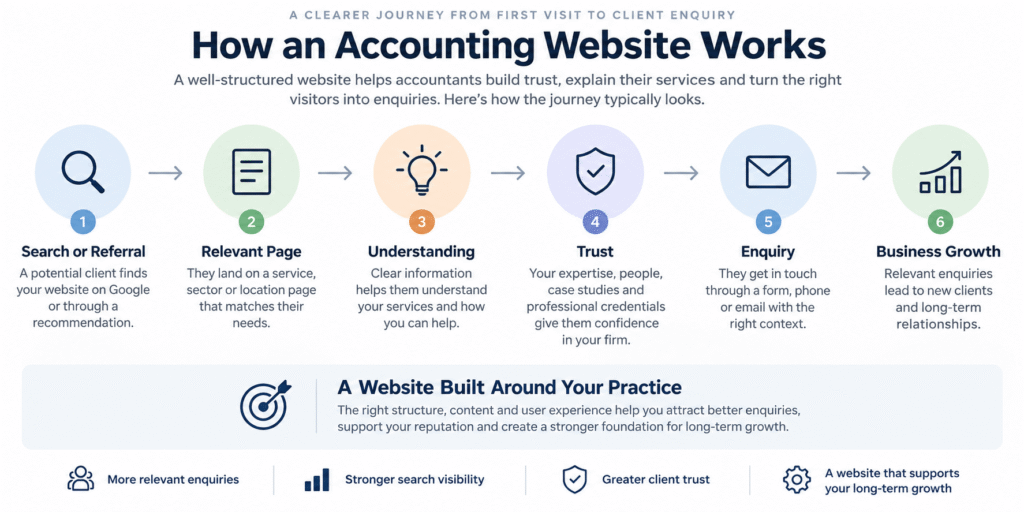
A typical journey can look more like:
Landing page → Understanding → Validation → Relevant service → Enquiry
Forms need similar judgement. Ask too little and the practice receives enquiries with almost no useful context. Ask for excessive detail and legitimate prospects may abandon the form.
If enquiries eventually move into a CRM or internal business system, the website should also collect information that is useful downstream. That avoids creating additional manual work simply because the public website and internal workflow were planned separately.
Mobile Performance, Accessibility and Security
Accounting clients do not only visit websites from office desktops. A recommendation might be checked from a phone, a tax page opened from a search result or an enquiry completed outside normal working hours.
Navigation, typography, forms and important calls to action therefore need to work properly on smaller screens rather than simply shrinking to fit them.
Performance also deserves restraint during design. Oversized imagery, unnecessary scripts and excessive visual effects can make an otherwise professional website slow and frustrating. Accessibility considerations such as readable contrast, logical heading structure, keyboard usability and clear form labels should be part of the build rather than added later.
For a website representing a financial professional, maintenance and security matter too. Software updates, backups, permissions and secure form handling should not become an afterthought once the design has been approved.
SEO Foundations Built Into the Website
A new accounting website should not need structural repair a few months after launch because search visibility was ignored during the design stage.
For accountancy website design, the SEO foundation begins with architecture. Search engines need to understand how services and supporting topics relate, while visitors need to move through those relationships naturally.
Technical considerations include crawlability, indexation, URL structure, internal linking, page hierarchy, metadata capability, structured data where appropriate, mobile usability and performance.
Content structure matters just as much. A firm offering several commercially important services should not expect a single generic Services page to represent all of them equally well in search.
This is the boundary between web design and ongoing SEO. The website should provide a strong technical and structural foundation. Keyword development, content expansion and authority building can then continue without having to fight against the site’s architecture.
Redesigning an Existing Accounting Website Without Losing SEO Value
Redesigning an established accounting website is not the same project as building one for a new practice.
The existing site may already contain pages that rank in Google, backlinks from other organisations, years of articles and URLs that clients or third parties still use. Replacing everything without assessing those assets can remove value that took years to accumulate.
Before migration, existing URLs should be reviewed. Valuable pages need an intentional destination. Content may be preserved, improved, consolidated or retired depending on its search, user and commercial value.
Redirects are important, but they are only one part of migration. Internal links, metadata, canonical signals, tracking, analytics, forms and external integrations can also be affected when the site changes.
And not everything deserves to survive. An old page with no useful traffic, links or business purpose should not automatically be carried into the new website simply because it exists.
The goal is not preservation for its own sake. It is to protect what already contributes value while improving what is holding the website back. For practices unsure whether a complete rebuild is necessary, a review of the existing website and its digital strategy can help establish that before scope is defined.
Custom Accounting Website or Template?
There is nothing inherently wrong with using an accountant website template.
For a newly established sole practitioner with a straightforward service offering, limited budget and little existing search footprint, a well-configured template may be perfectly sensible.
The trade-offs become more noticeable when the business grows. Multiple services, specialist sectors, several locations, substantial content or custom enquiry workflows can eventually leave the practice adapting itself to the template rather than the other way around.
Custom website design for an accounting firm provides greater control over architecture, UX and functionality, but it requires more planning and investment.
The right choice depends on the business case. Custom is not automatically better because it is custom. A template is not automatically inadequate because it is pre-designed.
Our Web Design Process for Accounting Firms
Discovery and Commercial Context
We begin by understanding the practice rather than designing a homepage immediately. Which services matter commercially? Who are the priority clients? How do enquiries currently arrive? What does the existing website do well, and where is it creating friction?
Architecture and Search Planning
Services, sectors, locations and supporting content are organised into a practical hierarchy. On redesign projects, existing URLs and organic performance are considered here rather than shortly before launch.
Content and UX
We define what individual pages need to communicate and how different visitors should move through the site. This avoids the common situation where important content later has to be forced into layouts designed without knowing what the page actually needs to say.
UI Design and Development
The visual system is developed around the practice’s identity and information hierarchy, then translated into a responsive website. Forms, analytics requirements and agreed integrations are built around the user journeys rather than attached as isolated features.
Testing, Migration and Launch
Core journeys are tested across devices and browsers. Forms and integrations are checked, agreed redirects are implemented and analytics or search monitoring should be working when the new site goes live.
Post-Launch Improvement
Once real visitors begin using the site, actual search and behavioural data becomes available. That evidence can guide later improvements far more reliably than assumptions made during the design stage.
What Does an Accountant Website Cost?
The cost of web design for accountants is usually determined by the complexity of the project rather than the profession itself.
A focused website for an independent accountant with a small number of services is fundamentally different from rebuilding an established firm’s digital presence with numerous indexed URLs, multiple service areas, content migration and system integrations.
Scope can be affected by architecture, page volume, custom functionality, content requirements, CRM or booking integrations, migration risk, technical issues in the existing website and the number of people involved in review and approval.
This is why comparing quotations by page count alone can be misleading. One proposal may cover primarily visual design and development. Another may include architecture, migration planning, technical search considerations, content support and post-launch testing.
Understanding what is actually included is more useful than comparing headline numbers without context.
How Long Does an Accounting Website Take?
A smaller site with clear branding, agreed services and content ready to use can move considerably faster than a large redesign.
More complex projects usually involve dependencies: architecture must be agreed before certain content can be finalised; specialist pages may need input from partners; development relies on approved designs; migration work depends on knowing which URLs will change.
Content frequently becomes the unexpected delay. A website can reach an advanced design stage while key service pages are still waiting for technical input or internal approval.
For established sites, migration also needs time for mapping, redirects and quality assurance. Launch should not become a rushed domain switch simply because an arbitrary date was agreed early in the project.
We prefer to identify those dependencies during scoping so the project timetable reflects the work involved.
Accounting Website Projects and Practical Outcomes
Accounting & Consulting Website: Architecture, SEO and Enquiry Growth
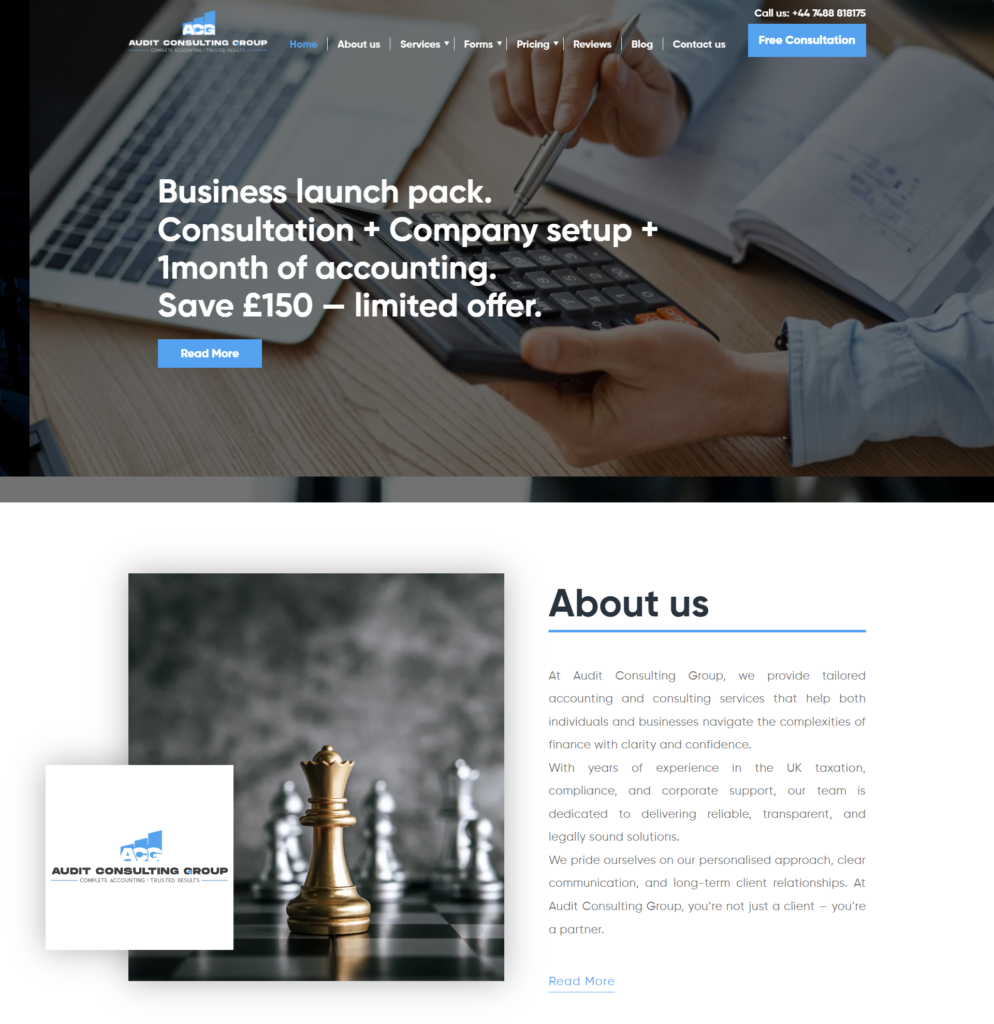
Audit Consulting Group required more than a small brochure website. The business covers a broad range of accounting and tax services, so the site needed enough depth to represent those services individually while keeping the wider structure understandable.
The work combined website architecture, UX, development and search strategy. Service intent was considered as part of the site structure rather than added later as an SEO exercise.
The website subsequently developed into an important client acquisition channel, reaching around 3,000 monthly organic visitors and generating more than 100 website enquiries alongside 30+ telephone enquiries in a month.
The significance is not simply higher traffic. Once a website starts generating enquiries at that level, decisions around service architecture, forms, tracking and internal handling become operational business decisions.
The project can be explored in more detail in our accounting and consulting website design case study.
Connecting Website Enquiries with an Accounting Workflow
As enquiry activity increased within the same accounting business, the next limitation appeared behind the website.
New opportunities needed to be recorded, reviewed and moved through a structured workflow instead of relying on fragmented communication and manual follow-up. A custom CRM and business management system was developed around the firm’s actual internal process.
This was not a reason to turn the website into a CRM. The two systems have different jobs. The value came from designing a clearer handover between acquisition and operations so an enquiry did not simply disappear into an inbox after a successful form submission.
For a growing accountancy practice, this is a useful reminder that website performance should eventually be measured beyond traffic. Enquiry quality, response handling and progression through the firm’s workflow matter too.
Implementation Scenario: Redesigning an Established Accounting Website
An established practice can present a different type of project. The existing site may already have useful rankings, backlinks, service pages and years of indexed tax content, while the design itself has become dated or the navigation no longer reflects the business.
In that situation, rebuilding everything from zero would not automatically be a sensible recommendation. Existing organic landing pages, enquiries, rankings, Core Web Vitals and other relevant baseline data should be recorded before implementation. Valuable URLs can then be retained or mapped carefully while design, usability and technical weaknesses are improved.
The measurable outcome should be judged against that baseline after launch: whether important search visibility has been retained, whether key journeys work more effectively and whether the new website improves the commercial experience without sacrificing assets that were already performing.
This is an implementation scenario rather than a claimed client result. It illustrates why redesign work should begin with evidence rather than an assumption that every existing element needs replacing.
Common Accounting Website Mistakes
Some weaknesses are immediately visible. Others sit inside the structure.
One common mistake is giving every service a short paragraph on a single page. It keeps the site small, but leaves very little room to explain individual services properly or support meaningful organic visibility.
The opposite extreme is excessive expansion: dozens of similar service, sector and location pages created primarily around keyword variations. The website becomes larger without necessarily becoming clearer or more authoritative.
Generic positioning is another problem. If the homepage could belong to almost any accounting firm after changing the logo, it does little to explain why a particular client should choose that practice.
Other weaknesses tend to surface later: enquiry forms collecting the wrong information, mobile navigation becoming unwieldy, important team information hidden several levels deep, outdated tax content remaining live indefinitely or every URL changing during a redesign without a proper migration plan.
These details rarely receive the same attention as a homepage concept. They often have greater long-term consequences.
Choosing a Web Design Agency for Your Accounting Firm
Strong visuals are useful evidence of design ability, but a portfolio alone does not tell you how an agency will handle an established accounting website.
Ask what happens to existing search visibility if the structure changes. Who maps URLs and redirects? How is the service architecture decided? Who owns analytics, the domain and other accounts? Who is responsible for content? How are forms and integrations tested before launch?
For a growing practice, consider the next few years as well. Can new services, locations or specialist sectors be added without rebuilding the site? Can the platform connect sensibly with the systems the firm uses? Is ongoing website maintenance and support available once the initial project is finished?
Sector experience matters when it produces better decisions. An agency offering websites for accountants in the UK should understand why referral validation, professional trust, search architecture, enquiry quality and content migration matter to an accounting practice. Merely placing photographs of calculators and spreadsheets into a generic agency template is not sector expertise.
Where the requirement extends beyond the website itself, the wider digital services for accountants and accounting firms section explains how website development connects with SEO, marketing, branding and business systems.
Frequently Asked Questions
How much does a website for an accountant cost?
Cost depends on the scope of the project, including architecture, content, custom functionality, integrations and whether an existing website needs to be migrated. A small website for an independent accountant and a multi-service accounting firm redesign can therefore have very different budgets. The quotation should make clear whether strategy, content, SEO migration and post-launch support are included.
How long does an accounting website take to build?
A straightforward website can usually progress faster than a complex redesign involving substantial content, integrations and migration. The timetable is influenced by architecture, design, development, content preparation, stakeholder approvals, testing and the condition of the existing website.
Do you provide website design for chartered accountants?
Yes. Website design for chartered accountants should make relevant qualifications, memberships, people and specialist experience easy to verify while keeping the content understandable for clients who may not be familiar with professional terminology.
Can you redesign our existing accounting website?
Yes. Redesign work should begin by assessing what already carries value. Existing pages, organic visibility, backlinks, content, analytics and integrations can all influence what should be retained, improved or migrated.
Will we lose our Google rankings during a website redesign?
A redesign can affect rankings when URLs, content, internal links or architecture change. The objective of migration planning is to reduce unnecessary risk by reviewing important organic landing pages, mapping URL changes and implementing redirects deliberately.
Is SEO included in accountant website design?
The website should be built on a sound SEO foundation, including crawlable architecture, sensible page hierarchy, internal linking, technical performance and migration planning where required. Ongoing SEO strategy and content development are broader activities and can be scoped separately.
Can an accounting website integrate with a CRM?
Yes. Website enquiries can connect with CRM and business systems where there is a clear operational purpose. It is usually better to define what should happen after an enquiry first and then determine which information and automation the integration needs.
Can you migrate content from our existing accounting website?
Yes. Migration should distinguish between content worth preserving, material that requires improvement and pages that no longer have meaningful search, user or commercial value. Existing URLs and organic performance should be reviewed before content is removed or consolidated.
Do accounting firms need custom websites or are templates enough?
Templates can work well for smaller practices with straightforward requirements. Custom design becomes more useful when the firm has complex services, specialist sectors, substantial content, multiple locations, specific integrations or an information architecture that cannot be represented well within a standard template.
Can you support our accounting website after launch?
Yes. Ongoing support can cover maintenance, security, performance, content changes and continued improvement. For a website generating regular enquiries or organic traffic, post-launch maintenance is part of protecting a business asset rather than merely keeping software updated.
Plan a Website Around the Practice You Want to Grow
A new accounting website is an opportunity to solve more than a visual problem. It can clarify how services are presented, make expertise easier to understand, protect or strengthen the foundation for search and improve the route from first visit to enquiry.
Prime Lion Digital combines web design and development, UX, architecture and technical search considerations around the requirements of UK accounting practices. Where an existing website already has value, we start from that evidence rather than assuming everything should be replaced.
If you are considering a new accounting website or a redesign, the useful first step is to review what the current site needs to achieve, what should be preserved and where it is limiting the practice. From there, the scope can be defined around the business problem rather than an arbitrary number of pages.