
B2B Ecommerce Development Built Around How Your Customers Actually Buy
Leave your details and our team will get back to you shortly to discuss your website, SEO or digital growth project.
B2B ecommerce becomes difficult when the platform assumes every customer buys in the same way.
Real trade relationships are rarely that simple. One customer may have negotiated pricing and 30-day terms. Another may require purchase-order approval. A national account might have several buyers, different permissions and multiple delivery locations. A distributor may need pricing, stock and product information to come directly from an ERP or PIM rather than being maintained separately online.
Prime Lion Digital provides B2B ecommerce development for UK manufacturers, wholesalers, distributors and trade businesses that need ecommerce to reflect those commercial realities.
We develop B2B ecommerce platforms, trade portals, account functionality, ordering workflows and integrations around the way customers actually purchase. Before discussing features or platforms, we typically map the company account structure, pricing source and order journey. That exposes the decisions that matter much earlier.
Tell us how your trade customers order today, where the friction sits and which systems are involved. That is usually a better starting point than a feature list.
B2B Ecommerce Is Not B2C With a Trade Login
A conventional consumer ecommerce journey can be relatively simple: an individual finds a product, sees a price, adds it to a basket and pays.
In B2B, the customer may actually be an organisation rather than the person using the website.
That organisation can have negotiated prices, approved products, several delivery locations and employees with different purchasing authority. An order might need a PO number, internal approval or intervention from an account manager before it becomes final.
That changes the architecture.
Adding a login area and hiding retail prices does not create a useful B2B ecommerce platform. Company accounts, commercial rules and ordering workflows need to reflect the relationship already in place between supplier and customer.
For some businesses, that means moving most routine purchasing into self-service. For others, a hybrid model works better: straightforward repeat orders happen online while account managers remain involved in negotiation, complex quotations and high-value purchases.
Where Traditional B2B Ordering Starts Creating Friction
Many established B2B businesses already have a sales process that works. Customers can place orders. The difficulty is often the amount of manual work required to process them as the business grows.
Orders Still Arrive by Email, Phone and Spreadsheet
A customer emails a spreadsheet. Someone checks the account price, confirms availability, enters the order elsewhere and sends confirmation back.
At lower volumes, that may be perfectly manageable. At scale, experienced salespeople can end up spending a significant part of the day processing transactions that contain very little actual selling.
A B2B ecommerce platform can move suitable repeat purchasing into self-service while keeping people involved where their judgement genuinely matters.
Pricing Lives in Too Many Places
B2B pricing is rarely just a number attached to a SKU.
Prices may depend on the company, contract, quantity, product category, buying group or negotiated agreement. Problems begin when the website, ERP, spreadsheet and account manager all contain slightly different versions of what the customer should pay.
Before designing the pricing interface, the pricing architecture has to be understood.
Routine Questions Consume Sales-Team Time
Stock availability, invoice copies, previous orders and account prices are important to customers, but they do not always need a salesperson to answer them manually.
Giving authorised buyers access to dependable account information can reduce routine administration without weakening the relationship they have with the sales team.
Repeat Purchasing Is Slower Than It Should Be
A trade customer ordering the same 30 products every week has very different needs from a first-time consumer browsing a catalogue.
They may already know the product codes. They may want to reorder from history, maintain saved lists, enter quantities quickly or upload structured order data where the use case genuinely warrants it.
If sending a spreadsheet is still faster than ordering online, the digital journey has not solved the operational problem.
Online and Offline Account Information Disagree
If the website shows £120 while the customer’s contracted price is £96, confidence disappears quickly.
The same applies to availability, credit status, product restrictions and order information. B2B buyers need the online account to reflect the commercial relationship they already recognise offline.
What Should a B2B Ecommerce Platform Actually Handle?
 The answer depends on the sales model. A manufacturer working mainly through quotations has different needs from a wholesaler processing hundreds of repeat orders.
Strong B2B ecommerce development therefore starts with commercial rules rather than a standard feature checklist.
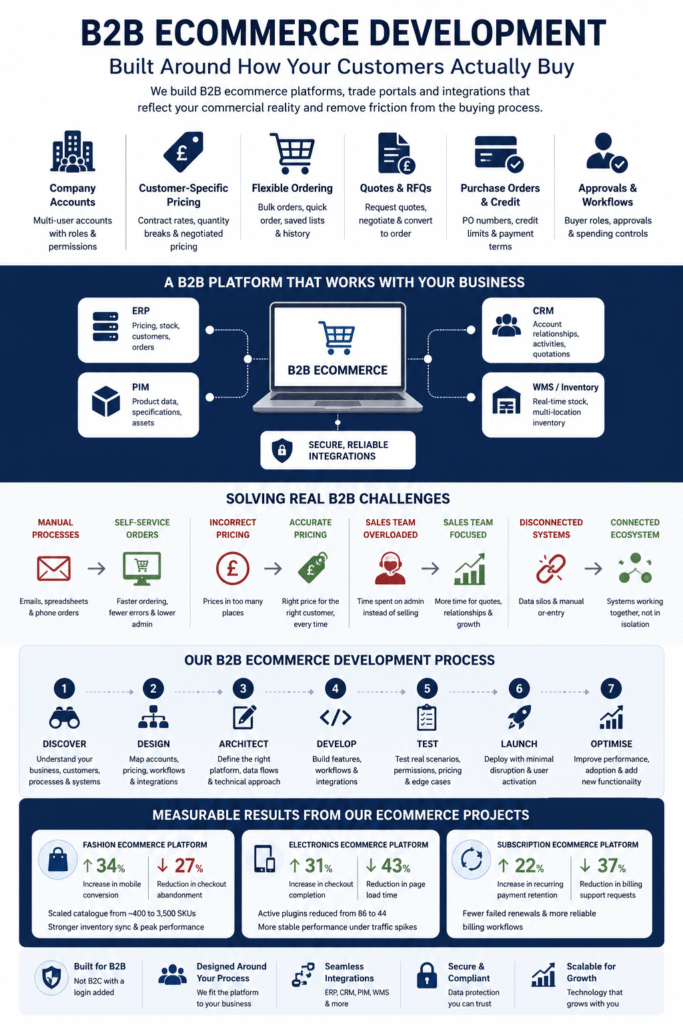
Company and Trade Accounts
The account model should recognise the organisation as well as the individual user. One company may contain several buyers, branches, departments, delivery locations and administrators while still belonging to the same commercial account.
Customer-Specific Pricing
Contract rates, quantity breaks, negotiated prices and customer groups can be reflected online so the right buyer sees the right commercial terms.
The harder question is where those prices originate. If the ERP already controls contract pricing, manually duplicating it inside ecommerce may simply create a second source of truth.
Account-Specific Products and Catalogues
Not every buyer necessarily has access to the same range.
Some accounts may have approved products, private SKUs, restricted categories or contract-specific catalogues. The platform can present what is relevant to that customer rather than treating the entire catalogue as universally available.
Bulk, Quick and Repeat Ordering
Experienced buyers often value speed more than browsing. Product-code entry, order history, saved lists, favourites and quick-order functionality can reduce the time required for routine purchases substantially.
Quotes and RFQs
Some transactions cannot sensibly begin with a fixed online price. Volume orders, configurable products and commercially sensitive purchases may still need quotation.
A useful RFQ process should connect the customer’s online request with the internal sales workflow rather than simply generate another email somebody has to re-enter manually.
Purchase Orders, Credit and Payment Terms
Established customers may buy using purchase orders or agreed account terms rather than paying immediately by card.
A B2B checkout can support PO references, account payment, credit rules and conventional online payment where appropriate. Different customer groups do not need to follow the same route.
Buyer Roles and Approval Workflows
Some companies allow staff to create orders but require a manager to approve them. Others limit spend, products or delivery locations by user.
Where those controls matter commercially, they can form part of the account architecture instead of living in a separate offline process.
One Company Can Have Several Buyers — and They Should Not All Have the Same Access
Account hierarchy is one of the most important differences between B2B and consumer ecommerce.
Consider a customer with six branches. Head office negotiates the commercial agreement. Individual branch managers place orders for their own sites. Procurement needs visibility across the account. Finance wants invoices and statements but has no reason to place an order.
Representing all of those people as unrelated customers creates duplication. Giving everyone identical permissions creates a different problem.
A structured company account can associate users with the same organisation while controlling purchasing, approvals, pricing visibility, delivery locations, quotations and administration according to role.
The point is not to build complicated permissions because B2B software is expected to look complicated. The system should represent the real purchasing responsibilities closely enough to remove work rather than create another administrative layer.
Your Sales Team Should Work With Ecommerce, Not Compete Against It
B2B ecommerce projects can create internal resistance when they are presented as a way to replace manual sales.
That is often the wrong objective.
A salesperson’s value is rarely in copying a familiar repeat order from an email into an ERP. It is in understanding accounts, negotiating opportunities, solving unusual requirements and developing commercial relationships.
Ecommerce can remove some of the repetitive work around those relationships.
A customer might place routine orders online but speak to an account manager when a new project needs different pricing. A salesperson may prepare a quote that the buyer accepts through the portal. The same customer history and commercial rules can support both channels.
In that model, ecommerce becomes part of the sales infrastructure rather than a competing sales channel.
If your ordering process still depends heavily on sales staff, show us what those people actually do during a typical order. The useful question is where their judgement adds value and where administration is simply consuming time.
Not Every B2B Transaction Should Become Fully Self-Service
A common mistake is to automate everything that can technically be automated.
A £150 repeat consumables order and a £70,000 configured equipment purchase do not necessarily deserve the same buying process.
High-value purchases may need negotiation. Some product combinations require technical validation. New accounts may require credit approval. Certain delivery requirements genuinely need human review.
The platform should support those situations rather than pretend they are ordinary checkout transactions.
The better question is where self-service removes friction and where intervention still protects the customer, supplier or commercial relationship.
Connecting B2B Ecommerce With ERP, CRM, PIM and Operational Systems
For established B2B businesses, ecommerce rarely operates alone.
Customer records may already live in a CRM. Contract prices and account terms may come from an ERP. Product specifications can be managed in a PIM. Warehouse systems may hold the most reliable view of stock.
The website needs to participate in that environment without becoming an uncontrolled copy of everything else.
ERP and Pricing
ERP integration can allow the ecommerce platform to receive account pricing, stock, customer terms or product information and send completed orders back into the operational system.
But a working API is not the same thing as a sound integration. The project still needs to establish which system owns each important data type, how synchronisation works and what happens when one side is temporarily unavailable.
Our API integration services can form part of a wider B2B ecommerce project where operational systems need to exchange data reliably.
CRM and Customer Relationships
CRM integration can help connect online activity with the wider account relationship.
Account managers may need visibility of quotation requests, registrations, orders or other relevant activity without having to monitor another disconnected platform.
PIM, Product Data and Inventory
Large or technically complex catalogues are often difficult to maintain directly inside ecommerce.
A PIM can remain responsible for structured product data while ecommerce handles presentation and transactions. Stock may need to come from warehouse or ERP systems, sometimes across multiple locations.
What matters is not displaying the largest possible quantity of data. It is displaying information the business can genuinely stand behind.
Credit and Account Information
Trade accounts may have credit limits, overdue balances or payment terms that affect whether another order should proceed.
Where the source data is reliable, those commercial rules can influence the ecommerce journey rather than requiring finance or sales staff to check every transaction manually.
Where Should the Correct Customer Price Actually Come From?
Customer-specific pricing sounds like a frontend feature. Usually it is an architecture decision first.
Suppose a buyer has a negotiated contract price, qualifies for a volume rate and is looking at a product currently included in a promotion. Which price wins?
That requires a commercial rule before it requires code.
The project also needs to determine where the authoritative price lives. If the ERP controls contracts, ecommerce may retrieve or synchronise those values. If another system owns promotional logic, the relationship between those rules must be explicit.
Otherwise a sophisticated platform can still confidently show the wrong number.
B2B Checkout Works Differently From Consumer Checkout
A consumer checkout is usually designed to move an individual from basket to payment as quickly as possible.
A B2B ecommerce checkout can have different responsibilities. It may need to recognise the company, purchasing authority, available credit, mandatory PO references, approved addresses or an internal approval step.
That does not mean checkout should become cumbersome.
Returning buyers should not repeatedly enter information the platform already knows. Account details, delivery locations, payment arrangements and permissions can simplify the process while preserving necessary controls.
A new trade customer may pay by card. An established account may purchase on agreed terms. Another company’s buyer might submit an order for approval rather than placing it immediately.
The shortest checkout is not always the best checkout. The aim is the shortest appropriate route for that account.
B2B Ecommerce UX Should Make Repeat Purchasing Faster, Not More Impressive
B2B ecommerce UX is often judged using consumer ecommerce conventions that do not fully reflect how professional buyers behave.
A procurement manager who already knows the SKU may not want an elaborate product-discovery journey. They want the correct product, their price, dependable availability and a fast way to enter the required quantity.
Another buyer may need detailed technical filtering across thousands of similar components. A repeat customer may want to reopen last month’s order and adjust quantities.
The interface should support those jobs.
Fast search, product-code ordering, saved lists, order history, account-specific navigation and clear pricing often matter more in B2B than adding another layer of visual novelty.
Where the primary issue is broader product discovery, customer journey or interface quality, our ecommerce website design work covers those requirements in greater depth.
Choosing the Right B2B Ecommerce Platform
There is no single best B2B ecommerce platform for every UK business.
The decision depends on account complexity, catalogue structure, integration requirements, existing technology, internal capability and how much genuinely custom behaviour is required.
Shopify B2B and Shopify Plus
Shopify development can be appropriate where businesses want a managed commerce environment and their B2B model fits comfortably within the platform, available B2B functionality and extension ecosystem.
For a business comparing a Shopify B2B ecommerce development agency, the more useful question is not whether Shopify supports B2B in principle. It is whether the required account, pricing, ordering and integration model fits it cleanly.
WooCommerce for B2B
WooCommerce can provide considerable flexibility, particularly for organisations already invested in WordPress or needing greater control over particular ecommerce behaviours.
That flexibility needs discipline. A B2B store assembled from many overlapping plugins can become difficult to maintain when several components are modifying accounts, pricing and checkout simultaneously.
Adobe Commerce / Magento
Adobe Commerce can suit organisations with substantial catalogue, account and operational complexity where that depth is justified.
Its capability also brings a heavier ownership model. Choosing enterprise technology for requirements that do not need it can create cost and maintenance overhead without equivalent commercial value.
When More Custom Development Makes Sense
Sometimes an established ecommerce platform remains the correct foundation while specific B2B workflows require custom engineering. In other cases the commercial model is sufficiently unusual to justify a more bespoke architecture.
The business requirement should drive that decision, not the desire to make the technology stack look more sophisticated.
Should You Replace the Existing Platform or Extend It?
A B2B ecommerce project does not automatically require replatforming.
If the current platform is stable, supported and fundamentally capable of serving the future model, extending it can reduce project risk and preserve useful infrastructure.
Replacement becomes more compelling when the limitations are structural: the account model cannot represent the business, important integrations are unreliable, performance is constrained by architecture or years of extensions have made further change disproportionately difficult.
There is also a middle ground. Some businesses retain the ecommerce platform while changing where pricing, data or integration responsibilities sit.
Our wider ecommerce development services cover broader platform engineering, technical improvements and integrations where the problem extends beyond B2B-specific functionality.
If the direction is still unclear, ecommerce consulting can help assess platform fit, operational constraints and the case for phased change before committing to a rebuild.
Migrating Existing Trade Customers Without Disrupting Business
B2B migration is not just a product-data exercise.
The valuable information often sits in relationships between records: which contacts belong to which company, which price list applies, which delivery addresses are approved, what the customer normally buys and how existing account terms should behave.
Historic orders can also matter if customers rely on them for repeat purchasing.
Migration planning may therefore include company accounts, contacts, pricing relationships, catalogues, addresses, order history and identifiers shared with ERP or CRM systems.
Authentication deserves particular attention. A migration can be technically successful and still create a poor launch if established buyers suddenly cannot access their accounts.
For a live B2B operation, the cutover also needs to control the period where prices, orders or customer records might otherwise diverge between old and new systems.
Customer Adoption Is Part of B2B Ecommerce Development
A B2B portal can launch successfully from a technical perspective and still fail commercially if customers continue sending every order by email.
Adoption therefore needs to be considered before launch, not as an afterthought.
The strongest reason for customers to change behaviour is usually practical value. If ordering online gives them immediate access to their prices, previous orders, account information and a faster repeat-order process, there is a genuine reason to use it.
Internal adoption matters as well. Account managers who understand where ecommerce helps their customers are far more likely to introduce it positively.
For some businesses, phased rollout is sensible. A group of established accounts can test real ordering scenarios before wider migration. This also gives internal IT teams, ERP suppliers or incumbent software partners time to validate the parts of the system they remain responsible for.
Relevant Ecommerce Project Outcomes From Prime Lion Digital
B2B outcomes should ultimately be measured against the commercial process being improved: online order adoption, manual administration, quotation turnaround, pricing accuracy, order-processing time or account-service workload.
Where direct B2B project data is not being presented publicly, it is important not to manufacture it. The examples below are real Prime Lion Digital ecommerce engineering outcomes that demonstrate relevant capabilities around catalogue scale, integrations, checkout reliability and platform stability.
Scaling a Fashion Ecommerce Catalogue From Around 400 to 3,500 SKUs
One ecommerce platform was struggling as its catalogue expanded from approximately 400 products to around 3,500 SKUs. Mobile filtering had become difficult, inventory synchronisation was unreliable and checkout abandonment was a growing concern.
The work included restructuring product architecture, improving filtering logic and database indexing, strengthening the inventory API and introducing more dependable queue handling.
Within six months, mobile conversion increased by 34% and checkout abandonment reduced by 27%. Inventory synchronisation became significantly more reliable, mobile browsing improved and the platform handled promotional peaks more consistently.
For a B2B environment, the specific buying model may be different, but the underlying lesson is relevant: catalogue growth, inventory integration and transaction stability have to be engineered together rather than treated as isolated frontend tasks.
Recovering Checkout and Platform Performance for an Electronics Ecommerce Business
An electronics ecommerce platform had accumulated technical overhead as the business grew. Checkout slowed under load and traffic spikes exposed instability across the site.
The project reduced plugin dependency, improved caching and Redis configuration, optimised checkout AJAX behaviour and addressed inefficient database queries and server-side performance.
Over the following five months, checkout completion increased by 31%, average page load time fell by 43% and the active plugin count was reduced from 86 to 44. Mobile checkout became more dependable and campaign traffic was handled with greater stability.
This type of work matters in B2B as well. Adding account pricing, buyer permissions or ERP-connected checkout logic to an already fragile platform simply creates a more complicated failure point.
Stabilising Recurring Billing and Lifecycle Workflows
A subscription ecommerce platform was experiencing failed recurring payments, overloaded queues, delayed webhooks and customer account issues.
The work focused on subscription architecture, Action Scheduler cleanup, webhook retry logic, billing workflows and lifecycle automation.
Within five months, successful recurring payment retention increased by 22% and billing-related support requests reduced by 37%, while failed renewals fell significantly and subscription management became more dependable.
The commercial model is different from conventional trade ordering, but the engineering principle is the same: automated workflows only create value when failure handling, account state and system communication remain dependable.
Our B2B Ecommerce Development Process
Commercial Discovery
We start with how the business sells rather than which platform it expects to use.
That means understanding customer types, account structures, pricing, quotations, payment arrangements, fulfilment and the areas where unnecessary manual work is accumulating.
Customer and Account Mapping
We map the relationship between organisations and individual users: who can buy, what they can see, which prices apply, whether approvals exist and how branches or departments relate to the wider account.
Requirements and Architecture
Once the commercial model is clear, responsibilities can be divided between ecommerce, ERP, CRM, PIM and other systems.
This is also where we separate requirements that genuinely need custom development from those that can be handled safely by the chosen platform.
UX and Ordering Workflows
The customer experience is designed around actual buying tasks: finding known products, creating larger orders, repeating previous purchases, requesting quotations, approving baskets and accessing account information.
Complexity behind the platform should not automatically become complexity for the buyer.
Development and Integration
The required account logic, pricing, workflows and integrations are developed against the agreed architecture.
Where an internal IT team, ERP provider or existing software supplier remains involved, responsibilities should be clear early. Integration projects become unnecessarily slow when each party assumes another team owns the same problem.
Data Migration and Testing
Migration may cover products, company accounts, contacts, pricing relationships, addresses, order history and other records required for continuity.
Testing then needs to use real account scenarios rather than a single generic checkout. Different prices, permissions, payment routes, approval conditions, quantities and integration failures all need attention.
Launch, Adoption and Ongoing Development
Launch planning combines technical cutover with account activation and customer onboarding.
Where appropriate, rollout can be phased rather than forcing every account onto the new platform at once. After launch, ongoing work may cover maintenance, performance, monitoring and further B2B functionality as commercial requirements evolve.
How Much Does B2B Ecommerce Development Cost in the UK?
There is no useful single price for B2B ecommerce development in the UK because the technical responsibility can vary enormously.
A trade account area added to an existing platform is very different from a multi-company ordering environment with customer-specific catalogues, contract pricing, ERP integration, approval workflows and historical account migration.
The largest cost drivers are often not the number of pages. They are the commercial rules and systems sitting behind those pages.
A realistic estimate therefore requires an understanding of the existing platform, customer structure, pricing logic, integration requirements, migration and the workflows that need to change.
For an initial estimate, send us your current platform, the main systems it connects to and a short explanation of how customers place orders today.
What Determines the Cost of a B2B Ecommerce Platform?
Account complexity has a direct impact. A single trade login with one price group is much simpler than company hierarchies containing multiple buyers, branches and approval rules.
Pricing can also become substantial where several contract and quantity rules interact or values need to stay synchronised with another system.
Integrations vary just as much. A well-documented modern API with predictable data is different from a legacy ERP where important information is difficult to access or inconsistently structured.
Other factors include catalogue size, quotations, account credit, migration, performance requirements and the condition of the existing ecommerce platform.
Long-term ownership matters too. A lower initial build cost can become expensive if the finished platform depends on too many overlapping extensions or requires constant manual intervention.
Why Prime Lion Digital Approaches B2B Ecommerce Differently
B2B ecommerce projects sit between technology and commercial operations.
Understanding the storefront alone is not enough. A project can affect sales, finance, procurement, customer service, warehouse operations and existing software at the same time.
Our approach is therefore to understand the commercial rules first: where the correct customer price comes from, who is authorised to order, what information salespeople need, which system owns the customer record and what should happen when synchronisation fails.
We also do not assume every requirement needs custom code or every existing platform needs to be replaced. Standard functionality should remain where it works properly. More complex engineering is worthwhile when there is a real operational reason for it.
Because Prime Lion Digital works across ecommerce development, UX, API integrations, platform performance and digital strategy, we can look at the relationship between the customer experience and the systems behind it rather than treating them as separate projects.
The objective is practical: a B2B ecommerce environment customers can use, staff can operate and the business can continue developing without every new commercial requirement becoming another workaround.
B2B Ecommerce Development FAQs
What is B2B ecommerce development?
B2B ecommerce development is the design and engineering of ecommerce functionality for transactions between businesses. It can include company accounts, customer-specific pricing, bulk ordering, quotations, purchase orders, credit terms, approval workflows and integration with ERP, CRM, PIM or warehouse systems.
How is B2B ecommerce different from B2C ecommerce?
B2C ecommerce normally serves an individual buyer using relatively standard pricing and payment processes. B2B ecommerce may need to represent an organisation containing multiple users, negotiated terms, purchasing permissions, account credit and more complex ordering workflows.
Which platform is best for B2B ecommerce?
There is no universal best platform. Shopify, WooCommerce, Adobe Commerce and more custom architectures can all be appropriate depending on account complexity, integrations, catalogue requirements, internal resources and long-term plans.
Can Shopify support B2B ecommerce?
Yes. Shopify provides B2B capabilities, particularly within Shopify Plus, and can be extended through integrations and applications. Its suitability depends on how well the required pricing, account, workflow and integration model fits the platform.
Can WooCommerce be used for B2B ecommerce?
Yes. WooCommerce can support B2B functionality and offers considerable flexibility. The architecture should be controlled carefully where multiple extensions modify pricing, account behaviour or checkout.
Can B2B customers have individual prices?
Yes. Pricing can be associated with accounts, customer groups, contracts or other commercial rules. The important architectural question is where the authoritative price originates and how it remains accurate across connected systems.
Can one company account have multiple buyers?
Yes. A company account can contain several users with different roles, purchasing permissions and access levels where the business model requires it.
Can customers use purchase orders, account credit or agreed payment terms?
Yes. B2B checkout can capture PO references and support account-based purchasing, provided the necessary commercial rules and credit information are available to the platform.
Can customers request quotations online?
Yes. An RFQ or quotation workflow can allow customers to submit requirements, receive a quotation and, where appropriate, convert an accepted quote into an order.
Can a B2B ecommerce platform integrate with our ERP?
Yes, where suitable integration methods are available. ERP integrations commonly exchange orders, customers, prices, stock and product information. The exact data ownership and synchronisation logic should be defined before development.
Can we sell to B2B and B2C customers on the same platform?
Often, yes. Whether it is the right architecture depends on how different the customer journeys, catalogues, pricing, tax treatment and checkout requirements are. Sharing a platform should simplify management rather than force incompatible models together.
Can existing trade accounts be migrated?
Yes. Migration can include company records, contacts, addresses, pricing relationships, order history and other account information, subject to the quality and structure of the existing data.
Can B2B ecommerce development be delivered in phases?
Yes. In many cases, phased delivery is commercially sensible. A business might first establish accounts and repeat ordering, then add deeper ERP integration, quotations or more complex procurement workflows once the core process has been proven.
How long does B2B ecommerce development take?
Timescales depend heavily on scope. Account architecture, integrations, pricing complexity, migration and custom workflows usually influence delivery time more than the number of frontend pages. A realistic plan can be established after discovery and technical assessment.
Will B2B ecommerce replace our sales team?
It does not have to. For many businesses, ecommerce is most useful when it handles routine self-service activity while salespeople remain involved in negotiation, complex purchases and account development.
Could Your Customers Place Their Next Trade Order Without Calling or Emailing You?
If the answer is no, the useful question is why.
Perhaps they cannot see their agreed price. Maybe the website does not understand their account terms. Perhaps repeating an order online takes longer than emailing a spreadsheet. Or the systems behind the website simply do not contain the information customers need.
Those are the issues worth understanding before choosing technology.
Prime Lion Digital can map the existing buying process, identify which parts should move into self-service, establish where sales involvement still adds value and determine the B2B ecommerce architecture required to support both.
Talk to us about how your B2B customers buy today — and where that process is becoming difficult to scale.