
For Accountants & Accounting Firms
Leave your details and our team will get back to you shortly to discuss your website, SEO or digital growth project.
Prime Lion Digital provides digital solutions and marketing for accountants and accounting firms across the UK, connecting website development, search visibility, digital marketing, branding, CRM systems and ongoing optimisation around the way an accountancy practice actually attracts and manages clients.
For most firms, the challenge is not choosing a single digital service. It is understanding where growth is being restricted. A practice may have strong referrals but a dated website, good traffic but poor-quality enquiries, or a healthy pipeline that is increasingly difficult to manage internally. The right approach starts with that business reality rather than a predetermined package of services.
Digital Growth for Modern Accounting Practices
An accounting firm’s digital presence now extends well beyond its website. Prospective clients encounter the practice through search results, recommendations, Google Business Profile, professional networks, sector content, reviews and paid campaigns. They may compare several firms before contacting anyone.
Behind that visible journey sits another layer: analytics, enquiry handling, CRM, follow-up processes and the systems used to move a prospect towards becoming a client.
This is why effective digital solutions for accountants are better considered as an operating ecosystem. Website architecture influences SEO. Positioning and branding influence trust. Marketing creates or captures demand. Analytics provides visibility into what happens before an enquiry. CRM and workflow design determine what happens afterwards.
Not every practice needs all of these elements at once. The priority should depend on the firm’s current position, target clients and growth plans.
Why Accounting Firms Need a Different Digital Approach
Accountancy is a trust-heavy professional service. Clients may be sharing sensitive financial information, relying on deadlines being met and entering a relationship that continues for many years. A website therefore has to do more than look professional. It needs to make expertise, relevance and credibility understandable before the first conversation takes place.
The structure can also become complicated quickly. One practice might offer annual accounts, Corporation Tax, VAT, payroll, bookkeeping, Self Assessment and business advisory services while working with limited companies, sole traders, landlords and specialist sectors.
Clients do not necessarily think in that same internal service structure. A business owner might search for an ecommerce accountant, help with a VAT problem, an accountant near their office or a firm that understands construction businesses. Good digital architecture has to connect professional services with the way prospective clients actually identify their needs.
There is also a commercial distinction between generating more enquiries and generating the right enquiries. A practice that wants to grow advisory work should not measure marketing success simply by the number of people asking about low-value compliance services.
Who This Is Relevant For
The scale and complexity of the digital ecosystem varies considerably across the profession. A sole practitioner building local visibility has different priorities from a multi-service firm expanding into new locations or specialist sectors.
- Independent accountants and smaller practices building a credible digital foundation beyond referrals.
- Growing accountancy firms adding staff, services, locations or more structured client acquisition.
- Chartered and professional practices where qualifications, memberships and specialist expertise form an important part of trust.
- Tax and accounting firms managing several related compliance and advisory services.
- Specialist accountancy practices targeting particular industries, client types or complex areas of work.
- Accounting and business advisory firms whose proposition extends beyond traditional year-end compliance.
The appropriate mix of digital services for accounting firms changes with each model. That difference matters when deciding what should be improved first.
Digital Solutions for Accountants & Accounting Firms
A useful parent strategy should make the role of each digital discipline clear without treating every discipline as a separate project. Website development, SEO, marketing, branding and CRM address different stages of the same commercial journey.
Web Design & Development
An accounting website should make it easy for a prospective client to understand who the firm works with, which problems it solves and what to do next. Behind that simple experience sits information architecture, technical performance, accessibility, security, analytics and the ability to expand the site as the practice develops.
For established firms, redesign work also has to consider what already carries value. Existing content, indexed URLs and organic visibility should not be discarded simply because the visual identity is changing. Prime Lion Digital’s wider approach to website design and development considers those structural, UX and technical relationships from the start.
SEO & Organic Visibility
Search behaviour around accountancy is fragmented across services, problems, locations and sectors. Someone searching for help with Corporation Tax has a different intent from a company looking for an accountant in Oxford or a retailer looking for ecommerce accounting expertise.
SEO therefore begins with architecture and search intent, not simply adding keywords to existing pages. The broader HUB should establish how organic visibility fits the accounting ecosystem, while specialist SEO strategy belongs at child-service level.
Marketing & Client Acquisition
Marketing for accountants is most useful when it begins with the firm’s commercial priorities. Which services should grow? Which clients are most valuable? Where do strong enquiries already come from? Which opportunities should the practice deliberately avoid?
Those answers influence the role of organic search, paid search, content, email and other channels. A capable marketing agency for accountants should be able to distinguish between activity that generates attention and activity that supports the kind of growth the practice actually wants.
This is particularly important for marketing for accounting firms with several services. More traffic to a generic homepage is not necessarily a better outcome than fewer visitors reaching a highly relevant service or sector page. The same principle sits behind our broader integrated digital marketing work.
CRM & Business Systems
The public-facing journey ends at an enquiry. The operational journey starts there.
As a firm grows, staff need visibility over who contacted the practice, what they require, who owns the next action and where the opportunity sits. A CRM or custom business system can create that structure, but software should follow the workflow rather than dictate it.
The distinction matters. Automating an unclear process usually creates a faster unclear process.
Branding & Professional Identity
Accounting brands often have to balance stability with differentiation. A practice needs to look credible without becoming visually interchangeable with dozens of competitors using the same financial imagery and generic promises.
For an established firm, brand work may involve refinement rather than reinvention. Existing reputation, partner recognition and offline materials have value. Changes to the website, logo, proposals and client documents should strengthen that recognition rather than fragment it. A coherent brand identity and positioning system helps keep those touchpoints consistent.
Content & Professional Authority
Accounting content needs to work harder than ordinary promotional copy. It should be understandable to business owners while remaining technically credible.
There is also a difference between evergreen guidance and time-sensitive tax information. Content relating to HMRC rules, deadlines, Making Tax Digital or regulatory changes may require review and updating, while broader service and sector guidance can continue supporting discovery for much longer.
Useful content should therefore connect search demand with genuine expertise, not exist simply because an editorial calendar requires another article.
Website Support & Continuous Improvement
Practices change after a website launches. New services appear, team members join, legislation changes, Google search behaviour shifts and integrations need maintenance.
Ongoing support is most valuable when it protects the foundation while improving it gradually: maintaining performance and security, monitoring organic visibility, updating important content, checking conversion journeys and making sure the website still reflects the business it represents. Where a site has become operationally important, ongoing website care and maintenance becomes part of business continuity rather than a technical afterthought.
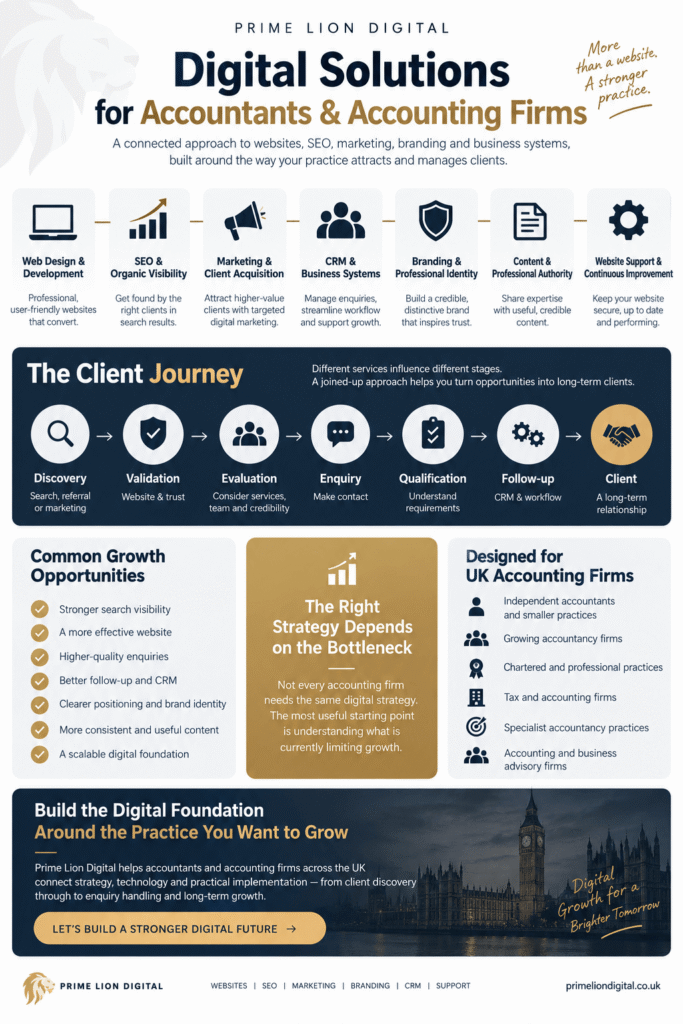
From Discovery to a New Client Relationship
A prospective accounting client rarely moves directly from seeing an advert or search result to becoming a client. The journey is closer to:
Discovery → Validation → Evaluation → Enquiry → Qualification → Follow-up → Client
Discovery may come from Google, a recommendation, LinkedIn, a local search or a paid campaign. Validation often happens next. The person checks the website, looks at the team, reviews services, considers professional memberships such as ICAEW, ACCA or AAT where relevant, and decides whether the practice appears credible for their situation.
Then the responsibility moves from marketing to operations. The enquiry has to reach the right person, the requirement needs to be understood, follow-up needs ownership and the opportunity may eventually move into onboarding and ongoing client management.
The strongest digital systems respect that transition rather than treating lead generation and client management as unrelated activities.
Trust Often Starts Before the First Conversation
This is particularly important for referral-led practices.
A recommendation may create the initial confidence, but the prospective client will often still search for the firm before getting in touch. They may compare the practice with alternatives, look for the relevant service, check the people behind the business and assess whether the overall presentation supports what they were told.
For someone arriving through search rather than a recommendation, the website has to establish that confidence from a colder starting point.
Useful trust signals are substantive: identifiable professionals, clear experience, relevant qualifications and memberships, genuine client feedback, coherent service information, secure technology and an obvious way to contact the practice. They work because they reduce uncertainty, not because they occupy space on a design.
Website, Marketing and CRM Need Different Roles
One of the most common sources of digital friction is not poor technology but disconnected ownership. A website may be managed by one supplier, SEO by another, advertising by someone else, while enquiries are followed up manually inside the practice.
Each part can technically work and the overall system can still be difficult to understand.
Marketing and search are responsible for creating or capturing relevant demand. The website has to turn that attention into understanding and action. Analytics should make the route measurable. CRM then gives the practice a structured view of what happens after contact.
Those roles should connect, but they should not be confused. A CRM will not fix weak positioning. More advertising will not fix a poor enquiry journey. A new website will not solve an internal follow-up problem.
Knowing which problem belongs to which part of the ecosystem is often more valuable than adding another platform.
Technology Behind an Accounting Digital Ecosystem
The technology stack should reflect how the practice works. A WordPress or other CMS-based website may connect with forms, booking tools, analytics and a CRM. Search performance may be monitored through Google Search Console and analytics platforms. Local practices may depend heavily on an accurate Google Business Profile.
Accounting software such as Xero, QuickBooks or Sage may form part of the wider operational environment, but integration needs a clear purpose. The fact that two systems can connect through an API does not mean that they should.
Before introducing automation or custom integration, it is worth mapping where information comes from, who needs it, where duplication occurs and which manual steps genuinely create friction. This usually produces better decisions than starting with software features.
What Should an Accounting Firm Invest In First?
The answer depends on the constraint.
A newer practice may need positioning, brand identity, a professional website and a credible local presence before spending heavily on acquisition. If prospective clients arrive on a weak site, increasing traffic simply exposes the weakness to more people.
An established firm with a strong reputation and functional website may be in the opposite position. Its next opportunity could be organic search, specialist content or paid acquisition designed to reduce dependence on referrals.
Another practice may already receive enough enquiries. The real problem is that opportunities are lost between inboxes, staff members and spreadsheets. In that case, fixing CRM and follow-up processes can matter more than generating another hundred website visits.
A larger practice with several offices or specialist divisions may face a structural problem: how to scale service pages, locations, content, analytics and internal systems without making the digital estate increasingly difficult to manage.
The first investment should address the bottleneck.
What Determines the Level of Investment?
Prices for marketing services for accountants, websites or business systems are difficult to compare without context because the underlying scope can be very different.
A focused website for a small local practice is not the same project as rebuilding a large accountancy site with existing rankings, multiple service areas, specialist sector content and complex migration requirements.
SEO investment depends on the condition of the current site, competition, geography, content quality and breadth of the target market. CRM work is shaped by workflows, users, permissions, data structures and integrations. Marketing budgets depend on the economics and competitiveness of the services being promoted.
This is why useful scoping starts with the commercial objective and the existing environment rather than a generic package.
Timelines and Implementation Complexity
Different parts of the digital ecosystem move at different speeds.
A branding or website project has a defined production cycle. That may include discovery, architecture, content, design, development, testing and migration. CRM work normally needs process mapping before configuration or development begins.
Search growth works differently. Technical improvements can be implemented relatively quickly, but organic performance develops over time. Paid campaigns can begin gathering data sooner, though optimisation still depends on seeing enough real search and conversion behaviour.
Migration can add another layer of complexity. Existing URLs, backlinks, indexed content, tracking, forms and integrations may all need to be preserved or replaced deliberately.
A realistic roadmap separates what needs to be built once from what needs to be improved continuously.
What Accounting Practices Commonly Underestimate
Content and migration are often underestimated because they are less visible than design. A new interface can be approved quickly; deciding what should happen to years of service pages, tax articles and indexed URLs takes more judgement.
Internal involvement matters too. Service pages may require input from partners or specialists. Professional claims need to be accurate. Content referring to HMRC requirements or regulatory changes may need ongoing review. Larger firms can also have different opinions internally about which sectors or services should receive priority.
Tracking deserves similar attention. If nobody agrees what counts as a meaningful enquiry, later reporting can become misleading. Form submissions, telephone calls and booked consultations may all represent different levels of commercial intent.
CRM implementation introduces its own challenge: adoption. A technically strong system still fails if the workflow is impractical for the people expected to use it every day.
Why Digital Projects for Accounting Firms Underperform
Some projects fail because the underlying proposition is generic. If every firm describes itself as professional, friendly and proactive, those claims do little to help a prospective client choose.
Others suffer because SEO is considered after the website architecture is already fixed. Search intent influences navigation, URLs, service relationships and content hierarchy. It is much easier to design those relationships early than retrofit them later.
Marketing underperforms when the focus stops at traffic. An enquiry can fail because the wrong audience was targeted, the landing page did not establish relevance or nobody followed up quickly enough.
CRM projects have an almost opposite failure mode. Too much attention is given to the system and not enough to the process the system is supposed to support.
These are different problems, but they share one lesson: digital decisions work better when they start with the business process rather than the tool.
Accounting Sector Projects: How the Ecosystem Works in Practice
Example 1: Website Architecture, Search Visibility and Enquiry Journeys
Prime Lion Digital’s work with Audit Consulting Group involved an accounting and consulting website where design could not be separated from service architecture and search visibility. The business covered multiple accounting and tax services, which meant the site needed a structure that could support both prospective clients and organic discovery without turning every topic into an isolated landing page.
The implementation therefore involved the relationship between website structure, UX, technical and on-page SEO, service intent and enquiry paths. The practical outcome was not simply a redesigned website. It created a clearer foundation from which individual accounting and tax topics could be expanded while remaining connected to the wider business.
The accounting and consulting website project illustrates why architecture becomes a growth decision when a professional-services firm has multiple services, search intents and client types.
Example 2: Moving from Website Enquiries to Operational Workflow
For the same accounting business, the next challenge existed behind the website. Enquiries and client work needed to move through a more structured internal process.
A custom CRM and business management system was developed around defined workflow stages, allowing client information, responsibilities and progress to be managed more consistently. The design challenge was therefore operational rather than promotional: understand the process first, then build the system around it.
This example shows why digital services for accountants can extend beyond marketing. The website and CRM solve different problems, but both influence the same client lifecycle.
Example 3: Improving an Existing Practice Without Replacing Everything
For an established accounting practice, a different implementation scenario may begin with assets that are already working: years of indexed content, recognisable branding, useful local visibility and systems that staff understand, alongside weaknesses in conversion, performance or information architecture.
In that situation, a complete rebuild can introduce more risk than value. The stronger approach may be selective: preserve useful URLs and content, improve navigation, strengthen key service journeys, correct technical weaknesses and connect measurement more reliably.
This is an important distinction when comparing marketing companies for accounting firms or broader digital agencies. A commercially sensible recommendation is not automatically the largest project.
Choosing the Right Digital Partner for an Accounting Practice
There are specialist marketing firms for accountants, web agencies, SEO consultancies, branding studios and software developers. None of those models is universally right.
A standalone identity project may need a focused branding team. A narrow paid-search requirement may be suited to PPC specialists. The decision becomes more complicated when website architecture, organic search, paid acquisition, analytics and internal systems affect one another.
In that situation, useful evaluation questions go beyond portfolio design. How will existing SEO value be protected during a rebuild? Who owns analytics and advertising accounts? How are enquiries measured? Can the agency explain what should happen between a website form and the firm’s CRM? Is an integration actually necessary, or is it adding complexity?
Sector experience matters, but it should be visible in the quality of the decisions being made. Simply calling a business a digital agency for accountants is not evidence that it understands how an accountancy practice works.
Client Feedback
Verified client review placeholder
Use a short, genuine review here that reflects communication, implementation clarity or the experience of improving a professional-services website.
Verified client review placeholder
Use verified feedback from a client who can speak about the practical side of the work: clearer structure, a better enquiry journey, improved digital organisation or ongoing support.
Verified client review placeholder
Use a slightly more detailed, genuine review where the client can describe working across more than one area, such as website development together with SEO, CRM, analytics or operational workflow. Replace this placeholder with verified client wording before publication.
How the Specialist Services Connect
This page provides the parent view. The individual disciplines require deeper treatment because each solves a different problem.
Web design and development for accountants covers the digital foundation: architecture, UX, performance, functionality and conversion paths. SEO for accountants concentrates on search demand, technical structure, service visibility, local relevance and authority. Digital marketing for accountants considers how appropriate channels can generate or capture demand against defined commercial objectives.
CRM development for accounting firms moves further into the operation itself, helping structure enquiries, responsibilities and workflows. Branding and logo development shape how the practice is recognised, while content marketing supports search visibility and professional authority. Website maintenance keeps the underlying platform secure, relevant and usable after launch.
These areas should have distinct strategies and, where appropriate, their own dedicated pages. The role of the HUB is to make the relationships between them clear rather than reproduce every child service in detail.
Where Digital Growth in Accountancy Is Heading
The profession is becoming more digitally connected, but that does not mean every new platform deserves immediate investment.
AI-assisted search is changing how information is discovered. Automation is reducing repetitive administrative work. CRM, analytics and website platforms are becoming easier to connect. At the same time, prospective clients still need to understand who they are trusting with their finances and why that firm is relevant to them.
That puts greater value on strong first-party digital assets: clear expertise, useful content, sound website architecture, reliable measurement and systems the practice actually controls.
The technology will continue to change. A good foundation should not need to be reinvented every time it does.
Frequently Asked Questions
What digital services are most useful for accountants?
That depends on the firm’s current constraint. A newer practice may need branding, a professional website and local visibility. An established firm looking for predictable acquisition may prioritise SEO or marketing. A growing firm already receiving enquiries may benefit more from CRM, analytics or workflow improvements.
Do accounting firms still need a strong website if most clients come through referrals?
Yes, because referrals frequently lead to online validation. A prospective client may hear the firm’s name from a trusted contact and then visit the website before making contact. The recommendation creates interest; the website helps confirm credibility and relevance.
Should an accounting practice invest in its website or marketing first?
If the existing website clearly communicates the firm’s proposition, works well technically and converts relevant visitors, marketing may be the logical next investment. If the site is dated, confusing or poorly structured, sending additional traffic to it may produce limited value.
How does marketing help accountants attract better clients?
Effective accounting firm marketing begins by defining which services and client types the practice wants to grow. Search strategy, paid campaigns, content and landing pages can then be aligned with those priorities rather than optimised for enquiry volume alone.
What is different about marketing for accountants in the UK?
Marketing for accountants in the UK has to account for professional trust, complex service choices, local search behaviour, referrals and long-term client relationships. It also needs to communicate technical competence without turning professional advice into generic advertising claims.
Can an accounting website connect directly with a CRM?
Yes. Website forms and other enquiry sources can often feed information into a CRM or custom business system. The more important question is what should happen once the information arrives: who owns the enquiry, which stage it enters and what follow-up should occur.
Do we need a specialist marketing company for accountants?
Not necessarily. Industry familiarity is useful, but broader capability can matter when website architecture, SEO, marketing, analytics and internal systems need to work together. The right partner should understand both the accounting context and the specific digital problem being solved.
How long does digital growth take for an accounting firm?
It depends on the activity. Websites, branding and CRM implementation have defined project periods. Paid campaigns can begin producing data relatively quickly. SEO and content generally require a longer period because organic visibility develops through technical, content and authority improvements over time.
Build the Digital Foundation Around the Practice You Want to Grow
An accounting firm’s digital requirements rarely remain static. A website that was perfectly adequate for a small practice can become restrictive as the business adds staff, locations, specialist sectors or more sophisticated client acquisition.
Prime Lion Digital approaches digital solutions for accounting firms from that wider perspective. Website development, SEO, marketing, branding, analytics and CRM remain distinct disciplines, but the decisions made in one area often influence what becomes possible in another.
The useful starting point is to understand where the current digital environment supports the practice, where it creates friction and which change would make the greatest difference to the next stage of the business.