
SEO Services for Bookkeepers & Bookkeeping Firms in UK
Leave your details and our team will get back to you shortly to discuss your website, SEO or digital growth project.
SEO for bookkeepers should connect the services you want to grow with the people already searching for them. That sounds straightforward, but it is where many SEO campaigns go wrong. More rankings and more traffic do not necessarily mean more suitable bookkeeping clients.
Prime Lion Digital provides SEO for UK bookkeepers and bookkeeping firms, with strategy built around your services, ideal clients, location and commercial priorities. We work with new and established websites, from locally focused practices to bookkeeping businesses serving clients remotely across the UK.
The starting point is your business rather than a predetermined SEO package. We look at what you sell, which work you want more of, how prospective clients search and what currently happens between finding your business on Google and making an enquiry.
Discuss SEO for your bookkeeping business:
+44 7488 818286
enquiries@primeliondigital.co.uk
SEO Built Around the Bookkeeping Services You Want to Grow
A bookkeeping practice rarely needs equal visibility for everything it offers. One firm may want more recurring monthly bookkeeping clients. Another may be trying to develop payroll, VAT support or catch-up work. A specialist practice might be interested in a particular sector rather than the broadest possible audience.
Those priorities should shape the SEO strategy.
A sole bookkeeper looking for clients around Oxford, for example, faces a different search market from a remote bookkeeping firm specialising in ecommerce businesses across the UK. The first may have a strong opportunity in local search. The second needs a convincing reason to compete beyond its immediate area, supported by appropriate service or sector expertise.
We therefore look beyond keyword volume. The more useful question is whether a search represents demand for work the practice actually wants to win.
What Should SEO Actually Achieve for a Bookkeeping Business?
The commercial purpose of SEO is not to collect rankings. It is to make the business more visible at useful points in a prospective client’s search journey and give that person a credible route towards an enquiry.
That may mean improving local discovery, increasing visibility for an important service, helping Google understand a previously unclear website structure or attracting a better mix of organic visitors.
Measurement needs to follow the same logic. Rankings and traffic are useful indicators, but the more meaningful progression is:
Search visibility → Relevant visits → Enquiries → Qualified opportunities → Clients
A site attracting 2,000 organic visits but very few prospective bookkeeping clients may have a weaker commercial search position than one attracting 500 highly relevant visits that regularly reach service and contact pages.
Why Bookkeeping SEO Starts With Services, Not Keywords
Keyword research makes more sense once the commercial structure of the practice is understood.
Take monthly bookkeeping, payroll, VAT support and catch-up bookkeeping. They may sit together on a services menu, but the reasons people search for them can be quite different. Catch-up work often begins with an immediate problem. Monthly bookkeeping is more likely to involve an ongoing relationship. Payroll can be bought alongside bookkeeping or separately, while VAT-related searches frequently overlap with broader accounting and tax intent.
That affects which searches are useful, what deserves a dedicated page and what a prospective client needs to know before making contact.
Service → Client need → Search intent → Page → Enquiry
Working in that order also reduces one of the more common SEO problems: creating several near-identical pages because a keyword tool returned several variations of essentially the same query.
How Prospective Bookkeeping Clients Search
Some prospects know exactly what they need and search directly for a bookkeeper. Others begin with a problem such as overdue records or bookkeeping that has fallen behind. Local businesses may add a town or use a “near me” search. A business already committed to Xero, QuickBooks or FreeAgent may look for someone comfortable working with that software.
Then there is another group that SEO discussions often overlook: referred prospects.
A recommendation does not always lead directly to a telephone call. Someone may hear the name of a bookkeeper, search for the business, look at its website and reviews, check the services and only then decide whether to make contact.
So organic visibility has two roles. It can introduce the practice to people who have never heard of it, and it can reinforce confidence for people already considering it.
SEO Keywords for Bookkeeping: What Is Actually Worth Targeting?
There is no universal list of the best SEO keywords for bookkeeping. The useful terms depend on the services, location, ideal clients and competitive position of the practice.
Keyword research might uncover broad bookkeeping terms, local searches, individual services, problem-led queries, software-related demand or sector-specific searches. Each needs to be judged in context.
For example, a practice might investigate searches around:
- bookkeeping services and ongoing bookkeeping support;
- local bookkeepers and location-specific searches;
- catch-up bookkeeping, payroll or other distinct services;
- software or sector terms where the business has genuine relevant expertise.
The important part comes after the list is produced.
A phrase with relatively modest search demand can be commercially valuable if it closely matches a recurring service. Conversely, a high-volume query may contribute little if the intent is mostly informational or the people searching are unlikely to become suitable clients.
Bookkeeping SEO Keywords by Search Intent
The same number of searches can represent very different commercial opportunities. The examples below show how bookkeeping search terms can be grouped by the likely need behind the search rather than treated as one keyword list.
| Search Type | Example Search | Likely Intent | Commercial Relevance | Best SEO Destination |
|---|---|---|---|---|
| Core Service | bookkeeping services | Finding a bookkeeping provider | High | Core bookkeeping service page |
| Local | bookkeeper Oxford | Finding a nearby bookkeeper | High | Relevant local or service page |
| Problem-Led | catch-up bookkeeping | Resolving overdue or incomplete records | High | Catch-up bookkeeping page |
| Software-Led | Xero bookkeeper | Finding a bookkeeper familiar with specific software | Medium–High | Relevant service or software-focused content |
| Sector-Led | bookkeeping for ecommerce | Finding sector-specific support | High where genuine expertise exists | Sector or specialist service page |
| Near-Me | bookkeeper near me | Finding a local provider | High for local practices | Google Business Profile + relevant website page |
| Informational | how to do bookkeeping | Learning rather than immediately buying | Low–Medium | Guide or supporting article |
Examples are illustrative. Actual keyword priorities should be based on the practice, services, location, competition and current search data.
Search Volume Is Only Part of the Commercial Picture
Recurring bookkeeping makes the economics of search particularly important.
Consider an illustrative client paying £200 per month for ongoing bookkeeping. Over 12 months, that relationship represents £2,400 in revenue before considering retention beyond the first year or any additional services.
A search theme capable of producing the right type of recurring client may therefore deserve attention even when its headline search volume looks modest. The opposite is also true: thousands of visits from broad informational searches do not automatically justify the time and cost required to acquire them.
This is why we consider search demand alongside client value, competition, intent and the likelihood that the practice can credibly satisfy the query.
The £200 example is illustrative rather than a recommended bookkeeping fee or expected client value.
Turning Bookkeeping Services Into Search Architecture
Once worthwhile search themes have been identified, the website needs an appropriate structure for them.
There are two common extremes. One website puts every service on a single generic page. Another creates a new page for every small keyword variation. Neither approach is particularly helpful.
A separate service page usually makes sense where there is a meaningful difference in what the client needs, what they are searching for and what must be explained before they enquire. Closely related terminology can normally sit naturally within the same page.
The final architecture should still make sense without SEO data in front of you. A prospective client should be able to see what the practice does, understand how related services fit together and reach the right information without navigating a maze of keyword-led pages.
Local SEO for Bookkeepers
Local search can be a strong acquisition route for bookkeepers whose clients are concentrated in a particular town, city or region. Even where meetings and day-to-day work happen remotely, some businesses still prefer a provider they see as locally established.
Good local SEO goes further than adding place names to page titles. The website, Google Business Profile, service information, reviews, business details and local relevance need to support the same picture of the practice.
Geographic expansion also needs restraint. Publishing a series of almost identical pages for every nearby town does not create genuine local relevance. Location pages are more defensible where the business actually serves the market and can provide useful information specific to that audience.
Google Business Profile and the Website Need to Work Together
For a locally focused bookkeeper, Google Business Profile can become one of the first places a prospective client encounters the practice.
Categories, services, contact details, reviews and business information should accurately represent what the firm does. Just as importantly, the pages people reach after clicking through should continue the same story.
If a profile creates interest in payroll or bookkeeping support but the website gives that service only a vague mention, part of the opportunity has been lost. The same applies when business details are inconsistent or the contact route is unnecessarily difficult on mobile.
We treat the profile and website as connected parts of local acquisition rather than unrelated SEO tasks.
Should a Bookkeeper Target Local Clients or the Whole UK?
The larger market is not necessarily the better market.
For a sole bookkeeper or regional practice, building meaningful visibility close to the business may be more achievable and commercially sensible than competing nationally for broad bookkeeping terms.
Wider UK targeting becomes more credible when geography is less important and there is another reason for a prospect to choose the firm: specialist sector knowledge, a distinctive service model, software expertise or an established proposition for remote clients.
A hybrid model is often possible. The practice can retain a strong local foundation while selectively building wider visibility around services or sectors where it has a genuine competitive position.
The right geographic strategy follows the way the business wins and serves clients. It should not be chosen simply because national keyword volumes look larger.
Local SEO or UK-Wide SEO: Which Approach Fits Your Bookkeeping Practice?
The appropriate search market depends less on how large an audience is available and more on how the bookkeeping business actually competes and serves clients.
| Practice Type | Typical Client Model | Geographic Priority | SEO Focus | Example Search Direction |
|---|---|---|---|---|
| Sole Local Bookkeeper | Businesses within a defined local area | Town + surrounding area | Local SEO, Google Business Profile and core services | bookkeeper Oxford |
| Regional Bookkeeping Firm | Clients across several nearby towns or counties | Regional | Service visibility supported by genuine local relevance | bookkeeping services Oxfordshire |
| Remote Bookkeeper | Clients served online across the UK | Selective UK-wide | Service-led organic search | catch-up bookkeeping services |
| Sector Specialist | Businesses within a specific industry | Potentially UK-wide | Sector + service expertise | bookkeeping for ecommerce businesses |
| Software Specialist | Clients using a particular accounting platform | Local or UK-wide | Software + service relevance | Xero bookkeeping services |
| Hybrid Practice | Local core clients plus selected remote work | Local + selective national | Local foundation supported by specialist service pages | Local searches + selected service searches |
These are strategic examples rather than fixed SEO rules. The right approach depends on the practice’s actual client base, service model and competitive position.
Service Pages That Support Search and Client Decisions
A bookkeeping service page has two jobs. It needs enough context for search engines to understand the topic, and enough substance for a prospective client to decide whether the service is relevant.
That usually means going beyond a definition of bookkeeping followed by a generic list of benefits.
A useful page may explain who the service is designed for, what is normally included, common situations that lead clients to need it, how the work fits with related services and what happens after an enquiry. Pricing logic can also be useful where the practice is comfortable discussing it publicly.
The strongest pages tend to answer genuine pre-enquiry questions while remaining commercially focused. They do not need to repeat the target keyword in every heading to achieve that.
Content Should Support the Practice, Not Become a Publishing Exercise
Not every bookkeeper needs to publish four articles a month.
Useful articles and guides can strengthen topical relevance, answer genuine client questions and create internal links into commercial services. But publishing volume is not a substitute for a weak core website.
If payroll, VAT support or monthly bookkeeping are strategically important yet poorly represented, those pages usually deserve attention before a large informational content programme.
Supporting content is most useful when it has a clear role: answering a question that cannot be handled properly on a service page, developing a relevant topic, supporting a client decision or strengthening the relationship between related services.
The aim is not to turn a bookkeeping website into an encyclopedia. It is to create enough useful depth around the work the practice wants to be known for.
Technical SEO for a Bookkeeping Website
A technically sound website makes it easier for Google to crawl, interpret and index the pages that matter. Depending on the starting point, that can involve indexation, redirects, canonicalisation, XML sitemaps, internal links, structured data, page performance and mobile usability. Where deeper technical issues are limiting performance, our technical SEO work can address those foundations directly.
Priorities matter here too.
If an important catch-up bookkeeping page is effectively orphaned from the main navigation and internal linking, resolving that may be more valuable than chasing a minor audit warning with little practical effect. If an old service URL already has rankings or external links, changing it without a redirect plan can create an avoidable loss.
We distinguish technical issues that materially restrict search performance from imperfections that happen to appear in an audit tool.
Internal Linking Should Reflect Real Service Relationships
Bookkeeping services naturally overlap. Catch-up work can become ongoing monthly bookkeeping. Bookkeeping may sit alongside payroll or VAT support. A specialist sector service can depend on several underlying capabilities.
Internal links should help people move through those relationships while giving search engines clearer context about the structure of the site.
For that reason, we plan important internal relationships as part of the architecture and content rather than adding arbitrary links after everything else has been published.
Trust Matters More in Financial Services Search
A prospective bookkeeping client is considering giving someone access to commercially sensitive financial information. A high Google position does not remove that concern.
Once the person reaches the website, they are likely to look for evidence that the business is established, understandable and appropriate for them. Clear company information, genuine reviews, relevant experience, named people where appropriate, professional contact details and transparent service explanations all contribute to that judgement.
Search authority also develops outside the website through relevant business citations, mentions and links. We favour signals connected to real businesses, relationships and useful resources rather than pursuing links simply because a third-party SEO metric looks attractive.
This is one area where SEO and conversion cannot sensibly be separated. Greater visibility is valuable only if the business looks credible when somebody finds it.
SEO for an Existing Bookkeeping Website
You do not automatically need a new website to start SEO.
An established bookkeeping site may already have useful pages, backlinks, rankings and years of accumulated search history. Replacing everything without reviewing those assets first can create more problems than it solves.
We look at what is already working before deciding what needs to change. Sometimes the issue is concentrated in a handful of weak service pages. In other cases the architecture no longer reflects the business, local visibility has been neglected or technical problems are limiting important pages. A structured SEO audit can help establish which of those issues actually deserves priority.
If a redesign is justified, SEO needs to be considered before the new site goes live. Existing URLs, useful content, backlinks and rankings should inform the migration and redirect plan. Our web design for bookkeepers service follows the same principle: preserve useful value first, then improve the parts that genuinely need changing.
A more modern website is not a successful redesign if valuable organic visibility disappears during launch.
Measuring Bookkeeping SEO Beyond Rankings
Rankings tell us where pages appear. Google Search Console shows how the site is being discovered. GA4 can help explain what organic visitors do after arriving. Enquiry data adds the commercial layer.
Viewed together, those sources can answer better questions.
Which services are gaining visibility? Are visitors reaching commercial pages or mainly reading informational content? Which landing pages contribute to enquiries? Are the enquiries relevant to the work the practice wants to grow?
This distinction matters. An 80% increase in organic traffic sounds impressive, but it means something quite different if nearly all of the growth comes from informational articles with little connection to client acquisition.
We prefer to understand where commercially relevant organic demand is developing rather than report a larger traffic number without context.
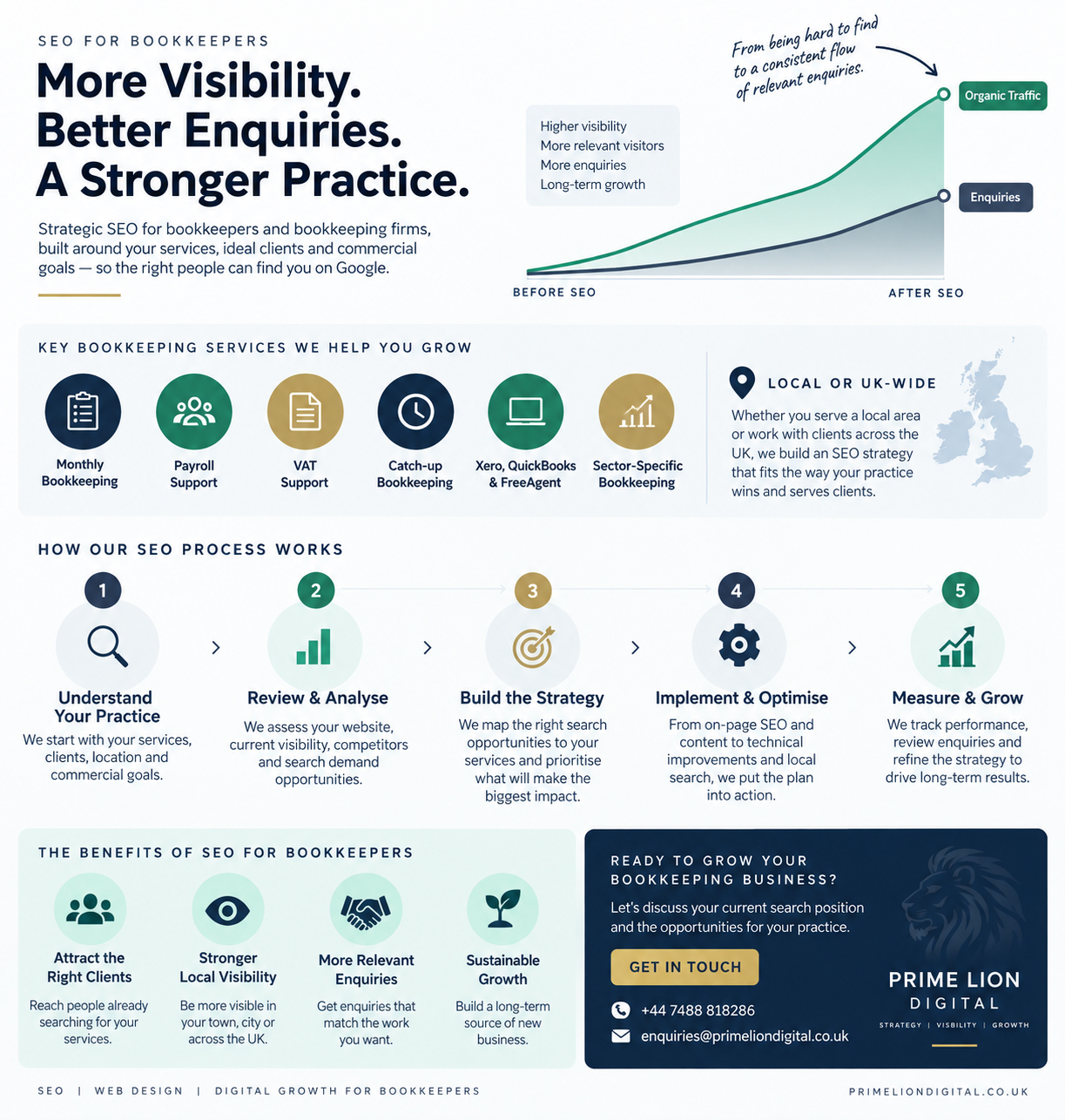
Our SEO Process for Bookkeepers
Understand the Practice
We begin with services, locations, ideal clients, current acquisition channels and the work the business wants more of. This gives the SEO strategy a commercial reference point.
Review What Already Exists
We assess the website, current rankings, indexation, service architecture, local presence and available Google Search Console or analytics data. Existing strengths are identified before changes are recommended.
Map Search Demand to the Business
Keyword and competitor research is organised around genuine services and client needs. Broad informational searches are separated from terms that could reasonably lead towards commercial work.
Prioritise the Constraints
One website may need technical corrections first. Another may have a sound platform but weak service pages. A locally focused bookkeeper might gain more from improving local search signals than from producing a large volume of new content.
We prioritise what is most likely to matter rather than applying the same monthly checklist to every practice.
Implement, Measure and Refine
Depending on scope, implementation can include on-page optimisation, service content, technical work, internal linking, local SEO and authority development. Performance is then reviewed against search visibility, relevant traffic and enquiry data, with priorities adjusted as evidence develops.
Related SEO Results and Practical Bookkeeping Scenarios
Related UK Accounting and Tax Project — Recorded Results
Our work with a UK accounting and tax business provides relevant evidence from a closely related professional-services market.
The project involved competitor and search-demand research, keyword clustering, service architecture, content development, on-page SEO, technical optimisation, internal linking and ongoing improvements. The work was not limited to SEO; the wider website and digital acquisition infrastructure also developed alongside it.
The website reached approximately 3,000 monthly organic visitors. In a recorded month, the business received 100+ website enquiries and 30+ telephone enquiries.
Those figures are not presented as a bookkeeping benchmark or as results created by SEO alone. They show what can happen when search visibility, service architecture, website quality, content and the enquiry journey are developed as connected parts of the same acquisition system.
Illustrative Scenario: A Local Bookkeeping Practice Reliant on Referrals
Consider a small practice that has built a stable client base through recommendations but is barely visible for non-branded local searches.
Jumping straight into a national content campaign would probably be the wrong starting point. A more proportionate plan could focus on the core services, local search positioning, Google Business Profile, reviews, business information and the pages prospective clients reach after discovering the practice.
Progress could then be measured through local search visibility, relevant organic visits, calls and website enquiries. There is no credible reason to attach a predetermined percentage increase to a scenario like this before the starting data is known.
Illustrative Scenario: A Remote Bookkeeper Targeting an Overly Broad Market
A remote bookkeeping business may initially want to rank nationally for the broadest bookkeeping terms available. The potential audience is larger, but so is the competition, and broad searches reveal relatively little about the type of client behind them.
If the practice has genuine experience with a particular sector, software environment or service model, narrowing the search architecture can create a more credible competitive position. The work might begin with focused service and sector relationships before attempting to build broader national visibility.
Here, the useful metrics would be growth in relevant impressions, qualified organic visits and suitable enquiries rather than whether the site reaches a headline position for the largest generic keyword.
How Much Does SEO for Bookkeepers Cost?
There is no sensible fixed price based purely on the fact that a business is a bookkeeper.
A sole practitioner needing focused local SEO around a small number of services has different requirements from a multi-service bookkeeping firm trying to compete across the UK. The condition of the existing website, competition, technical work, content requirements, geographic scope and authority of the domain all affect the amount of work involved.
We review the starting position before recommending a scope. In some cases the main constraint is relatively concentrated and does not justify a large SEO programme. In others, sustained work across content, technical SEO, local visibility and authority may be required.
That assessment also helps determine whether SEO should be the immediate priority at all. If the website cannot explain the service clearly or convert a reasonable level of existing demand, fixing that problem may come first.
Not sure where the main constraint is?
Prime Lion Digital can review your current search position, website and commercial priorities before discussing the most appropriate next step.
Putting Bookkeeping SEO Into Commercial Context
Search volume alone does not show what an SEO opportunity may be worth. For recurring bookkeeping services, even a relatively small number of suitable new clients can represent meaningful annual revenue.
| Illustrative Monthly Client Fee | Annual Revenue per Client | 3 New Clients | 5 New Clients | 10 New Clients |
|---|---|---|---|---|
| £150/month | £1,800 | £5,400 | £9,000 | £18,000 |
| £200/month | £2,400 | £7,200 | £12,000 | £24,000 |
| £300/month | £3,600 | £10,800 | £18,000 | £36,000 |
| £450/month | £5,400 | £16,200 | £27,000 | £54,000 |
| £750/month | £9,000 | £27,000 | £45,000 | £90,000 |
Illustrative calculations only. Figures assume the stated monthly fee continues for 12 months and do not represent recommended bookkeeping fees, SEO forecasts or expected Prime Lion Digital results. Client retention, service scope and actual revenue will vary.
Frequently Asked Questions
What is SEO for bookkeepers?
SEO for bookkeepers is the process of improving a bookkeeping business’s organic search visibility for relevant services and client needs. Depending on the practice, this can involve service architecture, keyword research, local SEO, technical improvements, content, internal linking, authority development and measurement.
How much does SEO for bookkeepers cost?
Cost depends on the starting position, competition, geographic market and scope required. A small local practice may need a relatively focused programme, while a bookkeeping firm competing across several services or wider UK markets can require substantially more work. We assess the existing position before recommending a scope.
How long does SEO take for a bookkeeping business?
SEO is generally a medium- to long-term acquisition channel. Some technical or on-page changes can be processed relatively quickly, but meaningful growth normally develops over time. Existing authority, competition, website quality and the searches being targeted all affect the timescale.
What are the best SEO keywords for bookkeeping?
There is no single best list. Useful bookkeeping keywords depend on the services offered, ideal clients, location and commercial priorities of the practice. Broad bookkeeping terms, local searches, individual services, software-related queries and sector searches may all be relevant in different circumstances.
Does a bookkeeper need local SEO?
Local SEO can be particularly useful where the practice serves a defined area or prospective clients value working with a nearby provider. A remote specialist bookkeeping business may place more emphasis on service or sector searches across a wider market.
Should I target my town or the whole UK?
It depends on how the business competes. Local targeting can provide a clearer opportunity for geographically focused practices. UK-wide SEO is more credible where the business serves clients remotely and has a sufficiently strong service, sector or specialist proposition to compete beyond its immediate area.
Do I need a new website before starting SEO?
No. An existing website may already provide a suitable foundation. We normally review its architecture, content, technical condition and current visibility before recommending a rebuild. Existing rankings, useful URLs and backlinks should be preserved where possible.
Should every bookkeeping service have its own page?
No. A dedicated page makes sense where there is a meaningful difference in search intent, client need or the information required to explain the service. Closely related terminology can often be covered naturally on the same page.
Can a sole bookkeeper compete with larger firms in Google?
Potentially, especially where the practice has a strong local position or genuine specialism. A sole bookkeeper does not need to compete with large firms for every broad national keyword. More focused search opportunities can be both more realistic and more commercially relevant.
How do you measure whether bookkeeping SEO is working?
We look beyond individual rankings. Relevant measures can include search visibility, organic visits to commercial pages, local discovery, enquiries and, where the available data allows it, the quality of opportunities generated through organic search.
Build Organic Visibility Around the Bookkeeping Work You Want More Of
A bookkeeping business does not need to appear for every search connected with bookkeeping. It needs a credible presence where its services, ideal clients and search demand genuinely overlap.
For one practice that may mean strengthening local visibility. For another it could involve restructuring service pages, resolving technical limitations or developing authority around a specialist market. The work should follow the commercial opportunity rather than an off-the-shelf SEO checklist.
Prime Lion Digital can review your current website and organic search position, identify where the strongest opportunities and constraints sit, and build the SEO strategy around the bookkeeping services you want to grow. For businesses looking at the wider relationship between their website, visibility and client acquisition, our digital services for bookkeepers hub brings those areas together.
Discuss SEO for your bookkeeping business
+44 7488 818286
enquiries@primeliondigital.co.uk