
Leave your details and our team will get back to you shortly to discuss your website, SEO or digital growth project.
Ecommerce Website Design UK Built Around How Customers Actually Buy
An ecommerce website has a harder job than a typical business website. It needs to help people find the right product, understand it, compare options, trust the business and complete a purchase without making any of those steps feel unnecessarily difficult.
Prime Lion Digital provides ecommerce website design for UK businesses that need more than an attractive online shop. We combine ecommerce UX, interface design, product architecture and development with the practical realities of payments, fulfilment, integrations, analytics and managing the store after launch.
That might mean building a new Shopify or WooCommerce store, redesigning an established ecommerce website, migrating from an ageing platform or developing something more specialised. We start with what the business and its customers actually need rather than forcing the project into a predefined package.
Planning an ecommerce project? Talk to Prime Lion Digital about the store, the commercial requirements and what needs to work better.
An Ecommerce Website Is a Buying Environment, Not Just a Digital Shopfront
Visual design matters. But it is rarely the reason an ecommerce project becomes difficult.
The harder questions are usually practical ones. How quickly can somebody find a relevant product? Can they distinguish between similar options? Does the product page answer the questions holding them back? What happens on mobile? Are delivery costs clear before checkout? Can the internal team manage products and promotions without creating more manual work?
These decisions are connected. Navigation affects product discovery. Catalogue structure affects filtering and search. Product information influences confidence. Mobile UX changes how much information a customer can comfortably process. Checkout design determines whether the final steps feel straightforward or uncertain.
Good ecommerce website design brings those pieces together. The storefront still needs to look right for the brand, but it also needs to make buying easier and remain practical for the people running it.
Where Ecommerce Websites Commonly Lose Customers
Most ecommerce problems are not obvious technical failures. The website loads, the basket works and payments can be taken. Yet customers still leave.
Sometimes the problem begins much earlier than checkout.
Finding the Right Product Takes Too Much Work
A navigation structure that works with 40 products may become frustrating at 400 or 4,000. Categories begin to overlap. Filters grow without a clear logic. Important attributes are inconsistent. Customers need to understand the company’s catalogue before they can use the website properly.
For larger stores, product discovery needs to reflect how people narrow their choices. Size, material, compatibility, brand, application, specification and price can all matter, but not every attribute deserves to become a filter.
The goal is not to offer the maximum number of choices. It is to help customers reach a sensible shortlist with less effort.
Product Pages Do Not Resolve Buying Questions
A product page has to do more than display photographs, a description, price and Add to Basket button.
What customers need depends heavily on what is being sold. Fashion buyers may need fit, sizing and returns information. Furniture customers care about dimensions, materials and delivery. Electronics often require specifications and compatibility. A trade buyer may need quantity pricing, stock information or account terms.
Those details should appear in an order that reflects the buying decision. Hiding important information in tabs, pushing delivery expectations too far down the page or giving every product detail equal visual weight can create friction even when all the necessary content technically exists.
Mobile Becomes a Smaller Version of Desktop
Mobile ecommerce needs its own thinking. There is less space for navigation, filters and product information, while every extra interaction feels more noticeable.
We consider touch behaviour, product imagery, option selection, filters, forms, purchase controls and checkout at smaller screen sizes throughout the design process. Mobile should feel like a deliberate shopping experience, not a desktop layout that happens to resize.
Where a project needs deeper behavioural research, prototyping or interaction work, our UI/UX services can support the wider ecommerce design process.
Checkout Adds Doubt at the Wrong Moment
 Someone reaching checkout has already done most of the difficult work. They have found a product and decided they are interested enough to buy it.
This is not the moment for unexpected delivery charges, unclear account requirements, unnecessary fields or confusing payment options.
A strong checkout is usually uneventful. The customer knows what they are paying, what information is required and what happens next.
How We Approach Ecommerce Website Design
There is no single design process that suits every online store. A direct-to-consumer brand with a focused range has very different requirements from a B2B supplier or an established retailer migrating thousands of SKUs.
We establish the commercial and operational requirements first. That gives the UX and design work something real to solve.
Customer Journey and Ecommerce UX
We look at how customers are likely to enter and move through the store. Some arrive through a category page from Google. Others land directly on a product from an advert, return to a saved item or search for something specific.
Understanding those journeys helps us decide what information, navigation and reassurance each stage needs rather than designing every page in isolation.
Information Architecture and Product Discovery
Product categories, attributes, variations and relationships need to make sense before detailed interfaces are designed.
Small catalogues often benefit from restraint. Larger ones may need layered filtering, stronger search, product comparison or navigation based on application rather than product type alone.
One issue we often look for early is whether the existing catalogue reflects how the business organises products internally rather than how customers actually look for them. The two are not always the same.
Category, Search and Filtering Design
Category pages need enough information for people to distinguish products without becoming crowded. Filters need to narrow choices meaningfully. Search should work particularly well for customers who already know what they want.
A clothing brand, furniture retailer and industrial supplier should not end up with identical filtering logic simply because they all use the same ecommerce platform.
Product Page Design
We structure product pages around the questions that need answering before purchase. That can include imagery, variations, specifications, sizing, availability, delivery, returns, reviews, finance or compatibility information.
The hierarchy matters. Essential buying information should not compete with secondary content for attention.
Mobile-First Ecommerce Design
Mobile behaviour is considered from the beginning rather than checked after desktop design is complete. Navigation, filters, product options, imagery, sticky controls and forms all need to remain usable when screen space is limited.
Basket and Checkout
Basket and checkout requirements vary between businesses. Guest checkout, express payments, promotional codes, delivery calculations, VAT treatment, finance and account functionality may all affect the journey.
We keep the process as simple as the commercial requirements allow.
Visual Design and Brand Experience
Commercial usability does not mean creating a generic-looking store. The visual system still needs to communicate the quality and character of the brand.
The difference is that visual decisions have to coexist with product information, merchandising and purchase actions. Ecommerce pages are working interfaces, not campaign posters.
Different Ecommerce Businesses Need Different Buying Journeys
There is no universal “best ecommerce layout”. The products, customers and business model change what the website needs to do.
A fashion retailer may rely on strong visual merchandising, easy variant selection and clear returns information. Furniture often requires dimensions, materials and more complex delivery expectations. Beauty brands may organise products around routines, ingredients, bundles or subscriptions. Electronics stores frequently need specification comparison and compatibility information.
B2B ecommerce can be different again. Account-specific pricing, quantity breaks, purchase orders, quotes, repeat ordering and restricted products may be more important than the conventional consumer shopping journey.
Even catalogue size changes the problem. Designing a store with 50 carefully curated products is not the same exercise as organising 10,000 SKUs with overlapping attributes.
This is why our custom ecommerce website design work starts with the commercial model and product structure rather than a standard page template.
The Storefront Is Only Half of the Ecommerce System
Customers see categories, products and checkout. The business sees stock, orders, customer records, product data, fulfilment, promotions, returns and reporting.
A store can look polished while creating considerable work behind the scenes. Manual stock updates, duplicate product entry, disconnected systems and fragile spreadsheets become increasingly expensive as order volumes grow.
Product and Inventory Management
We consider how products, variations, categories, stock and pricing will actually be maintained. Where another system controls part of that information, we establish how data should move between systems and which platform should be treated as the source of truth.
This becomes particularly important with large catalogues. A sensible product-data structure can save more operational effort over time than an impressive administration interface built around inconsistent information.
Payments, Shipping and Fulfilment
A UK retailer shipping standard parcels domestically may have straightforward requirements. International sales, multiple warehouses, unusual product dimensions or specialist fulfilment can change the technical scope considerably.
These requirements need to be understood early because they can influence platform choice, checkout and integrations.
CRM, ERP and Ecommerce Integrations
Many stores need to exchange information with CRM software, ERP systems, accounting platforms, inventory tools, fulfilment providers, marketplaces or internal applications.
Our ecommerce development services can include this work where it forms part of the wider project. For more complex system-to-system requirements, our API integration services cover data mapping, workflow logic and reliable connectivity between ecommerce and operational platforms.
Before connecting systems, we establish what information needs to move, which system owns it and what should happen if synchronisation fails. A successful API connection during development is only the beginning; the integration has to remain sensible when real orders and real data start moving through it.
Ecommerce Analytics and Tracking
Measurement should be planned before launch. Product views, internal search, add-to-basket behaviour, checkout stages and completed transactions can provide useful evidence for later decisions.
Tracking will not improve a store on its own. It does make it much easier to distinguish a genuine ecommerce problem from an assumption.
Shopify, WooCommerce or a Custom Ecommerce Build?
 Platform choice should follow the requirements, not the other way around.
Shopify Ecommerce Website Design
Shopify can work well for businesses that want a mature hosted ecommerce platform with relatively straightforward day-to-day management. Its ecosystem can also reduce the need to build common ecommerce functionality from scratch.
The trade-off is that applications, platform conventions and recurring costs need to be managed carefully. Adding an app for every new requirement can create its own performance and maintenance problems.
WooCommerce Ecommerce Website Design
WooCommerce can be a strong option where WordPress content management and greater technical flexibility are useful to the wider business.
That flexibility comes with more responsibility around hosting, plugin quality, security, compatibility and maintenance. For some businesses that is a reasonable trade-off. Others are better served by a more managed platform.
Custom Ecommerce Development
A more bespoke approach becomes relevant when standard platforms impose genuine restrictions around products, pricing, integrations or customer workflows.
Custom development is not automatically the premium choice. It carries additional development, testing and maintenance responsibility. We recommend it when the commercial requirement justifies that responsibility, not simply because “bespoke” sounds better.
Designing for Growth Beyond Launch Day
A store rarely stays the same for long. Product ranges expand. New categories appear. Marketing teams need landing pages and promotions. Businesses enter new markets, introduce warehouses or connect additional systems.
Not every future requirement belongs in the first release. Trying to build for every possible scenario can waste budget and create unnecessary complexity.
The architecture should, however, avoid making predictable growth difficult. A catalogue expected to grow should not depend on navigation that only works with 50 products. A business planning international expansion should consider market structure before duplicating large parts of the store. A company expecting B2B sales needs to know whether the selected platform can support the required account and pricing logic.
A useful question during planning is simple: what becomes difficult if the business succeeds?
Redesigning or Migrating an Existing Ecommerce Website
An established store brings a different type of risk. There are already customers, URLs, product data, analytics, order history and search visibility worth protecting.
We assess what should be preserved before deciding what needs to change.
Data Migration
Migration can involve products, variants, categories, images, customers, orders, reviews and supporting content. Moving everything is not always the right decision. Old stores often contain years of duplicated or obsolete data that should be understood before it is transferred.
Important records need validation after migration too. Matching product counts between platforms does not prove that variations, stock levels and relationships are correct.
Protecting Organic Search Visibility
Changing category and product URLs without a migration plan can put existing search visibility at risk. Valuable landing pages should be identified before the new architecture is finalised.
Redirect mapping, metadata, canonical behaviour and indexation controls can therefore form part of the migration rather than becoming an SEO repair job after launch.
Analytics Continuity
Tracking also needs continuity. If measurement changes significantly during a redesign, comparing performance before and after launch becomes unreliable.
We validate the new ecommerce event structure so that improvements are measured against meaningful data rather than changes in tracking configuration.
What Ecommerce Website Design Can Realistically Improve
A new design cannot guarantee more revenue. Product demand, pricing, traffic quality, competition, marketing and fulfilment all influence ecommerce performance.
What the website can do is remove avoidable friction from the environment in which those factors operate.
- Product discovery: make relevant products easier to find and compare.
- Buying confidence: answer important questions before they become reasons to leave.
- Mobile usability: make browsing and purchasing easier on smaller screens.
- Operational efficiency: reduce unnecessary manual work through better architecture and integrations.
- Technical foundations: support performance, measurement and organic search with a cleaner implementation.
Where the underlying platform is already suitable, a full rebuild may not be necessary. In those situations, focused ecommerce conversion optimisation can be a more proportionate investment.
Examples of Ecommerce Project Outcomes
Fashion Ecommerce UX Recovery
A UK fashion retailer was attracting strong paid traffic but mobile customers were abandoning category journeys and struggling with filtering. The work focused on category UX, simpler mobile filtering, clearer product cards, stronger sticky purchase controls and reduced visual clutter.
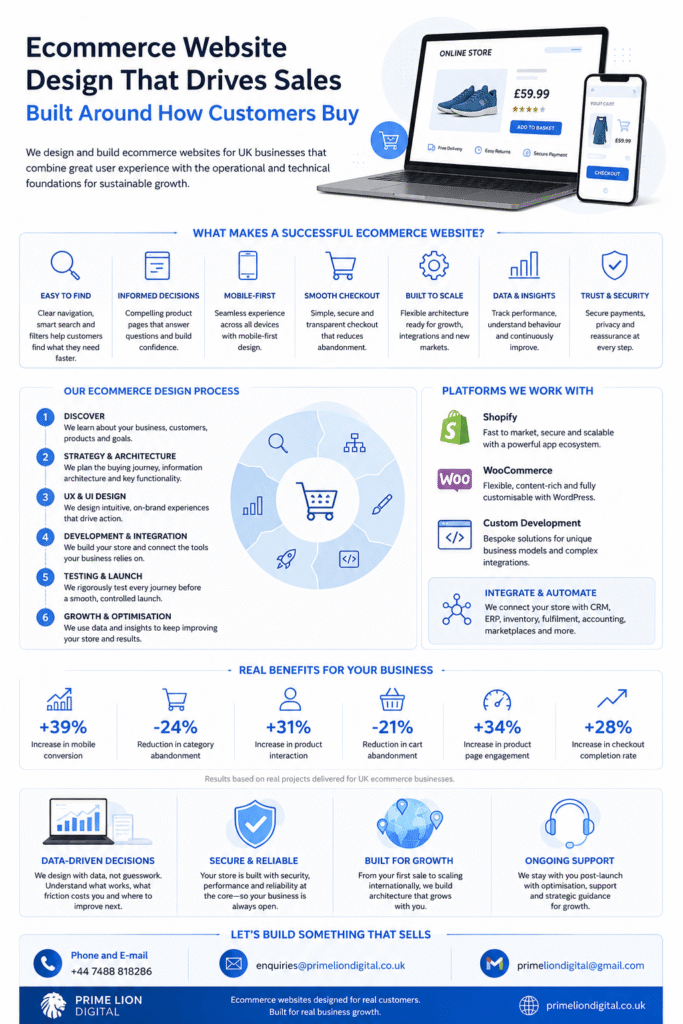
Within five months, mobile conversion increased by 39%, category abandonment reduced by 24%, product interaction increased by 31% and cart abandonment reduced by 21%. The commercial value was not simply a cleaner interface: more of the retailer’s existing traffic progressed further through the buying journey.
Electronics Catalogue Navigation
An electronics ecommerce business had grown beyond 4,000 products and customers were increasingly relying on internal search because category navigation had become difficult. Navigation depth, faceted filtering, predictive search, comparison visibility and product specification hierarchy were reworked.
Over six months, product-page interaction increased by 34% and bounce rate reduced by 19%, alongside stronger search engagement. For a catalogue of that size, making products easier to locate and evaluate reduced friction well before checkout.
Lifestyle Ecommerce Checkout Optimisation
A lifestyle ecommerce brand had healthy traffic and product demand but high checkout abandonment. Session analysis pointed to excessive form fields, weak delivery reassurance, distracting upsells and avoidable mobile payment friction.
After the checkout structure and reassurance hierarchy were simplified, checkout completion improved by 28% and returning-customer purchases increased by 17% within four months. The result came from reducing hesitation rather than adding more promotional pressure.
Our Ecommerce Website Design Process
Discovery and Requirements
We begin with the business, customers, products, existing technology and operational requirements. For an established store this can include analytics, current navigation, integrations and known problems. New ecommerce businesses may need more work around platform and scope definition.
Commerce, UX and Architecture
Customer journeys, catalogue structure, navigation and important page types are planned before detailed visual design. This is where we resolve decisions that become expensive to change once development is well underway.
UX and UI Design
Core ecommerce interfaces are designed around the agreed architecture and brand. Desktop and mobile behaviour are considered together, with particular attention to product discovery, product pages and purchase journeys.
Development and Integrations
The approved designs are implemented on the selected platform. Development can include reusable components, ecommerce configuration, custom functionality, payments, delivery and integrations with external systems.
Testing and Launch
Testing covers more than page appearance. We work through important customer journeys, variants, forms, basket behaviour, checkout, payments, delivery logic and integrations. Migration projects also require data, redirect and analytics validation.
Launch is treated as a controlled change, particularly where the business already depends on the store for revenue.
After Launch
Real customer behaviour usually reveals priorities that could not be confirmed during design. Ongoing work can include ecommerce UX, performance, SEO, analytics and ecommerce consulting where continued improvement is required.
How Much Does Ecommerce Website Design Cost in the UK?
The honest answer is that ecommerce website design costs vary considerably. A focused store using established platform functionality is a different project from a retailer migrating thousands of products, connecting an ERP and introducing custom B2B pricing.
Catalogue complexity, platform choice, data migration, integrations, custom functionality, international selling and the quality of existing product data all affect the scope. The number of visible pages is often one of the less useful ways to estimate an ecommerce project.
Prime Lion Digital prices ecommerce work against the requirements rather than applying the same package to every business. If you already have an existing store, catalogue or project brief, we can use that information to make the initial estimate more specific. Where the requirements are still uncertain, discovery helps separate what the business genuinely needs from functionality that can wait.
For a realistic project estimate, send us the current website or outline the catalogue size, preferred platform, integrations and functionality you expect the store to need.
What Affects the Cost of an Ecommerce Website?
A store with 100 simple products can sometimes be less complex than one with 20 highly configurable products. Equally, a visually straightforward website may require substantial work behind the scenes if it depends on multiple business systems.
The main cost drivers tend to be catalogue structure and variants, platform and design requirements, data migration, integrations, custom functionality, B2B or subscription logic, international selling and SEO migration.
Content readiness matters too. Product information that is inconsistent, incomplete or spread across several systems can create a significant data project before the storefront itself is ready.
This is why useful ecommerce quotations come from understanding the operation rather than counting templates.
Why Work With Prime Lion Digital?
We look at ecommerce projects across design, customer behaviour, development and business operations rather than treating the storefront as an isolated creative exercise.
That changes the questions we ask. We want to know how products are maintained, where orders go after purchase, what systems already hold customer and stock data, how customers currently find products and what the business expects to change over the next few years.
Sometimes the right recommendation is more custom development. Sometimes it is a simpler platform configuration. An additional app can solve a requirement quickly, but it can also add recurring cost and performance overhead. A complete migration may be justified, or the existing platform may only need a better implementation.
We prefer to make those trade-offs visible. It produces a clearer project and gives the business a better basis for deciding where its budget should go.
Ecommerce Website Design FAQs
How much does an ecommerce website cost in the UK?
The cost depends on catalogue complexity, platform, design requirements, migration, integrations and custom functionality. We scope these requirements before providing a project estimate rather than pricing purely by page count.
How long does an ecommerce website take to design and build?
Timescales depend on scope and how prepared the business is with product data, content and integration requirements. A focused new build can move considerably faster than a migration involving thousands of products and several external systems. We agree a delivery plan once the project requirements are understood.
Which ecommerce platform should I choose?
Shopify and WooCommerce are suitable for many UK businesses, while some projects justify more custom development. The choice should reflect catalogue requirements, internal management, integrations, checkout needs and future plans rather than platform popularity alone.
Do you design Shopify and WooCommerce websites?
Yes. Prime Lion Digital designs and develops Shopify and WooCommerce ecommerce websites where those platforms fit the project requirements.
Can you redesign an existing ecommerce website?
Yes. We can review the existing UX, product architecture, visual design and technical implementation before deciding whether improvement on the current platform or a wider rebuild makes more commercial sense.
Can you migrate an ecommerce website without losing SEO visibility?
No responsible agency can guarantee that a migration will have zero impact on organic visibility. The risk can, however, be reduced through proper URL mapping, redirects, metadata migration, technical SEO controls, testing and post-launch monitoring.
Can you integrate the website with our CRM, ERP or inventory system?
Yes, where the external systems provide appropriate integration options. We first establish which data needs to move, how often it needs to synchronise and which system should own each type of information.
Can you work with large product catalogues?
Yes. Larger catalogues require more planning around categories, attributes, filters, search, performance and product-data management. Those requirements are considered before the final architecture and technical approach are agreed.
Can you build B2B ecommerce functionality?
Yes. Depending on the platform, B2B ecommerce can include trade accounts, account-specific pricing, quantity discounts, purchase orders, quotes, restricted products and alternative ordering workflows.
Do you provide ecommerce SEO and optimisation after launch?
Yes. Ecommerce projects can connect with technical SEO, analytics, performance, UX and conversion optimisation. The appropriate ongoing scope depends on the store, its growth priorities and what the post-launch data shows.
Planning a New Ecommerce Website or Rethinking an Existing Store?
You do not need to arrive with a finished technical specification.
The project may start with a simpler problem: customers struggle to find products, the current platform is difficult to manage, mobile sales are weaker than expected, integrations are creating manual work or the store is no longer suitable for where the business is heading.
Prime Lion Digital can help turn those requirements into a practical ecommerce design and development plan, with the platform, scope and priorities made clear before unnecessary complexity is built into the project.
Discuss your ecommerce website project with Prime Lion Digital and get a clearer view of what should be built, what can remain simple and where the investment will matter most.