Website Design for Small Businesses in the UK
Leave your details and our team will get back to you shortly to discuss your website, SEO or digital growth project.
Professional Websites Built Around How Your Customers Actually Choose a Business
For many small businesses, the website is no longer just a digital brochure. It is often the first impression, credibility check, enquiry system and sales support tool all at once.
A potential customer may know very little about your business when they arrive. Within a short visit, they are trying to establish whether you offer the right service, operate in their area, look trustworthy and make it easy to take the next step.
A poorly structured website creates friction at exactly that point. Services are difficult to understand, mobile visitors struggle to navigate, important information is buried or there is no obvious reason to choose the business over a competitor.
At Prime Lion Digital, we provide website design for small businesses across the UK. We plan, design and develop professional websites around clarity, search visibility, customer behaviour and real commercial requirements — without adding technical complexity the business does not need.
The objective is practical: a website that represents the quality of your business properly, helps the right people find you and makes it easier for potential customers to become enquiries, bookings or sales.
A Small Business Website Has to Earn Trust Quickly
Large companies can sometimes compensate for a weak website through brand recognition, an established reputation or substantial advertising budgets. Smaller businesses rarely have that luxury.
Customers compare providers quickly, often from a mobile phone and often without any previous relationship with the companies they are considering.
They are usually asking straightforward questions:
- Can this business actually help me?
- Do they serve my area?
- Do they look established and trustworthy?
- Can I understand the service without having to call first?
- Is there evidence that they know what they are doing?
- How easy is it to get a quote, book or make contact?
 A strong small business website answers those questions without making the visitor work for the information.
Effective small business website design is therefore not primarily about adding more visual effects. It is about reducing uncertainty.
Why Small Business Websites Start Underperforming
Most small business websites do not fail because they look obviously bad. More often, performance declines through a collection of smaller problems that reduce confidence and make enquiries harder.
Customers Cannot Quickly Understand the Service
Business owners understand their own services in detail. New customers do not.
Internal terminology, vague headlines or overly broad descriptions can leave visitors unsure whether they are in the right place. A website has to communicate clearly to someone seeing the business for the first time.
The Website Looks Less Credible Than the Business
A good business can easily outgrow its website.
The company becomes more experienced, improves its service and wins better customers, while the website still reflects how the business looked several years ago.
That mismatch matters. Customers cannot see the quality behind the screen unless the website gives them enough evidence to believe it.
Mobile Visitors Have to Work Too Hard
Small buttons, awkward menus, slow pages, oversized forms and desktop-first layouts create unnecessary friction for people searching on a phone.
For a local service business, that can mean losing someone who was already prepared to call or request a quote.
There Is No Obvious Next Step
Not every business needs the same conversion action.
A plumber may need prominent call and quote options. A consultant may want prospects to book a conversation. A salon needs a booking journey. An ecommerce business needs customers to reach the right products and checkout with minimal friction.
The call to action should match how customers actually buy rather than being copied from a generic template.
The Website Was Built Without Search Visibility in Mind
A site can look polished while having weak page hierarchy, poor internal linking, thin service content or no meaningful local structure.
Repairing those foundations after launch is usually less efficient than considering them while the website is being planned.
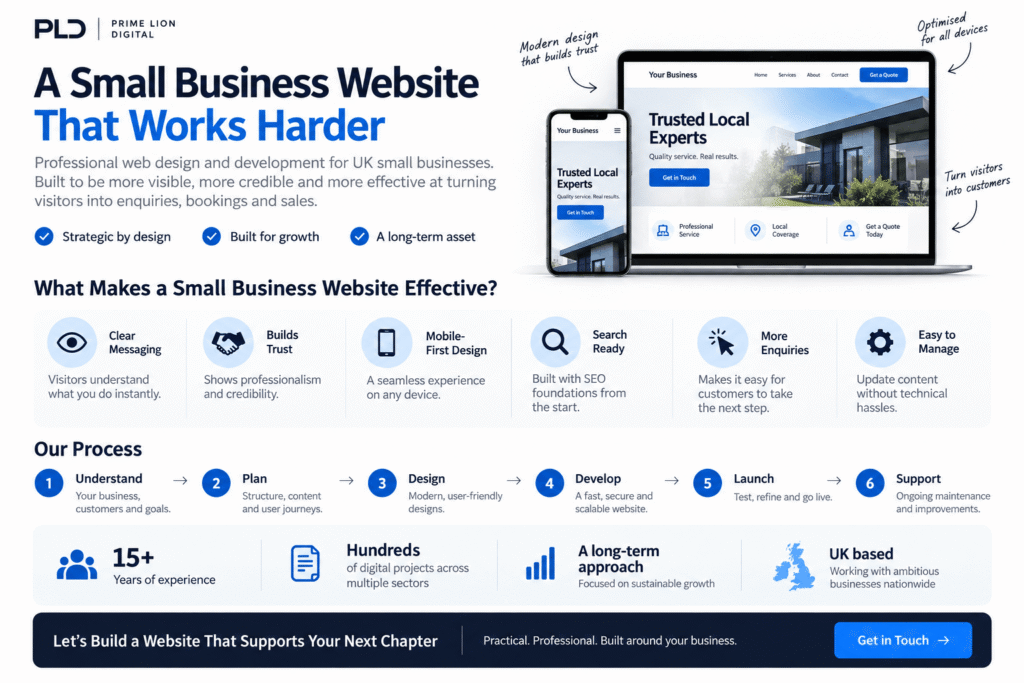
What Our Small Business Website Design Service Includes
Different businesses need different levels of design and development. A five-page consultancy website, a multi-location trades website and a small ecommerce store should not be treated as variations of the same package.
Our website services for small businesses can include the following, depending on what the project genuinely requires.
Planning and Website Structure
Before designing pages, we look at the business, services, customers, competitors, locations and the actions the website needs to support.
This helps determine the sitemap, page hierarchy and customer journeys before time is spent polishing individual screens.
UX and Website Design
We design around readability, credibility and ease of use. Visual design should support the business and its personality without making straightforward information unnecessarily complicated.
Website Development and CMS
The approved design is developed into a responsive, maintainable website using a platform appropriate to the project.
For many smaller businesses, WordPress web design offers a practical balance between flexibility, ownership and straightforward content management. More complex requirements may justify additional development rather than a collection of poorly matched plugins.
Mobile Optimisation
Layouts, navigation, forms and calls to action are designed for smaller screens from the beginning rather than treated as a desktop website compressed into a phone.
SEO Foundations
Page hierarchy, crawlability, internal linking, metadata structure, performance considerations and local relevance can be built into the project from the start.
This does not replace an ongoing SEO strategy where one is required, but it avoids launching with obvious structural disadvantages.
Forms, Booking and Business Integrations
Depending on the business, the website may need contact or quotation forms, appointment booking, payment functionality, CRM connections, email marketing or other operational integrations.
We recommend functionality because it improves the customer or business workflow — not simply because it can be added.
Analytics, Launch and Support
Where appropriate, analytics and conversion tracking can be configured so the business has a clearer view of how people use the website and which actions matter.
Before launch, important forms, mobile journeys, links and technical elements are checked. Support can continue afterwards for maintenance, content, performance, SEO and future improvements.
Professional Design Without Corporate Complexity

Small businesses need websites that feel professional, modern and credible without pretending to be multinational corporations.
Overly corporate design can create distance. At the other end of the market, cheap template websites often make completely different businesses look interchangeable because they use the same layouts, stock imagery and generic messaging.
Good design sits between those extremes.
We focus on clear hierarchy, strong typography, readable layouts, consistent branding, sensible use of visuals and obvious enquiry pathways.
Personality still matters. A family-run local business should not necessarily communicate like a financial consultancy, and a creative studio should not be forced into the same visual system as a construction company.
Professional design should strengthen how the business communicates, not overwhelm it.
Websites Built Around How Your Customers Actually Buy
People rarely visit a small business website because they want to explore every page. Usually, they are trying to complete a task.
They may want to check a price, compare services, find a location, see examples of previous work, understand availability or decide whether the business feels credible enough to contact.
That behaviour should influence the website structure.
Service pages need to answer the questions customers genuinely ask. Contact details should not be difficult to find. Forms should collect enough information to be useful without turning a simple enquiry into an application process.
Where enquiries are the main commercial objective, the principles behind lead generation website design become particularly important: the site needs to make the next step clear while giving visitors enough information to decide whether the business is right for them.
Trust signals should appear where uncertainty occurs rather than being isolated on an About page that many visitors will never read.
Good websites do not pressure visitors into converting. They remove the uncertainty that prevents action.
Mobile-First Websites for Real-World Customers
Customers search for businesses while travelling, working, comparing providers or dealing with a problem they want solved quickly.
A website that performs well on a large desktop screen but becomes frustrating on a phone can quietly lose valuable enquiries.
Mobile-first thinking affects navigation, button size, content order, form length, image weight, page speed and how quickly essential information appears.
For many websites for small businesses in the UK, the mobile experience is the primary customer experience rather than a secondary version of the desktop site.
Local SEO and Search Visibility From the Start
A new website does not automatically rank because it has been launched. The way it is planned and developed, however, can make future SEO substantially easier or unnecessarily difficult.
For businesses serving specific towns, counties or service areas, local search requires more than repeating place names throughout the copy. The website needs to make the relationship between services and locations understandable to users and search engines.
That may involve appropriate service pages, sensible location architecture, useful internal linking, local proof and consistency with the wider business presence online.
The website itself should provide a sound technical and structural foundation from day one, while businesses competing actively in local search may need an ongoing SEO strategy beyond the website build.
A Website You Can Actually Manage

Many small business owners want to change a service description, add an image or publish an update without contacting a developer each time. That is entirely reasonable.
Easy management, however, should not mean giving every part of the website unrestricted flexibility.
Complete freedom can gradually produce inconsistent layouts and broken page structures. A system that is too rigid creates the opposite problem: even minor changes require technical support.
The better balance is a CMS that gives the business control over the content it genuinely needs to manage while protecting the structural elements that should remain consistent.
- WordPress for flexible business websites;
- WooCommerce for suitable small ecommerce businesses;
- structured reusable content components;
- custom functionality where a genuine requirement justifies it;
- clear administrative access for day-to-day management.
The goal is to make ownership easier — not create technical dependence.
DIY Website Builder or Professional Website Design?
Not every new business needs a professionally developed website immediately.
For a very early-stage microbusiness with a limited budget, a simple service, little reliance on search and no complex functionality, a well-configured website builder may be enough to establish an initial online presence.
The decision changes when the website becomes an important acquisition or credibility asset.
If customers regularly compare you with competitors online, organic search matters, several services or locations need to be explained, paid campaigns are being used, or the existing site is limiting enquiries, professional small business website design in the UK becomes easier to justify commercially.
The comparison should not simply be “What is the cheapest way to put a website online?”
A more useful question is “What does this website need to do for the business over the next few years?”
A low initial build cost can become expensive if the owner spends significant time fighting the platform, pays repeatedly for workarounds or needs to rebuild as soon as the business grows.
Equally, there is no benefit in paying for bespoke development when a simpler system can meet the requirement properly.
What Should You Own When the Website Is Finished?
Website ownership is worth discussing before development begins rather than discovering the details after launch.
A small business should understand who controls its domain, website administration, content, analytics accounts, hosting arrangements and other important access credentials.
Third-party software and premium licences can have their own terms, so these should be distinguished from the content and assets the business itself controls.
This may feel like an administrative detail when choosing between website designers for small businesses, but it becomes important if you later change suppliers, bring marketing in-house or expand the site.
A professional relationship should reduce dependence, not create it through unclear access or ownership arrangements.
Websites for Different Types of Small Businesses
Different industries require different website strategies because customers make decisions differently.
- Local service providers may depend heavily on calls, quote requests, reviews and geographic visibility.
- Trades and contractors often need clear service-area information, examples of work and simple mobile contact journeys.
- Consultants and professional firms usually need deeper service explanations, expertise signals and better lead qualification.
- Health and wellness businesses may need appointment booking, practitioner information and carefully structured trust content.
- Creative businesses often rely more heavily on portfolios and visual differentiation.
- Small ecommerce brands need product discovery, performance, checkout usability and reliable store management.
- Hospitality and lifestyle businesses may depend on location information, bookings, menus, galleries or time-sensitive content.
The website should fit the business model rather than forcing every company into the same five-page template.
Do You Need a New Website or a Redesign?
An outdated website does not automatically need to be replaced from scratch.
If the platform remains technically sound, the content is useful and the underlying structure still makes sense, improving the design, navigation, mobile experience or conversion pathways may be the more sensible investment.
A broader rebuild becomes appropriate when the existing site is difficult to manage, structurally weak, technically unstable, slow, poorly suited to SEO or dependent on outdated functionality.
Existing search visibility also needs to be considered. Replacing URLs or removing useful pages without a migration plan can lose value the business has built over several years.
Our website redesign services can help where the business has outgrown the current experience but not everything needs to be discarded.
The decision should be based on what is worth preserving and what is genuinely holding the business back.
What Do We Need From You Before We Start?
One of the most common reasons website projects slow down is not development. It is waiting for decisions, content, images or access that nobody identified at the beginning.
Depending on the project, we may need information about your services, target customers, service areas, competitors, branding, existing website, domain, photography and any systems the website needs to connect with.
You do not need to arrive with a finished sitemap or professionally written copy. Those requirements can be established during planning.
What does matter is access to someone who understands the business and can make or approve decisions. Even a relatively small project can drag on if every service description or design choice waits weeks for approval.
Our Process for Small Business Websites
1. Understand the Business
We begin with the business rather than collecting a list of pages. We look at services, customers, competitors, geographic coverage, existing marketing and what the website needs to achieve commercially.
2. Plan the Website
We define the sitemap, content hierarchy, important user journeys and functionality before moving too far into visual design.
3. Design the Experience
Layouts are designed around clarity, usability and the actions customers need to take. Mobile behaviour is considered throughout rather than left until the end.
4. Develop and Configure
The website is built on the agreed platform with the required CMS structure, forms, integrations and technical foundations.
5. Add and Review Content
Services, images, calls to action and supporting content are reviewed in context. This is often where vague business messaging becomes obvious and can be improved before launch.
6. Test and Launch
Important journeys are tested across relevant devices and browsers. Forms, links, analytics and agreed functionality are checked before the website goes live.
7. Support and Improve
After launch, the website can continue evolving as the business adds services, targets new locations, learns from customer behaviour or invests further in SEO and marketing.
How Long Does a Small Business Website Take?
There is no useful universal timeline because scope matters.
A straightforward lead-generation website with clear content and limited functionality can usually move much faster than a multi-service site requiring copy development, booking functionality, integrations or migration from an established website.
The number of pages is only one factor. A five-page website with complex booking logic and unclear content can require more work than a larger informational site built around a clear structure.
Client availability affects delivery as well. Fast feedback, timely access to existing systems and clear approval responsibilities make a significant difference.
We establish expected project stages and dependencies before development begins so both sides understand what is required to keep the work moving.
How Much Does a Small Business Website Cost in the UK?
Small business website pricing varies significantly because the requirements behind apparently similar projects can be very different.
A lean website for a sole trader with a small number of services should not cost the same as a multi-location company website, a booking platform or an ecommerce store.
Typical cost factors include:
- number and type of pages;
- content and copy requirements;
- UX and design complexity;
- SEO setup and migration requirements;
- booking, ecommerce or payment functionality;
- custom development;
- third-party integrations;
- photography or branding requirements;
- hosting, maintenance and ongoing support.
Businesses looking for affordable websites for small businesses should consider value as well as initial build price.
Affordable does not have to mean cheap or disposable. A sensible project removes unnecessary functionality, uses the right level of technology and concentrates budget on the parts of the website that matter commercially.
Larger website packages for small businesses are not automatically better either. Paying for functionality customers will never use does not make a website more valuable.
When discussing website design for small business cost, we prefer to understand the actual requirement before giving a precise project figure.
The useful question is not only what the website costs to build, but what it will cost to own, maintain and eventually change.
What Happens After Launch?
A website should not become another source of stress once the project is finished.
Without basic maintenance, websites gradually accumulate outdated software, broken functionality, security issues and content that no longer reflects the business.
Support may include updates, security and backups, content changes, performance monitoring, SEO work and new functionality as the business grows. Our website maintenance services are available for businesses that want ongoing technical support after launch.
Not every company needs the same arrangement. Some owners prefer to manage most content internally and only need technical help when required. Others want ongoing support with the website, search visibility and future improvements.
The support model should reflect how the business actually intends to use the site.
Typical Small Business Website Project Scenarios
The examples below illustrate common small business website situations rather than presenting invented client results. Where project-specific performance data is not publicly available, we do not manufacture conversion percentages or present illustrative outcomes as verified case studies.
Local Trades Business With an Outdated Website
Business type: Electrical contractor serving several towns across Oxfordshire.
Starting problem: The website loads slowly, service areas are unclear and the mobile experience makes contacting the business unnecessarily difficult.
Typical project scope: Restructure service content, improve geographic information, rebuild the mobile enquiry journey, strengthen local SEO foundations and improve performance.
Useful measures: Qualified enquiries, calls from organic traffic, visibility for relevant local searches, mobile engagement and conversion from key service pages.
The commercial objective is not simply more traffic. It is helping more relevant local customers understand the service and make contact.
Professional Services Firm Whose Website Undersells the Business
Business type: Small UK consultancy.
Starting problem: The company has developed considerable expertise, but the website still feels generic. Services are vaguely described and enquiries often come from people who misunderstand what the firm actually does.
Typical project scope: Clarify service positioning, restructure key pages, introduce stronger expertise and trust signals, and improve the route towards consultation or enquiry.
Useful measures: Enquiry quality, consultation bookings, engagement with high-intent service pages and the proportion of enquiries matching the firm’s target customer.
For professional services, fewer but better-qualified enquiries can be more valuable than simply increasing form submissions.
Independent Ecommerce Business With Mobile Friction
Business type: Small UK retail ecommerce brand.
Starting problem: Product navigation is difficult on mobile, pages load slowly and customers encounter unnecessary friction before checkout.
Typical project scope: Improve product structure, mobile UX, performance, navigation and checkout flow while keeping day-to-day store management practical for the internal team.
Useful measures: Mobile conversion rate, product discovery, checkout abandonment, page performance and stability during promotional campaigns.
Where online sales are the primary requirement, our ecommerce website design service covers the deeper product, checkout and ecommerce considerations involved.
Why Small Businesses Choose Prime Lion Digital
Small business website projects need a different balance from large corporate programmes.
Owners usually need clear advice, sensible technology and a site that can support marketing without creating unnecessary operational overhead.
Prime Lion Digital works across website strategy, UX, development, SEO and ongoing digital growth. That means we can consider what happens before launch, how the site supports customer acquisition and how practical it will be to manage afterwards.
We do not assume every small business needs bespoke development, an enormous sitemap or a complicated marketing stack. We also do not reduce every project to a generic template simply because the company is smaller.
The appropriate solution depends on the business, its customers, its current stage and the role the website needs to play.
A good small business website should work like a practical business asset — not another piece of technology the owner has to manage.
Frequently Asked Questions
How much does a small business website cost in the UK?
Pricing depends on scope, number and type of pages, content requirements, design complexity, SEO, integrations and functionality. A straightforward lead-generation site will normally require a different budget from a booking website, multi-location site or ecommerce store.
How long does it take to build a small business website?
Timescales depend on scope and how quickly content, feedback and approvals are available. Straightforward projects usually progress faster than websites involving complex functionality, integrations or migration from an established site.
Do I need to provide all the website content?
Not necessarily. Some clients arrive with finished content while others need help defining page structure and messaging. The important point is to establish content responsibilities early so they do not delay design and development later.
Will I own my website?
Ownership and access arrangements should be clear before the project starts. This includes the website, domain, administrative access and relevant accounts, while third-party software and premium licences may remain subject to their own terms.
Can I update the website myself?
Yes, where that is part of the agreed setup. We aim to give businesses practical control over routine content while protecting important structural and design elements from accidental changes.
Is WordPress good for small businesses?
In many cases, yes. WordPress can provide a strong balance of flexibility, scalability and manageable content editing when it is built and maintained properly. It is not automatically the right platform for every project, so the choice should follow the requirement.
Should I use a website builder or hire a professional web designer?
A website builder can be suitable for an early-stage business with simple requirements and a very limited budget. Professional design becomes more valuable when the website plays an important role in enquiries, search visibility, customer confidence, integrations or future growth.
Do you include SEO?
SEO foundations can be incorporated into the website structure from the beginning, including page hierarchy, crawlability, internal linking, mobile usability and local considerations. Businesses competing actively for organic visibility may also require ongoing SEO work after launch.
Can you redesign my existing website?
Yes. We can assess what is worth preserving and whether the better approach is targeted improvement, a broader redesign or a rebuild. An existing site should not be discarded simply because parts of it need improvement.
Can you integrate booking or payment systems?
Yes, depending on the platform and business requirements. Booking, payment, CRM and other integrations should be selected around the operational workflow rather than added as unnecessary features.
Do you provide website maintenance and support?
Yes. Ongoing support can cover maintenance, security, backups, performance, content changes, SEO and future website improvements according to the needs of the business.
Can you build a website for a sole trader?
Yes. A sole trader may need a simpler website than a larger company, but the same principles still apply: customers should understand the service, trust the business and be able to make contact easily.
Can my website target several locations?
Yes, where the business genuinely serves those areas. Location targeting should be planned around useful, relevant content and a logical site structure rather than creating large numbers of near-identical pages simply to target place names.
Ready for a Website That Works Harder for Your Business?
If your current website no longer reflects the quality of your business, struggles to generate enquiries or has become difficult to manage, the first decision is not necessarily to rebuild everything.
We can look at what you have now, what customers need from the website and where the current experience is creating unnecessary friction.
For a new business, we can also help define the right level of website rather than adding functionality before there is a commercial reason for it.
Prime Lion Digital builds websites for small businesses in the UK around practical requirements: credibility, usability, search readiness, enquiries and manageable long-term ownership.
Tell us about your business, what you need the website to achieve and where you are now. We can then recommend a sensible next step and scope for the project.