Website Design for SaaS and Tech Companies That Need to Explain, Convert and Scale
Leave your details and our team will get back to you shortly to discuss your website, SEO or digital growth project.
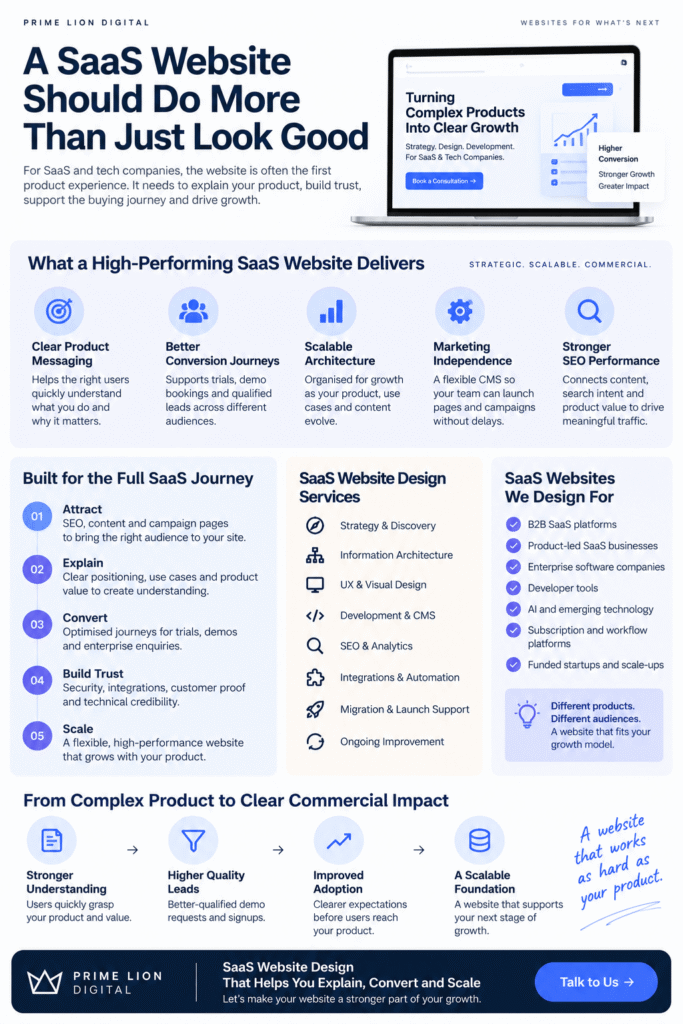
For SaaS and technology companies, the website is often the first product experience.
Before someone starts a trial, books a demo, reads documentation, speaks to sales or invites colleagues into the decision, they are already forming an opinion about the product through the website.
That judgement goes well beyond visual design. Prospective customers are trying to work out whether the product is relevant to them, how quickly they can understand it, whether implementation looks manageable and whether the company feels credible enough to trust.
If the website cannot explain those things clearly, even a strong product can become difficult to evaluate.
Prime Lion Digital provides website design for SaaS companies and technology businesses that need their marketing site to support more than brand presentation. We plan, design and develop websites around product understanding, acquisition, trials, demo journeys, content, SEO, analytics and the practical needs of a growing marketing team.
That may mean improving an established website, rebuilding a structure that no longer fits the product, creating a more flexible CMS, developing campaign pages or reshaping the wider site around new audiences, use cases and commercial priorities.
Your Website Is Often the First Product Experience
A SaaS website does not sit separately from the product. It shapes how people understand the product before they ever interact with the application itself.
Strong websites for SaaS companies therefore need to do more than describe features. They need to create useful momentum.
 One visitor might arrive because of a specific operational problem. Another is comparing vendors. Someone from IT wants to understand integrations. Procurement is checking security and implementation risk. A smaller self-service customer may simply want to know whether they can sign up and reach value quickly.
A developer evaluating an API and a finance director assessing implementation risk may be considering the same product, but they are asking very different questions. Good SaaS website architecture supports those differences without turning the site into a collection of disconnected funnels.
Who We Build SaaS and Technology Websites For
Different technology businesses need different balances of product storytelling, technical depth, conversion strategy and flexibility.
- B2B SaaS platforms that need clearer positioning, use cases, proof and better-qualified demo journeys.
- Product-led SaaS businesses where the website needs to reduce friction between discovery and signup.
- Enterprise software companies serving several stakeholders across technical, commercial and procurement teams.
- Developer tools where documentation, APIs and technical credibility matter as much as conventional marketing content.
- AI and emerging technology companies that need to explain unfamiliar products without relying on vague innovation language.
- Subscription and workflow platforms where product education and adoption are central to growth.
- Funded startups and scale-ups whose product, positioning and target market are changing faster than their existing website can accommodate.
The stage of the company matters as much as the category. An early SaaS startup may value speed and flexibility. A scaling product company may need stronger information architecture and greater marketing autonomy. An established software business may be dealing with migration risk, enterprise trust requirements and a far larger content estate.
Why SaaS Websites Start Underperforming
Most SaaS websites do not become ineffective overnight. The problems accumulate as the product and company evolve.
The Product Has Changed Faster Than the Website
New features arrive. New use cases appear. Enterprise customers become more important. Integrations multiply and messaging changes after customer research or sales conversations.
The website absorbs each change locally: another navigation item, another feature page, another audience page. Eventually everything is still there, but the structure no longer explains the product coherently.
If every product launch requires another menu item, the problem is not really the menu. The information architecture has stopped scaling with the product.
Visitors Understand the Features but Not the Value
SaaS companies know their products in detail, so websites naturally drift towards features, workflows and technical capability.
Customers usually need a different sequence. They first need to understand what changes for them if the product works. Feature depth matters, but only once the visitor has enough context to make sense of it.
One Conversion Path Is Serving Too Many Audiences
A self-service buyer may be ready to start a trial. A larger account may need a demo. A developer might want documentation before speaking to anyone. An enterprise buyer may need security and integration information first.
When every page ends with the same action regardless of intent, the website often creates friction rather than removing it.
Marketing Cannot Move Without Development Support
A website can look modern and still create operational drag behind the scenes.
If marketing needs developer involvement every time it launches a campaign page, introduces a new use case or tests a different conversion path, the website is slowing growth.
CMS flexibility has commercial value because positioning, campaigns and product content need to change without turning every adjustment into a development project.
Search Traffic and Product Journeys Are Disconnected
A SaaS company can generate substantial organic traffic without creating equivalent commercial momentum.
Educational content may perform well while product, use-case and integration pages remain weak. Visitors enter through useful articles but have no natural route towards the product that solves the problem they were researching.
That is an architecture issue as much as an SEO issue.
Product Clarity Must Come Before Feature Depth
Many SaaS websites introduce the product through features before users understand the core value.
A strong homepage should quickly help users answer three questions:
- What does the product help me achieve?
- Is it built for a business or situation like mine?
- Why should I evaluate this instead of the alternatives?
From there, the site can introduce use cases, workflows, integrations, pricing, implementation, onboarding and deeper technical detail at the appropriate point.
SaaS buyers rarely absorb everything in one visit. They scan, compare, return, share pages internally and revisit specific areas as the buying process develops.
The website should support that behaviour rather than trying to compress the entire sales conversation into the homepage.
Conversion Paths Should Match Your SaaS Growth Model

Product-Led SaaS
For self-service products, the website needs to reduce hesitation before signup. Users want to understand what they can achieve, how difficult setup will be and how quickly they can reach a useful outcome.
The transition between marketing site and product matters too. If signup feels like stepping into an entirely different experience, expectation and reality can separate before onboarding has even started.
Sales-Led B2B SaaS
For higher-value B2B products, the website also needs to improve the quality of conversations reaching sales.
A demo form cannot compensate for unclear positioning.
If buyers cannot establish who the product is for, which use cases it solves or whether implementation fits their environment, form conversion may look acceptable while demo quality remains poor.
Our broader B2B website design work covers longer commercial buying journeys where stakeholder education, trust and lead quality are central requirements.
Enterprise Software
Enterprise technology websites often support several stakeholders simultaneously. Operational leaders care about efficiency, finance about commercial impact, IT about integration and security, and procurement about risk.
The site does not need a separate experience for every job title, but those questions should be answerable without forcing everyone through the same product narrative.
Developer and Technical Products
Developer audiences have little tolerance for vague claims. Documentation quality, API structure, implementation examples and technical accuracy can influence trust before conventional marketing content does.
The challenge is serving technical users properly without making the product difficult for commercial stakeholders to understand.
What Our SaaS Website Design Service Includes
A SaaS website project can range from focused improvement work to a broader rebuild involving architecture, content, SEO, tracking and integrations.
Strategy and Discovery
We start with the product, audience and growth model rather than page designs. That means understanding how prospects discover the company, how the product is sold, what sales repeatedly has to explain and where the current website creates friction.
Information Architecture
We organise product, feature, use-case, integration, industry and resource content into a structure that remains understandable as the company grows.
The website should reflect the product, but it should not simply copy the internal product architecture. Terminology that makes sense to a product team may be completely wrong for a buyer trying to understand the category for the first time.
Product Messaging and UX
We organise the sequence through which users understand value, capability and differentiation, then design journeys around real tasks: evaluating fit, comparing options, finding integrations, checking pricing and deciding whether to trial, book a demo or continue researching.
Development and CMS
The technical implementation needs to support performance, maintainability and future change.
Our wider web development services cover projects requiring more substantial frontend, CMS or technical development.
Where publishing flexibility is a major requirement, our CMS development services can provide a more structured environment for product, campaign and content teams.
SEO, Analytics and Integrations
Search architecture should be considered while the site is being planned, not after development is finished. The same applies to tracking.
A demo request, free-trial signup, pricing interaction and enterprise enquiry can represent very different levels of intent. Measurement needs to preserve those differences.
Forms, CRM workflows, booking systems and marketing automation often sit directly behind the website journey. Where more substantial connectivity is required, our API integration services can support that layer.
Migration and Launch
For established SaaS businesses, launch is not simply the point where a new design replaces the old one.
Existing URLs, organic visibility, analytics, forms, CRM routing, conversion events, documentation and integrations all need to survive the transition where appropriate.
UX Should Reduce Cognitive Load
SaaS products are often complex. The website should not make them feel more complex than they are.
We structure SaaS websites around learning momentum: introduce the product clearly, provide enough context to keep the visitor moving and reveal deeper detail when it becomes useful.
Common UX problems include overloaded feature pages, unclear navigation, vague use cases, hidden commercial information and calls to action appearing before the visitor has enough confidence to act.
In many SaaS journeys, users are not resisting the product. They are resisting uncertainty.
The Pages a Growing SaaS Website May Need
There is no mandatory SaaS sitemap. Different page types exist for different commercial reasons.
- product and feature pages;
- use-case and industry pages;
- integration pages;
- pricing information;
- comparison or alternative pages;
- security and trust content;
- customer stories;
- documentation and implementation resources;
- educational content;
- campaign and product-launch landing pages.
Some pages create search visibility. Others help people evaluate fit, establish trust or remove the last obstacles before signup or contact.
Trying to make every page perform every job usually produces vague content and unclear journeys.
Landing Pages for SaaS and Tech Campaigns
Campaign pages are often where structural limitations become obvious.
A product launch, paid campaign, event or new integration may need a page quickly. If every landing page requires a mini redesign and several rounds of developer intervention, marketing becomes dependent on delivery capacity rather than campaign priorities.
We design landing pages for tech companies and SaaS businesses as part of a wider system rather than as disconnected one-offs. Reusable structures can accelerate production while still allowing enough flexibility for different messages, proof and conversion paths.
Information Architecture Has to Scale With the Product

Early SaaS websites are often simple. Complexity arrives gradually: new features, new audiences, more integrations, more documentation and new commercial models.
Without a scalable structure, the website becomes fragmented.
We design websites for tech companies and SaaS businesses with information architecture that can accommodate change without requiring a structural rethink every time the roadmap moves.
That may involve modular content models, reusable components and clearer rules around where new product information belongs. A technically flexible website can still become difficult to navigate if every team creates content according to a different logic.
SEO for SaaS Requires More Than Generic Traffic
SaaS SEO is not about chasing the largest possible search volume. It is about matching search intent with product value.
A stronger search architecture usually connects:
- problem-aware content for users researching operational challenges;
- solution-aware content for people comparing approaches;
- commercial pages for buyers evaluating products;
- use-case pages for specific industries or workflows;
- integration pages for technical discovery;
- documentation and resources that support adoption as well as search.
A high-performing article that attracts the right audience but provides no logical route towards relevant product content is only doing part of the job.
We therefore plan SaaS website architecture so SEO supports both discovery and commercial evaluation rather than operating as a separate content programme. The underlying site also needs a sound search-ready foundation, particularly around crawling, indexation, performance and architecture; these areas are covered in our technical SEO services.
Performance Is a Product Signal
A slow SaaS website damages more than user experience. It can affect product perception.
If the marketing site feels heavy or unstable, a technical buyer may reasonably wonder what that says about the software behind it.
Performance also matters commercially for paid campaigns, product launches and organic acquisition, so frontend implementation, asset weight, rendering behaviour and third-party scripts should be considered during the build rather than cleaned up afterwards.
Security, Integrations and Technical Credibility
Technology buyers often assess risk before they assess excitement.
For B2B and enterprise SaaS, security and integration information can sit directly inside the buying journey. A prospect may move from a use-case page to an integration page, then to security information, customer proof and finally a demo request.
Hiding those answers because they feel too technical can create unnecessary sales friction.
The aim is not to turn the website into a compliance manual. It is to make important reassurance available when users need it.
Content Should Help Users Understand and Justify the Product
SaaS content should help users make progress rather than simply attract visits.
For one person, progress means understanding the problem. For another, it means comparing approaches, convincing internal stakeholders or understanding how the product fits into an existing workflow.
For technical products, documentation can become one of the strongest trust signals on the site. Poorly organised documentation can create doubt before the user reaches the product.
Analytics Should Connect Website Behaviour With Product Goals

Basic traffic reporting is not enough for many SaaS businesses.
The useful questions are often about movement between stages: which content leads users towards product evaluation, which use cases produce stronger demo intent and whether different acquisition sources create different downstream outcomes.
If a campaign generates many demo requests but few suitable opportunities, website analytics should be considered alongside CRM outcomes. If trial volume increases while activation remains weak, the expectations created before signup may also deserve attention.
That makes analytics relevant to marketing, sales, product and onboarding rather than only monthly reporting.
Should You Redesign, Rebuild or Improve the Existing Website?
Not every underperforming SaaS website needs to be rebuilt.
If the structure is fundamentally sound and the CMS still supports the business, focused improvements to messaging, navigation, templates, conversion paths or performance may provide better value.
A larger redesign becomes more sensible when visual credibility, UX and product storytelling have fallen significantly behind the company.
A rebuild is usually justified when the limitations are structural: the information architecture no longer scales, the CMS restricts marketing, technical debt affects performance, integrations are fragile or every future improvement has become disproportionately difficult.
Our website redesign services cover broader redesign work where the existing platform still has value but the experience, architecture or technical implementation needs substantial improvement.
The right decision depends on the condition of the current website, not on the assumption that starting again automatically produces a better result.
Migrating a SaaS Website Without Losing What Already Works
Migration is one of the least visible parts of a redesign, but often one of the most commercially sensitive.
An established SaaS site may already have valuable rankings, backlinks, campaign URLs, CRM forms, conversion tracking and documentation paths used by customers.
A visually successful redesign can still damage the business if those assets are handled badly.
Migration planning may include URL mapping and redirects, content preservation, analytics validation, form routing, documentation continuity and technical SEO checks before and after launch.
Launch success is not simply “the new website is live”. The parts of the existing site worth preserving need to survive the move, and the new platform needs to support what comes next.
How We Work With SaaS Marketing, Product and Technical Teams
SaaS website projects rarely involve one stakeholder.
Product brings terminology and roadmap knowledge. Sales knows which questions prospects repeatedly ask. Marketing understands campaigns and acquisition. Developers know technical constraints. Leadership may still be refining positioning.
Those viewpoints are useful, but they do not always agree.
A product team may want more technical detail on the homepage while marketing needs a simpler message. Sales may want every objection answered immediately. Design wants clarity. SEO may need deeper coverage.
Part of the project is deciding how those trade-offs will be handled according to user and commercial priority.
Where the business has internal developers or product engineers, we can work alongside them. The marketing website does not need to use the same technical stack as the software product unless there is a practical reason for doing so.
If the requirement is development of the SaaS application itself rather than the website around it, our SaaS development services cover that separate technical scope.
Our SaaS Website Design Process
1. Product and Commercial Discovery
We establish what the product does, how it is sold, who influences the buying decision and what the current website needs to change.
2. Audience and Journey Mapping
We identify the important user groups and the information they need before progressing towards a trial, demo, technical evaluation or other meaningful action.
3. Content and Information Architecture
Product, use-case, feature, integration, resource and trust content is organised into a structure that supports both user understanding and future growth.
4. UX and Visual Design
Page structures and interfaces are designed around those journeys. The aim is not visual complexity; it is making a technically credible product easier to understand and evaluate.
5. Development, CMS and Integrations
The approved experience is developed with attention to responsiveness, performance, maintainability, publishing requirements and the agreed technical integrations.
6. Migration, QA and Launch
Where an existing website is being replaced, content and URLs are handled according to the migration plan. Important journeys are tested across devices and realistic scenarios before launch.
7. Ongoing Improvement
After launch, the website can continue evolving around product releases, campaigns, SEO opportunities, analytics and conversion behaviour.
How Long Does a SaaS Website Project Take?
Timescales depend on scope rather than the number of visible pages alone.
A focused redesign with clear content and few technical dependencies can move relatively quickly. A larger project involving positioning, several user journeys, content restructuring, integrations and migration naturally requires more time.
Client-side availability matters too. Product messaging may require founder or product-team input. Integrations may depend on developers. Security content may need internal approval.
A realistic project plan should identify those dependencies early rather than treating every delay as a development problem later.
What Does SaaS Website Design Cost in the UK?
The cost of SaaS website design varies because the underlying projects are rarely equivalent.
A smaller technology business with clear positioning, a contained sitemap and standard CMS requirements is a very different project from an established SaaS company with hundreds of URLs, several audiences, integrations and meaningful migration risk.
Typical cost drivers include strategy, the number and complexity of page templates, custom UX, CMS requirements, CRM or API integrations, content work, SEO migration, analytics and stakeholder review.
We prefer to understand those requirements before giving a precise project figure. An attractively specific estimate issued before anyone understands the product, content estate or integrations is not particularly useful.
A good budget conversation starts with what the website needs to change for the business.
Typical SaaS and Technology Website Project Scenarios
The examples below illustrate common SaaS and technology website situations rather than presenting invented client results. Where measurable project data is not available publicly, we prefer to be clear about that rather than manufacture conversion figures.
B2B SaaS Platform With Weak Demo Qualification
A workflow SaaS platform may have a capable product but a website dominated by features, making differentiation and ideal customer fit difficult to understand.
The work in this situation would typically focus on product hierarchy, operational use cases, clearer implementation messaging and a stronger route towards demo conversion.
Useful measures would include qualified demo rate, progression into genuine opportunities, engagement with high-intent product pages and whether sales conversations begin with better-informed prospects.
Technology Startup Whose Website Cannot Keep Pace With the Roadmap
An early-stage technology company may need to support product launches, evolving positioning, investor conversations and acquisition without rebuilding sections of the website every few months.
A modular content and CMS architecture can give marketing greater control over new use cases, product messaging and campaign journeys while maintaining structural consistency.
Commercial measures might include campaign-production time, the volume of changes marketing can make without developer involvement and the speed at which new product propositions can be tested.
Developer Product Serving Technical and Commercial Audiences
A developer-focused product can be technically strong while struggling to communicate effectively to both practitioners and business stakeholders.
Developers may require documentation, integrations and implementation detail. Commercial decision-makers need a clearer view of outcomes, organisational fit and adoption risk.
Separating those journeys within one coherent architecture can be assessed through documentation engagement, movement from technical content into product evaluation and the quality of trial or demo activity coming from different audience groups.
Why Prime Lion Digital for SaaS and Technology Website Design?
Designing websites for SaaS businesses sits between product communication, web development and commercial growth.
A design-only approach can miss the operational context. A development-only approach can produce a capable website that does little to improve product understanding. SEO can create visibility without solving what happens when the right visitor arrives.
Prime Lion Digital works across website strategy, UX, development, SEO, analytics and integrations, allowing us to look at how those disciplines interact rather than treating them as isolated projects.
We also do not assume every company needs a complete rebuild, the same CMS or the same conversion model. The appropriate solution depends on how the product is bought, how the business is growing and what the internal team needs to manage after launch.
Frequently Asked Questions
What does a SaaS website design project include?
The scope can include discovery, information architecture, UX/UI design, website development, CMS implementation, product and use-case structure, SEO foundations, analytics, CRM or marketing integrations, migration and launch support.
Should SaaS websites prioritise free trials or demo bookings?
It depends on the product, price point and sales model. Self-service products usually benefit from clear signup pathways, while higher-value B2B and enterprise products often need stronger demo qualification. Some companies need both.
What should a SaaS website explain before asking users to book a demo?
Users should normally understand what the product does, who it is for, the problems it solves and why it deserves consideration. Asking for a meeting too early can increase submissions without necessarily improving sales quality.
Can a SaaS website help reduce onboarding friction?
Yes. The website can set clearer expectations before signup, explain use cases, link to documentation and show what implementation or early product use looks like. Confusion created before signup often appears again during onboarding.
Should we redesign or completely rebuild our existing SaaS website?
Not always. If the existing platform and structure remain sound, targeted improvements may provide better value. A rebuild becomes more appropriate when architecture, CMS limitations, technical debt or integration problems prevent meaningful improvement.
Can you migrate an existing SaaS website without losing SEO?
Migration risk can be reduced significantly through proper planning. Important URLs, redirects, content, internal links, tracking and technical signals should be reviewed before launch. No migration is entirely risk-free, but SEO should be considered from the beginning rather than repaired afterwards.
Which CMS is best for SaaS companies?
There is no single best CMS. The right choice depends on publishing frequency, internal skills, governance, integrations, technical requirements and how much development support marketing should need after launch.
Can you work with our existing product and development teams?
Yes. SaaS website projects often involve internal marketing, product, sales and development teams as well as external providers. Responsibilities should be agreed early, particularly where the website connects with existing systems.
Can you build landing pages for campaigns and product launches?
Yes. Campaign and launch pages can be designed as part of a reusable system so marketing teams can move faster without creating a collection of visually and technically disconnected pages.
Do you design websites for both product-led and sales-led SaaS?
Yes. Product-led businesses often need faster routes towards signup and first value, while sales-led SaaS usually needs deeper qualification, proof and stakeholder reassurance before contact.
Can you help with SaaS SEO?
Yes. Search considerations can be built into website architecture, page planning, technical implementation and content relationships so SEO supports product discovery and commercial evaluation rather than operating as an isolated channel.
How important is documentation structure for SaaS SEO and adoption?
Documentation can support technical users, product adoption, support reduction and search discovery. Poor documentation structure can also damage credibility, especially for developer tools and technically complex products.
Is Your Website Keeping Up With the Product You Have Today?
A SaaS company can change considerably in twelve months while its website still reflects the product, audience and positioning it had several releases ago.
If visitors struggle to understand the product, every audience is pushed through the same conversion path, marketing cannot launch pages without developer support, or the site has become difficult to expand without creating more structural debt, the problem is unlikely to be visual design alone.
The strongest websites for SaaS companies connect product understanding, user education, acquisition, SEO, analytics, technical credibility and practical content management in one coherent system.
Prime Lion Digital can assess the current website, identify what is worth preserving and determine whether the right next step is focused improvement, a redesign or a broader rebuild.
Talk to us about your SaaS or technology website, how your product is sold today and where the current experience is making growth harder than it should be.