
Web Design Services for Bookkeepers in UK
Leave your details and our team will get back to you shortly to discuss your website, SEO or digital growth project.
A bookkeeping website should make the business easy to understand. Prospective clients need to see what you do, who you work with, whether your services fit their needs and how to take the next step without having to work it out for themselves.
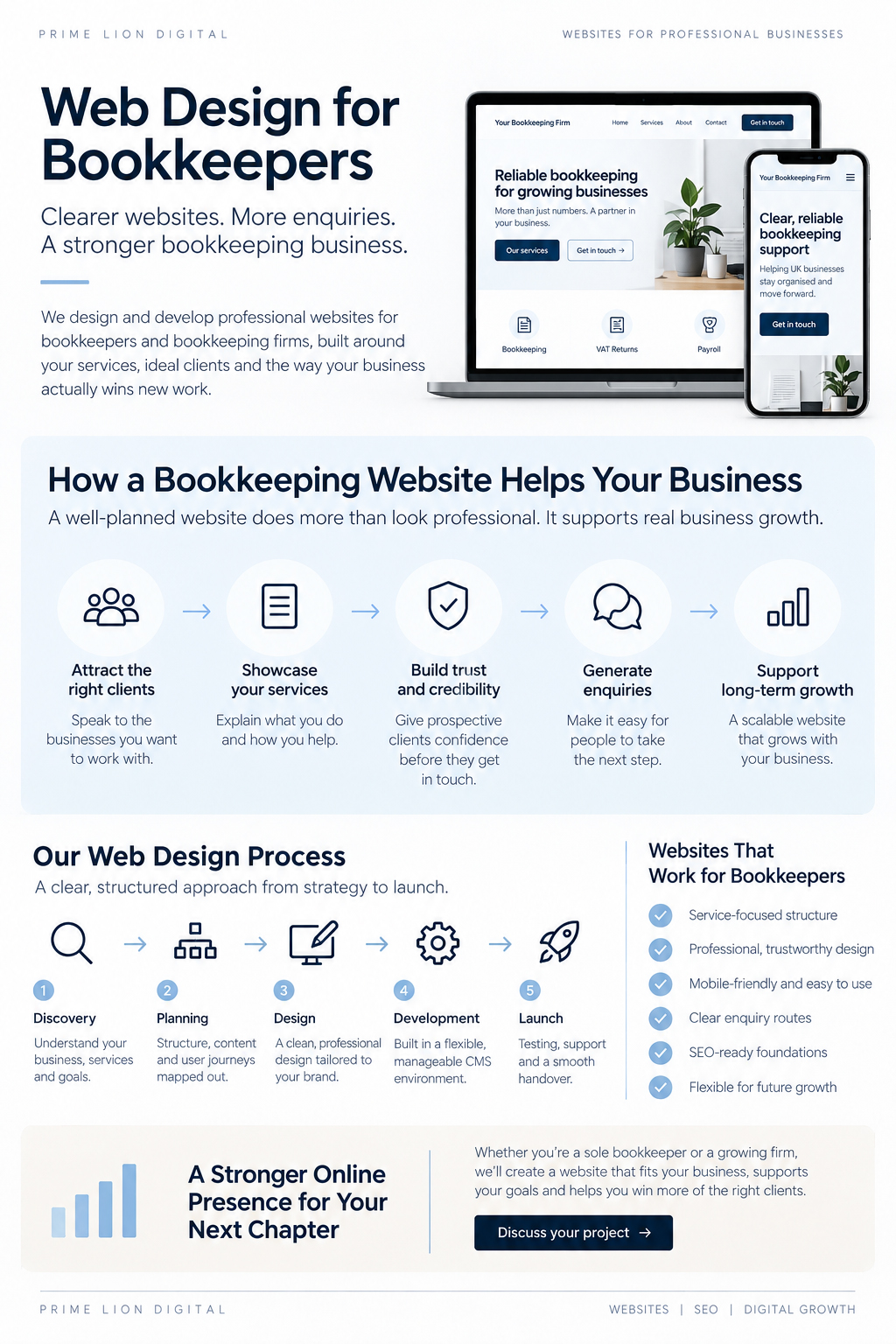
Prime Lion Digital provides professional web design for UK bookkeepers and bookkeeping firms. We plan the website around your services and ideal clients, then handle the structure, UX and visual design, development, content requirements, migration where needed, forms, testing and launch.
The useful question is not simply how the website should look. It is what the website needs to do for the bookkeeping business behind it.
Websites Built Around the Way Bookkeeping Businesses Win Clients
Bookkeeping firms do not all acquire clients in the same way. A sole bookkeeper serving businesses within a local area has different priorities from a growing practice providing bookkeeping, payroll, VAT and outsourced finance support across the UK.
That distinction should influence the website from the beginning.
Before deciding on layouts, we look at the services the business wants to grow, the clients it wants to attract, how new clients currently find the firm and what usually happens before somebody makes contact.
Bookkeeping Business → Services → Ideal Clients → Website Structure → Trust → Enquiry
Starting with the business helps prevent a familiar problem: a polished website that looks professional but gives prospective clients little reason to choose that particular bookkeeping firm.
Why a Bookkeeping Website Has to Do More Than Look Professional
Professional presentation matters. Bookkeepers handle financial information and become closely involved in the day-to-day operation of a client’s business, so an outdated or poorly organised website can introduce doubt before a conversation has even started.
Appearance, though, is only part of the job.
Someone may arrive after searching for a bookkeeping service, seeing the business locally, receiving a recommendation or already knowing the firm’s name. The website needs to make the essentials clear: whether the firm provides the right service, works with businesses like theirs, appears credible and offers an obvious next step.
If those answers are difficult to find, a visual redesign on its own is unlikely to solve the underlying problem.
What Should a Good Bookkeeping Website Actually Achieve?
More traffic is not automatically the objective of a website redesign. The immediate job is often to make existing and future visits more useful to the business.
A well-planned site should explain the firm’s proposition, organise its services logically and give the right prospective clients enough confidence to make contact. It can also help reduce unsuitable enquiries by making the scope of the business clearer before somebody gets in touch.
For one practice, monthly bookkeeping relationships may be the priority. Another may want to develop catch-up bookkeeping, VAT support, payroll or a broader outsourced finance service. Those commercial priorities should influence which services receive the greatest prominence rather than treating every offering as equally important.
What Difference Can Website Conversion Make?
The figures below are illustrative rather than performance benchmarks. They show why improving the quality of an existing website can sometimes matter as much as increasing traffic.
| Monthly Website Visits | Enquiry Rate | Approx. Enquiries per Month | Approx. Enquiries per Year |
|---|---|---|---|
| 500 | 1% | 5 | 60 |
| 500 | 2% | 10 | 120 |
| 500 | 3% | 15 | 180 |
| 1,000 | 1% | 10 | 120 |
| 1,000 | 2% | 20 | 240 |
| 1,000 | 3% | 30 | 360 |
Illustrative calculations only. Actual enquiry rates vary considerably depending on traffic quality, service, market, website, location and other factors.
Understanding Your Services Before Designing the Website
A list of services is not the same thing as a website structure.
A firm may provide bookkeeping, VAT returns, payroll and catch-up work, but the relationship between those services matters. Payroll might usually be sold alongside bookkeeping. Catch-up work might become a route into ongoing monthly support. VAT may be relevant to only part of the client base.
Understanding those relationships helps determine which services deserve dedicated pages, which can sensibly sit together and how visitors should move between them. It also prevents the site becoming unnecessarily large because every minor service variation has been turned into another page.
Website Structure for a Bookkeeping Business
Small bookkeeping websites often begin with a simple Home, About, Services and Contact structure. That can work well at an early stage. It becomes restrictive when the business starts offering several distinct services or needs to speak to clients with different problems.
A more developed site might separate areas such as monthly bookkeeping, VAT, payroll and catch-up bookkeeping while retaining a clear relationship between them. The exact architecture should follow the business rather than a predetermined page count.
We consider navigation, service hierarchy, page relationships, calls to action and future content requirements together. This makes the website easier for prospective clients to navigate and gives the business room to expand without repeatedly reworking its core structure. This sits within our wider website design approach, where structure and user journeys are planned before visual decisions are finalised.
Where the project also involves website development for bookkeepers, the technical implementation should support that architecture rather than forcing the business into a rigid template.
Designing for Trust Before a Client Makes Contact
Bookkeeping is a trust-led service. A prospective client may be considering giving somebody access to financial records, accounting software and information about how the business operates. The website cannot create trust by itself, but it can certainly undermine it.
Clear company information, genuine team details, relevant credentials, useful service explanations, real reviews and straightforward contact information all contribute to the decision.
Visual restraint can be useful here. A bookkeeping website does not need elaborate animation to appear established. Consistency, clarity and credible evidence usually matter more.
Service Pages That Help Prospective Clients Choose
A service page should do more than state that the firm offers bookkeeping.
Someone considering monthly bookkeeping may want to know what is normally included, what records they need to provide, whether cloud accounting software is supported and what type of business the service suits. A person looking for catch-up bookkeeping arrives with a different problem: their records may already be behind, incomplete or difficult to understand.
Those are different decision contexts even though both sit under bookkeeping. The website needs enough depth to explain the difference without turning navigation into a catalogue of near-identical pages.
Designing for Referrals as Well as Search
Not every valuable website visit starts with Google. Bookkeeping remains a referral-driven service, and the website often becomes the credibility check after somebody has already recommended the firm.
Recommendation → Website Check → Trust → Contact
That visitor may not need convincing from the beginning. They are looking for confirmation that the recommendation makes sense.
If the site looks neglected, makes the services difficult to understand or gives little indication of who is behind the business, the referral has to work harder than it should. This is one reason a good website still matters to a bookkeeping firm that already wins a substantial amount of work through recommendations.
Should Bookkeepers Show Prices on Their Website?
Publishing prices can reduce uncertainty and help people decide whether a service is broadly within budget before they enquire. For relatively standard packages, that can work well.
Bookkeeping fees, however, can depend on transaction volume, record quality, VAT requirements, payroll, software, frequency of work and the condition of the existing books. A rigid price may set the wrong expectation before the scope is understood.
Fixed packages are one option. Indicative ranges or “from” pricing can offer transparency without pretending every client requires the same amount of work. Some firms are better served by explaining how fees are determined and giving a price after an initial review.
The decision should reflect how predictable the work is and how the firm wants to qualify prospective clients.
Bespoke Bookkeeper Website Design vs Website Templates
A bookkeeper website template can be a sensible starting point. A new sole bookkeeper with a small service range, modest content requirements and a limited initial budget may not need a fully bespoke build.
The trade-off is flexibility.
As a practice develops, it may need a stronger service architecture, more control over layouts, integrations, different enquiry journeys, a larger content footprint and a design that is recognisably its own. Working around the limitations of an unsuitable template can eventually cost more than choosing a more flexible approach at the outset.
We assess the requirement first and recommend the level of custom design and development that the project actually justifies.
Mobile Design and the Enquiry Journey
Responsive design is expected. What matters is whether the mobile version remains genuinely usable.
Visitors should still be able to understand the page quickly, navigate between services and make contact without fighting with oversized elements or impractical forms. Information that works across a wide desktop layout may also need a different visual hierarchy on a phone.
Forms, Booking and Contact Routes
A smaller bookkeeping business may need little more than a well-designed contact form, telephone number and email address. Other practices may benefit from consultation booking, service-specific forms or a few qualification questions before an enquiry reaches the team.
The form needs to collect enough information to support the next conversation without turning first contact into an application process.
For businesses handling more enquiries, forms can also connect with CRM or internal management processes so that new opportunities have clearer ownership and follow-up. The integration should solve an operational problem, not exist simply because the technology is available.
SEO Foundations Without Turning the Website Into an SEO Template
Website design and SEO overlap, but they are different disciplines.
Site architecture, headings, URLs, internal relationships, mobile usability, performance and content structure can all affect how well a new website supports future organic visibility. These decisions are much easier to address before launch than after the site has been built.
That does not mean filling the website with awkward keyword repetition or creating dozens of near-identical location and service pages. Search structure should follow genuine services and useful distinctions.
Where organic acquisition is an important commercial objective, dedicated SEO work can then build on those foundations through search-demand analysis, service optimisation, supporting content, technical improvements and authority development.
Redesigning an Existing Bookkeeping Website Without Losing What Already Works
A redesign should begin by identifying what is worth keeping.
An established bookkeeping website may already have pages indexed by Google, useful content, external links, local visibility or URLs that clients regularly visit. Replacing those assets without reviewing them introduces avoidable risk.
We look at existing URLs and content, identify pages with organic or commercial value, decide what can remain and map redirects where URLs genuinely need to change. Where a project involves a larger move, our website migration work follows the same principle: preserve useful assets first and plan structural changes before launch.
Existing URLs → Useful Content → Search Visibility → Redirect Mapping → New Architecture
Sometimes a complete rebuild is justified. Sometimes a selective redesign is the better investment. We would not recommend replacing an existing website simply because it looks older.
Our Web Design Process for Bookkeepers
1. Discovery and Commercial Priorities
We start with the services you provide, the work you want more of, your typical clients, current acquisition routes and what is not working with the existing website.
2. Website and Content Architecture
We plan the main pages, service relationships, navigation and enquiry routes. If an existing site is being replaced, useful content and URLs are reviewed before decisions are made about the new structure.
3. UX and Visual Design
The interface is designed around the agreed architecture, with attention to clarity, credibility, mobile use and a visual identity appropriate for a professional financial service.
4. Development
Approved designs are implemented in a manageable CMS environment. Responsive behaviour, forms, technical foundations and agreed functionality are built into the site rather than added as disconnected extras later.
5. Content and Migration
Depending on scope, we can work with existing copy, restructure it or develop new website content. Where an established site is being replaced, agreed content and URLs are migrated carefully.
6. Testing and Launch
Key pages, navigation, forms, responsive behaviour and agreed technical requirements are checked before launch and reviewed again in the live environment. Ongoing website maintenance and support is also available where the business wants technical responsibility to continue after launch.
How Much Does a Bookkeeping Website Cost?
The cost depends on how much strategy, design, content, development and migration the project requires.
A focused website for a sole bookkeeper with a small service range is very different from rebuilding an established firm’s site with multiple service areas, existing organic visibility, custom forms and integrations. Branding and content readiness can also change the scope considerably.
We define the requirement before confirming a fixed project scope. That makes it easier to distinguish the work needed for launch from functionality that might be useful later but is not commercially necessary now.
Putting Website Investment Into Commercial Context
A website is normally used for several years, so the initial project cost can be more useful when considered against the number of clients it helps the business acquire over time.
| Illustrative Website Investment | New Clients Attributed Over 3 Years | Approx. Website Cost per Client | Average Clients per Year |
|---|---|---|---|
| £1,500 | 15 | £100 | 5 |
| £1,500 | 30 | £50 | 10 |
| £3,000 | 30 | £100 | 10 |
| £3,000 | 60 | £50 | 20 |
| £5,000 | 50 | £100 | 16.7 |
| £5,000 | 100 | £50 | 33.3 |
Illustrative calculations only. These figures are not forecasts or expected Prime Lion Digital results. Client acquisition depends on traffic, referrals, marketing, conversion, service demand and other factors.
How Long Does a Bookkeeping Website Take to Design and Build?
Delivery time follows scope. A compact new website can move relatively quickly when the services, branding and content are already clear. A larger redesign normally takes longer because existing pages, content, search visibility and migration decisions need to be reviewed alongside the new design.
Feedback and access matter too. Design approval, content decisions and access to existing systems can affect the schedule just as much as development itself. We therefore agree the main stages and dependencies at the start rather than presenting a generic timeframe that may not fit the project.
Bookkeeping Website Projects and Practical Outcomes
A Related UK Accounting and Tax Website Project
One relevant example comes from our work with a UK accounting and tax business. It is not presented as a bookkeeping-specific result, but the project involved many of the same professional-services challenges: a broad service range, trust-sensitive decisions, search visibility and the need to turn website visits into structured enquiries.
The work included website architecture, service content, design and development alongside SEO foundations and wider digital acquisition activity. As the digital presence developed, the site reached around 3,000 monthly organic visitors. In a recorded month, the business received 100+ website enquiries and more than 30 telephone enquiries.
Those acquisition figures should not be attributed to website design alone. They came from the wider relationship between site structure, content, SEO and digital activity. For the web project itself, the important point was that the architecture could support a growing service and content footprint rather than becoming a constraint as the business developed. You can see the wider work in our accounting and consulting website case study.
Related Professional Services Project: Recorded Digital Performance
The figures below come from a related UK accounting and tax project and provide useful context for the scale a professional-services website may eventually need to support.
| Recorded Metric | Result | Approx. Equivalent | Why It Matters |
|---|---|---|---|
| Monthly Organic Visitors | ~4,000 | ~130 per day | The website architecture needs to support sustained organic discovery across multiple services. |
| Website Enquiries | 100+ | ~3.3+ per day | Forms, service journeys and enquiry routes become operationally important as inbound activity grows. |
| Telephone Enquiries | 30+ | ~1+ per day | Not every website-assisted prospect converts through an online form, so telephone contact remains important. |
| Recorded Website + Phone Enquiries | 130+ | ~4.3+ per day | A growing digital presence needs to connect acquisition with a practical internal follow-up process. |
Approximate daily equivalents use a 30-day month. The 130+ figure is the simple combined minimum of 100+ website enquiries and 30+ telephone enquiries recorded in the same month. These are results from a related accounting and tax project, not a bookkeeping-specific benchmark, and they should not be attributed to web design alone.
Redesigning a Bookkeeping Site Without Replacing Everything
Consider an established bookkeeping business with a dated website that still contains useful service pages and some existing search visibility. The obvious answer might appear to be a complete replacement. It is not necessarily the best one.
A more careful project would identify valuable URLs and content first, then improve navigation, service presentation and the visual experience around those assets. Before launch, existing URLs can be accounted for, required redirects mapped, forms tested and priority service journeys checked against the previous site.
In this type of project, preservation is a meaningful outcome in its own right. Traffic and conversion changes can then be measured against the existing baseline rather than claimed before the redesigned site has real performance data.
This is an illustrative implementation scenario, not a claimed client result.
Creating the First Proper Website for a Sole Bookkeeper
Another project may begin with referrals, a social profile and perhaps a one-page site, but no clear place to explain services or send prospective clients.
The sensible first version does not need to be large. The work would start by clarifying the proposition, deciding which services genuinely need their own pages, establishing a credible visual and content structure, configuring practical enquiry routes and putting measurement in place from launch.
A useful initial outcome is therefore concrete: agreed core services represented, primary contact routes tested, analytics configured and a website architecture that can accept additional content later without requiring another immediate rebuild.
This is an illustrative implementation scenario rather than a claimed case study.
Frequently Asked Questions
How much does web design for bookkeepers cost?
It depends on the size and complexity of the project. A compact website for a sole bookkeeper requires a different level of strategy, design and development from a larger firm’s redesign involving existing content, migration, integrations and several service areas. We define the scope before confirming the project fee.
How long does a bookkeeping website take to build?
The timescale depends on scope, content readiness, design requirements, functionality and whether an existing website needs to be migrated. We agree the project stages and main dependencies before development begins.
Do you design websites for sole bookkeepers as well as bookkeeping firms?
Yes. The architecture should reflect the size and commercial needs of the business. A sole bookkeeper may need a focused site with a small number of clear services, while a growing firm may require a broader structure and more developed enquiry journeys.
Can you redesign my existing bookkeeping website?
Yes. We can review the existing site, identify what is worth preserving and determine whether a full rebuild or a more selective redesign is appropriate.
Will I lose my Google rankings when the website is redesigned?
A redesign can affect organic visibility if URLs, content and technical signals are changed carelessly. Existing rankings cannot be guaranteed, but migration planning can reduce unnecessary risk by reviewing valuable pages, preserving appropriate URLs and mapping redirects where URLs need to change.
Can I update the website myself?
Yes, where this is part of the agreed project requirement. For many bookkeeping businesses, a manageable CMS makes it possible to update routine content such as team information, service details and page copy without requiring development work each time.
Should every bookkeeping service have its own page?
No. Separate pages make sense where services have meaningfully different client needs, search intent or information requirements. Creating pages for minor variations purely to increase page count can make the website harder to maintain and less useful.
Should a bookkeeper display prices on their website?
It depends on how predictable the service scope is. Fixed packages or indicative pricing can reduce uncertainty, while more complex bookkeeping work may need to be assessed before a meaningful fee can be given. “From” pricing or an explanation of how fees are calculated can provide a useful middle ground.
Can the website connect to booking, CRM or accounting software?
Potentially, yes. The appropriate integration depends on the platform and the business process behind it. We first look at what information needs to move between systems and what should happen after an enquiry or booking is submitted.
Is a website template enough for a small bookkeeping business?
It can be. A good template may be an efficient starting point where the service range and functionality are straightforward. Bespoke design becomes more valuable when the business needs stronger differentiation, a more developed service architecture, specific functionality or greater flexibility as it grows.
Build a Website That Fits Your Bookkeeping Business
A bookkeeping website does not need unnecessary complexity. It does need to explain the business clearly, present its services professionally and give prospective clients a sensible route from interest to enquiry.
If you already have a website, we can first look at what is working, what is worth preserving and where the current structure may be limiting the business. If you are starting from scratch, we can plan the website around the services and clients you actually want to develop.
Prime Lion Digital also works across the wider financial services website sector, where credibility, clear service architecture and careful handling of trust-sensitive journeys are particularly important.
Discuss your bookkeeping website project with Prime Lion Digital.