
Tell us a little about what you’re looking for, and our team will be in touch to discuss how we can help.
Recruitment Video Production Services for UK Businesses
Give prospective candidates a clearer picture of the people, roles and working environment behind your vacancies. Prime Lion Digital provides recruitment video production for UK employers and recruitment agencies, helping organisations communicate what makes a role worth considering through carefully planned interviews, workplace filming and professional video editing.
A recruitment video can introduce your company culture, explain a specialist position, show a typical working day or support a wider hiring campaign. The most useful films go beyond attractive visuals: they answer questions candidates genuinely have before deciding whether to apply.
Recruitment video production starts from £1,000 per project. The final quotation depends on the creative brief, filming requirements, locations, participants, editing and agreed deliverables.
Whether you need a focused recruitment promo video or a collection of assets for a larger campaign, the starting point is the same: understand your target candidates, define what they need to know and select the right format for the message.
Request a Recruitment Video Production Quote
Recruitment Video Examples: Communicating Different Working Environments
Different industries require different approaches to recruitment storytelling. A manufacturing employer may need to explain its production environment and technical roles, while a healthcare organisation may need to communicate professional standards, workplace expectations and the experience of its people.
The following business video references illustrate industry settings that could inform recruitment video planning. They are not presented as completed recruitment campaigns or evidence of hiring results.
Manufacturing Business Video: Introducing an Industrial Workplace
Manufacturing recruitment often involves roles that candidates cannot fully understand from a written job description. A workplace film can help explain the production environment, the relationship between different teams and the practical nature of the work. This garment manufacturing video provides an industry-specific visual reference for considering how a production setting might be introduced on screen. For a dedicated recruitment film, the creative brief would need to go further by identifying the vacancies, speaking with suitable employees and showing relevant working conditions accurately. Technical terminology, workplace safety, filming permissions and operational disruption would all need consideration before production.
Healthcare Business Video: Presenting a Professional Service Environment
Healthcare recruitment films must communicate more than an appealing workplace. Depending on the organisation and role, candidates may want to understand team relationships, professional responsibilities, patient-facing duties, training and the support available to employees. This clinic video is a healthcare business reference rather than a verified recruitment film. It provides a useful starting point for discussing the difference between promoting a service to patients and introducing a workplace to prospective employees. A recruitment-focused production would require appropriate staff contributions, careful handling of confidential information and filming arrangements that protect patients, employees and normal clinical operations.
Solar Industry Video: Explaining a Specialist Technical Business
Recruiting for engineering, energy and other specialist sectors can be challenging when candidates have limited information about the employer’s actual projects and working environment. This CRG Solar video offers a sector-specific business video reference. In a recruitment context, a similar subject could be developed into a film explaining the types of roles involved, the practical demands of the work and how employees contribute to projects. The production decisions would depend on whether the target audience consists of experienced specialists, graduates, apprentices or people considering a career change. Clear explanations are particularly important when technical knowledge varies between candidate groups.
What Is Recruitment Video Production?
Recruitment video production is the process of planning, filming and editing video content intended to communicate employment opportunities, introduce an organisation as an employer or support the recruitment of particular candidates.
Unlike a general corporate promotional video, a recruitment film is built around the information a prospective applicant needs. The audience may want to know what a normal working day involves, who they would work with, what the organisation expects from them and what makes the opportunity different from similar roles.
Recruitment video production can serve several purposes:
- Employer branding: introduce the organisation’s working culture, people and values.
- Role awareness: explain what a specific position involves before candidates apply.
- Employee storytelling: allow existing employees to describe their own experiences.
- Recruitment advertising: create concise videos that direct suitable candidates towards a vacancy or careers page.
- Specialist recruitment: communicate technical roles, training routes or working environments that need more explanation.
- Recruitment agency marketing: introduce an agency’s specialisms, recruitment approach or employer-facing services.
Good recruitment videos should make the opportunity easier to understand. They should not create an unrealistic impression of the workplace or promise employment benefits that have not been confirmed.
Types of Recruitment Videos for Different Hiring Objectives
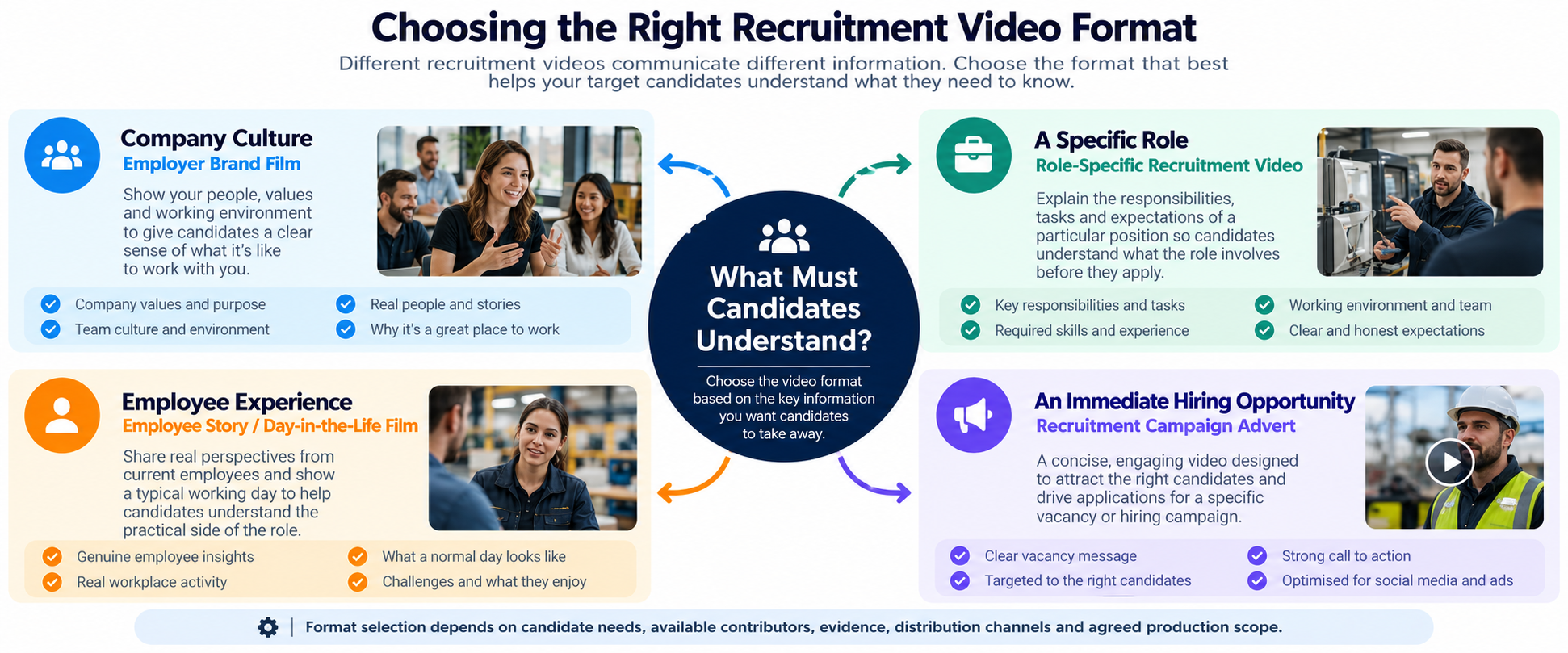
The appropriate format depends on the decision you want the viewer to make. A broad employer brand film can be valuable for long-term awareness, but it may be less effective than a role-specific video when the immediate task is to explain a difficult-to-fill vacancy.
| Recruitment video format | Main purpose | Suitable use | Key consideration |
|---|---|---|---|
| Employer Brand Film | Introduce the organisation as a workplace | Careers websites and employer branding | Needs a credible picture of the organisation, not only brand messaging |
| Role-Specific Recruitment Video | Explain a particular position | Vacancy pages and targeted recruitment | Must reflect actual duties and requirements |
| Employee Testimonial Video | Share a genuine employee perspective | Careers pages and social channels | Contributors should speak voluntarily and authentically |
| Day-in-the-Life Video | Show the practical working experience | Graduate, apprentice and operational recruitment | Filming must represent normal working conditions accurately |
| Recruitment Campaign Advert | Capture attention and prompt a next action | LinkedIn, paid social and recruitment campaigns | Needs a clear audience, message and destination |
| Recruitment Agency Promotional Video | Explain an agency’s specialism and service | Agency websites and business development | Must distinguish attracting candidates from attracting employer clients |
| Graduate or Apprenticeship Recruitment Video | Explain an entry-level career opportunity | Early-career recruitment and education outreach | Training, supervision and progression claims require verification |
Employer Branding and Company Culture Videos
An employer brand film introduces what it is like to work for an organisation. It may feature employees, managers, workplace environments and the principles that shape daily operations. The challenge is to turn broad statements about company culture into something candidates can understand.
Instead of relying entirely on claims such as “we are a supportive team”, a stronger brief identifies specific aspects of the employee experience that can be explained or demonstrated. These might include how colleagues collaborate, how new starters are supported or how responsibilities are shared.
Role-Specific Recruitment Promotional Videos
A role-specific recruitment promotional video focuses on one vacancy or closely related group of roles. It can introduce the work, responsibilities, environment and relevant people, helping applicants judge whether the opportunity suits their skills and expectations.
This is particularly useful when a job title is broad or unfamiliar. A role called Project Coordinator, for example, may involve very different activities in construction, technology or professional services. A carefully structured film can explain those differences without replacing the formal job description.
Employee Stories and Day-in-the-Life Films
Employee-led films allow candidates to hear from people who understand the work firsthand. Interviews can explore how employees joined the organisation, what their roles involve and which aspects of the job they find meaningful or challenging.
A day-in-the-life format adds practical context. It may show different tasks or workplace interactions, subject to access and consent. The editorial challenge is to create an engaging film without making an ordinary working day look misleadingly exceptional.
Creative Recruitment Videos and Campaign Advertising
Creative recruitment videos can use concise storytelling, distinctive visual ideas, interviews or campaign-specific messages to attract attention. Creativity is useful when it helps the intended audience understand the opportunity more quickly or remember the employer.
For paid recruitment campaigns, the film may need to communicate its main message in the opening seconds and direct viewers towards a relevant vacancy page. A visually interesting recruitment advert without a clear role, audience or next step may attract views without supporting the hiring objective.
What Makes a Good Recruitment Video?
The best recruitment video is not necessarily the most elaborate production. Its effectiveness depends on whether the film communicates useful, credible information to the right candidates and fits the channels where it will appear.
Start With the Candidate’s Questions
Recruitment content should be developed from the audience’s perspective. Someone considering a warehouse position may prioritise shift arrangements, workplace conditions and practical duties. A senior software engineer may be more interested in technical responsibilities, team structure and the nature of the projects.
Before production, identify what the audience already knows, what they are likely to misunderstand and which questions a video can answer more effectively than text alone.
Use Authentic Employee Contributions
Real employees can provide valuable insight, but authenticity does not mean filming interviews without preparation. Contributors should understand the purpose of the film, the topics they may be asked about and how their material is intended to be used.
Questions should encourage specific answers rather than scripted praise. An employee describing a real task or explaining how their team works will often provide more useful information than a general statement that the company is a great place to work.
Represent the Role Accurately
Recruitment videos can influence employment decisions. It is therefore important to distinguish confirmed working arrangements and benefits from aspirational employer branding messages.
Where a role includes physical requirements, travel, customer contact, shift work or specialist responsibilities, the film should not conceal relevant information simply to create a more attractive impression.
Design for the Intended Viewing Context
A video intended for a careers page may have more time to explain the organisation than a social-media advert. Mobile viewing, captions, the visibility of important information and the position of the call to action should be considered when planning the output.
Accessibility is also relevant. Clear speech, readable graphics and accurate captions can make content easier to understand for a wider audience, including people watching without sound.
Recruitment Video Production for Employers and Recruitment Agencies
Employers and recruitment agencies may both need recruitment videos, but their commercial objectives are not always the same.
Recruitment Videos for Direct Employers
A direct employer typically wants to explain its own workplace and attract candidates to specific roles or future opportunities. A film might focus on the wider employer brand, an individual department, a new facility or a particular hiring campaign.
For organisations recruiting across several locations, production planning should consider which messages apply company-wide and which details need to be specific to individual sites or teams.
Recruitment Agency Video Production
A recruitment agency may need content for two distinct audiences: employers seeking recruitment support and candidates considering opportunities through the agency.
An agency promotional film could introduce sector specialisms, consultants and the recruitment approach. A separate candidate-facing video might explain how applicants are supported or introduce a particular hiring campaign. Combining both audiences in one short film can dilute the message, so separate edits may be worth considering.
IT Recruitment Videos and Technical Hiring
IT recruitment video production can help employers explain roles that are difficult to communicate through generic vacancy advertising. Potential subjects include the kinds of technical challenges employees work on, how teams collaborate and what responsibilities a role carries.
Technical accuracy matters. An interview with a relevant team member can help avoid vague statements about innovation or technology. However, confidential systems, customer data and proprietary information must be excluded unless their use is authorised.
Healthcare, Manufacturing, Retail and Hospitality Recruitment
In operational industries, the physical workplace is often an important part of the employment proposition. Filming may need to accommodate working equipment, customers, patients, production schedules or safety procedures.
A useful recruitment film explains the role while respecting these constraints. It should not interrupt essential work or expose private information merely to obtain attractive footage.
How Recruitment Video Production Works
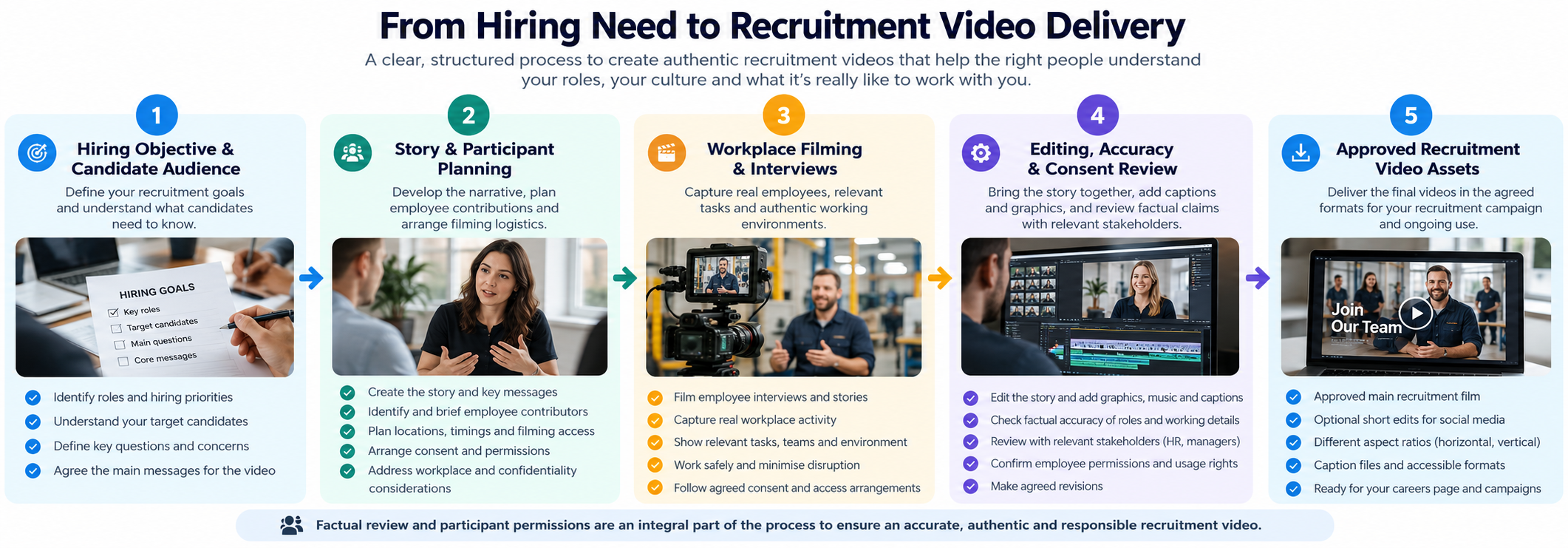
A recruitment video project benefits from a structured production process, although the precise activities depend on the scope. The following stages provide a practical framework for discussing a brief, assigning responsibilities and reducing avoidable revisions.
1. Define the Hiring Objective and Candidate Audience
The first decision is what the film needs to achieve. Is the organisation introducing itself to future applicants, explaining an active vacancy or supporting a short recruitment campaign? Each objective calls for a different balance of information, storytelling and calls to action.
The intended candidates should be defined as specifically as practical. Their level of experience, likely questions, relevant motivations and familiarity with the industry can all affect the script and format.
2. Plan the Story, Contributors and Filming
Planning establishes the main message, interview topics, locations and supporting footage. It should also identify the people who can speak accurately about the role and who has authority to approve employment-related claims.
At this stage, practical issues such as filming access, staff availability, workplace safety, employee consent and confidentiality should be addressed. These considerations affect both the production schedule and the suitability of the final material.
3. Film Employees and Relevant Working Environments
Production may involve interviews, workplace footage, demonstrations or other material relevant to the brief. The priority is to capture content that supports the intended story rather than collecting visuals without a clear editorial purpose.
For interview-led recruitment films, intelligible speech and a comfortable contributor experience are particularly important. The film should allow employees to communicate naturally while providing enough context for candidates unfamiliar with the organisation.
4. Edit the Recruitment Story and Review Accuracy
Editing brings the selected material into a coherent narrative. Depending on the agreed scope, it may involve interview selection, supporting visuals, music, titles, graphics, captions and different output versions.
Review should address more than appearance. Employers need to check factual statements about responsibilities, working arrangements, benefits, locations and recruitment opportunities. The relevant contributors and stakeholders should also have the agreed opportunity to review material where appropriate.
5. Approve and Deliver the Agreed Video Assets
The final stage is approval and delivery in the formats specified in the quotation. A main film, social edits, caption files and alternative aspect ratios are separate potential outputs; they should not be assumed to be included unless agreed.
Clear approval responsibilities and a defined list of deliverables help prevent misunderstandings, especially when several departments or recruitment stakeholders are involved.
Planning Employee Interviews and Authentic Workplace Footage
Employee interviews can be one of the most useful elements of a recruitment film, but they require careful planning. The aim is to obtain clear and relevant information without putting words into contributors’ mouths.
Questions might explore what the person does, how their role connects with colleagues, what new starters should expect and what skills are useful. Broad questions can be combined with practical follow-ups that encourage examples.
The interview plan should also distinguish personal experience from official company information. An employee can describe their own experience, but they may not be authorised to confirm company-wide benefits, salary policies or future career progression.
Supporting footage should add context to the interview. Showing relevant tasks, spaces or working interactions can make the film more informative, provided the material is authentic and the filming is permitted.
For workplaces involving customers, patients, children, confidential records or commercially sensitive operations, filming arrangements may require additional restrictions. Alternative shots, controlled filming periods or a narrower brief may be more appropriate than recording unrestricted activity.
Choosing the Right Recruitment Video Format and Length
There is no universal ideal duration for a recruiting video. Length should be determined by the information the viewer needs, the distribution channel and the action the organisation wants them to take.
A short campaign advert may introduce a vacancy and encourage a click. An employer brand film may need more time to explain the organisation. A specialist role video may require a fuller description of responsibilities and working conditions.
| Distribution context | Suitable content approach | Length consideration | Candidate action |
|---|---|---|---|
| Careers homepage | Employer brand introduction | Enough time to explain the workplace without unnecessary detail | Explore careers or vacancies |
| Individual vacancy page | Role-specific explanation | Long enough to answer important role questions | Review job details and apply |
| LinkedIn organic post | Employee story or concise role introduction | Prioritise a clear opening and mobile readability | Visit the relevant careers page |
| Paid social campaign | Focused recruitment advert | Keep the message concise and suited to the placement | Open a specific vacancy or campaign page |
| Graduate recruitment | Employee experience and learning opportunities | Allow time to explain the programme accurately | Review eligibility and programme details |
| Recruitment agency website | Agency introduction or sector-specialist film | Match the depth to candidate or employer intent | Register interest or make an enquiry |
As an editorial starting point, a short advert might run for around 15–45 seconds, while an employee story or employer brand film might run for approximately 60–180 seconds. These are planning examples, not fixed production rules or confirmed PLD package durations. Some subjects need less time; others require more.
The key question is whether every part of the film helps the intended viewer make a more informed decision.
What Can Be Included in a Recruitment Video Project?
The exact deliverables should be agreed before production. A single recruitment film and a multi-channel recruitment video campaign are different scopes, even if they use some of the same footage.
| Production element | Purpose | What to agree in the brief |
|---|---|---|
| Creative planning | Define the audience, message and narrative | Objectives, participants and required approvals |
| Interview preparation | Develop useful employee or stakeholder contributions | Interviewees, questions and consent arrangements |
| Workplace filming | Show relevant people, tasks and environments | Locations, access, filming time and restrictions |
| Main edited recruitment video | Deliver the principal agreed story | Approximate duration, content and output format |
| Short campaign edits | Adapt selected messages for other placements | Number of versions and intended channels |
| Captions and subtitles | Support accessibility and silent viewing | Language, caption format and accuracy review |
| Motion graphics and titles | Present important information clearly | Approved wording, brand assets and complexity |
| Alternative aspect ratios | Prepare content for different screen formats | Horizontal, square or vertical outputs |
| Additional filming | Cover more roles, sites or contributors | Extra locations, schedules and production costs |
These are possible components, not an all-inclusive package. The quotation should identify which items are included and which require separate approval or additional fees.
Recruitment Video Production Costs in the UK
Prime Lion Digital recruitment video production starts from £1,000 per project. This is a starting price rather than a fixed fee for every recruitment film.
A relatively focused production involving a straightforward message and limited filming requirements may need less work than a campaign covering several departments, locations and employee groups. The number of final videos can also make a substantial difference to editing and approval requirements.
What Affects Recruitment Video Production Pricing?
| Cost factor | Why it matters | Useful information for a quotation |
|---|---|---|
| Creative complexity | More detailed narratives may require additional preparation | Hiring objective and key messages |
| Number of locations | Travel, access and scheduling affect production | Addresses and filming restrictions |
| Number of contributors | Additional interviews require coordination and editorial selection | Expected employees or stakeholders |
| Filming requirements | Workplace conditions and specialist access can affect the shoot | Environment, activities and safety constraints |
| Editing complexity | Story development, graphics and audio work vary by brief | Preferred style and reference examples |
| Number of deliverables | Multiple edits and formats require additional production work | Main film and any campaign versions |
| Review and approval requirements | Multiple decision-makers may increase coordination | Who approves content and employment claims |
| Usage and third-party assets | Music, footage or other licensed material may have conditions | Intended channels and campaign usage |
When comparing recruitment video production companies, look beyond the headline price. Ask what the quotation covers, which deliverables are specified, how changes are handled and whether any third-party assets or additional versions carry separate costs.
A clear scope makes quotations easier to compare and reduces the risk of discovering important exclusions after production has begun.
Discuss Your Recruitment Video Budget and Requirements
Recruitment Video Production Timelines and Approvals
The time required to produce a recruitment video depends on the availability of contributors, access to filming locations, the complexity of the brief and the approval process.
A straightforward film with one location and a small number of contributors will generally involve fewer scheduling dependencies than a campaign requiring several sites, different departments and multiple final edits. However, a short finished video does not necessarily mean a short production process.
It is useful to establish the following before agreeing a deadline:
- The date the recruitment campaign or vacancy needs to go live.
- Availability of employees, managers and other contributors.
- Access requirements and any restrictions on workplace filming.
- Who will approve the brief, interview content and final edit.
- Whether legal, HR, brand or compliance review is required.
- Which video versions must be delivered before launch.
Where an urgent hiring deadline exists, a more focused creative brief may be preferable to an ambitious production that cannot realistically be approved in time.
Recruitment Video Campaigns and Candidate Engagement
A recruitment video campaign connects the creative content with a specific hiring objective, target audience and distribution plan. The film is one part of that process; the vacancy information, application experience and follow-up also affect what happens after someone watches.
For example, an employer seeking applicants for several technical positions might use a main film to introduce the organisation, role-specific edits to explain different opportunities and shorter promotional clips to direct viewers to individual vacancies.
Video recruitment marketing can involve careers websites, LinkedIn, organic social posts, paid campaigns, email communications or employer presentations. The same edit will not always suit every placement.
Match the Video Message to the Landing Page
Someone who clicks a recruitment advert should arrive at a page that continues the same message. If the video introduces a particular vacancy, directing viewers to a generic homepage can create unnecessary friction.
The destination should make it easy to find relevant role information, eligibility requirements, application instructions and any important employment conditions.
Plan Campaign Versions Before Filming
Different output formats can affect filming decisions. A wide workplace composition suitable for a website film may not adapt neatly to a vertical social-media advert. If vertical versions are required, the production brief should account for them from the outset.
Similarly, a short advert may need a direct opening message, while a longer employer brand film can establish context more gradually. Planning these uses early can make the available footage more suitable for the agreed outputs.
How to Evaluate Recruitment Video Performance
Video views alone do not establish whether a recruitment campaign is successful. A film may receive substantial attention from people who are not eligible or interested in the advertised role.
Useful measures depend on the original objective. An employer branding film may be evaluated differently from a paid advert intended to generate applications for a particular vacancy.
| Measurement | What it may indicate | Important limitation |
|---|---|---|
| Video views and reach | How widely the content was distributed | Does not demonstrate candidate suitability |
| Watch time and completion | How viewers engage with the film | Varies with duration, platform and audience |
| Clicks to vacancy pages | Interest in learning more | Does not establish completed applications |
| Application starts and completions | Progress through the application journey | Can be affected by the form and job requirements |
| Relevant applications | Whether the campaign reaches suitable candidates | Requires agreed qualification criteria and reliable data |
| Candidate feedback | Whether the content helps explain the opportunity | Feedback may not represent all applicants |
Where tracking is available, it can help to compare recruitment activity across channels and time periods. However, changes in applications or hiring outcomes should not automatically be attributed to the video alone. Job-market conditions, salaries, vacancy attractiveness, targeting and the application process may all influence results.
More Business Video Examples and Creative Applications
Recruitment storytelling draws on several wider video production disciplines, including workplace presentation, interviews, brand communication and industry-specific visual content.
The examples below are business video references, not verified recruitment films. They illustrate the types of sectors and communication challenges that can inform a recruitment brief. A dedicated recruitment production would need its own candidate-focused narrative and approved employment information.
Fashion Business Video: Introducing a Creative Industry Setting
Fashion and creative-sector recruitment can involve roles that differ substantially in their responsibilities, from customer-facing positions to design, production, coordination and business operations. This Fashion Synergy Mayfair London video provides a fashion-industry reference for considering how a business presents its identity and professional context. For a recruitment-focused version, the content would need to explain the actual roles, team interactions and expectations relevant to prospective applicants. A polished brand presentation may establish visual identity, but candidates also need credible information about the work. That distinction should guide the interview plan and editorial priorities.
Clothing Retail Video: Presenting a Customer-Facing Business
Retail recruitment often needs to communicate the working environment, customer interaction and practical responsibilities of a role. This clothing store video is a retail business reference that can help frame a discussion about how a store is introduced visually. A recruitment film would need to build on that context by addressing the employee experience: what the job involves, how staff work together and what applicants should expect. The balance between attractive retail presentation and useful employment information is important. A candidate should leave with a clearer understanding of the opportunity, not simply an impression of the products or premises.
The Turkish Touch: Barbershop Brand Video and Service Environment
Barbershop recruitment may focus on professional skills, customer relationships, workplace standards and the experience of working within a service team. This video from The Turkish Touch is a barbershop business reference, rather than evidence of a recruitment campaign. It illustrates a relevant sector for considering how a customer-facing business can be presented through video. To adapt this type of subject into a recruitment film, the brief would need to identify the intended applicants and explain the role from an employee perspective. Suitable contributions might address responsibilities, working practices and the environment, subject to the business’s approved information and filming arrangements.
ARTIchoke Cafe: Hospitality Business Video Reference
Hospitality recruitment often takes place in busy environments where teamwork, customer service and day-to-day responsibilities are important to prospective applicants. This ARTIchoke Cafe video provides a hospitality business reference. For a recruitment campaign, the relevant questions would be different from those of a customer promotion: what does a shift involve, which skills matter and what should a new employee understand before applying? Filming plans would also need to respect customer privacy, staff consent and the normal operation of the business. A candidate-focused film should provide useful employment context without making unsupported claims about pay, progression or workplace benefits.
Related Video Production Services
Recruitment films are one part of a wider business video strategy. Depending on your objectives, other formats may be relevant.
- Business Video Production — explore video content for business communication and commercial applications.
- Testimonial Video Production — understand how interview-led videos can communicate genuine experiences. Employee recruitment interviews require a different editorial focus from customer testimonials.
- Case Study Video Production — present documented projects, challenges and outcomes through structured storytelling.
- Video and Digital Portfolio — explore further creative references and published work.
Frequently Asked Questions About Recruitment Videos
What is a recruitment video?
A recruitment video is a film created to communicate employment opportunities, introduce an employer or explain what a particular role involves. It may feature employees, workplace footage, interviews or campaign-specific messages. Its purpose is to help prospective candidates understand the opportunity and decide whether to explore it further.
How much does recruitment video production cost in the UK?
Prime Lion Digital recruitment video production starts from £1,000 per project. Final costs depend on the creative brief, filming locations, contributors, editing requirements and agreed deliverables. A single focused film and a campaign requiring multiple video versions should be quoted according to their different production needs.
How long should a recruiting video be?
The appropriate duration depends on its purpose and where it will be published. A short recruitment advert may need only enough time to introduce a role and direct viewers to a vacancy, while an employer brand film or detailed employee story may need longer. As planning examples, adverts may be around 15–45 seconds and fuller films around 60–180 seconds, but these are not fixed limits.
What makes a good recruitment video?
A good recruitment video answers relevant candidate questions, represents the workplace accurately and presents a clear next step. Genuine employee perspectives, suitable supporting footage, understandable audio and thoughtful editing can all contribute. The film should be planned around a specific audience rather than simply trying to make the company look impressive.
Should we feature real employees or professional actors?
Real employees are often appropriate when the purpose is to explain genuine workplace experiences. Professional presenters or actors may be suitable for certain scripted campaign concepts, but their involvement should not mislead viewers into believing they are employees sharing personal experiences. The choice depends on the format, message and available contributors.
Can recruitment videos be used on LinkedIn and job advertising platforms?
Recruitment videos can be prepared for LinkedIn, careers websites, social channels and other relevant placements. However, individual platforms and advertising products have different technical and content requirements. The intended channels should be identified during planning so the agreed video versions can be prepared appropriately. Compatibility with a specific job platform should be checked before production.
Do you create recruitment videos for recruitment agencies?
Recruitment agency video production can be discussed as part of the service brief. An agency may need a film introducing its specialist recruitment services, a candidate-facing explanation of its process or videos supporting specific employer campaigns. The intended audience and permitted use of employer or candidate material should be clarified before production.
Can you produce IT and technology recruitment videos?
IT and technology recruitment video projects can be scoped around the organisation’s requirements. A useful film may explain technical responsibilities, team collaboration and the nature of the work. Subject-matter input from the employer is important for accuracy, particularly when the roles involve specialist terminology, confidential systems or complex technical processes.
How many employees should appear in a recruitment video?
There is no required number. A single well-chosen contributor may explain a straightforward role clearly, while a wider employer brand film may benefit from several perspectives. The decision should be based on what each person adds to the story, their availability and the practical filming scope. More interviews do not automatically produce a better film.
How long does recruitment video production take?
Production time varies with planning, staff availability, filming access, editing and approvals. Projects involving several locations or stakeholders may require more coordination than a focused single-location film. If the video is needed for a specific recruitment campaign launch, provide the deadline during the initial enquiry so the scope and schedule can be assessed.
What should we prepare before filming a recruitment video?
It is useful to prepare the hiring objective, target candidate profile, relevant job descriptions, preferred filming locations, possible employee contributors, brand guidance, publication channels and required deadline. You should also identify any confidentiality restrictions and the people responsible for approving employment-related information. A completed script is not necessary for an initial discussion.
Discuss Your Recruitment Video Production Project
Planning a recruitment film starts with understanding the people you want to reach and the information they need before applying. Whether your organisation requires an employer brand film, a role-specific video, an employee story or a wider recruitment campaign, a clear brief helps determine the most suitable production approach.
Prime Lion Digital offers recruitment video production starting from £1,000 per project. Share your hiring objectives, preferred filming location, intended channels and approximate deadline so the requirements can be reviewed and an appropriate quotation prepared.
Contact Prime Lion Digital About Recruitment Video Production