WordPress Development Services for UK Businesses
Tell us a little about what you’re looking for, and our team will be in touch to discuss how we can help.
WordPress can be straightforward to launch. Building it so that it remains useful as a business grows is a different challenge.
A website that starts with a handful of pages can eventually become responsible for lead generation, content publishing, ecommerce, recruitment, customer enquiries, CRM data and marketing workflows. More people need access. New integrations appear. Organic search becomes more important. What began as a relatively simple website becomes part of the operational infrastructure of the business.
Prime Lion Digital provides WordPress development services for UK businesses that need a new website, a better CMS, improvements to an existing platform, integrations, redevelopment or ongoing technical development.
The starting point is not deciding how many plugins to install or which theme to use. It is understanding what the website needs to do, who needs to manage it and how those requirements are likely to change.
WordPress Development Should Solve Business Requirements, Not Create New Dependencies
There is rarely one technically correct way to build something in WordPress. A requirement might be handled with native functionality, a carefully selected plugin, configuration of an existing system, an API integration or purpose-built development.
The difficult part is choosing the approach that still makes sense after launch.
Custom code can add unnecessary maintenance when established functionality already solves the problem well. Relying on plugins for every requirement creates a different risk: overlapping functionality, dependency chains, performance overhead and updates that become increasingly difficult to test safely.
 A plugin is not automatically technical debt. An undocumented dependency often is.
Good WordPress development involves judgement as much as coding. We consider the immediate requirement alongside editor experience, maintainability, performance, security, SEO, integrations and the likely direction of the business.
What Our WordPress Development Services Cover
Some businesses come to us with a specification for a new platform. Others have an established WordPress website that has reached the limits of its current implementation. Our development work covers both, with the scope determined by the problem rather than a fixed package.
WordPress Website Development
We develop WordPress websites that need to do more than display a collection of static pages. Projects can involve structured service architectures, reusable content components, enquiry journeys, resource libraries, location structures and functionality connected to wider marketing or operational systems.
Where visual direction and user journeys need to be established alongside the build, development works closely with WordPress web design rather than treating design and engineering as disconnected stages.
WordPress CMS Development
A CMS should make publishing safer and easier. Editors should not have to wonder whether changing a heading, adding a page or reusing a component will break something elsewhere.
We structure WordPress around the people who will actually use it. Depending on the project, that can involve Gutenberg, reusable blocks and patterns, structured fields, custom post types, controlled taxonomies, permissions and clear relationships between different types of content.
This matters particularly for organisations publishing large numbers of service, location, product or editorial pages. At that scale, backend usability becomes a business requirement rather than a developer preference.
Frontend and Backend WordPress Development
 Frontend development covers what visitors experience: responsive layouts, navigation, forms, templates and interactive components. Backend development deals with the systems behind that experience, including WordPress templates, PHP functionality, content relationships, database interactions and administrative workflows.
The distinction is useful, but the two rarely operate independently. A seemingly simple filtering interface, for example, can depend on how content is structured, queried and managed behind the scenes. Decisions made in one layer affect the other.
WordPress Integrations and API Development
For many businesses, WordPress no longer operates in isolation. Website enquiries may need to reach a CRM. Product or account information may come from another platform. Payments, transactional email, analytics, marketing automation and third-party data can all form part of the same customer journey.
We develop and configure connections between WordPress and external systems where there is a sound operational reason for doing so. More complex requirements can also involve our wider API integration services.
WordPress Redevelopment
An existing website does not automatically need replacing because it has technical problems.
Sometimes targeted redevelopment is enough: rebuilding a fragile component, restructuring templates, improving the CMS or replacing an unreliable integration. In other cases, years of accumulated workarounds make broader redevelopment commercially more sensible.
Before recommending either route, we look at what is worth preserving as well as what needs to change.
WooCommerce Development
WordPress can support substantial ecommerce requirements through WooCommerce, but store development introduces another layer of decisions around product structures, checkout behaviour, payments, shipping, filtering, customer accounts, extensions and performance.
Where ecommerce is the primary requirement, the project is better treated as WooCommerce development rather than forcing the entire scope into a general WordPress build.
Performance-Focused WordPress Development
Performance is partly an optimisation task, but it is also a development decision. Theme architecture, JavaScript, third-party scripts, image handling, database queries, caching, hosting and plugin choices can all affect how quickly a website responds.
Where an existing site has already accumulated performance problems, focused website performance optimisation may be more appropriate than redevelopment.
Ongoing WordPress Development
Launch is rarely the point at which a useful business website stops changing. New campaigns appear, integrations evolve, content structures expand and user behaviour reveals improvements that were not obvious during the original build.
We can continue developing the platform after launch. Routine updates, backups and monitoring can sit within website maintenance, while development remains focused on meaningful technical changes.
What Kind of WordPress Development Do You Actually Need?
The name of a service is less useful than the problem it needs to solve. A company planning its first substantial WordPress platform has different requirements from a business trying to untangle a website modified by several developers over a number of years.
| Business situation | Likely starting point | What should be assessed |
|---|---|---|
| Planning a new WordPress website | WordPress website development | Requirements, information architecture, CMS structure, UX, SEO foundations and future expansion |
| Existing WordPress site has become difficult to change | Technical review and redevelopment | Theme architecture, plugins, custom code, editor workflows and dependencies |
| Marketing team needs to publish at greater scale | WordPress CMS development | Templates, Gutenberg blocks, structured fields, taxonomies, permissions and content governance |
| WordPress needs to exchange data with another platform | Integration development | API capability, authentication, data ownership, error handling and ongoing dependency |
| Standard WordPress functionality cannot support the requirement cleanly | Custom WordPress development | Business logic, maintainability, alternatives and whether bespoke development is justified |
| Online selling is central to the project | WooCommerce development | Catalogue, checkout, payments, shipping, integrations and store performance |
| The website works but has specific technical limitations | Targeted development | Whether the issue can be solved without replacing valuable existing infrastructure |
Not sure which route fits your project? We can review the requirement before recommending whether it needs standard WordPress development, targeted redevelopment or a more specialised development approach.
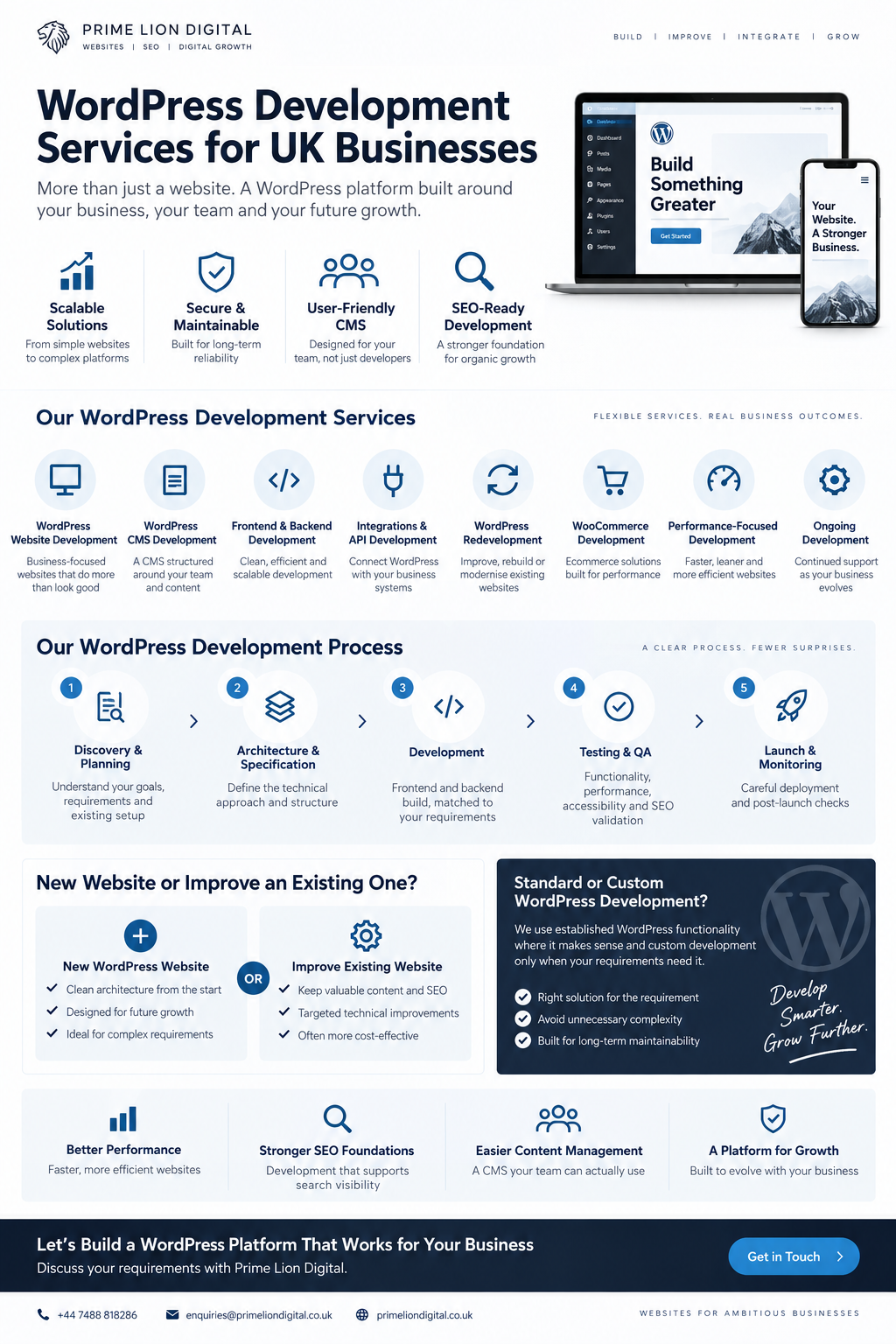
New WordPress Development or Improving an Existing Website?
Starting again can feel cleaner. It is not always the better business decision.
New WordPress Website Development
A new build gives us the opportunity to establish the architecture before legacy decisions exist. Content relationships, templates, editing controls, technical SEO, integrations and future requirements can be considered together rather than added one by one.
This is particularly useful where the website is expected to become an important acquisition, publishing or operational platform rather than a small brochure site.
Existing WordPress Redevelopment
An established website may already contain valuable content, backlinks, rankings, analytics history and workflows the business understands. Replacing all of it without a clear reason can introduce unnecessary risk.
Redevelopment starts with understanding the existing environment: what works, what is fragile, what creates measurable limitations and what needs to survive the transition. URL structures, redirects, forms, tracking, structured data and external integrations can all matter before a single template is replaced.
Targeted Technical Improvements
Sometimes the commercially sensible answer is neither a new website nor a major redevelopment.
A slow template can be rebuilt. An unreliable integration can be replaced. Publishing controls can be improved. A problematic dependency can be removed. A group of landing pages can be moved onto a more consistent component system.
Development should be proportionate to the problem.
Standard WordPress Development or Custom Development?
“Custom” is often treated as shorthand for better. It should not be.
Established WordPress functionality can be the more reliable choice when it already solves a requirement cleanly. It benefits from known update paths and leaves less project-specific code to maintain.
Custom development becomes valuable when the business requirement cannot be handled well within those constraints: unusual workflows, proprietary integrations, specialist data relationships, administrative tools or functionality that would otherwise depend on several overlapping plugins and workarounds.
The decision should be based on the requirement, not a preference for bespoke code. Projects where bespoke functionality is central should move into our Custom WordPress Development pathway, while this page remains focused on the wider WordPress development ecosystem.
WordPress CMS Development for Teams That Need to Publish at Scale
A website can look polished to customers while being frustrating for the people responsible for running it.
The problem often develops gradually. A marketing team creates a new landing page by duplicating an old one. Another department introduces a slightly different service template. Reusable components receive inconsistent names. Eventually the CMS becomes something staff work around rather than work with.
For content-heavy businesses, WordPress development should therefore include content governance. Editors need to know which components are reusable, what can safely be changed and how new content fits into the existing architecture.
Structured Gutenberg blocks, reusable patterns, custom post types, field validation, role-based permissions and controlled taxonomies can all help. The objective is not to restrict editors unnecessarily. It is to give them enough freedom to publish efficiently without allowing routine content work to undermine design, accessibility or SEO structure.
Integrating WordPress with the Rest of Your Business
A modern business website often sits between several systems rather than operating as an isolated marketing asset.
A contact form might create a CRM record, trigger an email workflow and record a conversion in analytics. Product information may be maintained elsewhere. An enquiry might need to reach different teams according to location, service or customer type.
These connections need more than an API key.
Before developing an integration, we consider where the authoritative data lives, what happens if one system becomes unavailable, how errors are recorded, whether information moves in one or both directions and who will be responsible for the connection after launch.
Typical environments can involve CRM platforms, REST APIs, payment gateways, email services, analytics, Google Tag Manager, marketing platforms, product feeds and internal business systems.
A technically successful integration is one that continues to make operational sense when the developer who built it is no longer looking at it every day.
What Makes a WordPress Website Technically Maintainable?
Technical debt is rarely created by one catastrophic decision. It accumulates.
A temporary workaround becomes a dependency. Another tool overlaps with it. A theme receives a modification that is never documented. A third-party script is added for one campaign and remains for years. Eventually even straightforward changes require disproportionate caution.
Maintainability comes from keeping dependencies intentional. That means sensible plugin selection, documented custom functionality, consistent development practices, staging environments, backups and version control where appropriate, with a clear distinction between content editors manage and functionality developers maintain.
It is not a competition to build a WordPress installation with the fewest plugins or the largest amount of custom code. The better test is whether the technical decisions can still be understood and safely changed later.
Our WordPress Development Process
The workflow changes with the project. A new website, a CRM integration and the redevelopment of an established content platform should not be forced through an identical production template. There are, however, several stages that consistently reduce risk.
Discovery and Technical Planning
We establish what the website needs to achieve, who will use it, what already exists and which dependencies matter. For existing websites, this can include reviewing themes, plugins, integrations, analytics, content architecture and current operational problems.
Some projects begin with WordPress development consultancy rather than implementation. If the correct technical route is not yet clear, resolving that question first is usually cheaper than making it during development.
Architecture and Specification
Requirements are translated into an implementation approach. This is where we decide what WordPress can handle effectively, where established functionality makes sense and where development is genuinely required.
Development
Frontend and backend work is carried out against the agreed architecture. Where appropriate, development is separated from the live website so unfinished work does not interfere with customers or internal teams.
Staging and Integration
Integrations, forms, tracking, content structures and third-party dependencies are tested together rather than treated as isolated components.
QA, Accessibility and SEO Validation
Quality assurance covers more than whether a page opens. Responsive behaviour, forms, navigation, editing workflows, browser behaviour, accessibility considerations, redirects, metadata handling and technical SEO requirements all need to survive the build.
Deployment and Post-Launch Monitoring
Deployment is planned around the risk of the project. After launch, critical functionality, analytics, forms, indexing signals and integrations are checked in the live environment rather than assuming successful staging tests guarantee identical behaviour in production.
Plan the Project Before Development Starts
A useful specification can prevent expensive assumptions later. If you are considering a WordPress project, our Website Development Brief helps document functionality, integrations, content requirements, scalability considerations and technical priorities before the build is scoped.
Download the Website Development Brief
You can return the completed brief to enquiries@primeliondigital.co.uk. We can then review the requirements, identify dependencies and clarify the development approach before preparing a quotation.
Development Decisions Affect SEO, Performance and Accessibility
SEO problems are not always created by SEO work. Performance problems are not always created by hosting. Accessibility problems are not always created by design.
Development decisions influence all three.
Heading structures, templates, internal linking components, taxonomy behaviour, pagination, JavaScript rendering, image handling, canonicalisation and structured content can affect how search engines discover and interpret a website. These considerations become increasingly important when a site contains large numbers of service, product, location or editorial pages.
Performance is similarly architectural. Heavy frontend frameworks, duplicated assets, third-party scripts, inefficient database queries and poorly selected plugins can undermine speed before a caching layer is configured.
Accessibility also needs to survive implementation. A design can appear accessible in a static prototype and lose that quality through incorrect markup, keyboard behaviour, forms or interactive components during development.
Where organic search is commercially important, development should work alongside technical SEO rather than treating search optimisation as something added after launch.
What Affects the Cost of WordPress Development?
The number of pages is often a poor way to estimate development complexity.
A 50-page website built from a small number of consistent templates can require less development than a 10-page platform with account functionality, unusual data relationships, CRM integration and bespoke workflows.
Cost is more commonly influenced by the number of unique templates and components, frontend complexity, CMS requirements, integrations, ecommerce functionality, migration work, custom development, content structure, testing requirements and the condition of any existing codebase.
There is also a difference between build cost and ownership cost. A cheaper implementation that depends on numerous paid extensions, manual workarounds or fragile integrations may cost considerably more to operate over several years.
We scope WordPress development around the actual requirements rather than using page count alone as a proxy for technical effort.
How Long Does WordPress Development Take?
Development time depends less on the word “WordPress” than on the number of decisions and dependencies involved.
A focused business website with an established design and prepared content can move relatively quickly. A platform involving bespoke UX, multiple content types, data migration, ecommerce or third-party integrations requires more planning, testing and coordination.
Content availability can affect the schedule just as much as development. A build may be technically ready while launch remains blocked by missing copy, product data, legal approval or access to an external system.
A realistic timeline should therefore distinguish development time from the complete project timeline. Discovery, design, content, stakeholder approvals, integrations, QA and deployment all contribute to the point at which a website can safely go live.
WordPress Development in Practice
Different projects illustrate why professional WordPress development cannot be reduced to one standard build process.
Audit Consulting Group: Building for Continued Content Growth

Audit Consulting Group needed more than a small professional-services website. The platform had to support a growing structure of accounting and tax services, educational content, enquiry journeys and organic search activity.
The development challenge was closely connected to information architecture and publishing scalability. WordPress needed to accommodate continued expansion without turning every new service or resource into an isolated page with no clear relationship to the rest of the site.
The wider digital project has grown from no established organic presence to more than 4,000 monthly organic visitors, alongside 100+ website enquiries per month. The practical lesson is not simply that more content can produce more traffic. Growth becomes much easier to manage when the CMS and site architecture anticipate it.
Freizeit Camper: WordPress as an Ecommerce Platform
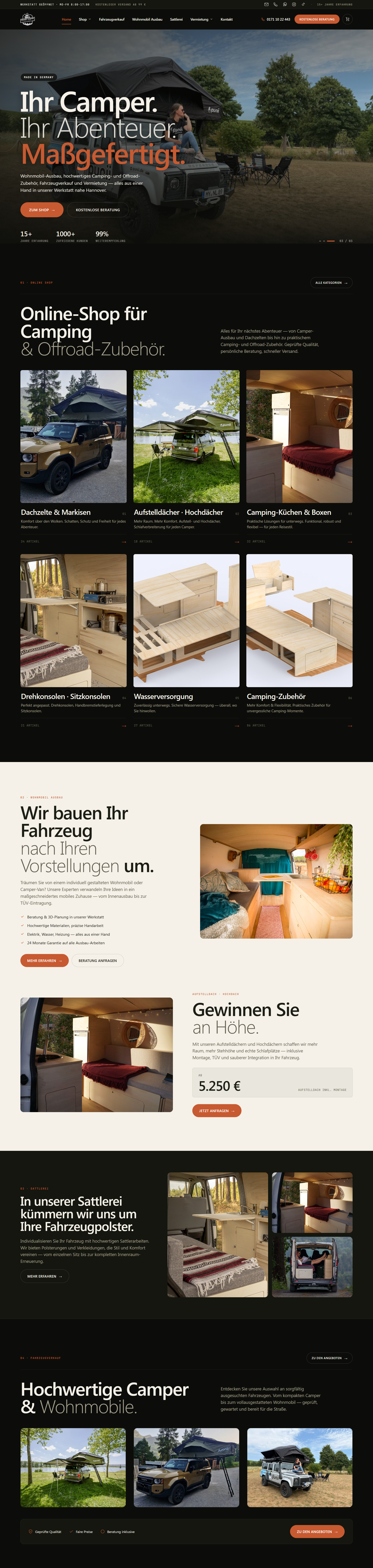
Freizeit Camper required WordPress to operate as an ecommerce environment rather than a conventional brochure website. The project included WooCommerce implementation, catalogue and customer-journey considerations, together with GA4 and Google Search Console setup.
That changed the development priorities. Product management, checkout behaviour, tracking and ongoing store administration had to be considered as part of the platform rather than as features added after the main website was finished.
The project is a useful example of a broader point: once WordPress becomes responsible for transactions, the quality of the operational setup matters as much as the appearance of the storefront.
Construction & Repair Work: Keeping the Build Deliberately Focused
Construction & Repair Work had a different requirement: a focused website for a UK service business where unnecessary technical complexity would have added little value.
The core website was delivered in approximately two weeks, with GA4 and Google Search Console included in the implementation. There was no reason to turn a straightforward commercial requirement into an elaborate development exercise.
That distinction matters. Professional WordPress development is not about making every website technically complex. Sometimes the better engineering decision is to keep the platform deliberately straightforward.
Why Businesses Work with Prime Lion Digital for WordPress Development
WordPress development sits between several disciplines. Code matters, but so do information architecture, UX, content management, SEO, analytics, performance and the way a business will operate the website after launch.
Our work brings those considerations into the same development conversation. We can work on a new platform, an existing WordPress environment or a defined technical requirement without assuming every project needs to become a complete rebuild.
We also prefer clear ownership. Clients should retain appropriate control of their domain, website, content, analytics and infrastructure, with important technical dependencies understood rather than hidden behind an agency relationship.
As a WordPress development company working with UK businesses, the objective is straightforward: develop what the project actually needs, avoid unnecessary complexity and leave the platform in a condition where future development remains possible.
Frequently Asked Questions
What are WordPress development services?
WordPress development services cover the technical work required to build, extend, integrate or improve a WordPress website. Depending on the project, this can include CMS architecture, frontend and backend development, themes and components, integrations, WooCommerce, redevelopment, performance work, testing and deployment.
What is included in professional WordPress development?
The scope depends on the requirement, but professional development should normally consider technical planning, implementation, content management, responsive behaviour, integrations, performance, security implications, testing and maintainability. For business websites, SEO and analytics requirements should also be considered before launch rather than added as an afterthought.
How much does WordPress development cost in the UK?
There is no useful single price for all WordPress development because technical complexity varies considerably. A focused business website and a platform involving ecommerce, APIs, custom workflows and data migration require very different levels of work. We scope projects around functionality, templates, integrations, content structure, existing technical conditions and testing requirements.
How long does a WordPress development project take?
A focused website can often be completed in a matter of weeks, while more complex projects can take several months. The schedule depends on design, functionality, content readiness, integrations, migration, stakeholder approvals and testing as well as development itself.
Can you develop an existing WordPress website without rebuilding it?
Yes. Where the underlying website remains viable, targeted redevelopment can be more sensible than starting again. We can assess templates, plugins, CMS structure, performance, integrations and other technical dependencies to identify what should be retained and what needs to change.
Do we need custom WordPress development?
Not necessarily. If established WordPress functionality solves the requirement cleanly, introducing bespoke code may add unnecessary maintenance. Custom development is more appropriate when the business has requirements that standard functionality cannot support well or when existing solutions would introduce greater complexity than a purpose-built approach.
Can WordPress integrate with our CRM or other business systems?
Yes, provided the other platform offers a suitable integration method or API. WordPress can connect with CRM systems, payment services, email platforms, analytics tools and other business systems. The approach depends on the available APIs, data requirements, authentication and how the integration needs to behave if one system becomes unavailable.
Can WordPress support a large or complex website?
Yes. WordPress can support substantial content libraries, multiple content types, ecommerce and complex publishing environments when the architecture, hosting and development approach are appropriate. Scale problems are often caused by implementation decisions and accumulated dependencies rather than WordPress alone.
Will our marketing team be able to manage the website after launch?
That should be part of the development requirement. We plan CMS structures with editors in mind so routine publishing does not depend on a developer. The appropriate level of flexibility varies by organisation; unrestricted editing is not always safer or more useful than well-designed reusable components and controlled fields.
Do you provide ongoing WordPress development after launch?
Yes. WordPress platforms continue to evolve, and we can support further functionality, integrations, performance improvements and technical changes after launch alongside appropriate maintenance and support.
Discuss Your WordPress Development Project
If you are planning a new WordPress website, considering redevelopment or trying to solve a specific technical limitation in an existing platform, the first useful step is to define what needs to change and why.
Prime Lion Digital provides WordPress development services for businesses across the UK, from focused website and CMS development to integrations, ecommerce and more complex technical projects.
Discuss your WordPress development project with Prime Lion Digital