Custom WordPress Website Development for UK Businesses
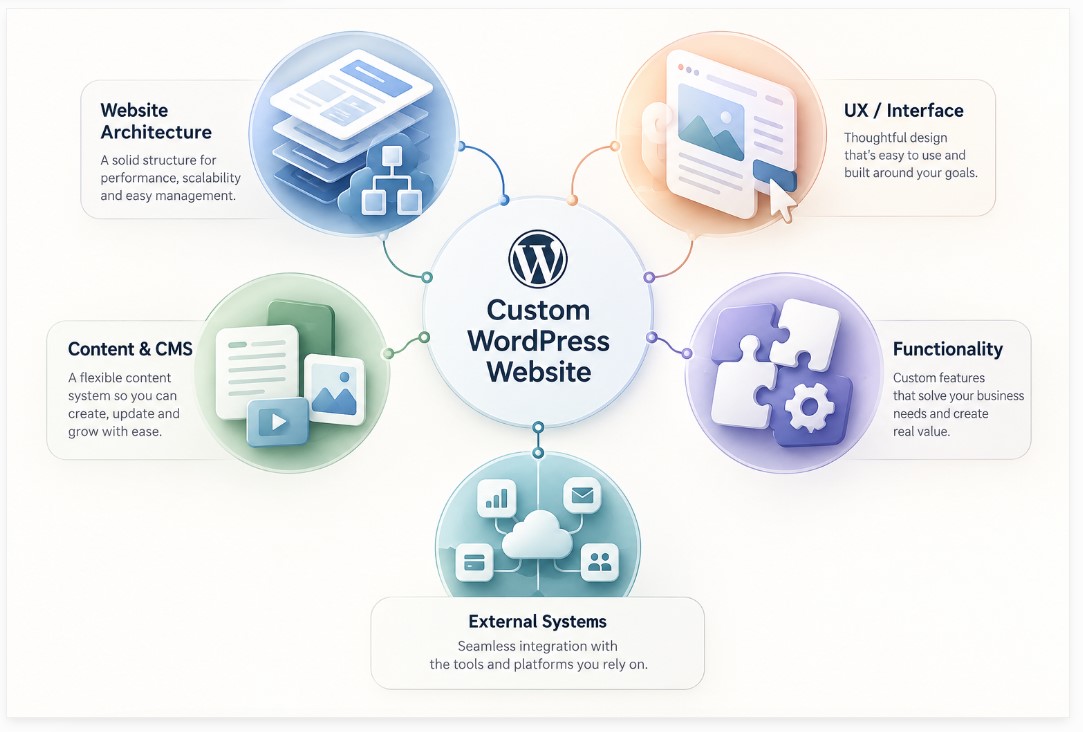
Prime Lion Digital builds custom WordPress websites for businesses that need more than a standard theme-led setup. We plan the website architecture, content structure, UX/UI, WordPress editing experience and scope-dependent functionality as one coordinated system, so the finished website reflects how your business actually needs to operate and grow.
Discuss Your WordPress Website Project | See How a Custom Website Is Structured
Website Architecture · WordPress Development · UX/UI · Technical SEO Considerations
A Custom WordPress Website Is More Than a Custom-Looking Theme
A website can look bespoke while its underlying structure is still constrained by a pre-built theme, unsuitable content model or collection of disconnected plugins.
Custom WordPress website development starts earlier. It considers what the website needs to contain, how information should relate, how visitors move through it, how your team manages content and which requirements genuinely need custom development.
That does not mean rebuilding everything WordPress already handles well. The stronger approach is to keep established functionality where it fits the requirement and customise the layers where a standard implementation would force unnecessary compromises.
What a Custom WordPress Website Can Enable
A Website Structure Built Around the Business
Services, products, locations, resources and supporting content can be organised around their real relationships rather than fitted into a hierarchy inherited from a theme. This can be particularly important for websites that contain several service families or are expected to expand substantially over time.
A More Controlled Publishing Experience
The public website is only one side of the product. A custom build can also consider how marketing and content teams create, update and reuse information inside WordPress. Depending on scope, structured content types, reusable components and defined editing patterns can make routine publishing more consistent.
Functionality Where the Requirement Justifies It
A custom website can include functionality beyond conventional pages and forms where the business requirement calls for it. More substantial independent functionality should be scoped separately and placed in the appropriate WordPress layer rather than being embedded into presentation code simply because it is part of the same website project.
UX, Content and Development Planned Together
Navigation affects content architecture. Content architecture affects templates. Editing requirements affect the CMS. Functionality affects visitor journeys. Planning these relationships together helps prevent one decision from creating avoidable constraints elsewhere in the website.
When Does a Complete Custom WordPress Website Make Sense?
You Are Building Around Requirements That Do Not Fit a Standard Theme
A business may know what its website needs to achieve but find that standard themes repeatedly force those requirements into predefined layouts, page types or workflows. A custom website allows the structure and implementation to follow the requirement instead.
Your Existing WordPress Website Has Outgrown Its Original Structure
A website can accumulate pages, plugins, landing pages and workarounds until the underlying structure becomes the real limitation. At that point, simply redesigning individual pages may not resolve the problem. The architecture and content model may need to be reconsidered before the interface is rebuilt.
You Need a Large Service or Content Ecosystem
Professional-services and content-rich websites may contain multiple service families, specialist pages, resources and supporting content. In these projects, hierarchy and content relationships become part of the development requirement rather than an SEO or navigation decision added after the build.
Several Commercial Journeys Need to Work Within One Website
A website may need to combine services, content, ecommerce or other journeys. A custom WordPress build can be planned so those journeys share a coherent architecture rather than behaving like separate websites assembled under one domain.
How a Custom WordPress Website Is Structured
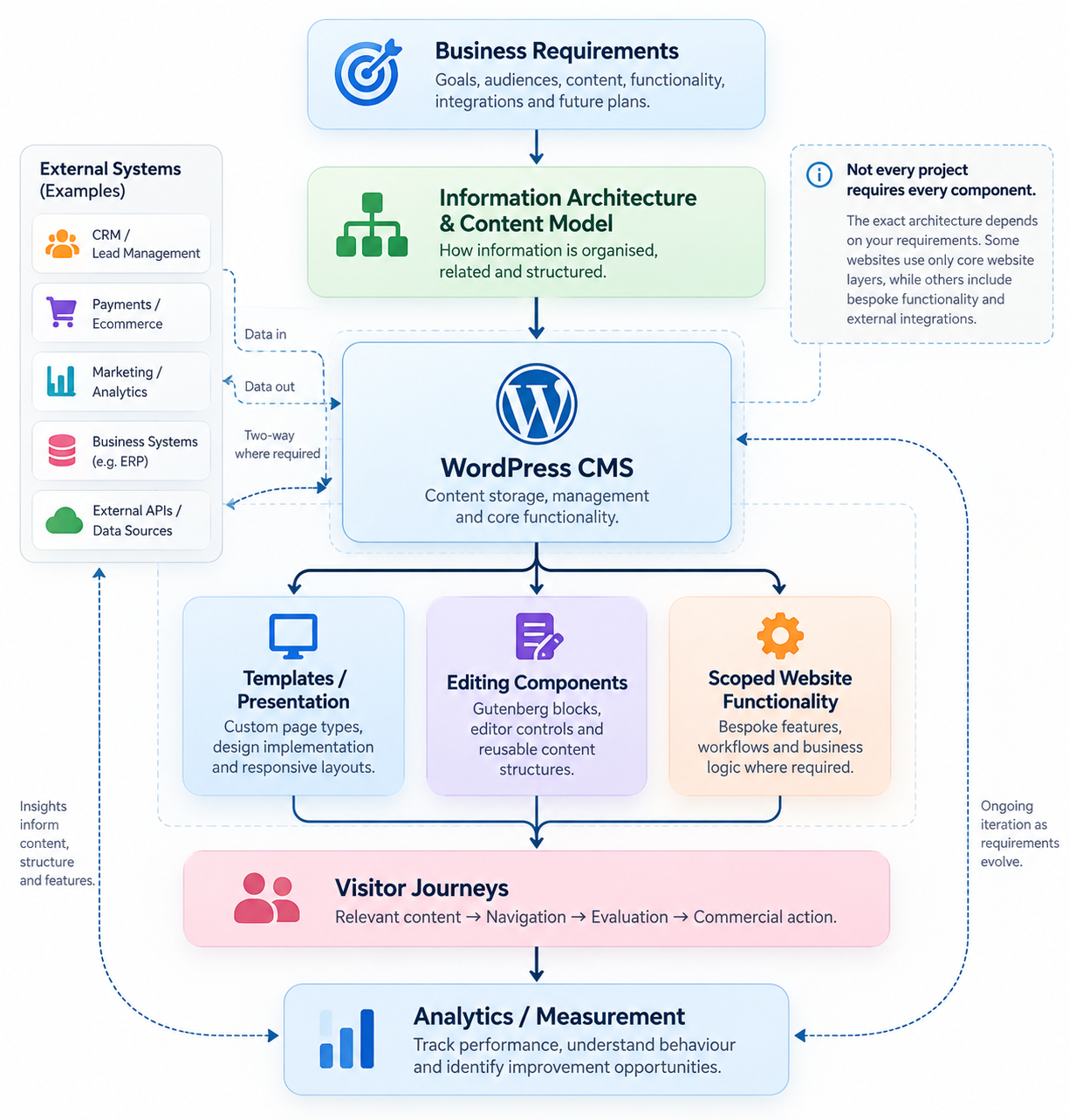
A complete website should not be approached as a collection of unrelated pages and features. The business requirement informs the information architecture and content model; those decisions shape the WordPress CMS; and the presentation, editing experience and functionality are then built around that structure.
- Business requirements — what the website needs to support.
- Information architecture and content model — how information is organised and related.
- WordPress CMS — how that information is stored and managed.
- Templates and editing components — how content is presented and maintained.
- Website functionality and visitor journeys — what users need to do.
- External systems where required — how WordPress may exchange information with other platforms.
- Measurement and iteration — how the website can be evaluated and improved after launch.
The exact architecture depends on the project. A content-heavy professional-services website does not necessarily need the same structure as an ecommerce website or a website containing substantial business-specific functionality.
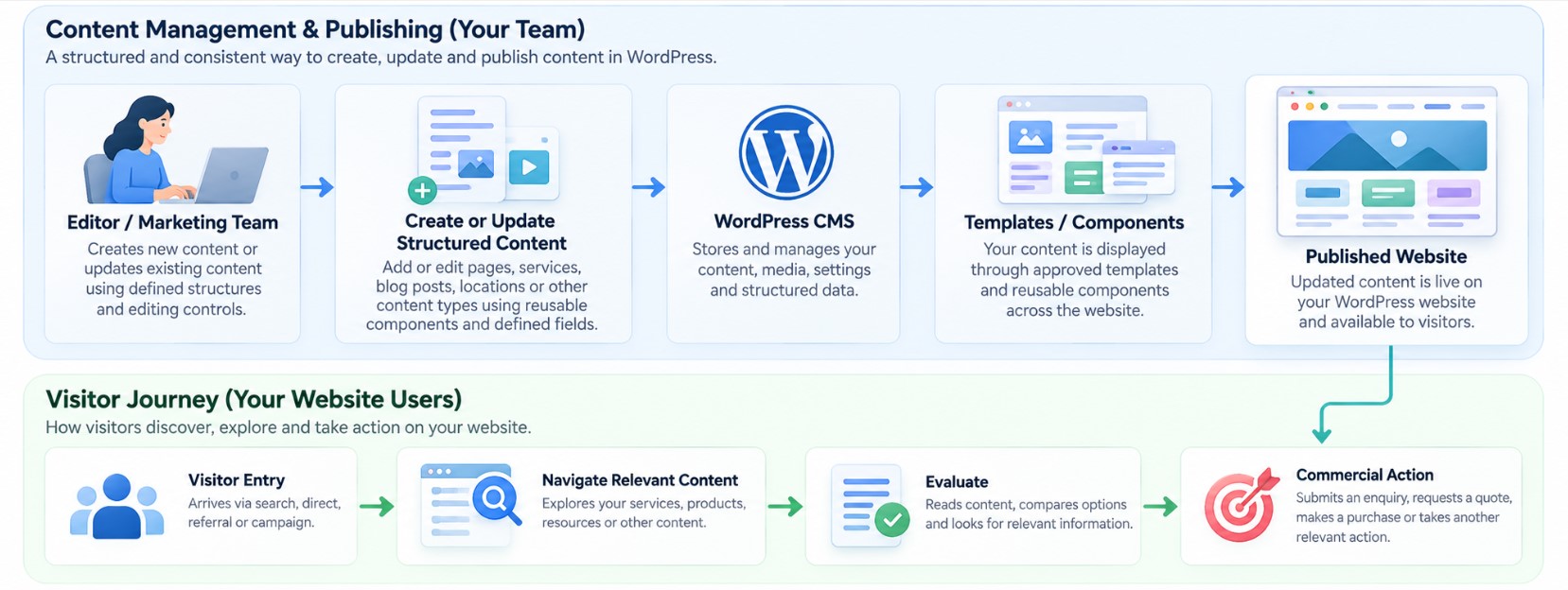
One Website, Two Operating Experiences
A custom WordPress website needs to work for the people visiting it and for the people responsible for maintaining it. Focusing only on the front end can leave the internal team with an unnecessarily difficult publishing process.
The Publishing Journey
Editor or marketing team → structured content → WordPress CMS → approved templates and components → published website.
The aim is controlled flexibility: enough freedom for teams to publish effectively without requiring every new page to become a fresh development or design exercise.
The Visitor Journey
Relevant entry page → related information → evaluation → appropriate commercial action.
The two journeys meet in the website architecture. What editors create and maintain inside WordPress determines what visitors can discover, understand and use on the front end.
What Can Be Included in a Custom WordPress Website?
The capability set depends on the approved project scope. A custom website is not a fixed package in which every possible feature is automatically included.
Website and Content Architecture
The project can include a planned hierarchy for services, products, resources, locations or other content types, together with navigation and internal relationships appropriate to the website.
Custom Front-End Implementation
Approved UX/UI can be implemented as responsive WordPress templates rather than being constrained by the layout of a pre-built theme.
If the primary requirement is specifically the presentation and template layer rather than a complete website, Custom WordPress Theme Development may be the more focused route.
Structured WordPress Content Management
WordPress can be organised around the information the business actually maintains, using appropriate content types, fields and reusable structures where required.
Reusable Editing Components
Where content teams repeatedly need the same structured components, the project can include custom Gutenberg blocks or other editor controls.
If reusable editorial components are the main requirement rather than the complete website, Custom Gutenberg Block Development should own that deeper intent.
Business-Specific Functionality
Where established WordPress functionality does not meet a defined requirement cleanly, scoped bespoke functionality may form part of the project. Independent business logic may be better separated into a dedicated plugin rather than tied to the visual theme.
For a functionality-led project, see Custom WordPress Plugin Development.
External Connections
Where required, WordPress can connect to external systems, APIs, ecommerce services, analytics or other platforms. The correct approach depends on the systems involved, available interfaces, data ownership and the role WordPress needs to perform.
Custom WordPress Website or Template-Led Build?
Custom development is not automatically the better option. The right approach depends on whether established WordPress components can meet the requirement cleanly without creating avoidable compromises.
| Decision Area | Template-Led WordPress Build | Custom WordPress Website |
|---|---|---|
| Requirement fit | Suitable when requirements align closely with an established theme or configuration | Useful when architecture, UX or functionality needs to follow a more specific requirement |
| Website architecture | Often adapted around existing structures | Can be planned around the business and its content model |
| Design control | Influenced by the selected theme or builder | Can follow approved project-specific UX/UI |
| Content management | Uses the structures provided by the selected setup | Can introduce content structures and editing patterns around publishing requirements |
| Functionality | Often assembled from established plugins | Can combine established functionality with scoped bespoke development where justified |
| Initial project scope | Usually more straightforward | Requires more discovery, architecture and implementation decisions |
| Best fit | Conventional website requirements that existing components can handle cleanly | Projects where several requirements need to work together as one coordinated website |
A template-led build can be entirely appropriate for a straightforward requirement. Custom development becomes more useful when adapting the business to the template would create more compromises than adapting the website to the business.
Custom WordPress Websites in Practice
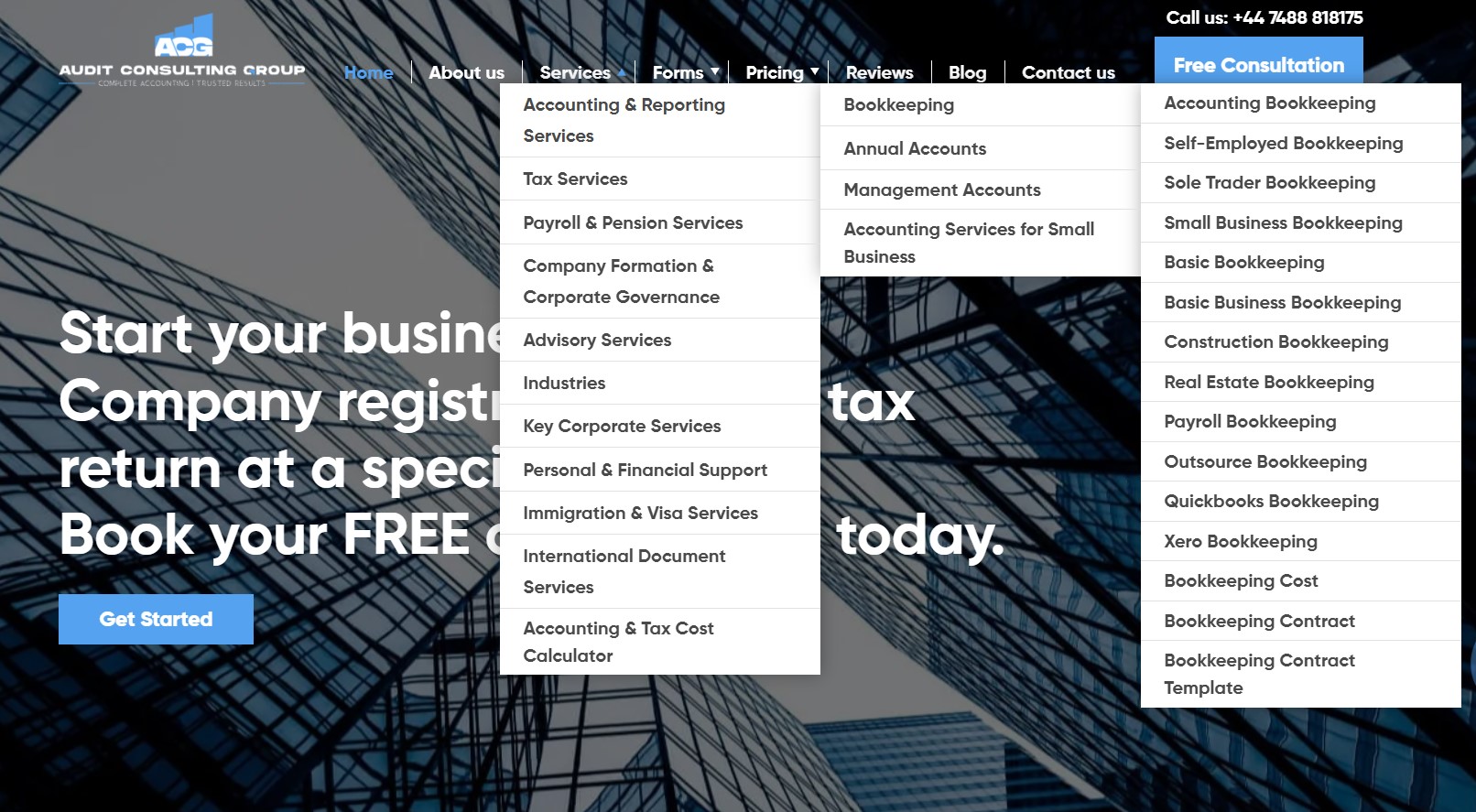
Audit Consulting Group — Architecture for a Growing Service and Content Platform
Prime Lion Digital developed the Audit Consulting Group website from a new domain, combining website development with competitor and keyword research, information architecture, content strategy and technical SEO. The architecture was built around a large accounting and tax service structure, with commercial services, sub-services and supporting content organised into connected clusters.
The wider development and organic-search programme subsequently reached more than 7 million Google Search impressions and 21,900 organic clicks. Those figures describe the combined website, content and SEO programme and should not be interpreted as a development-only result.
View the Audit Consulting Group project
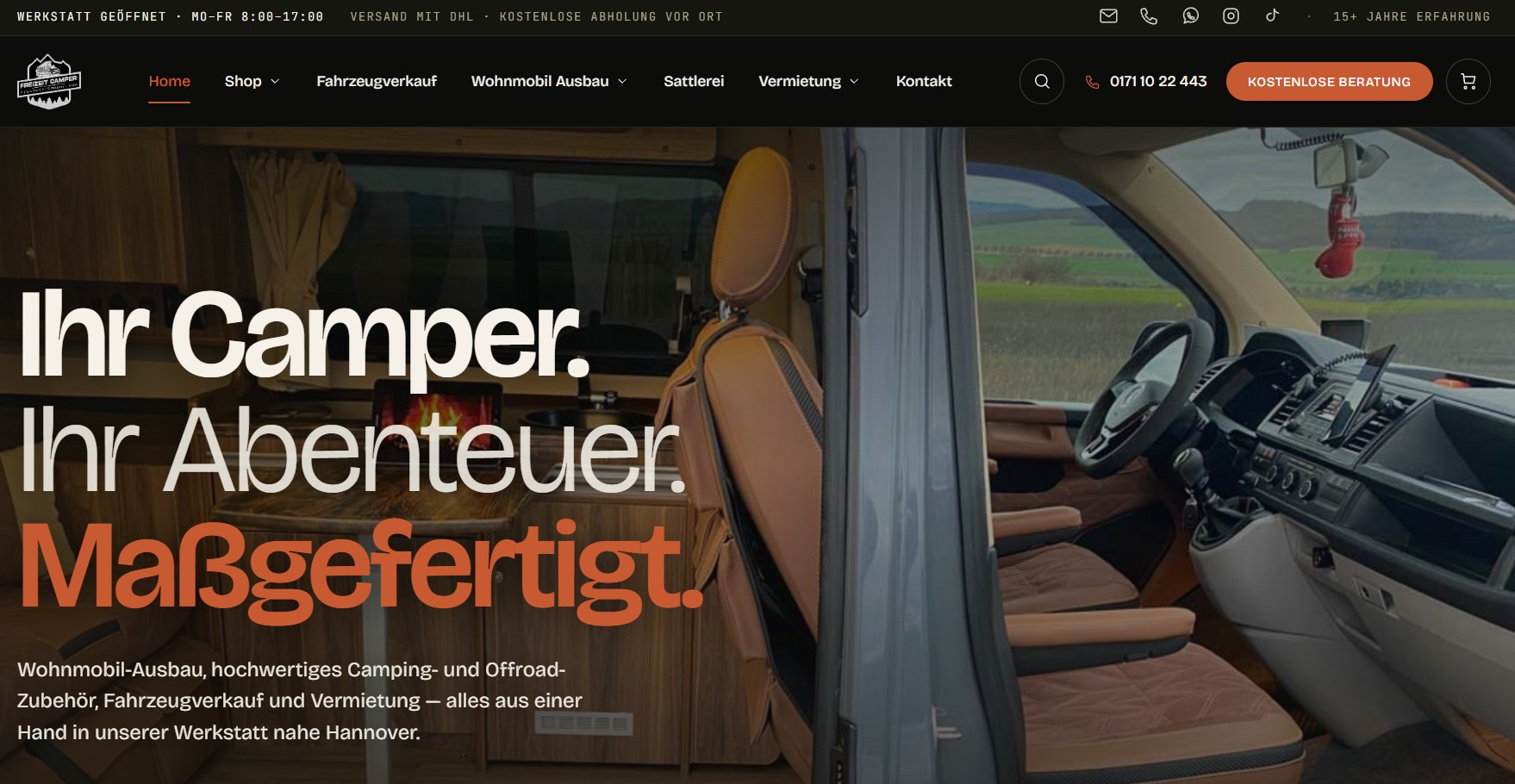
Freizeit Camper — Ecommerce, Services and Content in One Website
Prime Lion Digital’s Freizeit Camper project combined website strategy, architecture, UX/UI and WooCommerce development within a platform that needed to support ecommerce alongside camper-related services and content. It provides a different example of why a complete website may need several commercial journeys to be considered together rather than designed independently.
View the Freizeit Camper project
Plan UX, Content Structure and Search Requirements Before the Build Is Locked In
A technically functioning website can still be difficult to navigate, difficult to expand or awkward to manage.
For a custom WordPress website, UX decisions should connect to information architecture rather than being treated purely as visual styling. Navigation, page hierarchy, calls to action and responsive behaviour need to reflect the journeys the website is expected to support.
For public websites where organic search matters, search considerations can also influence architecture before development begins. The hierarchy of services and supporting content affects URL structure, internal relationships, crawl paths and how topics are separated across the site.
This does not guarantee rankings or traffic. It means structural and technical search requirements can be considered before the website architecture becomes substantially harder to change.
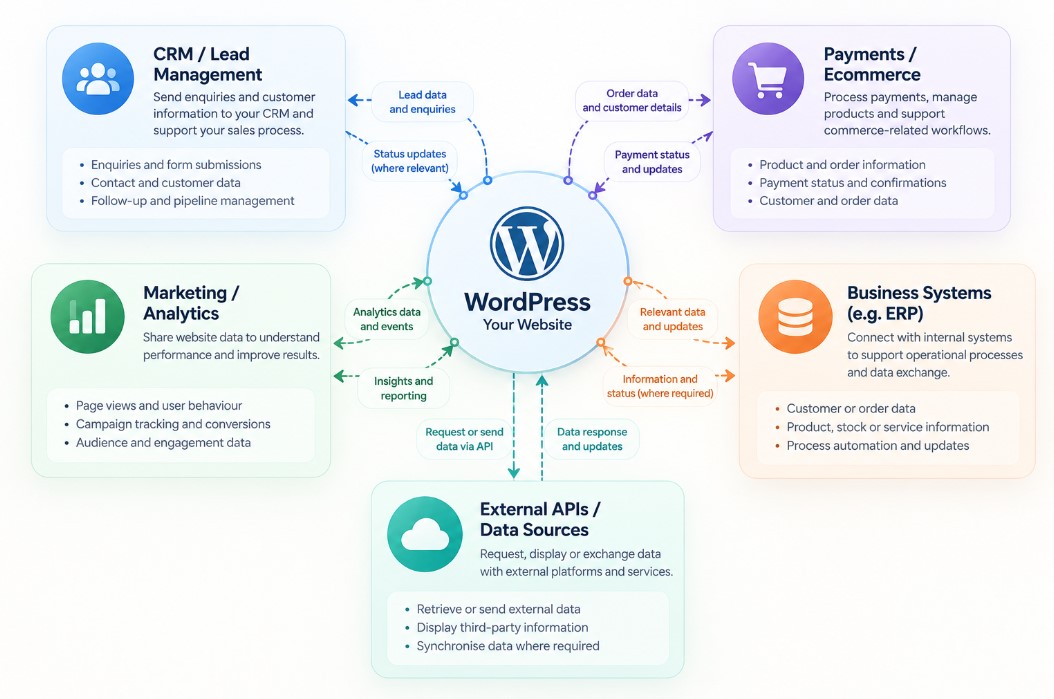
Connecting WordPress to Other Business Systems
A website does not always operate in isolation. Depending on the project, WordPress may need to send information to another system, receive information from it or support an exchange in both directions.
| Integration Area | Possible Website Role | What Needs to Be Defined |
|---|---|---|
| CRM / Lead Management | Send enquiry or customer information into a lead-management process | Data fields, triggers, ownership and available interface |
| Payments / Ecommerce | Support transactions, product information or order-related workflows | Commerce architecture and required data flow |
| Marketing / Analytics | Support measurement and campaign tracking | What needs to be measured and where the information is processed |
| Business Systems | Connect website actions with operational processes | System responsibility, data mapping and workflow |
| External APIs / Data | Request, display or exchange external information | API availability, authentication, data format and failure handling |
The presence of an external system does not automatically mean a custom integration is necessary. The integration route should be scoped around the systems involved and the information that actually needs to move.
Plan for the Parts of the Website That Are Likely to Grow
“Scalable” only becomes useful when it describes what is expected to change.
Content Expansion
Additional services, products, resources or landing pages can use an established content model rather than requiring a new structural decision every time the website expands.
Functional Expansion
New functionality can be introduced when a real requirement emerges, while deciding which WordPress layer should own it rather than automatically adding behaviour to the existing theme.
Integration Expansion
Additional external systems can be considered as business processes change, with each new dependency scoped around its data and workflow requirements.
The objective is not to predict every future requirement. It is to avoid obvious architectural decisions that make foreseeable expansion unnecessarily difficult.
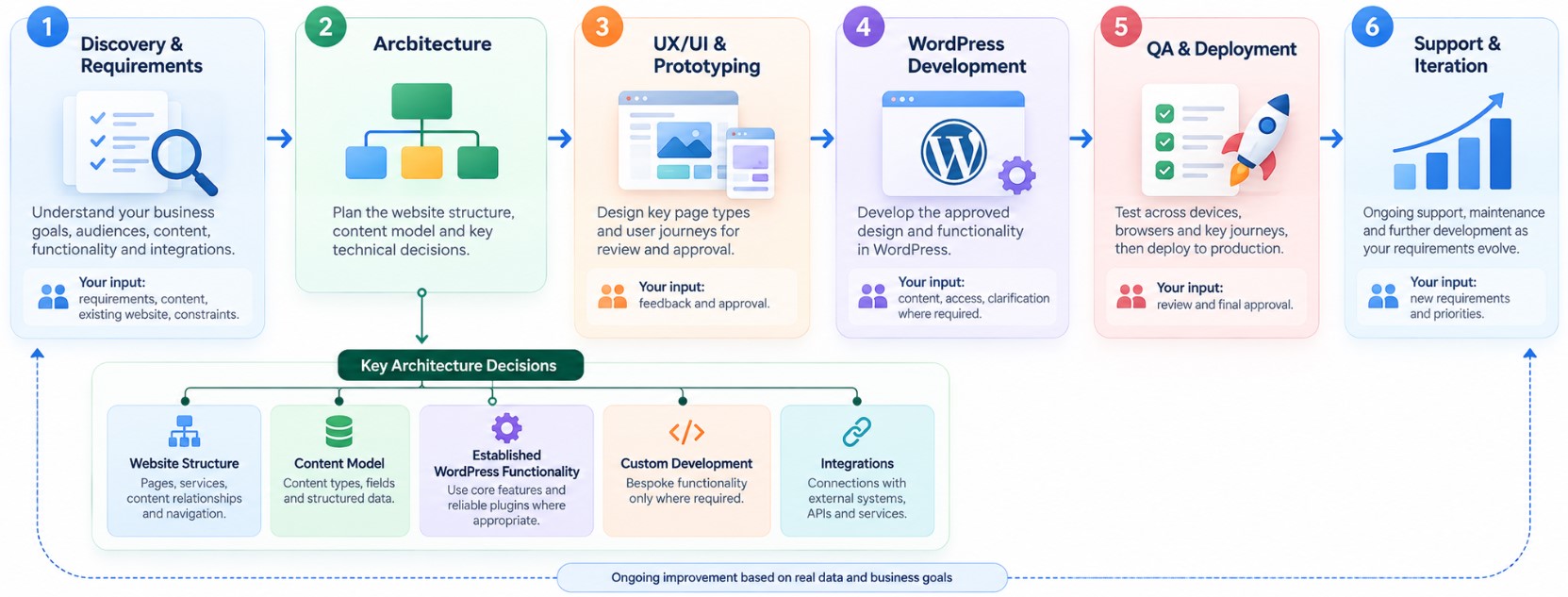
How We Deliver a Custom WordPress Website
1. Discovery & Requirements
We define the audiences, content, commercial journeys, internal publishing requirements, functionality and relevant external dependencies. The client provides business context, existing website information, available content and known constraints.
2. Architecture
We plan the website hierarchy, content relationships and major system decisions. This establishes which requirements can use established WordPress functionality and where project-specific implementation may be required.
3. UX/UI & Prototyping
Key page types and journeys are translated into an interface direction so important navigation, content and interaction decisions can be reviewed before they become development dependencies.
4. WordPress Development
The approved architecture and interface are implemented in WordPress together with the agreed CMS structures, templates, functionality and integrations.
5. QA & Deployment
The implementation is checked against the approved scope, including relevant responsive behaviour, content, interactions and integrations, before the approved website is deployed.
6. Support & Iteration
Where included in the agreed scope, post-launch work can cover maintenance, content development, further functionality or ongoing improvements as real requirements emerge.
What You Receive from a Custom WordPress Website Project
The exact deliverables are defined by the approved scope. Separating core outputs from scope-dependent work makes the commercial boundary clearer.
| Deliverable | What It Contains | Status | Why It Matters |
|---|---|---|---|
| Website architecture | Approved hierarchy and structural relationships | Core | Defines how the website fits together |
| WordPress implementation | Developed website based on the approved project scope | Core | Provides the working website |
| Responsive templates | Approved page and template types implemented for relevant screen sizes | Core | Supports usable presentation across devices |
| Content / CMS structure | Appropriate WordPress content model and editing structures | Core where relevant | Provides a manageable publishing structure |
| Testing & deployment | QA against agreed requirements and production release | Core | Moves the approved build into production |
| Custom functionality | Bespoke functionality defined during project scoping | Scope-dependent | Supports requirements not handled cleanly by established functionality |
| Integrations | Approved connections with external systems | Scope-dependent | Connects WordPress with wider business processes |
| Content migration | Transfer or mapping of agreed existing content or structured data | Scope-dependent | Supports rebuilds involving existing information |
| Documentation / guidance | Agreed handover information for relevant website functions | Scope-dependent | Supports internal management after launch |
| Ongoing support | Post-launch work under an agreed support arrangement | Scope-dependent | Supports maintenance and further iteration |
What Affects Custom WordPress Website Development Cost?
Two websites with a similar number of pages can require very different levels of development. Cost is more closely connected to architecture, functionality, dependencies and implementation complexity than to page count alone.
| Cost Factor | Typically Simpler | Typically More Complex | Why It Matters |
|---|---|---|---|
| Website architecture | Small number of conventional page types | Several interconnected content types and journeys | More relationships need to be planned and implemented |
| Existing vs new website | Clean new environment | Legacy setup with overlapping themes, plugins or code | Existing constraints may require investigation |
| UX/UI | Limited set of consistent layouts | Many distinct templates or interaction patterns | More interface states require design and implementation |
| Content model | Conventional pages and posts | Structured services, resources, locations or other relationships | CMS architecture becomes part of the project |
| Functionality | Mostly established WordPress behaviour | Bespoke business rules or interactive functionality | Additional logic requires implementation and testing |
| Integrations | Little external dependency | Multiple systems, APIs or data flows | External dependencies increase implementation and QA requirements |
| Migration | Limited content transfer | Large or structured content/data migration | Existing information needs mapping and validation |
| Testing | Conventional website interactions | Multiple workflows, roles, devices or external dependencies | More possible states increase QA scope |
Custom WordPress Website Development from £800
Custom WordPress website development starts from £800. The final cost depends on the website architecture, number and complexity of templates, UX/UI requirements, content structure, custom functionality, integrations, migration requirements and testing scope.
Straightforward custom websites with limited functionality will sit closer to the starting price, while larger websites with bespoke functionality, complex content structures or third-party integrations require a more detailed project estimate.
A useful first scoping question is not simply “How many pages do you need?” but “Which parts of the website cannot be handled cleanly by an appropriate standard WordPress implementation?”
Why Prime Lion Digital for a Complete Custom WordPress Website?
A complete WordPress website can involve more than development alone. Decisions about architecture affect content. Content affects templates. UX affects visitor journeys. Development decisions can affect how the internal team manages the website and how easily the platform can be expanded.
Prime Lion Digital’s work for Audit Consulting Group demonstrates website development being connected with service architecture, content strategy and technical SEO from the beginning. The Freizeit Camper project demonstrates a different requirement, with WooCommerce, services, content, UX/UI and website architecture operating within the same digital platform. :chatgpt-content-reference{index=”0″}
For a custom website project, that wider perspective matters because the objective is not simply to make each individual feature work. The parts need to make sense together as one website.
Expert Insight: Customise the Requirement, Not Every Layer of WordPress
One of the easiest ways to overscope a custom WordPress website is to assume that “custom” means every layer should be bespoke.
A better decision starts with three questions. Can WordPress already handle the requirement cleanly? Can an established component be configured without creating an awkward dependency or maintenance problem? If neither route is suitable, which layer should own the custom behaviour?
A presentation requirement may belong in the theme. Reusable editorial components may belong in the editing system. Independent business logic is generally better separated from presentation. A content-management problem may require a different content model rather than more front-end code.
The objective is therefore not the largest possible quantity of custom development. It is a website whose architecture and customisation match the requirements closely enough to justify the additional development and maintenance responsibility.
Related WordPress Services
Custom WordPress Development
If you know WordPress needs custom development but are not yet sure whether the requirement belongs to the complete website, theme, plugin, Gutenberg or backend layer, start with our Custom WordPress Development service.
Custom WordPress Theme Development
More appropriate when the requirement is concentrated in templates, presentation and front-end rendering rather than the architecture of the complete website.
Custom WordPress Plugin Development
More appropriate when the primary requirement is independent functionality or business logic that should remain separate from presentation.
Custom Gutenberg Block Development
More appropriate when the requirement centres on reusable structured components for WordPress editors.
WordPress Web Design
If UX, visual design and the public website experience are the primary requirements rather than a broader custom website system, explore WordPress Web Design.
Custom WordPress Website Development FAQs
What is custom WordPress website development?
It is the planning and development of a complete WordPress website around specific business, content and user requirements rather than primarily adapting those requirements to a pre-built theme. Depending on scope, it can include website architecture, bespoke templates, structured content management, reusable editing components, custom functionality and integrations.
How is custom WordPress website development different from custom WordPress development?
Custom WordPress development is the broader service family and can apply to an individual theme, plugin, Gutenberg component, backend workflow or complete website. Custom WordPress website development specifically covers projects where several website layers need to be planned and delivered together.
Do I need a custom WordPress website or just a custom theme?
If the requirement mainly concerns templates and front-end presentation, custom theme development may be enough. A complete custom website becomes more relevant when the requirement also affects information architecture, content management, functionality, visitor journeys or integrations.
Can you rebuild an existing WordPress website?
Yes. The appropriate approach depends on the existing architecture, theme, plugins, content model and other dependencies. A rebuild does not automatically mean preserving the existing structure if that structure is part of the limitation.
Can a custom WordPress website include bespoke functionality?
Yes, where required by the approved project scope. The important decision is where that functionality should live. Substantial independent business logic may be better separated into a dedicated plugin rather than tied directly to the website’s visual theme.
Can WordPress connect to our CRM or other business systems?
Potentially. WordPress can connect to external systems where suitable interfaces are available. The integration should be scoped around the systems involved, the information that needs to move, data ownership and the required direction of exchange.
How much does custom WordPress website development cost?
Custom WordPress website development starts from £800. The final cost depends on the website architecture, UX/UI requirements, content structure, functionality, integrations, migration and testing scope. We assess these requirements before confirming the final project estimate.
How long does a custom WordPress website take to build?
The timeline depends on requirements clarity, architecture, UX/UI complexity, content readiness, functionality, integrations, migration, review cycles and testing. A numerical delivery range should be confirmed only after the project has been scoped.
Scope Your Custom WordPress Website Around What It Actually Needs to Do
If a standard WordPress setup would force your website into the wrong structure, start with the requirement rather than choosing the technical solution in advance.
Tell Prime Lion Digital what the website needs to achieve, what is limiting the current setup, what content needs to be managed and which functionality or external systems may be involved. We can then identify what should remain standard, what can be configured and where bespoke development may be justified.
Scope Your Custom WordPress Website
Or explore the wider Custom WordPress Development service if you are not yet sure which WordPress layer needs to change.