

Bespoke Website Development: When Do You Need It?
Not every website problem is really a website problem. Sometimes it is a process problem, a data problem, an integration problem, or a commercial model that no longer fits neatly inside a template.
That is usually the point at which the conversation shifts from “we need a new site” to something more serious: “we need a system that happens to live on the web”. Bespoke website development sits in that gap. It is not automatically better than an off-the-shelf platform, and it is often a poor choice when the underlying need is simple. But when a business has outgrown the assumptions built into themes, plugins and generic site builders, custom development becomes less of a luxury and more of an operational requirement.
Leave your details and our team will get back to you shortly to discuss your website, SEO or digital growth project.
This is where many decisions go wrong. Companies either overbuy too early and end up funding complexity they do not need, or they stay on improvised platforms for too long and quietly accumulate process debt, integration friction and avoidable limitations. The important question is not whether bespoke development sounds impressive. It is whether the business has reached the point where standard tooling is actively getting in the way.
Why this question matters more than it used to
A few years ago, many businesses could get surprisingly far with a polished brochure site, a handful of forms and a patchwork of plugins. That is less true now. Websites increasingly sit closer to the centre of operations. They connect with CRMs, internal systems, stock platforms, booking tools, payment services, client portals, onboarding flows, support processes and reporting environments. They are expected to load quickly, behave consistently across devices, handle growing content estates and support commercial teams without constant technical firefighting.
In other words, the website is often no longer just a communication layer. It is part of delivery infrastructure.
That changes the economics. A templated build may still be the right answer for many firms, particularly if the requirements are straightforward and likely to stay that way. But when a site starts carrying business logic, handling role-based access, managing structured data or coordinating multiple integrations, the hidden cost of “making a standard setup do non-standard work” rises quickly.
What bespoke website development actually means
The term is used loosely, which does not help. In practice, bespoke website development usually means the site’s functionality, architecture and workflows are designed around the organisation’s specific requirements rather than around the limits of a pre-built theme or boxed platform.
That does not always mean building everything from scratch. Good bespoke work is rarely about reinventing the wheel. It is about choosing where custom engineering is justified and where established components still make sense. A business may need a custom backend, a tailored content model, a client portal, a complex booking engine, a product configurator, or a web platform that integrates with internal software in ways off-the-shelf tools cannot support cleanly.
Sometimes the front end looks deceptively simple. The real custom work is underneath: data flows, user permissions, workflow automation, API connections, performance architecture, security controls and maintainability.
That distinction matters. A visually unique site is not necessarily bespoke in any meaningful technical sense. Equally, a modest-looking platform may involve substantial custom engineering because the commercial logic behind it is complex. There is also a difference between bespoke website design and bespoke development: one may shape how the interface looks and feels, while the other determines how the system actually behaves.
The clearest signs that a standard build is no longer enough
There is rarely a single moment when a business “qualifies” for bespoke development. It is usually a pattern. Certain frustrations start repeating: the team cannot shape the user journey properly, reporting is fragmented, integrations are brittle, content structures are awkward, and each new requirement triggers another workaround.
A few signs tend to appear together.
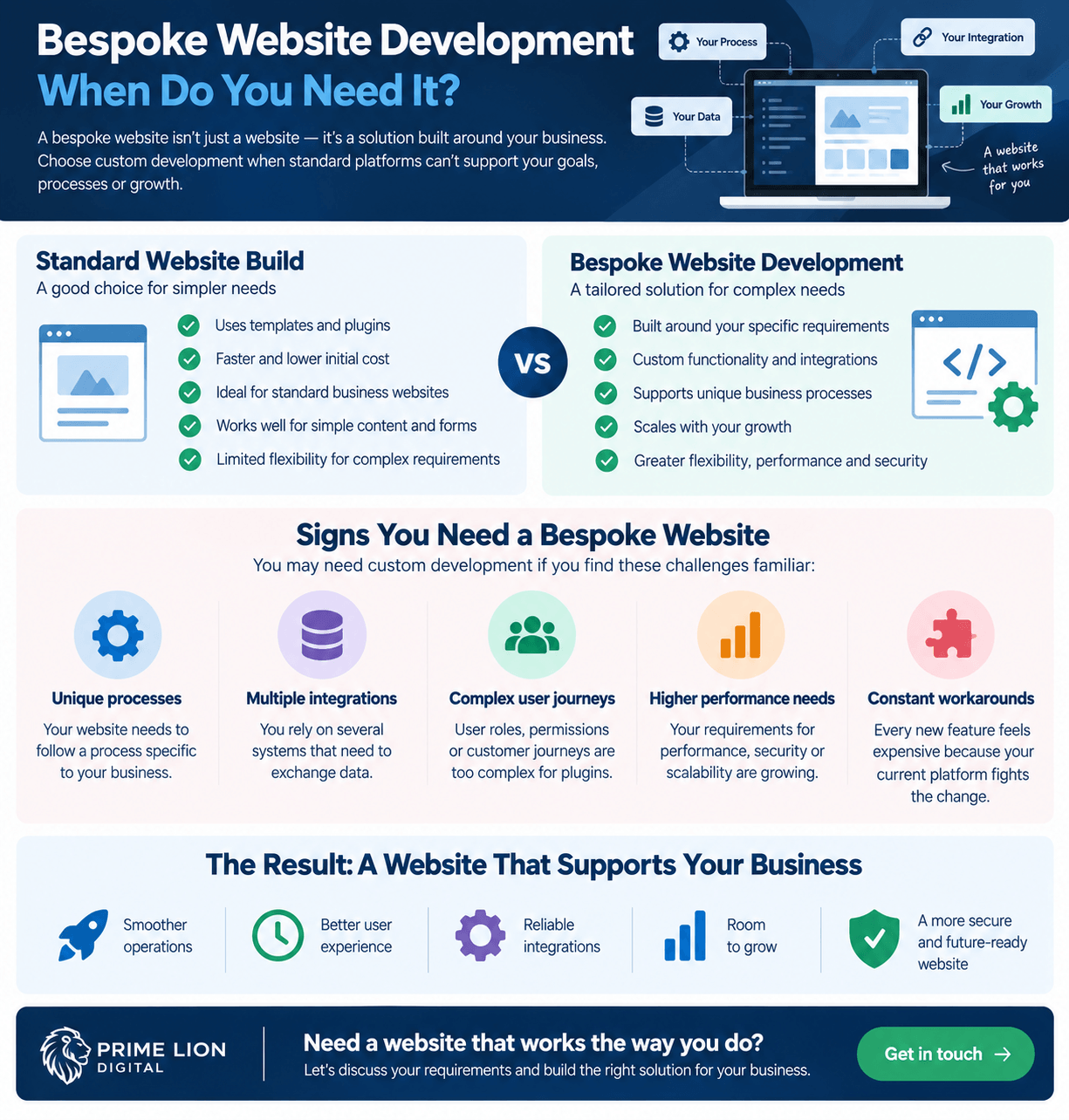
- Your website needs to reflect a process unique to your business, not a generic online pattern.
- Teams rely on multiple systems that need to exchange data reliably.
- User roles, permissions or customer journeys are too complex for plugin-based logic.
- Performance, security or scalability requirements are rising faster than the current setup can handle.
- Every new feature request feels disproportionately expensive because the existing platform fights the change.
One sign on its own is not enough. A business with one awkward integration may still be fine on a standard setup. But once limitations begin affecting operations, reporting, conversion flow or team efficiency, the issue stops being cosmetic. That is usually where the discussion moves closer to custom web development rather than further plugin layering.
Where bespoke development tends to make commercial sense
The case for custom development is usually strongest when the website influences revenue, service delivery or internal efficiency in a measurable way.
Consider a firm with a complex lead qualification process. On the surface, that sounds like a forms problem. In reality, it may involve dynamic logic, data enrichment, routing rules, CRM synchronisation and different journeys for different service lines. A generic setup can mimic parts of this, but the process often becomes fragile. If leads are mishandled, duplicated or delayed, the commercial loss is larger than the development saving.
The same principle applies to membership models, portals, quotation systems, multi-step applications, self-service dashboards, event systems, inventory-linked content, multi-location structures and operational reporting layers. Once the website becomes a working part of the business model, compromise becomes expensive in quieter ways.
That is often the real justification for bespoke work: not “we want something premium”, but “we need something that behaves properly under real operating conditions”.
Typical business scenarios where bespoke is often justified
Some scenarios come up repeatedly.
A SaaS business may need a public marketing site that also connects into trial sign-up logic, product onboarding, account states and customer lifecycle events. That sits somewhere between a website and a product surface. A startup validating a digital concept may need an MVP that cannot sensibly be pieced together from plugins because the learning depends on specific features, not just a landing page.
A services company may need a corporate website with non-standard lead routing, gated resources, multiple stakeholder journeys and integrations into a CRM and business system. A professional body or educational provider may require secure customer portals or role-based environments with different user roles, document access rules and account-based workflows. A growing organisation may need custom backend and frontend layers because the user experience and data handling have become too specific for generic tooling.
There are also cases where the primary driver is integration. Businesses often assume the website is the main challenge, then discover the harder issue is connecting it cleanly to existing systems. APIs, databases, payment providers, scheduling platforms, ERP environments or internal CRMs introduce a level of dependency that changes the whole shape of the build.
In those situations, bespoke development is not about style. It is about fit.
What many businesses misunderstand at the start
The most common misunderstanding is thinking the decision is between “cheap template” and “expensive custom”. It is not. The real trade-off is between standardisation and control.
Standard platforms are efficient precisely because they impose assumptions. They assume familiar content structures, common ecommerce behaviours, ordinary permission models and predictable user journeys. If your organisation broadly fits those assumptions, they are extremely useful. If it does not, each deviation introduces tension.
Another misunderstanding is the idea that bespoke development means total freedom with no downside. In reality, custom systems create responsibilities. Architecture decisions matter more. Technical documentation matters more. Handover quality matters more. Ongoing support matters more. A weak bespoke build can be worse than a well-implemented standard one because the business inherits complexity without discipline.
There is also a tendency to mistake custom design for custom engineering. A visually distinctive website may still rely on the same rigid content model and plugin stack as hundreds of others. The question is not whether it looks unique. The question is whether it solves a genuinely non-standard requirement cleanly.
Standard Website vs Bespoke Website Development
| Factor | Standard Website | Bespoke Website Development |
|---|---|---|
| Best for | Straightforward business requirements | Complex or unique business requirements |
| Functionality | Standard features, themes and plugins | Functionality built around specific workflows |
| Integrations | Common third-party integrations | Complex API, CRM, ERP and internal system integrations |
| User journeys | Conventional website journeys | Custom journeys, roles and permissions |
| Scalability | Suitable for predictable growth | Designed around evolving operational requirements |
| Flexibility | Limited by the platform and plugin ecosystem | Greater control over architecture and functionality |
| Performance | Depends heavily on platform, theme and plugins | Can be engineered around specific performance requirements |
| Security | Mostly platform and plugin dependent | Security architecture tailored to the system and its risks |
| Development time | Usually faster | Usually requires more discovery, architecture and testing |
| Initial cost | Typically lower | Typically higher |
| Long-term maintenance | Can become complex with heavy customisation | More controlled when properly architected and documented |
| When to choose it | Your requirements fit established platform capabilities | Standard platforms are becoming a constraint on the business |
The hidden problem is often operational debt
By the time a company starts exploring bespoke website development, the visible complaint is usually frustration: the CMS feels clumsy, the site is slow, reports are unreliable, the admin experience is awkward. But underneath that sits operational debt.
Operational debt builds when the website no longer maps well to how the organisation actually works. Teams begin compensating manually. Sales people re-enter data. Marketing exports and cleans records by hand. Developers patch around plugin conflicts. Customer service explains avoidable friction. Leadership sees symptoms but not always the architecture behind them.
This is why some apparently minor website issues persist for years. They are not isolated defects. They are signs of structural mismatch.
A bespoke rebuild is not the automatic cure, but it is sometimes the first time a business stops designing around the limitations of its tools and starts designing around the reality of its workflows.
Where bespoke projects become technically different
The difference is not simply “more code”. It is a different level of architectural responsibility.
With off-the-shelf builds, many decisions are pre-made. With bespoke work, someone has to decide how content is modelled, how systems communicate, where logic lives, how permissions work, how the frontend consumes data, how performance is managed, how the application scales and how future changes will be accommodated.
That can involve a custom content architecture, API-first delivery, tailored admin interfaces, bespoke integrations, modular frontend components, a structured backend, or framework-led development where maintainability matters as much as launch speed. In some environments, technologies such as Laravel are chosen not because they are fashionable, but because the build needs clarity, control and room to grow without turning into a maintenance trap.
Security also becomes more contextual. A brochure site and a logged-in portal do not carry the same risk profile. Nor do a landing page and a business-critical application surface. Once the site handles user accounts, internal data, sensitive workflows or transaction-related logic, security decisions need to be made deliberately rather than inherited casually through plugin ecosystems.
The cost question is usually asked too narrowly
Most businesses ask, sensibly enough, “How much does bespoke website development cost?” The better question is, “Compared with what over what period?”
Initial build cost matters, but so do the costs of compromise: slower internal processes, duplicated admin work, patch-heavy maintenance, failed integrations, poor data quality, lower conversion efficiency, migration pain later, and technical constraints that limit the next commercial move.
A standard build with heavy customisation can look cheaper at procurement stage and then become disproportionately expensive in year two. Equally, a bespoke build can be over-engineered and never return the investment because the original business case was weak.
That is why total cost of ownership matters more than launch price alone. The right answer depends on how important the website is to the organisation’s operating model, how likely requirements are to change, and how costly platform limitations will be if ignored.
Three short scenarios that show the difference
A growing professional services firm
The business begins with a conventional corporate website. Over time, it adds gated content, event registrations, region-specific enquiry flows, CRM integration and several service-line journeys. None of these features is unusual on its own. Together, they create a site that is administratively awkward and commercially inconsistent. Bespoke development becomes justified when the business needs cleaner data, better governance and a website structure that supports how teams actually work.
A venture-backed product company
The company needs a public site, user onboarding, account logic, a help environment and behavioural analytics tied to product events. Calling this “just a website” is misleading. It is closer to a platform edge. A custom architecture is often the sensible route because the marketing layer and product layer need to interact in deliberate ways.
An organisation with client access requirements
There is a need for secure logins, role-based visibility, document access, status tracking and system integrations. At that point, the build enters portal territory. Trying to force that through a conventional CMS setup often results in fragile permissions, awkward user management and escalating risk. Bespoke becomes less optional.
Why plugin-heavy customisation often reaches a ceiling
Plugins are not the enemy. They are useful, sometimes excellent, and often entirely appropriate. Problems start when they are used to simulate a product or workflow the core platform was never designed to support.
A plugin stack can become a substitute for architecture. One tool handles forms, another handles permissions, another handles search, another synchronises data, another manages custom fields, another modifies checkout behaviour, another patches performance. Each may work reasonably well in isolation. Together, they create dependency chains that are hard to predict and harder to maintain.
When that happens, change becomes expensive not because the requested feature is inherently difficult, but because the platform has become structurally fragile. Teams start negotiating with the stack instead of improving the experience.
There is a point where custom development is simply the cleaner, less risky route.
The decision is rarely just technical
One of the more overlooked realities is stakeholder misalignment. Leadership may want a strategic digital asset. Marketing may want publishing flexibility. Sales may want better data and lead routing. Operations may want process efficiency. IT may want security and maintainability. If those needs are not reconciled early, bespoke projects drift.
This is partly why some custom builds disappoint. The business buys development before it has properly defined what the system is meant to do, who it is for, which constraints are non-negotiable and where standardisation is still acceptable.
A good discovery process usually exposes that tension early. It may show that only one part of the website needs to be bespoke. It may show that a corporate website can remain relatively standard while a portal, MVP or integration layer is custom-built. Or it may show that the organisation is trying to solve internal workflow issues through public-facing technology.
That is not uncommon.
What a sensible decision framework looks like
The cleanest way to think about bespoke website development is to test the requirement across four dimensions.
First, complexity: are the user journeys, data structures or internal rules genuinely non-standard?
Second, dependency: does the website need to exchange information reliably with other systems or support multiple teams operationally?
Third, consequence: if the current setup fails or remains limited, what does that cost in revenue, efficiency, compliance, experience or strategic agility?
Fourth, durability: is this a short-term campaign need, or a platform the business expects to evolve over several years?
If the answers skew low, bespoke is probably unnecessary. If they skew high across all four, the case becomes stronger very quickly.
What implementation reality tends to look like
Bespoke website projects are often underestimated because people imagine the visible output rather than the delivery process. The work normally starts with discovery: business goals, stakeholders, workflows, technical constraints, content structures, integration requirements, governance and success measures. Without that stage, custom builds become guesswork with invoices attached.
Then comes architecture. This is where decisions are made about system structure, frontend and backend responsibilities, CMS approach, user roles, APIs, data models, hosting, security and future extensibility. None of it is glamorous, but this is the stage that determines whether the site remains usable a year later.
Design and development follow, but in bespoke environments they are rarely separate in any neat sense. Interface choices affect data collection. Workflow decisions affect permission models. Integration realities affect user experience. A seemingly simple requirement on the page may require significant engineering underneath. That is particularly true where API integrations sit behind the user journey rather than alongside it.
Testing is also broader than visual QA. It includes workflows, edge cases, data handling, device behaviour, performance, security posture and integration reliability. Then there is migration: content, redirects, structured data, forms, accounts, documents, reporting continuity. That is where many launches become more complicated than expected.
Migration and launch are where hidden risk often appears
Teams sometimes focus so heavily on the build that they underweight transition risk. Yet the move from an old platform to a bespoke one is where awkward realities surface: inconsistent content, messy URLs, historical redirects, unknown dependencies, duplicated records, poor media governance, obsolete templates and unowned integrations.
Even when search visibility is not the central concern, migration discipline still matters. URL structures, content hierarchy, internal search behaviour, metadata continuity, page speed, indexable content rendering and technical accessibility all influence whether the new platform creates avoidable disruption.
Launch is not the end of the project either. It is simply the point at which the architecture begins meeting real users and real internal behaviour. The first few months often reveal process assumptions that looked fine in workshops and proved messy in practice.
Common failure patterns in bespoke website projects
The worst outcomes are surprisingly consistent.
One is overbuilding: commissioning a custom platform for requirements that were neither complex nor durable. Another is under-scoping: treating a system-level project as if it were a design refresh. Then there is platform confusion, where a company asks for bespoke results but still expects the speed, simplicity and low maintenance profile of a standard template setup.
Documentation failures are common too. If the business cannot understand how the system is structured, how content should be managed, how integrations behave and what the support model looks like, dependency risk increases. A bespoke platform without clarity can become a black box.
And then there is the familiar trap of solving every future possibility at once. Sensible bespoke development leaves room for growth, but it does not attempt to pre-build every conceivable use case. Good architecture is extensible; it is not bloated.
How the market is shifting
There is a noticeable split in the market. On one side, no-code and off-the-shelf tools continue to improve, which is good news for businesses with relatively standard requirements. On the other, organisations with more complex digital operations are becoming less tolerant of patchwork systems that look acceptable on the surface but create friction underneath.
That means bespoke website development is becoming more clearly defined. It is less about prestige and more about operational alignment. The stronger use cases are not aesthetic. They are structural.
There is also more overlap now between websites, products and internal systems. Public-facing platforms increasingly connect to SaaS environments, portals, business systems, CRM infrastructure and API-led services. The old distinction between “website project” and “software project” is blurrier than many procurement processes assume.
So when do you actually need bespoke website development?
You need it when the website has become too important, too specific or too interconnected to be governed by generic assumptions.
That may be because your organisation has unusual workflows. It may be because the platform needs to integrate deeply with business systems. It may be because user roles and permissions matter. It may be because the website is part of the product itself. Or it may simply be because the cost of compromise has quietly overtaken the cost of doing it properly.
You probably do not need bespoke development just because you want a better-looking site, a fresher brand expression or a modest uplift in usability. Those are not trivial goals, but they do not automatically justify custom engineering.
The honest threshold is this: bespoke development makes sense when standard platforms stop being enablers and start becoming constraints.
A final practical view
The smartest organisations are not the ones that always choose bespoke. They are the ones that know exactly where bespoke is warranted and where it is not.
Sometimes a straightforward corporate website is enough. Sometimes a focused landing page setup is the right commercial decision. Sometimes a custom web development approach is necessary because the site is carrying logic, data and workflows that generic platforms handle poorly. And sometimes the real requirement is not a website in the traditional sense at all, but an MVP, a SaaS layer, a portal, CRM and internal system development, a tailored frontend, a custom backend, or a cleaner integration model.
That is the point worth holding onto. Bespoke website development is not a badge of seriousness. It is a response to complexity. If the complexity is real, it can be exactly the right response. If it is not, simpler is usually better.
The discipline lies in telling the difference before the build begins.