
Why Have My Google Rankings Dropped?
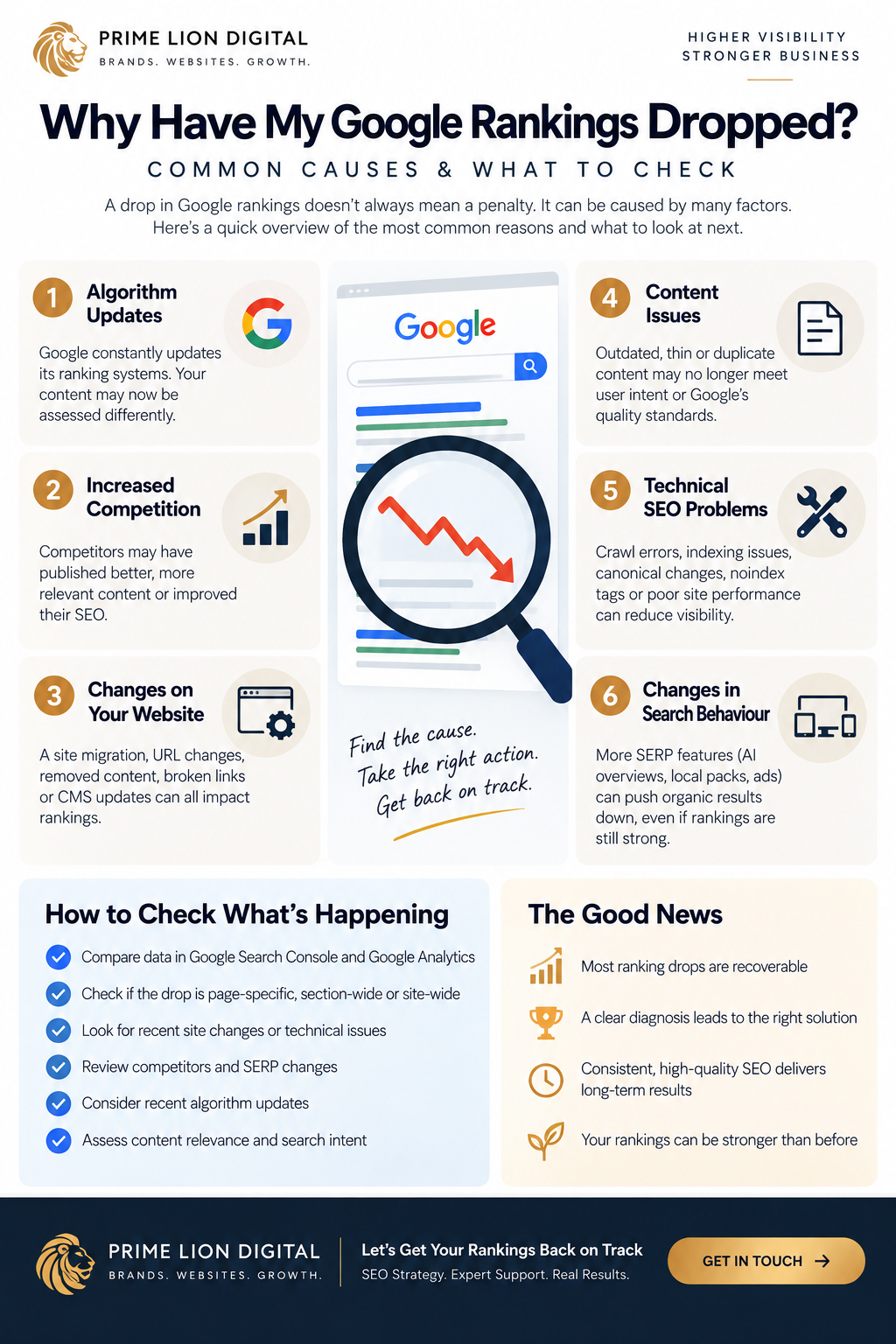
A ranking decline rarely has a single cause. Sometimes google rankings dropped because Google changed how it evaluates relevance. Sometimes the site changed. Sometimes competitors improved. And sometimes nothing is technically “broken” at all; the search landscape simply moved.
That is why a calm diagnosis matters. When a google ranking dropped dramatically, the worst response is usually the fastest one: rewriting pages blindly, removing content in a panic, or blaming an algorithm update before checking the data properly.
Leave your details and our team will get back to you shortly to discuss your website, SEO or digital growth project.
This article looks at what ranking drops usually mean in practice, how to separate a real problem from normal volatility, and what to review before making changes that create a bigger mess than the original decline.
Not every drop is a crisis
Search visibility moves more than many site owners expect. Positions fluctuate by device, location, query intent, SERP features, personalisation and competitor activity. A page that sat at position three last month may sit at six today without any penalty, error or manual action.
The real question is not whether a keyword moved. It is whether the pattern is meaningful. If one phrase slipped by two places but clicks and conversions are stable, that is very different from a site-wide loss across core commercial pages. When people say their google ranking suddenly dropped, they are often describing three different situations under one label: ordinary volatility, a measurable decline, or a structural SEO issue.
What a ranking drop usually looks like behind the scenes
In real-world reporting, ranking losses tend to fall into a few recognisable patterns.
One is a query-level drop: a specific page loses visibility for a cluster of terms because intent no longer matches as well as it once did. Another is a section-level drop: blog content, product pages or location pages all soften at once, often pointing to template, content quality or internal linking issues. The most serious is a domain-level drop, where large parts of the site lose ground together, suggesting broader technical, quality, authority or indexing problems.
That distinction matters. If your google ranking dropped on one page, the diagnosis is different from a sharp fall across hundreds of URLs.
| Type of Ranking Drop | Typical Scale | Example Impact | Priority |
|---|---|---|---|
| Minor fluctuation | 1–3 positions | 1–5 keywords or a small number of queries | Monitor |
| Page-level decline | 3–10+ positions | 1–5 important URLs | Medium |
| Section-level decline | 10–30% visibility loss | 10–100+ URLs within one section | High |
| Sitewide decline | 20–50%+ visibility loss | Hundreds or thousands of URLs | Urgent |
| Severe organic collapse | 50%+ traffic or visibility loss | Major commercial pages and keyword groups | Critical |
Why this matters more than vanity positions
Rankings are not just an ego metric. A meaningful decline can affect lead flow, sales forecasting, paid media efficiency and even board-level confidence in digital performance. A small visibility loss on high-intent terms can have a disproportionate commercial effect if those terms sit close to the conversion point.
For local firms, a fall in map visibility or location-based organic results can reduce calls almost immediately. For online shops, category-page losses can dent revenue long before the marketing team has a neat explanation. For publishers, traffic decline can ripple into ad yield and sponsorship value.
That is why serious teams pair ranking analysis with broader SEO measurement rather than isolated keyword screenshots.
Common scenarios where rankings fall
A few scenarios come up again and again.
A site migration launches with redirect gaps. A CMS update changes canonicals or internal linking. A content refresh strips out useful detail in favour of a cleaner but thinner page. Product pages go out of stock at scale. Tracking breaks, so what looks like an SEO collapse is actually a measurement problem. Or competitors publish materially better pages and quietly take market share.
There are also cases where the drop is seasonal, sector-specific or driven by changing search behaviour. Some queries simply become less valuable over time because Google inserts more SERP features, AI summaries, local packs or shopping elements above the traditional organic listings.
The cause is often less dramatic than people think
When a google ranking dropped dramatically, people tend to jump to penalties. In practice, penalties are far less common than misalignment.
Google may have reassessed whether a page is the best answer. That reassessment can be triggered by freshness, authority, page experience, duplication, crawl inefficiency, weak internal signals, or a broader quality recalibration. None of that necessarily means the site has done something reckless. It may simply mean the competitive threshold has risen.
That is an uncomfortable answer, but usually the honest one.
What businesses often misunderstand
The first misunderstanding is assuming rankings should be stable if no one touched the site. Search is not static. Competitors publish, links change, entities evolve, product availability shifts, and Google rewrites the results page constantly.
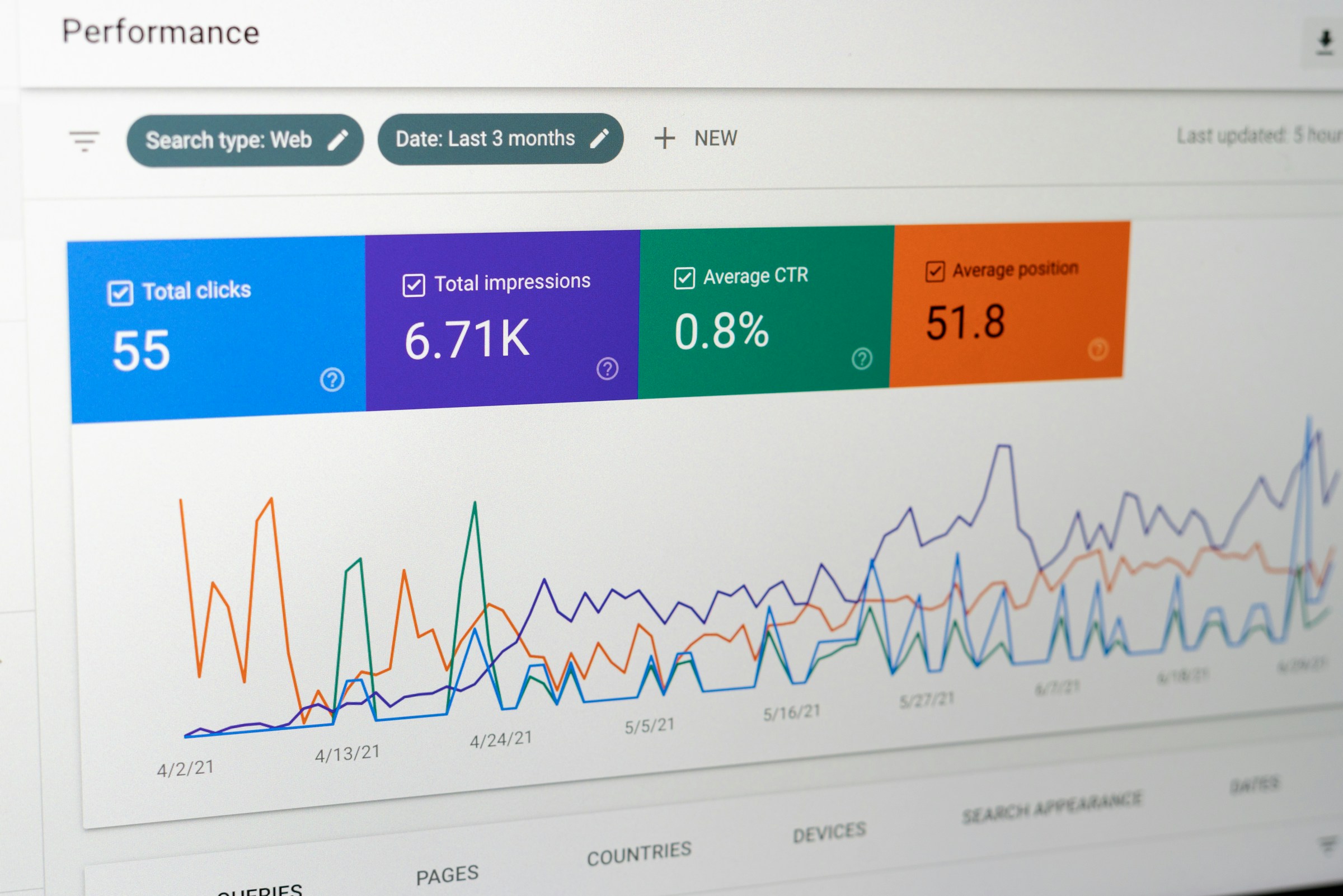
The second is treating all ranking tools as ground truth. Third-party trackers are useful, but they sample reality rather than reproduce it perfectly. Before declaring that google rankings dropped, check Search Console, landing-page traffic, click-through rate, impressions and segment behaviour alongside analytics validation.
The third is thinking more activity automatically fixes the problem. Some of the biggest recoveries come not from doing more, but from identifying the precise failure point: crawling, duplication, weak intent match, content decay, authority gaps, or analytics confusion.
Start with the data before touching the site
The first pass should be diagnostic, not corrective. Look for timing. Did the drop happen on one day, over several weeks, or gradually across a quarter? Did it affect mobile first? Did branded terms hold steady while non-branded terms fell? Did only informational pages decline while service or product pages remained intact?
A ranking story is rarely useful in isolation. You need to know what happened to organic sessions, engaged traffic, assisted conversions and revenue pathways as well.
On sites with more complex sales cycles, customer journey data often reveals that the “dropped ranking” problem is really a mid-funnel traffic shift rather than a collapse in bottom-funnel demand.
The numbers below are illustrative examples showing how different SEO signals can help diagnose a ranking decline.
| Metric | Example Before | Example After | Change | What It May Indicate |
|---|---|---|---|---|
| Average Position | 4.2 | 9.8 | -5.6 positions | Real ranking deterioration |
| Organic Clicks | 10,000 | 6,800 | -32% | Reduced organic traffic |
| Impressions | 250,000 | 190,000 | -24% | Lower overall search visibility |
| Organic CTR | 4.0% | 3.6% | -10% | SERP changes or weaker search snippets |
| Organic Conversions | 300 | 225 | -25% | Commercial impact of the decline |
| Indexed Pages | 1,000 | 720 | -28% | Possible crawling or indexation issue |
Technical causes are still common, just not always obvious
Technical SEO issues remain one of the fastest ways to lose visibility, but they are often subtle enough to slip through launches and routine updates.
Pages may still load, yet become harder to crawl because JavaScript rendering changed. Canonical tags may point to the wrong version. Important URLs may be accidentally noindexed. Pagination signals may weaken. Internal linking paths may become shallower. Core templates may generate duplication at scale. Faceted navigation may explode the crawl space. Server instability may reduce how efficiently Googlebot accesses the site.
This is why a review of technical SEO issues matters when a decline is broad or sudden. It is also why many teams use a structured SEO audit rather than relying on surface-level checks.
Content decline is rarely about word count
If your google ranking dropped after a content update, the issue is usually not that the page became shorter. It is that it became less useful, less specific, less trustworthy or less aligned to the real search intent.
Pages lose ground when they drift into generic language, remove practical detail, bury the main answer, or fail to address the commercial and informational realities behind the query. Thinness is often qualitative rather than quantitative.
A review of on-page content signals looks beyond headings and term frequency. It checks whether the page still deserves to rank against the current field.
Sometimes the page is fine and the strategy is the problem
A ranking drop can expose strategic weakness rather than page-level weakness. If a site has grown without a clear information architecture, keyword ownership becomes muddy. Multiple pages compete for the same topic. Commercial pages are under-supported by informational content. Internal link equity pools in the wrong places. The result is not always a catastrophic crash. More often it is a slow erosion.
That is usually where longer-term prioritisation becomes more important than isolated page edits. Fragmented publishing and unclear topic ownership eventually show up in the rankings.
Competitors may have earned the position back
It sounds obvious, but this is one of the most neglected checks. If a google ranking suddenly dropped, compare the current top results rather than staring only at your own page. The winners may now have stronger product detail, fresher examples, better category depth, more authoritative backlinks, cleaner UX, or a format that better matches the query.
Google does not need to decide your page is bad in order to rank it lower. It may simply decide another result is better.
This is especially visible in sectors where competitor authority improves through off-page signals and steady link profile changes. Authority gaps do not always hurt immediately. Then they do.
A few mini-scenarios that happen all the time
Local business: rankings drop for “near me” and city terms after a site redesign. The root cause is not the redesign itself, but weaker location-page copy, inconsistent local signals and diluted internal links.
Ecommerce site: category pages lose visibility after stock volatility, faceted URLs multiply, and template content becomes repetitive. The decline looks like an algorithm hit, but the underlying problem is crawl waste plus weaker category usefulness.
Lead generation site: service pages hold position, but blog traffic falls sharply. The likely issue is not domain-wide trust collapse; it is informational content decay, intent mismatch, or fresher competing resources.
The mistakes that usually make recovery slower
The most damaging reactions are surprisingly consistent.
- Changing too many pages at once, which makes diagnosis harder.
- Deleting content before understanding whether it still drives impressions or assists conversions.
- Obsessing over one rank tracker instead of triangulating with Search Console and analytics.
- Assuming an algorithm update is the cause simply because one happened recently.
- Ignoring template, crawl and indexation problems because the pages “look fine” in a browser.
Another big one: commissioning large-scale rewrites before checking whether the affected URLs even lost rankings for their primary intent cluster. Quite a few “content fixes” end up harming pages that were not the actual problem.
These ranges are practical examples rather than fixed Google thresholds. The importance of a ranking drop depends on its scope, duration and commercial impact.
| Ranking Change | Duration | Traffic Impact | Risk Level | Recommended Response |
|---|---|---|---|---|
| 1–3 positions | 1–7 days | Under 5% | Low | Monitor before making changes |
| 3–5 positions | 1–2 weeks | 5–15% | Moderate | Review affected queries and URLs |
| 5–10 positions | 2+ weeks | 15–30% | High | Run content and technical diagnostics |
| 10+ positions | Several days or longer | 30–50% | Very High | Investigate immediately |
| Sitewide decline | Any sustained period | 50%+ | Critical | Full technical, content and authority audit |
How to investigate a ranking drop properly
A sensible workflow is usually sequential.
First, confirm the loss is real and significant. Compare impressions, clicks, average position and landing-page traffic over a meaningful period. Second, isolate scope: one page, one directory, one device type, one country, or the whole domain. Third, map timing against releases, migrations, content changes, outages and known SERP shifts. Fourth, review the current winners in the SERP. Fifth, inspect technical signals, internal links, indexation and content quality.
Only then should remediation start.
Recovery depends on the type of decline
If the issue is technical, recovery may begin as soon as Google recrawls and reprocesses the corrected signals. If the issue is intent mismatch or content weakness, recovery often takes longer because Google needs to reassess usefulness relative to the field. If the problem is authority, there is rarely a quick fix. Off-site trust and relevance are cumulative.
And if your google ranking dropped dramatically because the SERP itself changed, the answer may not be “get back to the old position”. It may be adapting to a new results page reality where clicks are distributed differently.
There is usually more than one cause
This is the part people dislike because it complicates neat narratives. On larger sites, ranking losses are often layered. A technical inefficiency weakens crawl depth. Thin templates reduce page distinctiveness. Internal links favour the wrong pages. Competitors improve. Then an algorithmic recalibration exposes all of it at once.
In those cases, asking for the single reason a google ranking dropped is the wrong question. The better question is which weaknesses were tolerable before, and which became decisive now.
What senior teams should ask before approving a fix
Three questions tend to sharpen the discussion.
First, are we dealing with lost relevance, lost accessibility, lost authority, or bad measurement? Second, is this concentrated in revenue-driving pages or mostly affecting supporting visibility? Third, do we have evidence for the proposed fix, or are we acting because the explanation sounds plausible?
That last point matters more than it should. Search teams often have several believable theories. Only one or two are supported by the data.
Wider commercial implications
Ranking drops often reveal operational issues outside SEO. Content governance may be weak. Development releases may go live without proper QA. Merchandising decisions may create thin or unstable category pages. Analytics may not be robust enough to distinguish discovery traffic from conversion traffic. Teams may be reporting on positions while missing revenue leakage.
In that sense, a decline in organic visibility is sometimes an early warning system. It shows where digital operations are less joined-up than the dashboard suggests.
What the market is changing around you
Search is harder to read than it was a few years ago. Google is more dynamic, results pages are more crowded, and intent interpretation is less forgiving. Pages that once ranked on basic on-page relevance now compete in a field shaped by experience signals, topic depth, brand trust, SERP design and query nuance.
That means future ranking stability will depend less on isolated SEO tactics and more on durable foundations: sound technical implementation, clearer site structure, stronger editorial judgement, better data and a more coherent publishing model.
If your rankings have dropped, what should you do first?
Do not panic. Do not rewrite everything. Do not assume penalty.
Check whether the decline is real, scoped and commercially meaningful. Review timing, affected URLs, devices, geographies and query classes. Inspect the current SERP. Look for technical change, content drift, internal linking weakness, authority gaps and measurement issues. If the picture is messy, it usually means the site needs diagnosis, not instant action.
That sounds less dramatic than most ranking-drop advice online. It is also closer to how recoveries actually happen.
Final perspective
When people ask, “Why have my Google rankings dropped?”, they are usually asking something slightly different: has Google decided my site is worse than it was before?
Sometimes yes. More often, Google has become less convinced that a particular page is the best result under current conditions. That may be because your site changed, because competitors improved, because search intent shifted, or because technical and quality issues finally became visible enough to matter.
The important thing is not to treat every decline as a mystery or a disaster. A ranking drop is a signal. Read it carefully enough, and it usually tells you what the site has stopped doing well.