

How Much Does SEO Cost in the UK? A Complete Pricing Guide for 2026
SEO pricing in the UK has never been more variable, or more misunderstood. In 2026, one business might pay a few hundred pounds for a basic local campaign, while another commits five figures a month to technical remediation, international content production and digital PR. Both may still describe what they are buying as “SEO”. That is part of the problem.
If you are trying to work out how much SEO costs in the UK, the more useful question is not simply what is the monthly fee? It is what scope, capability and level of execution does that fee actually buy? The gap between cheap SEO and effective SEO is often wider than the gap in price suggests.
Leave your details and our team will get back to you shortly to discuss your website, SEO or digital growth project.
This guide breaks down UK SEO pricing for 2026 in practical terms: typical cost ranges, what shapes the fee, where retainers usually go, what changes for local and ecommerce brands, and how to judge whether a quote is realistic or just attractively vague.
The UK SEO market in 2026 looks busy, but uneven
There is no single “market rate” for SEO because the service itself is not standardised. A freelancer offering light on-page work and reporting is not pricing the same thing as a specialist team handling strategy, technical SEO, analytics, content planning, CRO input and authority building.
Search has also become more operationally demanding. AI-generated content has raised the noise floor. Google’s quality systems are less forgiving of thin pages and template-led optimisation. Meanwhile, stakeholders expect SEO to prove commercial value more clearly, often against paid media channels that look easier to measure.
That means pricing has shifted in two directions at once. Low-cost SEO is still widely available, often packaged around outputs rather than outcomes. At the other end, serious SEO programmes cost more because they involve more people, more systems, and more cross-functional work than many buyers initially expect.
Typical SEO prices in the UK for 2026
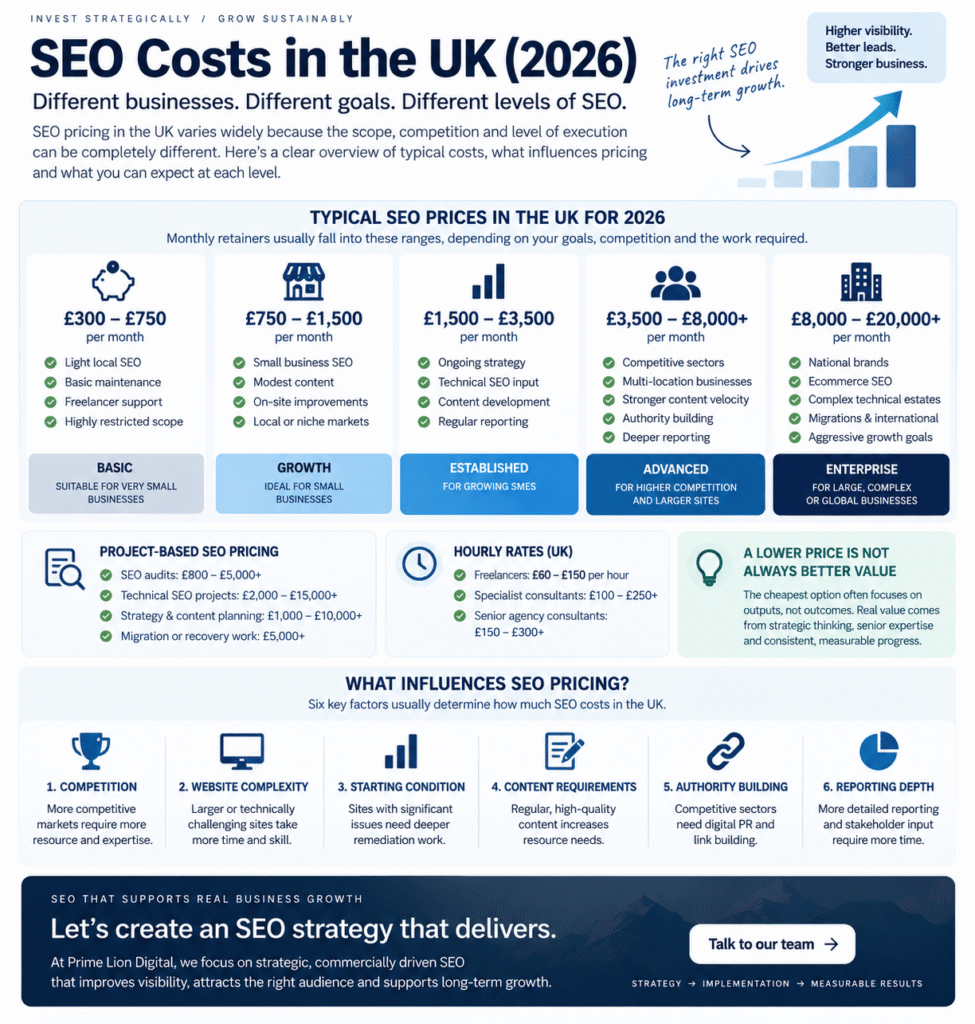
As a rough guide, UK SEO pricing usually falls into these bands:
- £300 to £750 per month: very light local SEO, basic maintenance, freelancer support, or highly restricted scope
- £750 to £1,500 per month: small business SEO with modest content and on-site improvements
- £1,500 to £3,500 per month: established SMEs needing ongoing strategy, technical input and content development
- £3,500 to £8,000+ per month: competitive sectors, multi-location businesses, stronger content velocity, authority work and deeper reporting
- £8,000 to £20,000+ per month: national brands, ecommerce SEO, complex technical estates, migrations, international reach or aggressive growth goals
Project work sits separately. A standalone SEO audit in the UK might range from roughly £800 to £5,000+, depending on depth. A serious set of technical SEO issues on a large site can push project pricing beyond that. Strategy projects, recovery work, content architecture planning, or measurement clean-up can also be priced as fixed engagements before a monthly retainer begins.
Hourly rates vary too. In 2026, experienced UK SEO freelancers often charge around £60 to £150 per hour. Specialist consultants and agencies may price senior consultancy materially above that, especially for complex diagnostics, migration planning or high-stakes recovery work.
Why two SEO quotes can be miles apart
This is where most confusion starts. SEO pricing is not just a reflection of time. It is a reflection of scope, capability, risk, speed, and how much thinking sits behind the work.
A £600 monthly retainer may include rank tracking, a few metadata tweaks and a templated report. A £3,000 retainer may include a proper search strategy, prioritised roadmaps, content briefs, internal linking logic, analytics QA, developer tickets, stakeholder meetings and ongoing performance analysis. Both are sold as SEO. They are not remotely equivalent.
In practice, UK SEO costs are usually shaped by six factors: market competitiveness, website complexity, starting condition, content requirements, off-page authority needs, and reporting depth. If any one of those is heavy, the price moves quickly.
What you are actually paying for
Good SEO is not one task. It is a stack of disciplines that have to work together without creating operational drag.
At the strategic layer, there is research, prioritisation and forecasting. Then there is execution: content and on-page work, content production systems, internal linking, technical fixes, page experience work, schema, crawl management and indexation control.
Beyond the site itself, some campaigns need authority growth through link acquisition or wider off-site visibility work. Measurement matters as well. If conversion tracking is weak, the commercial story behind SEO becomes fuzzy, which is why some retainers include analytics fixes and reporting validation.
That is the uncomfortable truth behind SEO pricing. You are not only paying for deliverables. You are paying for diagnosis, judgement, sequencing and the ability to avoid wasting six months on work that looked sensible but was pointed at the wrong problem.
Local SEO costs less than national SEO, but not always as much less as people think
For local businesses, the assumption is often that local SEO should be cheap. Sometimes it is. A single-location service business in a modest market may only need foundational work: Google Business Profile optimisation, service pages, local citations, review signals, basic content and technical clean-up.
That might place a realistic local SEO retainer somewhere between £500 and £1,500 per month.
But multi-location SEO is a different animal. Once there are dozens of branches, overlapping service areas, duplicated templates, inconsistent NAP data and internal stakeholder bottlenecks, local search becomes a systems problem. Costs rise not because “local keywords” are expensive, but because the operating model becomes messy.
Ecommerce SEO pricing rises fast because the workload compounds
Ecommerce SEO requirements tend to cost more for a reason. Product and category architecture, faceted navigation, cannibalisation, thin collection pages, discontinued URLs, internal search behaviour, stock volatility and platform constraints create work at scale. Often the issue is not one big mistake but hundreds of small inefficiencies quietly suppressing growth.
A small ecommerce site might spend £1,500 to £3,000 per month. A more serious retailer can easily move into the £4,000 to £10,000+ range, especially where category content, technical SEO, merchandising logic, CRO alignment and link acquisition all matter at once.
It is also one of the clearest examples of why low-cost retainers can underperform. If the site has 5,000 products, a couple of blog posts and a monthly rank report will not shift much.
The hidden cost is often not the retainer. It is the implementation gap.
This is the part many SEO pricing guides skip. A business may sign a sensible retainer, receive a sound roadmap, and still see limited movement because internal implementation is slow or fragmented.
Technical recommendations require developer time. New landing pages need copy, approvals and design support. Analytics fixes may involve tag management, cookie compliance and CRM alignment. Even straightforward recommendations can sit in a queue behind trading updates, product launches or platform bugs.
So when comparing SEO packages, it is worth asking not just “what does the agency do?” but “what has to happen inside our business for this to work?”
That distinction matters. Cheap SEO sometimes appears efficient because it asks very little of the client. Serious SEO often exposes internal constraints. Ironically, that can make the stronger option look more expensive before it has even started.
Why “how much does SEO cost?” is partly the wrong buying question
The better question is usually: what level of SEO do we need to solve the problem in front of us?
If the goal is to maintain visibility for a small local service business with low competition, the answer may be quite modest. If the goal is to reverse a traffic decline, recover after a migration, or grow revenue in a crowded national category, the required programme is different altogether.
This is why fixed package pricing can be misleading. It makes SEO feel interchangeable when it rarely is. The strategic effort needed to improve a well-built site in a low-competition niche is completely different from the effort needed to untangle poor information architecture, duplicate content, weak internal linking and non-existent attribution.
Common UK pricing models and where each one works
Monthly retainers remain the most common model because SEO benefits from continuity. Rankings, crawling behaviour, content performance and authority growth do not move in neat weekly cycles. A retainer allows prioritisation over time.
Project fees make sense for diagnostics, audits, migrations, launches or one-off strategy work. They are often the right starting point where the business first needs clarity before committing to ongoing activity.
Hourly consulting suits in-house teams that need senior input rather than execution. It can work well when internal capability is strong, but someone external is needed to challenge assumptions or pressure-test a roadmap.
Performance-based SEO still appears in the market, but it is usually less clean than it sounds. If the commercial model rewards narrow ranking wins, it can distort behaviour. Not always, but often enough to be cautious.
What most businesses still get wrong about SEO pricing
The biggest misunderstanding is treating SEO as a media buy rather than an operational discipline. You are not purchasing guaranteed visibility in the way you purchase clicks. You are funding research, implementation, iteration and problem-solving inside a competitive environment you do not control.
The second misunderstanding is assuming more deliverables means more value. Ten pages of recommendations are not better than three pages that identify the real bottleneck. Volume can be a smokescreen.
The third is underestimating the value of measurement. Without reliable attribution, SEO can look either better or worse than reality. Businesses often debate agency pricing before confirming whether enquiries, revenue events and assisted conversions are being tracked properly. That is backwards.
A few realistic scenarios
A family law firm in a mid-sized UK city might spend around £1,200 to £2,500 per month if it needs local service page improvements, better content targeting, Google Business Profile work, competitor analysis and gradual authority building. If the city is highly competitive, the range shifts upward.
A regional home services company with six locations may need £2,000 to £4,000 per month once duplicate location pages, review acquisition, local landing pages, technical hygiene and reporting are all included.
A direct-to-consumer ecommerce brand on Shopify may begin around £2,500 per month, but if category expansion, content strategy, crawl management and digital PR are involved, the fee can increase quickly.
A B2B SaaS company might spend less on link volume than an ecommerce brand, but more on strategy, information architecture and higher-value content planning. The spend profile changes because the search behaviour changes.
Where cheap SEO usually breaks down
Low-cost SEO is not always bad. Sometimes it matches the business stage. But when it fails, it tends to fail in predictable ways.
First, strategy is thin or absent. The work becomes a checklist: title tags, light blogs, generic outreach. Second, execution is junior-heavy, with little senior review. Third, reporting focuses on movement rather than meaning. Traffic may rise while qualified leads do not. Or rankings are reported for keywords nobody inside the business actually cares about.
Another recurring issue is channel isolation. SEO recommendations are made without reference to UX, sales process, content quality, or tracking accuracy. That often creates activity without commercial clarity.
In 2026, the cheapest SEO is not always the lowest invoice. It is often the work that consumes months of internal attention without solving the underlying search problem.
How to judge whether an SEO quote is realistic
A credible quote should reflect your site, your market and your constraints. If every prospect receives the same package with the same outputs, caution is justified.
Look for signs that the provider understands diagnosis before delivery: the state of your analytics, whether technical debt exists, how content production will happen, who implements recommendations, how priorities will be sequenced, and what trade-offs are likely in the first three to six months.
If the proposal speaks confidently about results but vaguely about process, that is usually a warning sign. Good SEO providers are rarely vague about where the work will go.
What a sensible SEO budget should include beyond the agency fee
This is another area where real costs get blurred. The retainer is only one line item. Depending on your model, the broader SEO budget may need to cover copywriting, design support, development time, PR outreach, content editing, data tools and stakeholder time.
That does not mean every campaign needs a huge surrounding budget. But it does mean decision-makers should distinguish between the cost of SEO services and the cost of making SEO work.
For some organisations, the second number is the more important one.
How long it takes before SEO spend starts to make sense
Usually longer than impatient stakeholders want, and often shorter than sceptics assume, provided the fundamentals are right.
For smaller local campaigns, meaningful movement can appear within three to six months. For more competitive UK markets, six to twelve months is a more realistic window. Recovery projects, technical overhauls and large-scale ecommerce programmes may take longer simply because implementation and recrawling take time.
That is not an argument for endless patience. It is an argument for honest expectations. If the site is technically weak, the content model is thin and the market is crowded, early months are often spent building the conditions for growth rather than harvesting it immediately.
Where the market is heading in 2026
SEO pricing in the UK is gradually polarising. At the lower end, automation and AI-assisted production make it easier to sell large volumes of visible activity cheaply. At the higher end, businesses are paying more for strategic clarity, content quality control, technical depth and commercially reliable measurement.
That gap is likely to widen.
In other words, SEO is becoming less about “doing SEO tasks” and more about integrating search insight into a wider digital operating model. Providers that can connect broader SEO analytics work, technical performance, content decisions and commercial reporting will continue to justify higher fees than providers selling isolated deliverables.
That may sound obvious. In practice, it still is not standard.
So, how much should you expect to pay?
If you want a simple answer, most UK businesses in 2026 should expect to spend somewhere between £750 and £3,500 per month for credible ongoing SEO support, with complex, competitive or ecommerce-led programmes moving beyond that range.
If you want the more truthful answer, expect to pay according to difficulty, not desire. The market does not charge based on how important growth feels internally. It charges based on how much work it takes to earn visibility in your category and how much organisational friction sits between recommendations and implementation.
That is why the same question, “how much does SEO cost in the UK?”, can produce answers that are all technically correct and still wildly unhelpful unless context is added.
Final perspective
SEO pricing is rarely confusing because agencies are bad at maths. It is confusing because businesses are often comparing unlike-for-unlike: maintenance versus growth, outputs versus strategy, reporting versus implementation, activity versus actual search improvement.
The most useful way to approach SEO cost in the UK is to start with the commercial objective, then work backwards into the real workload. What needs fixing? What needs building? What content has to exist? What technical debt will slow things down? Who owns implementation? What does success actually look like?
Once those questions are answered, the price usually makes far more sense.
And if a quote still seems surprisingly low, it probably is.