
How Long Does SEO Take to Work? Realistic Timelines for UK Businesses
One of the most common questions in search marketing is also one of the hardest to answer neatly: how long does SEO take to work? Business owners want a timeframe, finance teams want forecasting, and marketing leads want to know when effort turns into measurable growth. The uncomfortable truth is that SEO rarely moves in a straight line.
For most UK businesses, the honest answer is this: you may see early movement within a few weeks, clearer traction within three to six months, and materially stronger commercial impact over six to twelve months. In more competitive sectors, it can take longer. On newer websites, longer again.
Leave your details and our team will get back to you shortly to discuss your website, SEO or digital growth project.
That is not because SEO is vague, mystical or impossible to measure. It is because search visibility depends on several systems moving together: crawling, indexing, site quality, content relevance, internal architecture, authority signals, competition, and user behaviour. Google does not reward activity. It rewards accumulated evidence.
So if you are asking how long does it take for SEO to work, or how long does it take to see SEO results, the better question is usually: what kind of results, on what kind of website, in what market conditions?
The short answer most businesses are really looking for
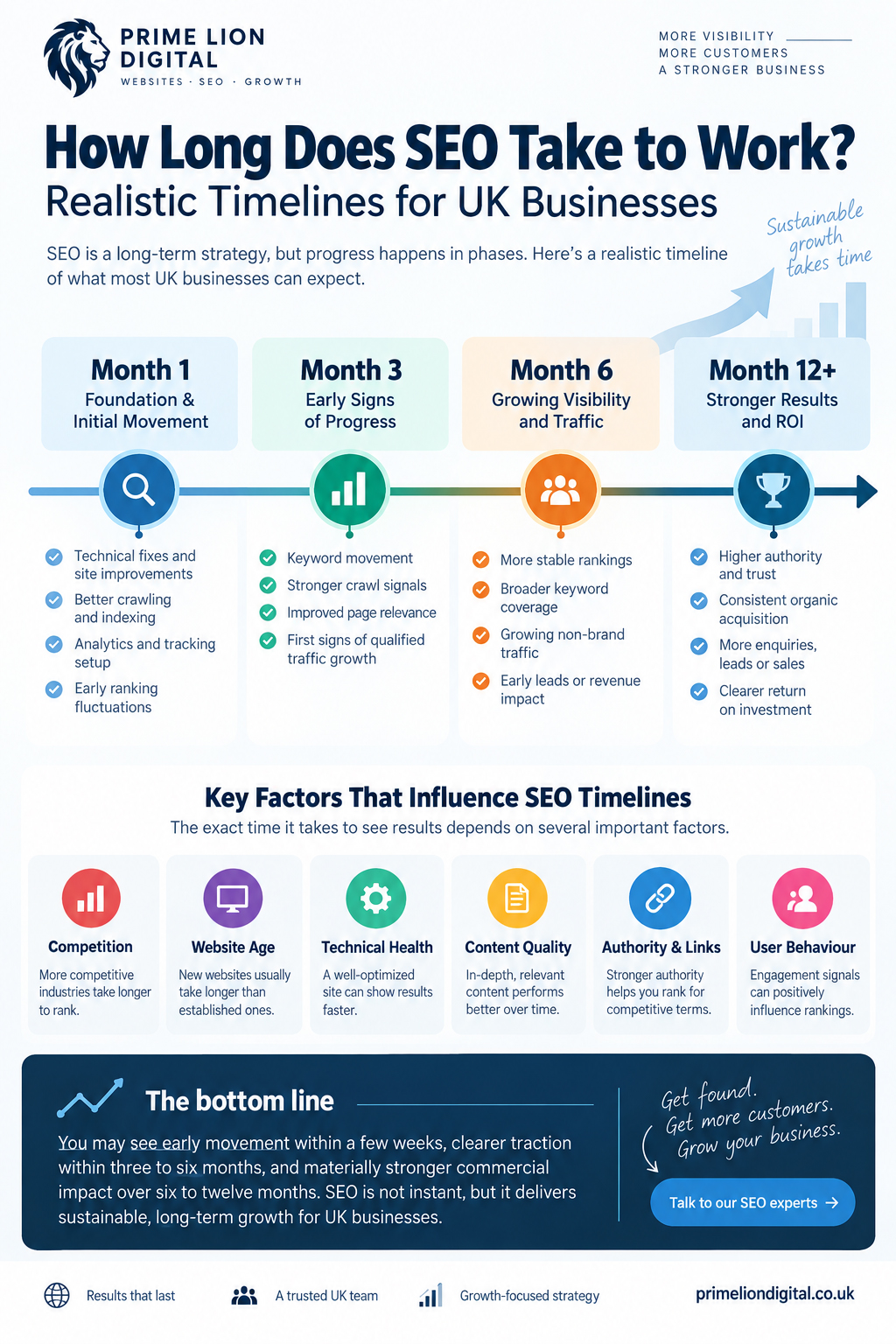
If a UK company starts serious SEO work today, a realistic SEO timeline UK often looks like this:
- First month: technical fixes, indexing improvements, measurement setup, early ranking fluctuations
- By month three: some keyword movement, stronger crawl signals, better page relevance, first signs of qualified traffic growth
- By month six: more stable rankings, broader keyword visibility, growing non-brand traffic, early lead or revenue impact
- By month twelve: stronger authority, more consistent organic acquisition, better conversion learning, clearer return on investment
That is the broad pattern. But broad patterns hide the detail that actually matters.
Why SEO timelines feel slow, even when progress is happening
When people ask why does SEO take so long, they are usually reacting to a mismatch between effort and visible outcome. A team publishes content, fixes metadata, improves service pages and expects a fairly immediate uplift. Instead, rankings wobble, impressions rise before clicks do, and traffic can lag behind the work by weeks or months.
That lag exists because search engines are cautious. They need to discover changes, recrawl pages, reprocess internal signals, compare your pages with competitors, and reassess how trustworthy and useful your site appears within a topic area. A rewritten title can update fairly quickly. A shift in domain-level trust does not.
And there is another issue. Many SEO changes are upstream changes. They improve the conditions for ranking before they improve ranking itself. Better technical foundations, cleaner site structure, stronger measurement through SEO analytics, sharper content strategy, and improved internal linking often create the platform for later gains rather than instant wins.
What “results” actually means in SEO
A lot of confusion comes from the word results. If you ask how long does SEO take to show results, you need to define what counts as a result.
For some teams, a result means pages being indexed properly. For others, it means first-page rankings. For a managing director, it usually means leads, pipeline or sales. These are not the same milestone.
In practice, SEO tends to produce results in layers.
Layer one is technical and diagnostic: cleaner crawling, corrected indexing issues, improved page rendering, fixed duplicate or cannibalisation problems, and more reliable attribution in analytics.
Layer two is visibility: impression growth, ranking movement, wider keyword coverage, and pages beginning to appear for more commercially relevant searches.
Layer three is traffic: more organic sessions, especially from non-brand queries.
Layer four is commercial: enquiries, qualified leads, booked calls, transactions, assisted conversions, or lower acquisition dependence on paid channels.
If you judge SEO only at layer four, it will often feel late. If you know how to read layers one to three, you can usually tell much earlier whether the strategy is genuinely working.
Month 1 to 3: early signs, but rarely a finished picture
This is where expectations tend to go wrong. In the first quarter, many businesses ask how long do SEO changes take or how long does SEO take to update because they have made visible edits and assume rankings should follow quickly.
Some things do move fast. Title tags may change in search results within days or a few weeks. Technical errors can be resolved quickly if Google recrawls the affected pages promptly. Newly improved pages can begin to rank for longer-tail terms surprisingly early, especially on established domains.
But months one to three are usually still a foundation phase. Good work here often includes an SEO audit usually surfaces these bottlenecks early, technical cleanup, content gap analysis, page rewrites, internal linking improvements, local optimisation where relevant, and better tracking through analytics. None of that is wasted. It just is not always immediately visible in board-level reporting.
For a UK B2B services site, month three may bring increased impressions, modest gains in lower-competition phrases, and a clearer sense of which pages are capable of driving growth. For an ecommerce SEO campaign, you may start seeing collection pages, category pages or key product clusters gaining more search coverage. For local SEO, map visibility and local landing page performance can sometimes move faster than national non-brand rankings.
Still, month three is usually too early for a confident verdict unless the site was held back by obvious technical problems.
Month 3 to 6: where SEO often becomes visible
If someone asks how long does SEO take to get results, this is the range where the answer becomes more tangible. Between the third and sixth month, useful patterns begin to stabilise.
Pages that were reworked around clearer intent often start earning stronger positions. Supporting content begins to help service and category pages rather than sitting in isolation. Technical issues slowing progress become less of a drag when crawl paths, rendering, Core Web Vitals and architecture are improved. Off-page SEO and link acquisition, if handled properly, begin to reinforce credibility. That matters, especially in competitive UK verticals where authority is a real ranking constraint.
This is also the point where weak strategies start to reveal themselves. If rankings remain flat across the board, impressions are not improving, and better pages are still not appearing for relevant searches, it is often a signal that the issue is not patience but direction. The site may have deeper relevance problems, poor information architecture, thin commercial pages, weak content quality, or simply stronger competitors occupying the space.
By month six, many established businesses can answer how long does it take to see SEO improvements with something more concrete: rankings are up, organic leads are beginning to rise, and the site is more visible for the right commercial themes. Not always dramatically. But clearly enough to justify the strategy.
Month 6 to 12: when compounding starts to matter
The six-to-twelve-month period is where SEO usually stops looking like a series of tasks and starts behaving like an asset. This is especially true if the work has been consistent across technical SEO, on-page SEO content, content strategy, and authority building.
At this stage, pages have had time to settle, clusters have had time to mature, and Google has more evidence about the site’s topic depth and reliability. That is why the question how long does SEO ranking take cannot be answered by pointing to a single page edit. Rankings are the outcome of accumulated signals.
By month twelve, a well-executed campaign often produces stronger keyword breadth, higher click-through from better aligned snippets, more resilient visibility across core commercial themes, and clearer conversion learning. Customer journey analysis becomes more useful too, because there is enough organic traffic to understand what users do before they enquire or buy.
This is the period where SEO starts to influence budget allocation. Businesses that once treated organic search as an experimental channel begin to recognise it as an acquisition system.
| SEO Timeline | What Is Usually Happening | What You May Start to See | Commercial Impact |
|---|---|---|---|
| Weeks 1–4 | SEO audit, technical fixes, tracking setup, crawling and indexing improvements, keyword mapping | Early ranking fluctuations, improved indexation and technical health | Usually limited — this is primarily the foundation stage |
| Months 1–3 | Content improvements, service page optimisation, internal linking, technical SEO and early authority building | More impressions, long-tail keyword movement and early organic traffic growth | First qualified visits or enquiries may begin to appear |
| Months 3–6 | Content clusters mature, rankings stabilise and authority signals begin to compound | Broader keyword coverage, stronger non-brand rankings and more consistent organic traffic | Organic leads and revenue contribution can become measurable |
| Months 6–12 | Topical authority, content depth, links and technical improvements work together | Stronger rankings, wider search visibility and more resilient organic traffic | SEO can become a meaningful and repeatable acquisition channel |
| 12+ months | Continuous optimisation, content expansion, authority growth and conversion improvements | Greater keyword breadth, stronger competitive positions and sustained organic visibility | Potential for stronger ROI and reduced dependence on paid acquisition |
New website vs established website: the timeline is not the same
Two companies can invest the same amount into SEO and get very different speeds of return.
A new website typically takes longer. It has limited trust history, fewer indexed pages, weaker internal depth, little or no backlink profile, and often uncertain brand demand. In that environment, asking how long does Google SEO take is really asking how quickly a new site can earn credibility. Usually, not quickly.
A new domain may need six to twelve months just to build enough momentum for consistent organic growth in a competitive sector. That does not mean nothing happens before then. It means the early wins are narrower, and the ceiling is lower until the site accumulates more evidence.
An established website can move faster, particularly if it already has some authority, historical rankings, branded searches, and a decent technical base. Here, SEO often behaves less like a cold start and more like a recovery or acceleration process. If the site already has trust and relevance, strong improvements can emerge inside three to six months.
The wrinkle is that older sites also carry baggage: legacy pages, cannibalisation, messy migrations, outdated templates, redirect chains, thin blog archives, and conflicting signals from years of unstructured publishing. Established does not always mean efficient.
How long does local SEO take?
How long does local SEO take is one of the more practical variations of this question because local search behaves differently from broader national campaigns.
For many UK businesses with a clear service area, a properly optimised Google Business Profile, strong local landing pages, consistent location signals, and decent review health, local SEO can move faster in the right conditions. Some improvements show within a few weeks; more meaningful progress often appears in two to four months.
That said, local SEO is not automatically faster in every case. In London, Manchester, Birmingham and other dense markets, map pack visibility can be fiercely competitive. Proximity, prominence, category alignment, review profile, local links, and behavioural signals all play a role. If several firms in the same postcode are competing hard, the timeline can stretch significantly.
Local SEO also creates a false sense of simplicity. A business may rank well in its immediate area but struggle across surrounding towns or counties. So the right question is not merely how long until I rank locally? but where, for which services, and with what level of commercial intent?
Competitive industries take longer, sometimes much longer
Sector matters. A regional accountancy firm, a niche software consultancy, and an online furniture retailer do not face the same organic search conditions.
In lower-competition niches, a well-structured site with credible content and solid technical foundations can gain traction relatively quickly. In aggressive markets such as legal, finance, SaaS, insurance, property, health, or established ecommerce categories, the answer to how long does SEO take to rank is usually “longer than you hope”.
That is because you are not competing against a blank page. You are competing against domains with deeper content libraries, stronger backlink profiles, better brand recognition, higher engagement history, and teams that have been refining the same search territory for years.
In those markets, six months may produce progress without producing dominance. Twelve months may produce meaningful growth without producing category leadership. This is normal. It is not necessarily a sign the campaign has failed.
What changes update quickly, and what takes longer?
Some of the supporting questions around this topic are really about update speed rather than campaign speed. For example: how long does it take to see SEO changes, how long does SEO take to reflect, or how long does Google SEO take to update.
Here it helps to separate page-level edits from site-level performance shifts.
Faster updates can include title tags, meta descriptions, basic on-page revisions, internal links on frequently crawled pages, and fixes to obvious technical errors. If the page is crawled often, these can be reflected relatively quickly.
Slower updates include authority growth, trust rebuilding after quality issues, recovery from poor site architecture, competitive repositioning, and the cumulative impact of content strategy. Those outcomes depend on many pages and signals working together over time.
To answer a few common questions directly: how long does it take for SEO title to update and how long does it take for SEO description to update? Often days to a few weeks, though Google may rewrite snippets regardless of what you set. That update does not guarantee a ranking change.
Likewise, if you ask how long does SEO take to be effective, effectiveness should not be judged by whether one edit appears in search, but whether the overall search experience, relevance and authority of the site are improving.
Why good SEO work can look invisible before it looks successful
There is a frustrating period in many campaigns where the team is doing sensible work but the headline metrics are not yet exciting. This is common, and it often separates patient operators from businesses that stop just before momentum starts.
Technical SEO is a good example. Fixing crawl issues, template problems, rendering blockers, poor canonicals, index bloat or internal duplication can be essential, but those fixes are rarely glamorous. They remove drag. They do not always create immediate lift.
The same is true of measurement. Better analytics, event tracking, search console interpretation, and customer journey mapping may not increase rankings on their own, yet without them it becomes very difficult to judge which pages are actually helping revenue and which merely attract noise.
In other words, some of the most important SEO work improves decision quality before it improves traffic.
What most businesses underestimate about the timeline
Usually, three things.
First, they underestimate the amount of legacy friction on their own site. Weak page intent, conflicting URLs, underpowered category or service pages, slow templates, thin location pages, and poor content hierarchy all reduce the speed of change.
Second, they underestimate competitors. Even average-looking rival sites may have ten years of authority, accumulated links, stronger branded search demand, and pages that have been quietly earning trust for a long time.
Third, they expect SEO to behave like media buying. Paid search can generate traffic the same day. Organic search does not buy attention; it earns recurring visibility. The timescales are different because the mechanism is different.
That is why how long does organic SEO take is best answered with a commercial lens. Organic search often starts slower than paid channels and then compounds more effectively if the foundations are sound.
A few realistic UK business scenarios
Scenario one: a new regional service business
A newly launched website for a local trades or professional service company may see modest local visibility inside the first two or three months if its location signals are clear and the competition is not brutal. But broad organic growth across multiple services and surrounding towns usually takes longer. Six months is more realistic than six weeks.
Scenario two: an established B2B firm with poor structure
An older site with authority but messy architecture can sometimes improve faster than expected once core service pages, internal linking and content relevance are fixed. Rankings may move noticeably by month three, with stronger lead impact around month six. This is one of the few situations where SEO feels fast.
Scenario three: an ecommerce site in a crowded category
Ecommerce SEO often needs more patience. Category structure, faceted navigation, product duplication, technical performance, thin collection text, and fierce competition all slow the process. Early improvements may appear in long-tail searches, but stronger category-level gains often need sustained work over six to twelve months.
Scenario four: a business hit by years of inconsistent SEO
If a company has published low-value content, built poor links, created duplicate service pages, or migrated the site badly, the timeline becomes less about growth and more about repair. Recovery work can absolutely succeed, but not on a convenient monthly schedule.
| Website / SEO Scenario | Early Signs | Meaningful Traction | Stronger Results | Main Factors Affecting Speed |
|---|---|---|---|---|
| New Website | 1–3 months | 3–6+ months | 6–12+ months | Domain history, indexation, content depth, backlinks and competition |
| Established Website | Several weeks–3 months | 3–6 months | 6–12 months | Existing authority, technical health, legacy content and current rankings |
| Local SEO | Several weeks | 2–4 months | 4–12+ months | Location, competition, Google Business Profile, reviews and local authority |
| Established B2B Website with Structural Issues | 1–3 months | Around 3–6 months | 6–12 months | Existing authority, service-page quality, architecture and internal linking |
| Ecommerce SEO | 1–3 months | 3–6+ months | 6–12+ months | Category competition, site architecture, faceted navigation, duplication and authority |
| Highly Competitive Industry | 1–3+ months | 6+ months | 12+ months may be required | Competitor authority, backlinks, content depth, brand strength and search demand |
| Website Requiring SEO Recovery | 1–3+ months | 3–6+ months | 6–12+ months | Severity of technical, content, migration or link problems |
How to tell whether your SEO is on track
The right way to assess progress is not to stare at one vanity keyword. It is to watch whether the site is becoming stronger in the places that matter.
A healthy campaign usually shows some combination of broader index coverage, improved rankings across a topic cluster rather than a single term, growth in non-brand impressions, better landing page engagement, more qualified enquiries, and clearer paths from organic session to conversion.
That is where measurement discipline matters. If reporting focuses only on traffic volume, businesses can misread both success and failure. Better SEO reporting looks at visibility, intent, assisted conversions, landing page performance, and the difference between branded and non-branded demand. In practice, poor measurement often makes progress look slower than it is.
Sometimes SEO is working, but attribution is poor. Sometimes the opposite is true.
When slow SEO is normal, and when it is a warning sign
Slow does not automatically mean broken. But not all delay is healthy.
It is usually normal if the site is new, the market is competitive, the work only began recently, authority is weak, or the campaign is still fixing deep structural issues.
It may be a warning sign if six months have passed and there is still no real improvement in rankings, impressions, page quality, crawl efficiency or lead quality. At that point, the business should question the strategy, not just the patience level.
Common reasons include weak page targeting, generic content, over-reliance on blog posts while commercial pages remain thin, lack of technical depth, poor internal linking, weak link profile, or unrealistic keyword selection. Sometimes the team is doing activity rather than solving the constraint.
The hidden operational work behind faster SEO outcomes
Businesses often ask how to shorten the timeline. There is no legal shortcut, but there is such a thing as reducing avoidable drag.
Campaigns tend to move faster when the basics are properly joined up: strategy, technical SEO, content planning, on-page execution, authority building, analytics, and commercial feedback from sales or lead handling teams. Fragmented SEO almost always takes longer.
A site with clear measurement, sensible prioritisation, and coherent implementation has a better chance of producing earlier wins because the work compounds instead of colliding. That may involve better SEO strategy, more disciplined technical audits, cleaner content operations, improved off-page activity, or stronger local SEO foundations depending on the site’s starting point.
This is where many organisations lose time internally. Approvals stall. development queues are long. content briefs drift. nobody agrees on the commercial pages that matter most. The SEO timeline is not only about Google; it is also about operational throughput inside the business.
So, how long does SEO take to work for UK businesses?
If a business wants the most practical answer possible, it is this:
Expect early signals inside one to three months, meaningful traction in three to six months, and more serious business impact in six to twelve months.
For a new site, stretch that expectation. For local SEO in a lighter market, compress it slightly. For highly competitive industries, extend it again.
That is the realistic middle ground between overpromising and hand-waving. SEO results UK businesses care about do not usually arrive all at once. They arrive in stages, and they reward consistency more than intensity.
The final point people often miss
The question is not only how long does SEO take. It is also what happens if you stop.
Paid channels switch off when spend stops. SEO has a slower ramp, but it can create a more durable acquisition base if the work is competent and sustained. That is why mature companies treat SEO less like a campaign burst and more like a strategic operating layer across site structure, content, authority and measurement.
So yes, patience is part of it. But blind patience is not the lesson. The better lesson is to understand which signals should move first, which outcomes take longer, and whether the work being done is actually capable of compounding.
Once you understand that, the timeline becomes much less mysterious.