

How to Choose a Web Design Agency in the UK
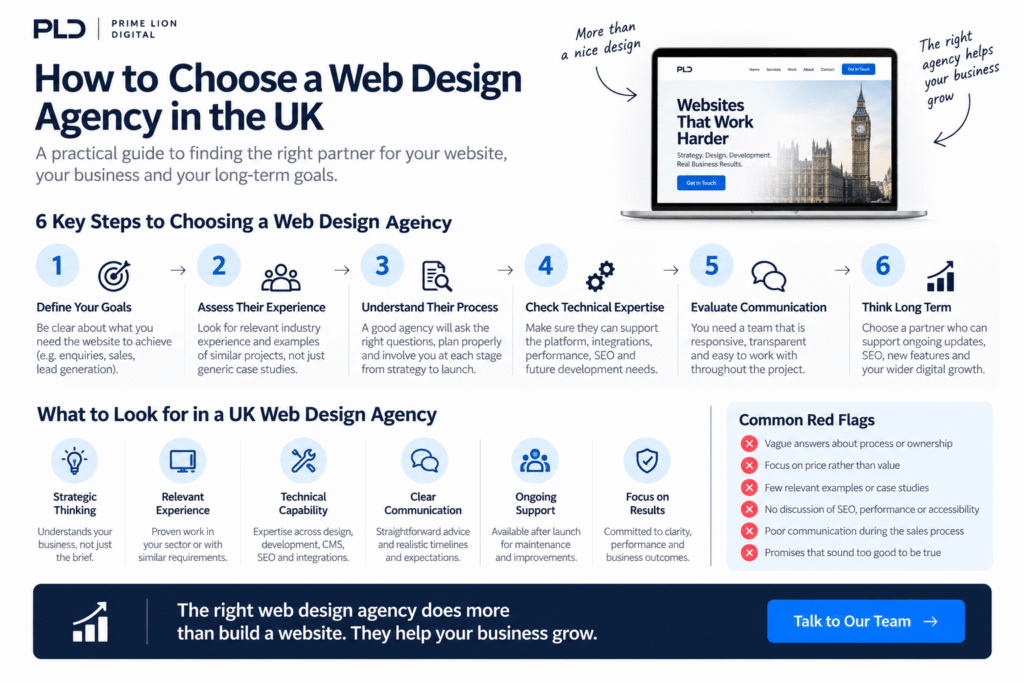
Choosing a web design agency in the UK sounds straightforward until you begin speaking to agencies. Almost all of them claim strategic thinking, user-focused design, technical expertise and strong results. On paper, the differences can look cosmetic. In practice, they rarely are.
A good agency can improve clarity, lead quality, conversion performance and internal confidence in your digital presence. The wrong one can leave you with a site that looks respectable in screenshots but creates problems the moment real users, editors, sales teams or search engines interact with it.
Leave your details and our team will get back to you shortly to discuss your website, SEO or digital growth project.
This is where many buying decisions go wrong. Businesses often compare style, price and speed, when the bigger issue is fit: fit with your commercial model, your internal workflow, your content capability, your systems, your approval process and your growth plans.
This guide is designed to help with that. Not with a simplistic shortlist, but with a more realistic view of how to choose a website design agency in the UK when the project has actual business consequences.
The UK market is crowded, but the real issue is comparability
The British web design market is broad. You have freelancers, boutique studios, WordPress specialists, brand-led creative agencies, development-heavy teams, conversion-focused agencies and full-service digital firms that include design as one offer among many. That variety is healthy, but it makes comparison messy.
Two agencies may both say they build bespoke, high-performing websites. One may mean a tailored design system supported by discovery workshops, CMS planning, accessibility considerations and careful QA. The other may mean a lightly customised theme with a few extra page layouts and a compressed timeline.
Neither description is necessarily dishonest. They simply refer to different levels of process, technical depth and commercial intent.
That matters because most businesses are not just buying pages. They are buying an operational asset: something the marketing team needs to update, the sales team needs to trust, leadership needs to approve and customers need to understand within seconds.
What a web design agency is really being hired to do
A professional web design agency is not there merely to make a site look modern. At its best, the agency translates business goals into digital structure. That includes hierarchy, messaging clarity, user journeys, page intent, CMS usability, mobile behaviour, speed considerations and technical decisions that affect what happens after launch.
Good design work sits between strategy and execution. It asks awkward questions early, because those questions are cheaper before development begins.
For example: who owns the content internally? Will the site need to support multiple service lines? Are there compliance sensitivities? Will the business expand into new locations? Does the marketing team need landing-page flexibility without developer support? Is the current site losing organic visibility because of architecture, migration risk or thin templates rather than just appearance?
If an agency never gets near those questions, it is usually not doing full web design work. It is producing a visual layer.
Why the choice has wider commercial consequences
Website projects are often treated as contained design exercises. They are not. The agency you choose affects timelines, internal workload, content quality, platform flexibility, long-term cost of ownership and, sometimes, revenue friction you do not see until six months later.
A visually strong but structurally weak site can create subtle damage. Sales teams start working around it. Paid traffic lands on pages that do not convert cleanly. Editors avoid updating the CMS because it is cumbersome. New services get bolted onto outdated page templates. Eventually the site still exists, but the organisation stops relying on it.
That is one of the more common failure patterns in UK mid-market businesses: the website becomes a branded brochure rather than a maintained commercial tool.
The stronger agencies understand this. They know launch day is not the finish line; it is the point at which the site begins proving whether the underlying decisions were sound.
The first question is not “Who is best?” but “Best for what?”
There is no single best web design agency in the UK. There are agencies that are best suited to early-stage start-ups, others built for complex B2B environments, others excellent at design systems, others strong in development-heavy builds, and some particularly good at stakeholder management inside larger organisations.
That distinction is often missed during procurement. Businesses compare agencies as if they are interchangeable providers delivering the same product at different prices. They are not.
A start-up launching a first credible site has very different needs from a professional services firm replacing an outdated CMS, or a multi-location company that needs governance, role permissions and content consistency across teams.
Before reviewing portfolios, it helps to define the real shape of the project. Not just “we need a new website”, but what kind of problem the website is expected to solve.
Common buying scenarios and what they demand from an agency
Some website projects are primarily about credibility. The business has outgrown a weak online presence and needs a site that reflects its maturity. In that case, positioning, messaging clarity, page hierarchy and polish matter more than technical complexity.
Others are transformation projects. The business is dealing with an ageing platform, poor editor experience, fragmented templates, slow performance or migration concerns. Here, the right agency needs stronger development planning, discovery rigour and implementation control, especially on website redesign projects where legacy structure cannot simply be ignored.
Then there are conversion-led projects, where traffic already exists but the site underperforms commercially. That requires a different kind of thinking again: user intent, friction mapping, information architecture, forms, trust signals and page-level decision design.
And occasionally the brief says “design”, while the real issue is internal. Conflicting stakeholders, unclear ownership, weak content governance or a leadership team that has not agreed what the site is for. No agency can fully solve that, but an experienced one will spot it early and structure the process around it.
A smaller business might need a lean brochure site with a few tightly built service pages, a manageable CMS and room to publish occasional campaign pages later. A larger B2B organisation may have very different corporate website requirements: governance, multiple approvers, legacy content, department-level needs and greater scrutiny around performance, accessibility and handover.
Where many businesses misjudge agencies
The most common mistake is overvaluing surface evidence. A polished homepage, a slick proposal or a recognisable client logo can create confidence quickly, but none of those prove the agency is right for your project.
Portfolio work is especially easy to misread. Strong visuals do not tell you whether the agency improved conversion pathways, managed a complex migration, created a maintainable CMS or handled multi-stakeholder approvals effectively. In many cases, the work you are seeing reflects collaboration with an in-house brand team, an external copywriter or an existing technical stack that the agency inherited rather than defined.
That does not make the portfolio irrelevant. It means it needs context.
Ask what the agency was actually responsible for. Strategy? UX? Copy structure? Front-end build? CMS implementation? Technical SEO considerations during redesign? Integrations? Governance? Without that, portfolio review becomes theatre.
What to look for beyond design taste
A competent design agency should of course demonstrate visual quality. But if that is your main filter, you risk choosing a team that is creatively attractive and operationally weak.
The more useful signals tend to sit elsewhere: how they scope a project, how they question assumptions, whether they understand content as part of design rather than an afterthought, how they discuss CMS usability, what they say about accessibility, how they approach mobile-first layouts, whether they seem alert to performance constraints, and how clearly they explain trade-offs.
Trade-offs are important. Serious agencies rarely pretend every decision is universally right. They will explain, for instance, that a highly flexible CMS can create governance problems if internal teams lack discipline, or that a fast deadline may require template compromise, or that replatforming introduces risk that needs active management rather than cheerful optimism.
When agencies speak honestly about constraints, they tend to be more dependable in delivery.
The discovery process tells you almost everything
If you want one practical way to evaluate a web design agency, pay close attention to discovery. Not the sales pitch. Discovery.
Strong agencies do not rush past the uncomfortable early phase. They spend time understanding business model, audience, user intent, internal politics, current website pain points, content reality and technical dependencies. They do this because design decisions are expensive to change later.
Weak agencies often move too quickly to moodboards, page counts and launch dates. That can feel efficient. It usually is not. It often means they are standardising the project around their process rather than designing the process around your needs.
A good discovery phase should leave you feeling better informed about your own project, not just impressed by the agency. That is an underrated test.
Questions worth asking before you sign
Most agency selection meetings ask predictable things: timeline, cost, examples, process. Useful, but not enough. The better questions reveal how the agency thinks when the project gets complicated.
- What typically causes delays on projects like this, and how do you reduce that risk?
- How do you handle content if the client team is not ready when design starts?
- Who makes decisions on UX, structure and CMS rules when stakeholders disagree?
- How do you approach accessibility, performance and mobile behaviour in practice?
- What happens after launch if internal teams need additional page types, integrations or governance changes?
- What parts of the project are most likely to be underestimated at the start?
The quality of the answers matters more than the confidence of the delivery. Vague certainty is common in this market. Specificity is rarer.
Budget is not just about cost; it is about what is being protected
Businesses often search for web design agency UK pricing as if there is a normal market rate. There is not, at least not one that tells you much on its own. Fees vary because the work varies: discovery depth, content support, UI complexity, CMS configuration, development standards, integrations, QA, migration planning and post-launch support all change the real scope.
Low fees are not automatically a warning sign. Some smaller agencies run lean and do very good work. High fees are not automatic proof of rigour either. The point is to understand what the budget is protecting.
Is it protecting strategic thinking at the start? Better implementation quality? Reduced revision chaos? Stronger governance? Cleaner code? Better handover? Less rework six months later?
That framing tends to produce better decisions than simply asking which proposal is cheapest or which is most expensive.
Cheap websites can become expensive in slower ways
Not every project needs a large investment. But there is a difference between appropriate efficiency and false economy.
A website that is hard to edit creates hidden labour cost. A weak page structure reduces the value of paid acquisition. Fragile templates slow future campaigns. Poor migration planning can damage search visibility. Inadequate QA creates reputational friction that nobody budgets for at procurement stage.
These costs rarely arrive as one dramatic invoice. They show up as repeated compromise: another workaround, another plugin, another page that does not quite fit, another argument about why the site is difficult to update.
That is why experienced buyers tend to assess long-term usability, maintainability and organisational fit alongside initial design quality.
Platform choices matter more than many briefs admit
When companies ask how to choose a web design agency, they sometimes focus entirely on aesthetics and overlook platform implications. Yet CMS and development decisions shape the site long after the launch visuals have become familiar.
For many UK businesses, WordPress remains a sensible choice because it is flexible, widely supported and commercially practical. But one WordPress delivery model can look very different from another depending on architecture, theme dependence, editor experience, plugin discipline and governance.
The same is true of other platforms. A proprietary build may offer control but create support dependency. A visual builder may speed delivery but introduce performance or maintainability concerns if misused. A headless approach may be entirely justified, or entirely excessive, depending on internal capability and the site’s actual needs.
Some projects only need sensible CMS development considerations and a manageable editorial workflow. Others involve integrations, account areas or deeper custom web development requirements where a design-led team on its own may not be enough.
The agency does not need to push one platform dogmatically. It should be able to explain why the chosen setup suits your content model, budget, growth plans and team capability.
Content is usually the hidden constraint
One of the least glamorous truths in web projects is that content delays break more timelines than design delays. Businesses often imagine the agency will “do the website” while internal teams somehow provide the right copy, approvals, imagery and service detail along the way. In reality, content is usually where momentum starts slipping.
This is another useful test during selection. Does the agency treat content as central to the project, or as a client-side dependency to be mentioned briefly in a project plan?
Experienced teams know that weak content creates weak design decisions. Placeholder copy produces false confidence. Late messaging changes trigger layout revisions. Missing evidence points weaken trust on key pages. Even simple things, such as inconsistent terminology between teams, can damage clarity more than businesses expect.
If an agency seems casual about content, be careful. They may still design something attractive, but the commercial performance of the site may depend on assumptions that were never properly resolved.
Real-world signs an agency understands implementation
Implementation maturity has a tone to it. You can usually hear it in the way an agency talks about workflow.
They mention approvals without sounding irritated by them. They have opinions about staging environments, content population, redirect planning, QA rounds and browser/device testing. They know that stakeholders often react differently to wireframes than to polished designs. They understand that launch timing may be shaped by CRM changes, legal review, recruitment cycles or sales activity rather than simply development readiness.
They should also be clear about ownership. That includes who controls the domain, where the site is hosted, who retains CMS admin access, what happens to design files, whether the codebase can be handed over cleanly, who manages analytics setup, and what documentation is provided at the end. These are not legal footnotes. They shape how dependent you remain after launch.
In other words, they speak like people who have actually lived through projects, not just presented them.
That does not require jargon. In fact, too much jargon can be a warning sign. The stronger agencies usually explain technical and process complexity in fairly plain language because they have had to align non-technical stakeholders before.
Red flags that deserve more weight than they usually get
Some warning signs are obvious: generic proposals, thin case studies, poor communication. Others are more subtle.
An agency that promises unusually fast delivery without probing content readiness is taking a shortcut somewhere. An agency that says yes to every request during sales is often deferring difficult conversations until after the contract is signed. An agency that cannot explain who will actually work on the project may be selling senior expertise and delivering junior execution.
There is also the problem of strategic mimicry. Many agencies now use the right language: discovery, UX, conversion, accessibility, performance, SEO-friendly structure. The presence of that vocabulary is not proof of depth. Ask how those things are handled, by whom, at what stage, and how trade-offs are managed if priorities conflict.
Proposal review can reveal a lot as well. Be wary of vague scope, unexplained revision rounds, unclear third-party costs, no mention of testing, no statement on post-launch responsibility and no clear answer on handover. If the practical boundaries are blurry before appointment, they rarely become clearer later.
The answers are usually revealing very quickly.
A shortlist should compare operating models, not just creative work
By the time you reach a shortlist, the evaluation should become more structured. Not rigid, but structured enough to compare agencies beyond first impressions.
At that stage, it helps to look at four things together: strategic capability, design quality, technical implementation and delivery fit. Delivery fit is the one that gets neglected. A strong agency can still be wrong for you if its process assumes a level of internal responsiveness, content maturity or governance simplicity that your organisation simply does not have.
Some agencies are excellent with decisive founder-led businesses and visibly less comfortable in layered stakeholder environments. Others are strong at enterprise process and slower in fast-moving commercial settings. Neither is inherently better. The fit matters.
How decision-making usually breaks down inside the client business
It is easy to evaluate the agency as if all project risk sits on their side. Often it does not.
Website selection decisions are frequently distorted by internal misalignment. Senior leadership focuses on brand perception. Marketing focuses on growth. Operations wants control. Sales wants speed and relevance. Compliance wants caution. IT wants stability and security. All legitimate. But if those priorities are not surfaced early, the agency is forced to discover them mid-project, which is slower and more expensive.
One reason businesses feel disappointed by agencies is that they bought from a proposal built around an incomplete internal brief.
That is why good agencies push for clarity before scoping too confidently. From the client side, it is worth deciding who owns the final call, what success looks like, and which compromises are acceptable. Without that, even a capable agency can look ineffective.
Choosing a local agency versus a remote one
For UK businesses, the question of local versus remote still comes up. It matters less than it once did, but it has not disappeared.
If the project involves intensive workshops, sensitive stakeholder dynamics or complicated approval chains, in-person sessions can still be valuable. They reduce ambiguity, speed alignment and often surface tensions earlier. For simpler projects, remote collaboration is usually perfectly workable, provided the agency is organised and communicative.
The better test is not geography on its own. It is whether the agency can manage the communication rhythm the project needs. Some remote agencies are excellent at this. Some local agencies are not.
Still, UK market familiarity does help. Tone, buyer expectations, sector norms and even compliance sensitivities can vary enough that local commercial awareness makes the process smoother.
What a sensible selection process looks like
In practical terms, a strong selection process is rarely complicated. It is simply more disciplined than many businesses make it.
Start by defining the business problem, not just the deliverables. Then decide what the new site must do well in year one: improve lead quality, support a repositioning, make internal editing easier, reduce technical debt, accommodate growth, or all of the above. Shortlist agencies that appear relevant to that reality, not merely attractive.
From there, use conversations to test depth. Review process, case studies, who is on the team, how they manage content, how they handle scope pressure, and what they see as the main risks. If the proposal stage teaches you nothing about your own project, something is missing.
And once proposals arrive, compare assumptions as much as costs. Two quotes can be far apart because one agency has included the difficult parts honestly and the other has not.
The role of SEO, performance and accessibility in the decision
These areas are often mentioned late, which is a mistake. You do not need a web design agency to behave like a specialist consultancy in every discipline, but it should understand how design and development choices affect visibility, usability and compliance.
For example, redesigns can damage existing search performance if architecture changes are handled carelessly. Heavy design components can affect speed and mobile experience. Poor contrast, weak focus states or inaccessible navigation can create exclusion as well as risk. None of that is fringe detail. It is part of what makes a website work in the real world.
If an agency treats these issues as optional extras, rather than part of responsible delivery, that should influence the decision.
What the strongest agencies usually have in common
They are not always the flashiest. Sometimes they are the agencies that are a little harder to summarise because they combine commercial awareness with practical restraint.
They ask good questions. They can explain trade-offs. They do not oversell certainty. They understand that a website needs to satisfy users, stakeholders and systems simultaneously. Their process is clear without feeling rigid. Their work shows taste, but also judgement.
Perhaps most importantly, they make the project feel more legible. After speaking to them, you understand the risks, the likely sticking points and the shape of the work ahead more clearly than before.
That kind of clarity is easy to undervalue during procurement. It becomes much more valuable halfway through a project.
Where the market is heading
The UK web design market is moving away from purely visual differentiation. Businesses are increasingly asking harder questions about performance, maintainability, CMS flexibility, governance and post-launch usefulness. AI tools may speed parts of workflow, but they also make shallow design thinking easier to produce at scale. Which, oddly enough, increases the value of sound judgement.
That is likely to shape agency selection more than trend-driven visual styles over the next few years. Businesses do not simply need nicer websites. They need sites that can adapt, support internal teams and remain commercially useful without constant reinvention.
In that environment, the agencies that stand out will be the ones that connect design quality with operational reality.
The clearest way to make the right choice
If there is one idea worth holding onto, it is this: choosing a web design agency in the UK is less about finding the most impressive firm and more about finding the agency that understands your situation with enough depth to make good decisions inside it.
That means looking past presentation and into method. Past aesthetics and into usability. Past price and into long-term fit. Past promises and into process.
The right agency should not just show you what your next website could look like. It should help you understand what it will take for that website to work properly once the launch excitement fades and ordinary business reality returns.
That is the standard worth using. And it is usually the difference between a project that merely ships and one that continues to earn its place.