

How Much Does an Ecommerce Website Cost in the UK?
There is no single UK price for an ecommerce site, which is why so many budget conversations go wrong before a project has properly started. A very small online shop can be launched for a few thousand pounds. A serious mid-market store with custom design, integrations and operational thinking behind it will usually cost far more. Once ERP links, complex stock logic, subscriptions, B2B pricing, migration work or bespoke checkout behaviour enter the picture, the figure changes again.
So if you are asking how much does an ecommerce website cost UK, the honest answer is that cost depends less on “having a website” and more on what the website has to do for the business.
Leave your details and our team will get back to you shortly to discuss your website, SEO or digital growth project.
That distinction matters. A brochure site with a basket bolted on is not the same as a revenue platform. In practice, the ecommerce website cost UK market spans everything from lean Shopify launches to custom trading systems that happen to have a front end.
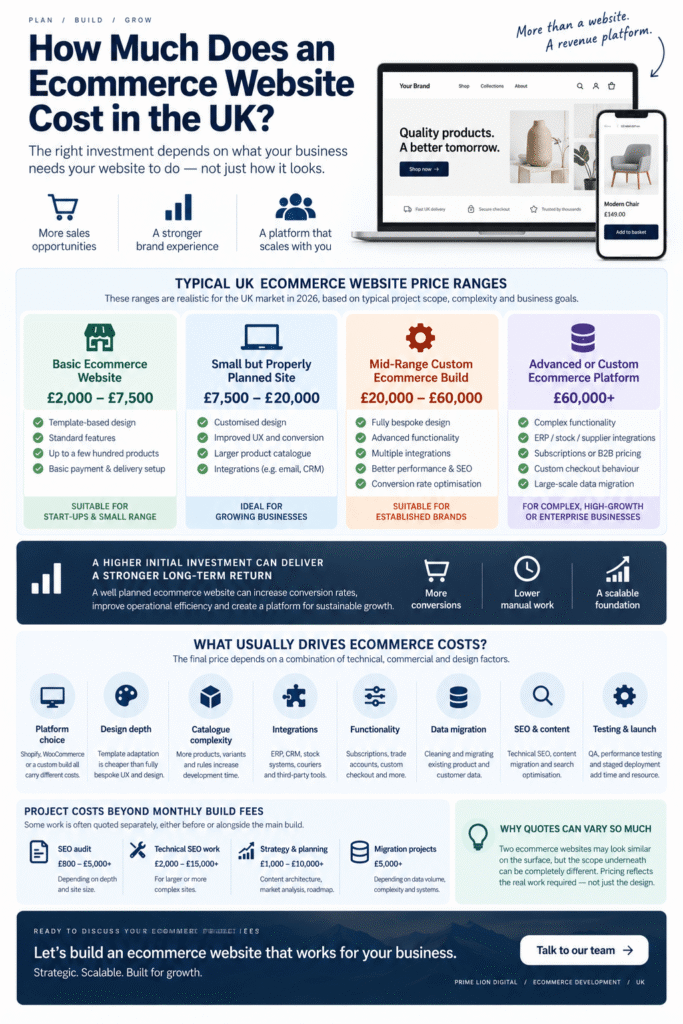
The short answer: typical UK ecommerce website price ranges
For readers who want a working benchmark before the nuance, these ranges are broadly realistic in the UK market.
- Basic ecommerce website: roughly £2,000 to £7,500
- Small but properly planned ecommerce site: roughly £7,500 to £20,000
- Mid-range custom ecommerce build: roughly £20,000 to £60,000
- Advanced or custom ecommerce platform: £60,000+
Those ranges are not arbitrary. They usually reflect differences in catalogue size, design depth, platform choice, integrations, content migration, UX requirements, conversion work, performance engineering, testing and internal approval complexity.
That is why questions such as how much does an ecommerce website cost, how much ecommerce website cost or how much do ecommerce websites cost rarely have useful answers unless the commercial model sits alongside the technical scope.
Why the same question produces wildly different quotes
Two companies can both ask for an online shop and receive estimates that are tens of thousands of pounds apart. Usually, neither quote is automatically wrong. They are just pricing different realities.
One retailer may need a polished theme-based build with straightforward products, Stripe payments, standard shipping rules and a modest launch deadline. Another may need multi-warehouse stock visibility, trade account pricing, product data imports from several suppliers, subscription logic, VAT complexity, courier integrations and a staged migration from an existing platform. Both are “ecommerce websites”, but only in the loosest sense.
This is the central reason the cost of ecommerce website UK varies so much. The visible site is only part of the job. The expensive part is often the layer underneath: business rules, systems, exceptions, workarounds and future-proofing.
What usually drives ecommerce costs in real projects
The biggest pricing drivers are rarely the things non-technical buyers expect. Businesses often focus on page count or whether they need a homepage redesign. Agencies and development teams tend to look elsewhere first.
Platform choice is an obvious cost factor. Shopify, WooCommerce and fully custom builds do not carry the same setup demands, ongoing maintenance profile or scalability trade-offs. A firm weighing Shopify development against a more open-ended build will usually find that a hosted platform reduces infrastructure overhead, but may introduce limits around bespoke functionality. Equally, companies exploring WooCommerce development often gain flexibility, though governance, hosting and plugin discipline become more important over time.
Then there is design depth. Template adaptation is cheaper than full UX-led design. But “cheaper” is not always cheaper in the long run if the site creates friction at checkout, hides delivery information, confuses mobile shoppers or makes merchandising harder for the internal team.
Catalogue complexity matters too. Selling ten products is one thing. Selling 8,000 SKUs with variants, bundles, trade discounts, stock dependencies and changing seasonal rules is another. Product data is often where timelines slip and budgets widen.
Integrations are another major cost driver. Accounting software, CRM, ERP, WMS, fulfilment partners, payment gateways, subscriptions, marketplaces and marketing tools all add complexity. An integration that looks simple in a planning call can become a substantial project once field mapping, error handling and edge cases appear.
And then there is content and migration. Rebuilding product pages, moving category structures, cleaning legacy URLs, preserving search visibility, recreating customer accounts and handling historical order data all add cost. Businesses asking how much does it cost to create an ecommerce website often underestimate this part because it sits outside pure design and development, yet it consumes real project time.
The difference between a cheap shop and a usable ecommerce operation
This is where the conversation gets more commercially important.
A low upfront price can buy a store that technically works, but still creates operational drag. Slow category pages, awkward filtering, poor mobile layouts, fragile plugins, duplicate product data, manual stock updates and clumsy promotions do not always show up on a proposal line by line. They surface later, through lower conversion rates, team frustration and costly fixes.
That is why the question is not only how much should an ecommerce website cost. It is also what problem the spend is meant to solve. If the site is expected to support acquisition, retention, average order value, customer self-service and internal efficiency, then a “cheap” launch can turn expensive surprisingly fast.
In many cases, the better framing is total cost of ownership rather than build price alone.
Typical UK cost bands by business type
Early-stage or very small online retailers
If a business is launching a simple direct-to-consumer store with a tight catalogue and standard fulfilment rules, a basic setup may be enough. This is where questions such as how much does a basic ecommerce website cost, how much does a simple ecommerce website cost and how much does a small ecommerce website cost usually sit.
In the UK, that often means a templated build on Shopify or WooCommerce, limited custom functionality, standard payment setup and a relatively contained product import. Realistically, projects in this category often land between £2,000 and £10,000 depending on who is doing the work, how much content exists already and whether the business has clear requirements.
The danger here is not overspending. It is under-scoping the basics: mobile UX, speed, product filtering, shipping logic and merchant usability.
Growing ecommerce brands
This is the segment where most budget misalignment happens. The business is no longer experimenting. It wants a site that looks stronger, converts better and integrates more cleanly with operations. It may need custom landing pages, better collections architecture, subscription tools, reviews, personalisation, advanced analytics and structured merchandising controls.
At this point, the average cost of ecommerce website UK becomes a slightly misleading phrase, because “average” mixes lightweight startups with far more operationally demanding builds. For many established SMEs, a more realistic budget range is £10,000 to £35,000, and sometimes higher.
This is also where ecommerce website design and development start to separate. A site might not need a ground-up custom platform, but it may well need tailored user journeys, sharper category logic and a proper conversion-led design process.
Mid-market, multi-channel or operationally complex retailers
Once a business has multiple revenue channels, internal systems, segmented customer groups or serious catalogue management needs, the project becomes less about “building a website” and more about designing commerce infrastructure.
These are the projects where the answer to how much does a full ecommerce website cost or how much does a good ecommerce website cost is often £25,000 to £60,000+, sometimes well beyond that. Not because somebody decided to be expensive, but because the site is carrying more commercial weight.
At this level, a company may be evaluating custom ecommerce development, more specialist ecommerce web design, or a platform architecture that can absorb future complexity rather than merely survive launch week.
B2B ecommerce and account-based buying journeys
B2B is often priced badly at discovery stage because the front end can look deceptively simple. A clean trade portal may hide account hierarchies, negotiated pricing, quotation workflows, VAT handling, offline purchasing patterns, repeat-order logic and approval processes.
That is why B2B ecommerce often carries a higher project cost than a visually richer B2C store. The difficulty is not always in the pages customers see. It is in permissions, integrations and purchasing logic.
Platform choice changes the cost structure, not just the launch fee
Businesses comparing quotes usually focus on upfront build cost. Sensible buyers also look at how cost behaves after launch.
Shopify generally reduces technical maintenance and hosting burden. That is one reason many firms exploring Shopify web design or working with a Shopify agency prefer it for speed to market and easier governance. It can be a strong fit where the business wants a cleaner operating model and does not need highly unusual back-end behaviour.
WooCommerce can be more flexible for certain content-rich or WordPress-led businesses, and a capable team of WooCommerce development experts can shape it into a strong trading setup. But plugin sprawl, hosting quality and update discipline matter. Cheap WooCommerce can become messy WooCommerce.
Custom ecommerce builds sit in a different category altogether. If you are asking how much does a custom ecommerce website cost, the answer is usually linked to complexity rather than design ambition alone. Bespoke architecture makes sense when there is a genuine requirement: unusual product configuration, custom account logic, heavy integration demands or platform constraints that materially affect growth.
There is no universal winner here. There are only trade-offs. A platform that looks cheaper in month one can become restrictive by year two. A custom build that looks expensive at procurement stage can make operational sense if it eliminates manual work, duplicate systems or constant third-party patching.
What businesses often leave out of the budget
The question how much does it cost to make an ecommerce website is often treated as if build cost is the whole picture. It is not.
In real projects, budgets are affected by photography, copy, product data preparation, tax setup, feed management, legal content, cookie compliance, accessibility work, user acceptance testing, redirects, training, analytics configuration, search migration checks and post-launch issue resolution. None of these are glamorous. All of them matter.
There is also the internal cost of decision-making. Delayed product data, uncertain sign-off ownership, repeated stakeholder changes and late scope additions can turn an efficient project into an expensive one. Sometimes the problem is not development at all. It is organisational friction.
That is worth saying plainly because plenty of overruns blamed on agencies are really governance problems inside the client business.
How much does it cost to run an ecommerce website?
Launch cost gets the attention. Ongoing cost is what shapes margin.
If you are asking how much does it cost to run an ecommerce website, expect a monthly or annual stack that may include platform fees, hosting, app or plugin subscriptions, support retainers, security monitoring, development time, testing, payment processing charges and ongoing optimisation work.
A modest UK store might run on a few hundred pounds a month in core platform and tool costs, excluding paid media and internal staffing. A larger trading site with several apps, agency support, monitoring and specialist functionality can sit comfortably in the low thousands per month before transaction fees are even considered.
This is why build decisions should not be separated from operating model decisions. A cheaper launch that depends on too many paid apps or fragile extensions can create a more expensive business over time.
How much does it cost to host an ecommerce website?
For hosted platforms like Shopify, the hosting element is effectively bundled into the platform fee, though businesses still need to account for plan tier, apps and transaction-related charges. For WooCommerce or custom builds, hosting is more variable.
So if the question is how much does it cost to host an ecommerce website, the range can be very wide. A very small store on modest infrastructure might spend tens of pounds per month. A busier ecommerce operation that needs stronger uptime, security, backups, CDN support and room for traffic spikes may spend several hundred pounds a month or more. Once there are multiple environments, dedicated resources or enterprise-grade infrastructure requirements, the figure rises again.
Hosting should not be treated as a commodity if the site actually trades. Slow infrastructure is not just a technical annoyance. It affects conversion, search visibility, campaign efficiency and support volume.
How much does it cost to maintain an ecommerce website?
How much does it cost to maintain an ecommerce website depends on platform, code quality, extension risk and how actively the store evolves.
Maintenance usually includes updates, bug fixes, compatibility checks, backups, monitoring, security work and occasional development changes. For stores that trade seriously, maintenance also includes performance reviews, UX fixes and conversion refinement. In other words, maintenance is not just “keeping the lights on”. It is protecting commercial performance.
A very simple store may only need a light monthly support arrangement. A larger store, especially one on WooCommerce or a custom stack, may need regular technical oversight. Businesses investing in ecommerce optimisation, including ecommerce performance optimisation, ecommerce UX optimisation and ecommerce conversion optimisation, are usually responding to this reality: the site is not a one-off asset. It is a trading environment that keeps changing.
Where quotes become misleading
There are a few familiar failure patterns in the UK ecommerce market.
The first is the low entry quote that excludes essential work. A proposal may cover design and development but leave out migration, structured testing, feed setup, analytics, redirects or support. The number looks competitive until the missing pieces return as extras.
The second is false customisation. A business is told it is buying a “custom” store when the build is really a lightly altered theme with app stacking doing most of the work. That is not automatically bad, but it should be priced and described honestly.
The third is architecture mismatch. Some firms are sold a platform based on trend rather than fit. Others are pushed into bespoke development when a cleaner platform setup would have been enough. Both mistakes are expensive, just in different ways.
And then there is the conversion blind spot. A site may look polished, launch on time and still underperform because checkout friction, mobile hierarchy, search behaviour or category logic were never properly addressed. Good-looking ecommerce is not the same thing as effective ecommerce.
A few real-world budgeting scenarios
Scenario one: a new independent retailer
A startup skincare brand with 25 products, simple shipping rules and no existing customer database may launch sensibly on Shopify with a premium theme, light customisation and a focused product architecture. In that case, how much does it cost to start an ecommerce website might realistically mean £3,000 to £8,000, depending on design ambition and content readiness.
Scenario two: an established SME replatforming from a dated store
A retailer with 1,500 SKUs, weak mobile conversion, messy collections, legacy redirects and poor integrations will usually face a broader project. Here, how much does it cost to create ecommerce website is the wrong phrasing, because the real job is replatforming, restructuring and de-risking revenue. A more believable range might be £15,000 to £40,000.
Scenario three: a trade supplier moving online properly
A wholesaler that needs customer-specific pricing, order templates, account permissions and back-office integration is often entering B2B ecommerce territory rather than standard retail. In that case, the visual design may not be the main cost centre. The logic is. Budgets can move well beyond the mid-teens very quickly.
What most buyers misunderstand about ecommerce pricing
The biggest misunderstanding is thinking that ecommerce cost is mainly about front-end design. It rarely is.
In most serious builds, cost is shaped by decisions around data, workflows, exceptions, integrations, merchandising control and the number of moving parts that need to function together without constant manual intervention.
Another common misconception is that the cheapest route is the safest route for an early-stage business. Sometimes it is. Sometimes it produces a weak store that has to be rebuilt within a year, after the business has already invested in products, stock and acquisition.
There is also a tendency to ask for an exact figure too early. Before anyone understands product structure, fulfilment, platform fit, design expectations and operational dependencies, precision is mostly theatre.
What a sensible ecommerce budget conversation should include
A better budget conversation usually starts with four points: what the business sells, how the business operates, what the site must integrate with and what success needs to look like after launch.
If the aim is to reduce admin, improve repeat purchases, support trade accounts, raise mobile conversion or handle more products without chaos, those outcomes should shape the budget. That is much more useful than asking for a generic ecommerce website price UK benchmark without context.
Well-run projects also separate must-haves from phase-two ideas. Not every ambition needs to be funded upfront. But the architecture should allow sensible expansion later, otherwise phase one simply stores up rework.
Cost versus value is the real commercial question
It is easy to focus on whether one quote is £8,000 and another is £18,000. The harder and more important question is what each option means for trading performance over the next two or three years.
If a higher-quality build improves conversion rate, reduces support queries, shortens merchandising time, lowers plugin risk and avoids an early rebuild, the commercial maths changes. Not dramatically in a pitch-deck sort of way. Just in the ordinary way better systems quietly improve margins.
This is why experienced ecommerce teams tend to think beyond launch. Strong ecommerce conversion optimization and ecommerce performance optimisation work often has more commercial value than adding visual complexity for its own sake. Likewise, a thoughtful ecommerce web design process is not about surface polish. It is about making the store easier to buy from and easier to run.
How the UK market is shifting
UK ecommerce projects are becoming less tolerant of waste. Merchants are more cautious about app bloat, slower to approve speculative custom features and more interested in operational resilience. Teams increasingly want cleaner analytics, better checkout performance, stronger mobile experiences and tighter connections between the storefront and the back office.
At the same time, customer expectations have not become simpler. Delivery clarity, returns transparency, account convenience, page speed and trust signals remain basic requirements. Add inflation pressure and margin sensitivity, and suddenly the site has to do more commercial work than before.
That combination is pushing many businesses away from purely aesthetic procurement decisions. They are looking harder at platform fit, long-term maintenance and the cost of carrying technical debt. Sensibly so.
So, how much should an ecommerce website cost in the UK?
If the goal is a realistic answer rather than a neat one, here it is.
A very simple store may cost a few thousand pounds. A credible SME ecommerce build in the UK often sits in the mid four figures to low five figures. A more robust platform with custom journeys, integrations and genuine operational thought behind it will usually move into the tens of thousands. A complex custom or B2B build can go much higher.
So when someone asks how much does ecommerce website cost UK, how much it cost to build e commerce website or how much does it cost to create an ecommerce website, the best answer is this: price follows complexity, and complexity is created by commercial reality, not just design preference.
The most reliable way to avoid overspending is not chasing the lowest quote. It is getting clearer, earlier, about what the website must do, what the team must manage after launch and which compromises are genuinely acceptable.
Final perspective
The UK ecommerce market is full of attractive numbers that mean very little in isolation. What matters is whether the budget matches the trading model.
A basic launch can be perfectly sensible. So can a larger investment. The mistake is assuming those are interchangeable options.
If you are comparing proposals, ask not only what the build includes, but what it prevents: manual work, fragile integrations, poor mobile conversion, future rebuilds, support headaches and revenue leakage. That is where the real cost of an ecommerce website tends to reveal itself.
And that, more than any headline figure, is the answer to how much does an ecommerce website cost UK.