

CRM Website Integration in UK
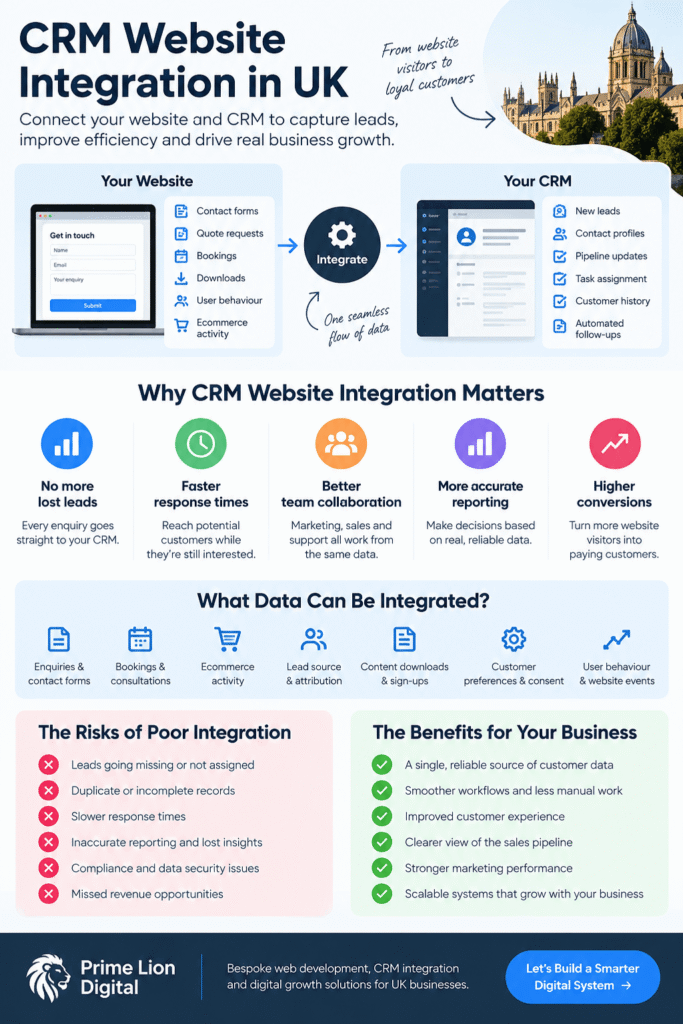
For many firms, the website and the CRM still behave like separate worlds. One attracts enquiries, captures forms and tracks user actions; the other is supposed to hold customer history, pipeline movement and sales reality. When those systems are loosely connected, or worse, manually stitched together, the commercial cost is usually hidden at first. Leads go missing quietly. Data becomes unreliable in small increments. Teams compensate with spreadsheets, duplicate entry and internal workarounds that nobody planned but everybody starts depending on.
Leave your details and our team will get back to you shortly to discuss your website, SEO or digital growth project.
That is why CRM website integration matters far beyond a technical hand-off. It changes how marketing data is trusted, how sales teams respond, how service teams inherit context and how leadership reads commercial performance. In practice, integration is less about “connecting a form” and more about deciding how the business wants customer information to move, when it should move, and who should be able to act on it.
Why this topic has become more urgent
A few years ago, many organisations could get away with partial setups: a contact form pushing into an inbox, a CRM updated later, and some reporting assembled at month end. That model is increasingly fragile. Modern sites capture more than simple enquiries. They handle quote requests, consultation bookings, gated content, account registrations, support requests, abandoned checkouts, consent preferences and behavioural signals. If those interactions do not reach the CRM correctly, the commercial picture becomes distorted almost immediately.
The pressure is sharper in multi-touch environments. Prospects might first arrive through organic search, return via branded search, read a case study, complete a calculator, book a call and then speak to sales days later. Without proper integration, that journey breaks into disconnected fragments. Teams may still be working hard, but they are working from an incomplete record.
What CRM website integration actually means
At a basic level, CRM website integration means transferring website-originated data into a customer relationship management system automatically and consistently. In real-world terms, it often includes much more than a contact form feed. It can involve lead source attribution, deal creation, contact enrichment, event tracking, consent syncing, support workflow triggers, e-commerce behaviour, quotation requests and status-based messaging.
Some integrations are fairly light: a brochure site with one enquiry form, one pipeline and one notification path. Others are much deeper. A business may need the website to recognise known contacts, display role-specific content, pre-fill forms, surface account history, push user actions into the CRM and trigger follow-up tasks across departments. At that point, integration becomes part of the operating model, not just a development task.
The commercial consequences of getting it wrong
Poor CRM website integration rarely fails loudly on day one. More often, it introduces low-grade operational drag that compounds over time. Sales follow up the wrong contacts. Marketing reports stronger lead volume than the pipeline reflects. Duplicate records distort conversion data. High-intent enquiries sit unassigned because a field mapping failed. Customer service inherits no context from pre-sale interactions. Senior teams then make decisions on reporting that looks complete but is not.
There is also a speed issue. If a serious enquiry arrives through the site at 09:07 and only reaches the right person after manual triage at 13:40, that delay is not just a process flaw. It affects close rates, customer experience and revenue efficiency. Integration quality directly influences response time.
In some sectors, compliance becomes part of the picture as well. Consent records, marketing preferences and enquiry history may need to move accurately between systems. A loose integration can create uncertainty over what was captured, when it was captured and what the business is allowed to do next.
Where businesses usually underestimate the complexity
The common assumption is that CRM website integration is mainly about APIs. APIs matter, of course, but the more difficult questions are normally operational. Which form submissions should create a contact, and which should update an existing one? When should a lead become an opportunity? What happens if the same user submits three forms with slightly different details? Which source should be treated as authoritative if CRM data and website data conflict?
These are business rules disguised as technical questions.
Another overlooked issue is field design. Many CRM projects inherit poorly structured properties: ambiguous lifecycle stages, inconsistent source labels, free-text fields doing the job of controlled values, and internal pipeline logic that only one or two staff members properly understand. Connecting a website to that environment does not solve the underlying problem. It simply automates the confusion faster.
The integration gap between marketing logic and sales reality
This is where projects often wobble. Marketing wants clean attribution, campaign visibility and frictionless conversion paths. Sales wants qualified records, fewer duplicates and immediate context. Operations wants reliability. Leadership wants reporting that can be believed. These priorities overlap, but not perfectly.
If the website passes every low-intent action into the CRM as a “lead”, sales teams stop trusting the system. If marketing strips forms back too aggressively to maximise completion rate, sales may receive records too thin to act on. If the CRM demands too much structure too early, the website experience becomes clunky and conversion rates fall. Good integration is a negotiated balance between user experience, internal workflow and reporting integrity.
What a mature setup tends to include
The strongest implementations usually share a few characteristics. Not because there is a universal template, but because certain principles hold up in practice. Data capture is intentional rather than excessive. Field mapping is documented. Duplicate handling is thought through. Failure states are monitored. Ownership is clear. And crucially, the CRM is treated as part of a wider business system rather than a standalone sales database.
On the delivery side, this is often where web development services become relevant. CRM integration tends to touch form architecture, validation logic, user accounts, API behaviour, middleware, analytics and sometimes the CMS itself. It is rarely isolated for long.
A few real-world scenarios that expose the difference
Consider a B2B consultancy site offering downloadable sector reports, event registrations and consultation requests. If all three actions enter the CRM identically, the pipeline becomes noisy. A casual report download should not be treated like a board-level advisory enquiry. Integration needs to reflect intent, not just transfer data.
Now consider a service business with multiple offices and specialist teams. A website may need to route enquiries based on postcode, budget range, service type or urgency. If that routing happens manually after submission, the CRM becomes a passive storage tool rather than an active workflow engine. With better integration, the record can be assigned, categorised and actioned immediately.
Or take an environment with multi-step qualification. A visitor may start with a broad enquiry, answer follow-up questions later, and only then become sales-ready. If the integration posts only the first touch and ignores later qualification steps, the CRM record looks complete while the commercial picture is not.
The technical architecture matters, but not in the way people think
There is always a temptation to ask which platform “integrates best”. That is sometimes the wrong question. More useful questions are these: how flexible is the data model, how robust is the API, what rate limits exist, how are failures logged, what middleware is needed, what happens during retries, and how easy is it to maintain the setup without creating operational debt?
A direct integration can be appropriate for straightforward cases. For more complex estates, a middleware layer may be safer. It can validate payloads, normalise data, queue events, log errors and prevent a website outage or API timeout from breaking core lead capture. That sounds technical because it is technical, but it is also a commercial safeguard. If the website is mission-critical, brittle integrations are a risk to revenue.
This is particularly relevant for firms planning wider web design and development work. CRM integration decisions often start during a site build or redevelopment, because form structure, CMS behaviour and frontend-backend coordination shape what is possible later.
The mistakes that keep repeating
The first is treating the CRM as a destination rather than a workflow environment. Data lands, but nothing useful happens next.
The second is assuming the native connector is good enough because it exists. Native integrations are often fine for baseline syncing, but many break down when businesses need conditional logic, multi-step processes or reliable exception handling.
The third is failing to design for change. New services, new forms, new consent rules and new sales stages appear over time. A rigid integration built around today’s exact fields can become fragile surprisingly quickly.
Then there is the reporting trap. Teams often build dashboards before they have trustworthy inputs. A visually impressive dashboard sitting on top of inconsistent CRM-website logic gives false confidence, which is worse than having limited reporting and knowing its limits.
Implementation is as much a governance exercise as a build exercise
The cleanest projects are not necessarily the ones with the fanciest stack. They are the ones where someone has done the slower thinking first. What counts as a qualified lead? Which fields are mandatory? Who owns taxonomy? When should automation stop and a human step in? How will errors be spotted? Who reviews the logic after launch?
Without that governance layer, even competent development work can drift. Different departments request small adjustments. One new field is added for a campaign. Another is added for sales. A hidden field changes. A webhook gets replaced. Six months later, nobody is entirely sure why the CRM contains three similar lead source values that should have been one.
That is how integration debt builds: not through one dramatic failure, but through unmanaged iteration. In more involved environments, that is usually the point where deeper CRM architecture requirements need reviewing rather than patching one more symptom.
How to judge whether your current setup is genuinely working
A useful test is not whether data moves, but whether the right people trust what arrives. If sales exports and cleans records before acting on them, trust is low. If marketing cannot reconcile campaign performance with CRM outcomes, trust is low. If operations relies on inbox notifications because the CRM workflow feels unreliable, trust is low. Functional does not always mean fit for purpose.
Another test is exception visibility. Most teams know the happy path: user submits form, record appears, notification fires. Fewer know what happens when the API call partially fails, when validation breaks, when the CRM is temporarily unavailable or when duplicate logic misfires. Mature integrations plan for the unhappy path because that is where real reliability is proven.
Choosing the right level of integration
Not every company needs a highly customised environment. For a smaller firm with a simple sales cycle, lightweight CRM website integration may be entirely sensible. The mistake is copying enterprise complexity too early. The opposite mistake, though, is hanging onto a basic setup long after the organisation has outgrown it.
In practice, the right level depends on a few things: the value of each lead, the complexity of routing, the number of internal stakeholders, the need for attribution, the role of automation and the cost of bad data. A low-volume, high-value lead environment may justify much more careful logic than a business chasing broad top-of-funnel volume.
If the integration only needs to capture a small number of structured enquiries, a native connector may be enough. If multiple systems, qualification steps or assignment rules are involved, the work starts to look more like managed infrastructure across forms, APIs and middleware.
What this means for search visibility, customer experience and growth
CRM website integration is not an SEO tactic, but it can influence search-led growth indirectly. If the site attracts the right enquiries and the CRM captures them cleanly, the business gets better evidence about which content, landing journeys and user intents actually lead to revenue. That sharpens decision-making. It also helps avoid the common disconnect where traffic reporting looks healthy but commercial outcomes remain vague.
There is a customer experience angle too. When users receive more relevant follow-up, repeat fewer details and encounter a business that appears joined-up, trust improves. They may never see the integration architecture, but they definitely feel the difference when it is poor.
Where the market is heading
CRM integrations are becoming less passive and more event-driven. Websites are expected to trigger workflows in real time, personalise journeys based on known data and feed cleaner first-party information into wider business systems. AI-assisted lead scoring will sit on top of some of this, but only usefully where the underlying data architecture is sound. There is no shortcut around that. Automating broken logic just produces faster confusion.
We are also seeing a shift away from isolated platform thinking. The website, CRM, analytics layer, marketing automation and service workflows increasingly need to be understood as one operating system. Businesses that grasp that early tend to avoid expensive rework later.
What decision-makers should take away
CRM website integration is not finished when a form submits successfully. That is the beginning, not the standard of success. The real question is whether the integration supports how the business qualifies, routes, measures and responds to demand.
If the website is a growth channel, the CRM connection deserves strategic attention. It affects response speed, data quality, reporting confidence, internal coordination and customer experience. In stronger organisations, that is understood. In weaker ones, integration is treated as a background technical task until something breaks or revenue reporting stops making sense.
The better view is more sober. Treat it as infrastructure for commercial clarity. Design the logic before the automation. Build for exceptions, not just happy paths. And make sure the system reflects how the business actually works, not how the software demo suggested it might.
In the end, the quality of CRM website integration is a good proxy for organisational maturity. When it is thoughtful, reliable and aligned with real workflows, it usually means the business understands its customer journey at a deeper level. When it is patchy, manual and full of quiet inconsistencies, the problems tend to run wider than the technology.