How Much Does Branding Cost in the UK? Branding Prices & Packages
Ask ten agencies how much branding costs in the UK and you can get ten very different answers. That is not always evasion. Quite often, it reflects the fact that “branding” can mean anything from a logo refresh for a sole trader to a full identity system, naming, messaging, visual rollout and governance for a growing company.
So the honest answer is this: branding prices in the UK vary widely because the scope varies widely. A basic logo project may sit in the low hundreds. A properly developed brand identity for a small business may run into the low or mid thousands. A more strategic programme involving research, positioning, verbal identity, visual identity, guidelines and rollout can move well beyond that.
Leave your details and our team will get back to you shortly to discuss your website, SEO or digital growth project.
This guide breaks down what actually drives the numbers, what typical branding packages UK businesses encounter, where money tends to go, and how to judge value without reducing the whole exercise to a day rate and a moodboard.
Why branding quotes vary so much
Most confusion around branding cost UK questions comes from one basic problem: people compare unlike-for-unlike. A freelance logo designer, a local studio, and a specialist branding agency may all use the word branding, but they may be pricing entirely different deliverables.
One quote might cover a logo and colour palette. Another might include stakeholder workshops, competitor analysis, brand positioning, messaging, typography systems, iconography, social templates, packaging concepts, brand guidelines and launch support. On paper both are “branding”. In practice, one is a design task and the other is a business tool.
That is why branding agency prices UK businesses receive can seem inconsistent. They often reflect depth of thinking, level of strategic input, number of applications, revision stages, and the risk attached to getting it wrong.
A realistic view of branding prices in the UK
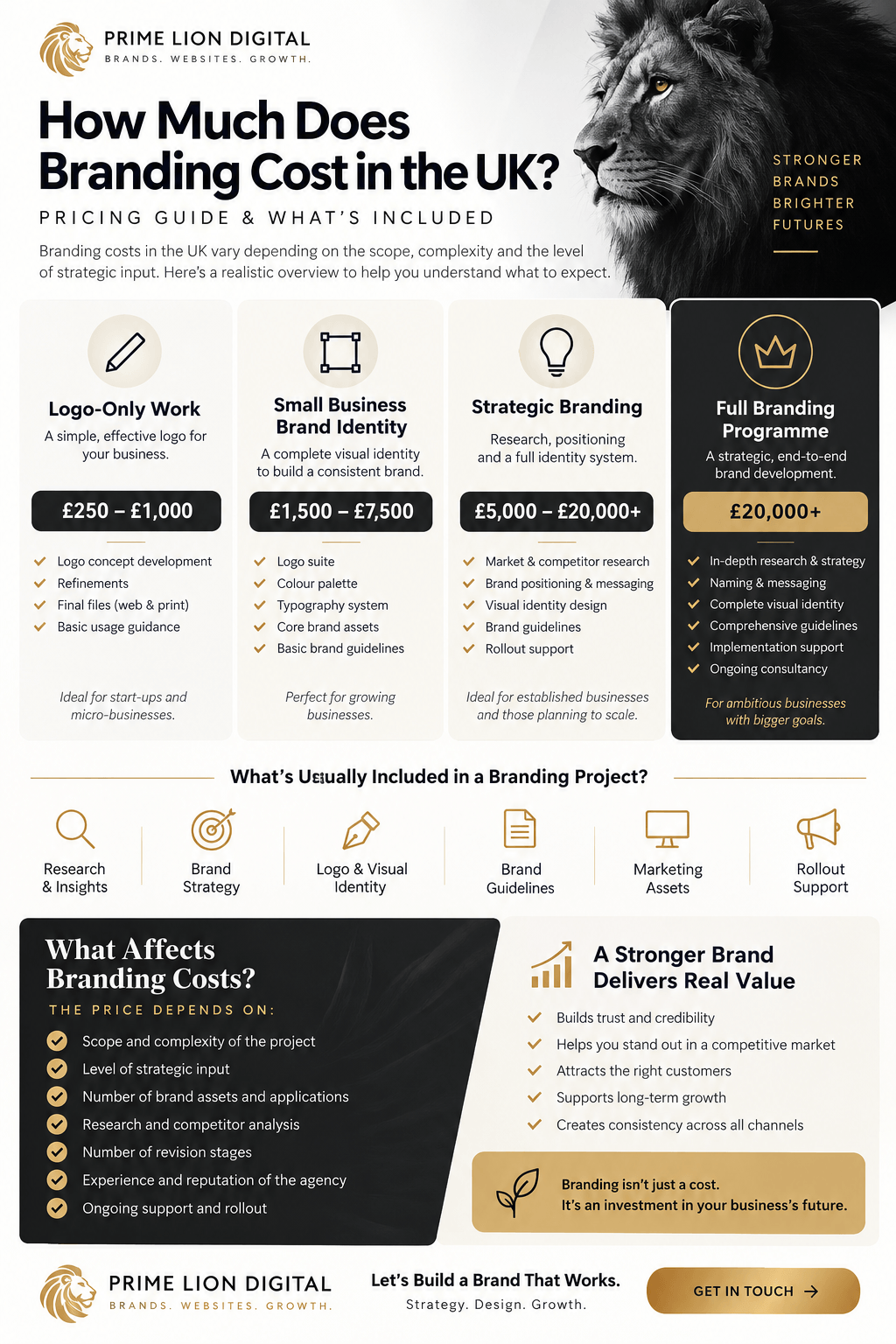
There is no fixed rate card across the market, but there are recognisable bands. The figures below are broad and intended to help with expectation-setting rather than act as universal pricing.
Logo-only work
If the question is really how much does a logo cost in the UK, the range is usually the widest. A simple logo design cost UK quote might start at a few hundred pounds for a very light-touch project and rise into the low thousands if the work includes concept development, refinement, usage thinking and basic asset preparation.
At the lower end, the output is often a visual mark with limited strategic thinking behind it. That can be enough for a micro-business with minimal brand complexity. It is rarely enough for a business planning to scale, hire, pitch, expand product lines or compete in a crowded category.
Small business brand identity
For many firms asking about small business branding cost UK, the real requirement is not just a logo. It is a coherent identity: logo suite, colours, type system, visual direction, a few core applications and some basic rules for consistent use.
In the UK market, this sort of work commonly lands anywhere from around £1,500 to £7,500, depending on who is delivering it and how much strategic work is involved. Some projects sit below that. Some sit above it. The big difference is whether the identity is being assembled quickly or built to solve a positioning problem.
Strategic branding and full identity systems
Once research, positioning, brand architecture, messaging, identity design, brand guidelines and implementation support enter the brief, costs rise accordingly. A fuller brand identity design cost UK project may begin around £5,000 to £10,000 and can move well past £20,000 for more complex organisations.
This is usually where working with a branding agency starts to make sense. The budget is not only paying for creative output. It is paying for diagnosis, alignment, decision-making, strategic judgement and the systems that stop the brand fragmenting six months later.
What businesses are actually buying
It helps to separate branding into layers. That is where most budget misunderstandings start.
The first layer is visual expression: logo, colours, typography, layouts, supporting assets. The second is brand identity in a broader sense: how the business looks, sounds and presents itself consistently. The third is strategic brand work: why the company exists, what it stands for, how it should be positioned, who it is trying to reach and what perception it wants to own.
When people search for brand identity cost UK, they are often hovering between the first two layers. When they search for branding agency cost UK, they are usually edging into the third.
That distinction matters. A cheap project can still be fair value if the need is narrow. An expensive project can be wasteful if the organisation is not ready to use what it buys. Price only becomes meaningful when scope and business context are clear.
Typical branding packages UK businesses see
Although every studio structures work differently, most branding and design services are grouped into a few familiar categories.
- Starter package: usually logo, colour palette, typography and a few basic brand assets.
- Identity package: broader visual identity system with logo variations, imagery direction, brand applications and light guidelines.
- Strategic branding package: discovery, positioning, messaging, visual identity development, brand guidelines and rollout support.
- Comprehensive brand package: everything above plus naming, sub-brand structure, campaign assets, print collateral, digital templates and implementation planning.
Branding package prices UK companies encounter depend less on the label and more on what is included behind it. Two “identity packages” may differ by several thousand pounds once workshop time, research depth, revision structure and rollout assets are accounted for.
| What’s Included | Logo Only | Brand Identity | Strategic Branding | Full Branding |
|---|---|---|---|---|
| Logo Design | ✓ | ✓ | ✓ | ✓ |
| Colour Palette & Typography | Limited | ✓ | ✓ | ✓ |
| Visual Identity System | — | ✓ | ✓ | ✓ |
| Market & Competitor Research | — | Limited | ✓ | ✓ |
| Brand Positioning | — | — | ✓ | ✓ |
| Messaging & Verbal Identity | — | — | ✓ | ✓ |
| Brand Guidelines | Basic | ✓ | ✓ | Comprehensive |
| Marketing Assets & Templates | — | Optional | Optional | ✓ |
| Rollout & Implementation Support | — | — | ✓ | ✓ |
| Typical UK Cost | Under £1,000 | £1,500–£5,000+ | £5,000–£15,000+ | £15,000–£20,000+ |
| Best Suited For | Micro-businesses & start-ups | Small & growing businesses | Established businesses | Complex or scaling organisations |
The factors that move branding costs up or down
There are predictable cost drivers, and they are worth understanding before comparing quotes.
Business complexity
A new local service business with one audience, one offer and one decision-maker is simpler to brand than a company with multiple services, internal politics, legacy perceptions and competing stakeholder opinions. Complexity is expensive because clarity takes time.
Strategy versus decoration
If the brief is essentially “make us look better”, costs stay lower. If the work must clarify market position, sharpen the proposition and create internal alignment, prices climb. Strategy is slower than design and usually more valuable.
Number of deliverables
Brand identity design cost UK projects can expand quickly once applications are added: signage, deck templates, social assets, packaging, email signatures, sales collateral, web direction, icon systems, brochures, exhibition materials. The identity itself may be one phase; rollout is often another.
Decision-making friction
This is rarely discussed openly, but it affects price. Projects with several founders, senior managers or departmental stakeholders often need more workshop time, more presentation logic, more revision control and more diplomacy. Agencies price for that whether they say so or not.
Experience level of the provider
A freelancer with lower overheads may offer very different branding prices UK businesses find appealing. That can be perfectly sensible for straightforward briefs. A specialist team handling broader brand identity work usually costs more because the process is wider, the accountability is higher and the output is expected to hold up across multiple channels.
Urgency
Fast turnarounds nearly always distort cost. Rushed brand work tends to compress research, shorten exploration and push teams into reactive decisions. If a business needs branding in two weeks because a launch slipped, it often pays a speed premium or accepts a thinner outcome.
Logo cost versus brand identity cost
One of the biggest pricing errors is treating logo design cost UK and brand identity cost UK as interchangeable. They are not.
A logo is a symbol or wordmark system. A brand identity is the full operating language around it: visual rules, hierarchy, typography, tone, layout logic, asset usage, consistency principles and the context that makes the logo recognisable rather than just visible.
This matters because businesses often think they need a new logo when the real issue is inconsistency. The logo may be fine. The problem may sit in unclear messaging, weak design rules, poor rollout or scattered marketing materials. In that scenario, paying only for a new logo can be a false economy.
That is also why a proper brand identity design project usually costs materially more than a logo-only job. It is solving a broader commercial problem.
Where cheaper branding often goes wrong
Low pricing is not automatically a red flag. Some independent designers do strong work at modest rates. But there are recurring patterns in the cheapest end of the market.
First, discovery is often skipped. The designer is handed a few visual references and asked to produce concepts without much commercial context. That can generate something attractive, but it does not always generate something appropriate.
Second, revisions become the strategy. Without clear positioning upfront, the project turns into a sequence of subjective reactions: “Can we make it pop?”, “Can we try another font?”, “Can we see three more directions?” Time gets used, but certainty never really improves.
Third, handover is thin. The files arrive, perhaps a PNG and an SVG, but there is no guidance on spacing, colours, typography, usage rules or rollout. Six months later the business looks inconsistent again.
In other words, some low-cost branding is not cheap because it is efficient. It is cheap because key parts of the problem are left unsolved.
What a stronger branding process usually includes
When branding agency prices UK quotes look higher, the extra cost is usually sitting in process. Not fluff. Process.
A stronger engagement often starts with discovery: founder interviews, stakeholder input, category review, competitor mapping and an honest look at where the current brand is creating friction. From there, the work moves into positioning and identity development, then into application, documentation and rollout.
That middle stage is the part many buyers underestimate. Good brand work is not simply made by producing more concepts. It comes from making sharper decisions earlier. The strongest projects reduce ambiguity before design exploration becomes expensive.
That may include structured brand identity planning, a defined verbal and visual territory, and eventually usable brand guidelines that give the business a way to stay consistent after the project ends.
Three common UK branding scenarios
Not every company needs the same level of investment. The context changes the economics.
Scenario one: a new small business
A start-up consultancy, local trade company or independent retailer usually needs enough identity to appear credible, consistent and recognisable. The sensible spend may be modest, but it should still cover more than a single logo if the business expects to operate across a website, social channels, proposals and printed materials.
For this type of company, small business branding cost UK decisions tend to work best when the brief is disciplined. Focus on a clear identity system and a few high-impact applications rather than trying to imitate a corporate rebrand.
Scenario two: an established business that has outgrown its image
This is common. Revenue has grown, the team has expanded, the offer has changed, but the brand still reflects the business at year one. Here, the cost is often higher because the project is not just creative. It involves repositioning, internal alignment and translating a more mature business into a more credible brand.
The risk of under-investing is greater too. A superficial visual refresh can leave the core confusion untouched.
Scenario three: a company preparing for growth, funding or a bigger market move
When a business is entering new markets, raising capital, consolidating services or recruiting at pace, branding starts to influence perception beyond aesthetics. Investors, partners, candidates and larger clients read inconsistency as uncertainty. That is where strategic branding has a measurable commercial role, even if it still cannot be reduced to a neat ROI formula.
Why branding is difficult to price like a commodity
Some services are easy to benchmark. Branding is not one of them. The output is visible, but the real value often sits in what it prevents: mixed signals, indecisive messaging, low-trust first impressions, fragmented sales materials, awkward launches, internal inconsistency and constant redesign requests.
That makes branding costs UK conversations slightly uncomfortable for buyers. They are being asked to invest in clarity, confidence and consistency, which are commercially important but not always immediately attributable in a spreadsheet.
Still, there are practical ways to evaluate value. A good question is not just “How much is this package?” but “What future work will this package save us from having to redo?”
Branding packages can become expensive in rollout, not just creation
Another blind spot: the identity itself is sometimes only half the spend. Once the brand is approved, businesses often discover they also need presentation templates, social graphics, brochures, landing page visuals, email signatures, internal documents, sales sheets, signage or packaging updates.
That is where adjacent marketing design support starts to matter. The identity may be solid, but if it is not translated into day-to-day assets, the brand never fully shows up in the market.
This is one reason branding package prices UK quotes can feel incomplete at first glance. Some providers price for identity creation only. Others include rollout support in later phases. Neither is wrong, but buyers need to know which stage they are funding.
Questions worth asking before you compare quotes
If you are trying to make sense of branding agency cost UK proposals, a few questions are more useful than simply asking for a discount.
Ask what discovery work is included. Ask whether the quote covers only visual design or also positioning and messaging. Ask what file formats, templates and guidelines are part of the handover. Ask how revisions are structured and who is expected to give feedback on your side. Ask what happens after approval when the brand needs to be applied in the real world.
Those questions quickly reveal whether you are comparing branding packages, design outputs or just labour time.
What many businesses misunderstand about value
They assume value sits in the number of concepts shown. It usually does not. Ten logo options can be a sign of uncertainty, not rigour.
They assume a polished PDF equals a strategic process. It often does not. Good branding work may look elegant at presentation stage, but its commercial usefulness depends on the reasoning underneath.
And they often assume that brand work is mostly external. In practice, a great deal of brand friction is internal: teams using different decks, sales and marketing speaking in different tones, founders disagreeing on positioning, no one knowing which version of the logo is current. Strong branding processes tend to solve for consistency inside the business as much as perception outside it.
How to decide what budget is sensible
The right budget depends on the cost of brand ambiguity to your organisation.
If you are a very early-stage business needing a credible launch presence, it may be sensible to keep scope tight and invest in a practical, well-built identity without commissioning a heavyweight strategic exercise.
If the business has multiple services, a growing team and more than one decision-maker, it is usually worth budgeting beyond a logo. That often means a more structured identity project with clear usage guidance.
If reputation, trust, category differentiation or market expansion materially affect revenue, then branding becomes a strategic lever. At that point, trying to solve it with the cheapest quote is often the expensive option in disguise.
A practical way to think about cost bands
As a rough rule of thumb in the UK:
Under £1,000 usually buys limited logo-focused work or a very lightweight identity package.
Roughly £1,500 to £5,000 may buy a more considered small business identity, depending on scope and provider.
Around £5,000 to £15,000 often covers stronger strategic input, broader identity development and a more usable handover.
Above that, the project is typically moving into comprehensive brand systems, multiple stakeholder environments, larger rollouts or more complex commercial contexts.
These are not official market rates. They are simply useful expectation markers. Exceptional work can sit outside them in either direction.
The market is shifting, and branding briefs are changing with it
UK businesses now expect branding to work across more surfaces than they did a few years ago. A brand is no longer judged only on a website and business card. It has to stretch across pitch decks, social clips, digital ads, sales documents, internal comms, recruitment pages and sometimes product interfaces.
That changes both scope and cost. The identity needs to be robust enough to survive everyday use, not just launch day.
At the same time, buyers are getting more sceptical of decorative rebrands. Quite right. There is more demand now for work that connects brand decisions with market position, growth plans and operational reality.
So, how much does branding cost in the UK?
The shortest credible answer is this: branding cost UK projects can range from a few hundred pounds for simple logo work to several thousand for small business identity systems, and well into five figures for strategic brand programmes with full rollout.
If you are comparing branding prices UK providers have sent you, do not ask only whether one quote is cheaper. Ask what business problem each quote is actually solving. A low price may be perfectly sensible for a narrow brief. It may also leave you paying again once the lack of strategy, documentation or rollout support becomes obvious.
The better framing is not “What is the cheapest way to get a brand?” It is “What level of branding do we genuinely need for the next stage of the business?”
Final perspective
Branding is expensive when it is treated as art direction without decisions. It is cost-effective when it gives a business a clearer position, a more coherent identity and a system people can actually use.
That is why the most useful conversations about brand identity cost UK or branding package prices UK rarely start with visuals. They start with context: where the business is now, what has changed, where confusion is showing up, and what the brand needs to do next.
Once that is clear, the numbers usually make more sense.