

Link Building for UK Businesses: What Still Works and What Looks Risky
Link building never really disappeared. It just stopped being easy to fake.
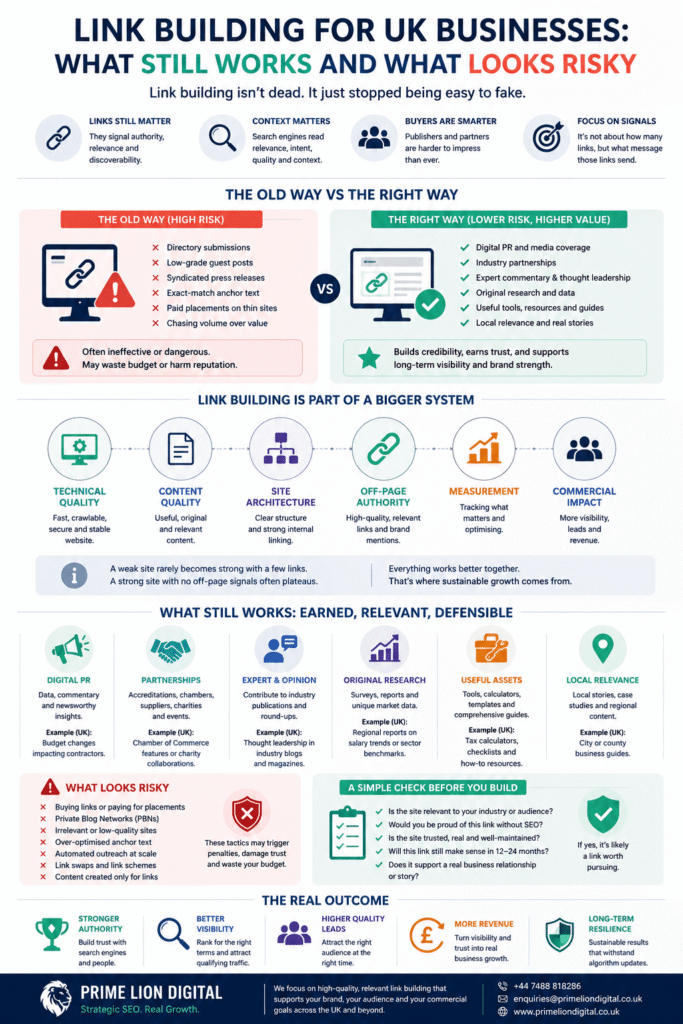
That is the part many UK businesses still wrestle with. A decade ago, “building links” often meant volume: directory submissions, low-grade guest posts, syndicated press releases, exact-match anchor text, and agency reports full of referring domains nobody had heard of. Some of that produced movement for a while. Much of it now sits somewhere between ineffective and actively dangerous.
Today, the question is less how many links can we get? and more what signals are we actually sending? Search engines have become far better at reading context, relevance, editorial intent and site quality. At the same time, buyers, journalists, publishers and industry partners have become harder to impress. So the old shortcuts have weakened from both sides.
Leave your details and our team will get back to you shortly to discuss your website, SEO or digital growth project.
For UK firms trying to invest sensibly, the conversation needs to move on from link counts. The real issue is whether a link supports visibility in a credible way, on a site that makes sense, for a reason that would still make sense if Google did not exist.
The market has changed, but not in the simplistic way people claim
You will often hear two lazy positions. One is that link building is dead. The other is that links remain the single most important ranking factor and therefore almost any tactic is justified if it moves the dial. Neither view is especially useful.
Links still matter because they remain one of the clearest external signals of authority, relevance and discoverability. But their value is filtered through far more surrounding context than it used to be. A link from a respected trade publication, local news outlet, specialist association or genuinely read industry blog can still help. A batch of paid placements on thin websites built largely to sell links usually tells a different story.
In practice, search performance now tends to reflect a broader system. Technical quality, content quality, internal architecture, measurement, crawl efficiency and off-page authority all reinforce one another. A weak site rarely becomes strong because of a few acquired links. Equally, a strong site with no off-page signals often plateaus. Link building still works. Isolated link buying as a substitute for strategy usually does not.
That is why many businesses end up needing a proper baseline first, whether through a proper SEO audit, a clearer broader SEO strategy or stronger measurement. Without that, link activity is often being judged in a vacuum.
Why this matters commercially, not just algorithmically
Bad link building is expensive in a very ordinary way. Not always through a dramatic penalty, although that can happen. More commonly, it wastes budget, distorts reporting and delays more useful work.
A managing director sees a link acquisition programme in a monthly report and assumes authority is improving. The marketing lead sees rankings wobble but cannot isolate the cause. The agency points to total referring domains while the sales team notices leads are not getting better. Six months later, the business has more links on paper but no meaningful commercial improvement.
That is the real commercial risk: not catastrophe, but drift.
For UK SMEs especially, that drift matters. Budgets are tighter. Search is expected to support pipeline, not just vanity metrics. If a company operates in legal, finance, home services, healthcare, B2B manufacturing or ecommerce, the margin for low-trust tactics is even smaller. Reputation, brand fit and publisher quality matter almost as much as the raw SEO outcome.
What still works tends to look more like PR, partnerships and useful assets
The tactics that still hold up are rarely the most glamorous. They are usually the ones that create a plausible reason for a publisher, organisation or website owner to reference you.
That may include digital PR around data, commentary or local trends. It may mean partnerships with suppliers, accreditors, chambers, charities or events. It can involve expert contributions, original research, genuinely useful tools, location-led resources, specialist guides or newsworthy observations based on real market data.
In other words, the link is increasingly a by-product of something defensible.
For a UK accountancy firm, that might be commentary on budget changes affecting contractors. For a regional ecommerce brand, it could be proprietary data on seasonal demand by county. For a local service business, it may be strong community relevance combined with well-executed local SEO work. For a national retailer, it might be category-led editorial assets supported by solid commercial page architecture.
None of that sounds like the old “100 links per month” pitch, because it is not. Sustainable link building has moved closer to reputation-building and content-led authority work. The mechanics of outreach still matter, but the reason behind the link matters more.
The uncomfortable truth: most link problems start before outreach
One of the biggest misunderstandings in this space is that link acquisition begins with prospecting. Usually, it begins with whether the destination page deserves attention.
If the page is thin, interchangeable, unclear or commercially over-eager, response rates fall. Even where links are secured, they often point to content that has limited staying power. Publishers have become familiar with pages built purely to absorb authority. Readers can tell too.
This is where link building overlaps with content quality and site quality more generally. If the destination does not offer something distinct, the link campaign is doing the heavy lifting for a weak asset.
The same applies technically. If key pages are slow, hard to crawl, poorly structured or cannibalised by similar pages, authority does not consolidate efficiently. A business may think it has a link problem when it actually has weak technical SEO foundations or a measurement problem. That is why strong off-page work should sit inside a wider search framework, not operate as a detached monthly deliverable.
What UK businesses still misunderstand about “good links”
A good link is not simply one from a site with high authority metrics. Third-party scores can be useful shorthand, but they are not a strategy. They do not tell you whether the site is trusted by real readers, whether it exists primarily to sell placements, whether it covers the topic credibly, or whether the page itself will remain indexed and visible over time.
Relevance is also routinely oversimplified. It does not always mean the linking site must sit in the exact same sector. A manufacturer can earn coverage from regional press, trade associations, business media, suppliers and education partners. A law firm can attract links from news publishers, local institutions and specialist commentary sites. Context is what matters.
Anchor text is another area where outdated habits linger. Heavy use of exact-match commercial anchors still looks forced in many cases. Natural profiles tend to contain brand mentions, URL anchors, topical phrasing and a fair amount of inconsistency. Real people do not all describe a business in the same way. Over-engineered anchor patterns are often a giveaway that the links were built for rankings first and readers second.
What looks risky now, even if somebody can still sell it to you
Risk in link building is not limited to obvious spam. Some tactics sit in a greyer area: they may still produce movement, but the quality, sustainability and reputational logic are poor.
The clearest warning signs are familiar:
- bulk guest posting on sites with no real editorial identity;
- paid placements across networks of unrelated blogs;
- over-optimised anchor text concentrated on money pages;
- digital PR campaigns with no actual story, just outreach volume;
- expired-domain sites repurposed mainly to pass authority;
- directory and citation work far beyond what local discovery genuinely requires;
- link exchanges at scale, sitewide footer links and automated outreach spam;
- reporting centred on quantity while avoiding quality discussion.
What makes these risky is not just the possibility of an algorithmic discount. It is that they rarely age well. Once a link profile becomes crowded with weak placements, future clean-up is messy. Even if there is no manual action, the business can end up carrying a layer of authority noise that clouds what is really helping.
A few realistic scenarios from the UK market
A regional home improvement company wants to rank in several counties. An agency proposes dozens of location-page links from generic blogs. On paper, that sounds scalable. In practice, it often creates a brittle profile pointing at near-duplicate pages. A more credible approach would combine local partnerships, project-led case content, regional press opportunities and properly differentiated service-area pages. Less volume, more legitimacy.
A B2B software provider wants authority for a competitive category. Buying placements on “business” websites with inflated metrics may produce short-term noise, but not necessarily market trust. The stronger route is often slower: expert commentary, integration partner mentions, industry reports, founder insights and content that sales teams actually use. When that work is measured properly, the business can judge whether links are improving qualified visibility rather than just rankings snapshots.
An ecommerce brand launches a content campaign designed purely to attract links, but the commercial category pages remain weak. Traffic lifts at the top of the funnel, yet revenue barely moves. This is common. Links can expand the authority footprint, but unless category, collection and product architecture are commercially fit, the return stays partial.
The best link building often starts with something worth citing
There is a pattern behind campaigns that keep working. They tend to give publishers or partners one of four reasons to link: evidence, expertise, utility or relevance.
Evidence means original data, research, surveys, market observations or proprietary trends. Expertise means commentary, interpretation, specialist opinion or practical analysis. Utility means calculators, templates, tools, checklists, mapping resources or genuinely useful reference content. Relevance means local involvement, trade membership, sponsorship, partnerships, accreditation or event participation.
These are not mutually exclusive. In fact, the strongest campaigns usually combine two or three. A useful guide supported by real data and distributed with expert commentary travels further than a generic article written only to “earn backlinks”.
That is also why measurement matters. Businesses need to know which assets attract coverage, which links assist visibility, which sections of the site actually benefit, and whether authority is accruing to pages with commercial value. Without discipline around measuring what search traffic actually does, link building too easily becomes a story people tell around a spreadsheet.
Where agencies and in-house teams often talk past each other
There is a recurring operational tension here. In-house teams want predictability, clean reporting and confidence that activity is safe. Agencies often want enough freedom to pursue opportunities opportunistically, because the best coverage rarely lands on a fixed monthly schedule.
Both sides have a point.
Link acquisition is not manufacturing. Some months are quiet. Others produce several strong placements at once. But “PR is unpredictable” cannot be used to excuse vague strategy or poor-quality outputs. Equally, demanding a guaranteed number of premium links each month can push delivery teams towards the very shortcuts a business should avoid.
The healthier model is to agree on quality thresholds, target themes, linkable assets, acceptable tactics, reporting logic and escalation rules in advance. That creates enough structure for governance without forcing teams into low-trust behaviour simply to hit a quota.
How to judge whether a link opportunity is actually worth taking
A practical test helps. Before saying yes to a placement, ask a few blunt questions.
Does the site have a real audience or at least a believable reason to exist? Is the content coherent, maintained and topic-led? Would the link still make sense if it brought no direct ranking benefit? Does the page sit alongside material a reputable brand would be comfortable appearing next to? Is the anchor text natural? Would you still want that mention if a prospect, journalist or competitor found it?
If the answer to several of those is no, the opportunity is probably weaker than it first appears.
This sounds obvious, but a surprising amount of risky link building survives because businesses assess opportunities through metrics first and judgement second. The reverse tends to produce better decisions.
Process matters more than most businesses expect
Good link building is not just a tactic; it is an operating model. Someone has to identify themes, prepare assets, coordinate approvals, handle outreach, manage brand risk, track placements, monitor page health and tie outcomes back to search performance. The work crosses content, PR, SEO, compliance and stakeholder management.
That is one reason weaker providers reduce everything to lists of target websites. Lists are easier to show than process maturity.
A more serious workflow usually looks something like this: assess whether the site is ready, define authority gaps, identify pages and themes worth supporting, create or refine linkable assets, segment prospects by publication type, run outreach with editorial judgement, monitor resulting links and brand mentions, then review impact over a meaningful period. It is closer to campaign planning than bulk procurement.
Why “safe” does not mean passive
Sometimes risk aversion creates its own problem. After hearing enough horror stories about toxic backlinks and penalties, some businesses retreat into complete passivity. They produce decent content, wait for links to arrive naturally and wonder why competitors continue to outrank them.
Unfortunately, passive hope is not a strategy either.
Most sectors in the UK are too competitive for that. Stronger businesses usually do something deliberate to increase the odds of being cited, mentioned or covered. They invest in original material. They build relationships. They contribute opinions. They publish better resources. They create local relevance. They support launches and research with proactive outreach. None of that is manipulative by default. It is simply intentional.
The wider implications for SEO performance
One of the mistakes people make is treating link building as though it influences rankings in a neat, linear way. In reality, the benefits often appear indirectly. Improved authority can help newer pages index with more confidence. Stronger brand mentions can improve click behaviour. Better coverage can lead to second-order links. Useful assets can support outreach, internal linking and content strategy at the same time.
That is why off-page work should not be judged only by last-click traffic from the linking domain. Some valuable links send little referral traffic but materially strengthen visibility. Others send decent referral traffic and little ranking benefit. Some do both. The point is to understand the role each type of placement plays rather than forcing every link into the same success metric.
What the next phase will probably look like
Link building in the UK is likely to become even more brand-sensitive, not less. Search engines are better at interpreting signals in aggregate, and publishers are under more pressure to protect credibility. Thin websites created largely for SEO monetisation will keep losing trust, even if some still manage to trade for now.
At the same time, AI-generated content is making average content easier to produce and easier to ignore. That raises the bar for link-worthy material. Mere existence is not enough. If everyone can publish a generic guide in an afternoon, the assets that attract attention will increasingly be those tied to real evidence, strong points of view, local knowledge, proprietary information or operational experience.
So the future probably belongs to businesses that treat links as a consequence of being worth referencing, then operationalise that idea properly. That is less tidy than buying placements, but considerably more durable.
What a sensible decision framework looks like
If you are evaluating link building as a UK business, the first question is not “how many links do we need?” It is “what kind of authority gap are we trying to close?” Sometimes the issue is market trust. Sometimes it is local relevance. Sometimes it is category competitiveness. Sometimes it is simply that the site has not earned enough editorial recognition relative to peers.
From there, the useful questions are more strategic than tactical. Is the site technically ready to benefit? Are the target pages good enough? Do we have something worth promoting? Which publications or partner types would make sense for our brand? What level of risk is acceptable? How will we know whether the work is helping beyond vanity reporting?
Those questions lead to better investment decisions than any package promising a fixed number of backlinks at a suspiciously neat monthly price.
Final view
What still works in link building is not mysterious. Earned coverage, strong editorial placements, relevant partnerships, expert contributions, useful assets, local authority signals and thoughtful outreach still work because they reflect something real.
What looks risky is also fairly clear now. Scaled placements on weak sites, formulaic guest posting, over-optimised anchors, purchased relevance and reporting built to obscure quality all belong in the caution column, however attractively they are packaged.
For UK businesses, the practical takeaway is simple enough: build links in ways that strengthen reputation as well as rankings. If a tactic would feel embarrassing to explain to a serious stakeholder, it probably is not the right tactic. And if a link only makes sense inside an SEO report, its long-term value is likely limited.
The businesses that do best here usually stop chasing backlinks as units. They focus on becoming cite-worthy, then make that visibility process systematic. That is a slower discipline. It is also the one that still works.