

Digital Growth Strategy for UK SMEs: Website, SEO, Brand and Analytics Working Together
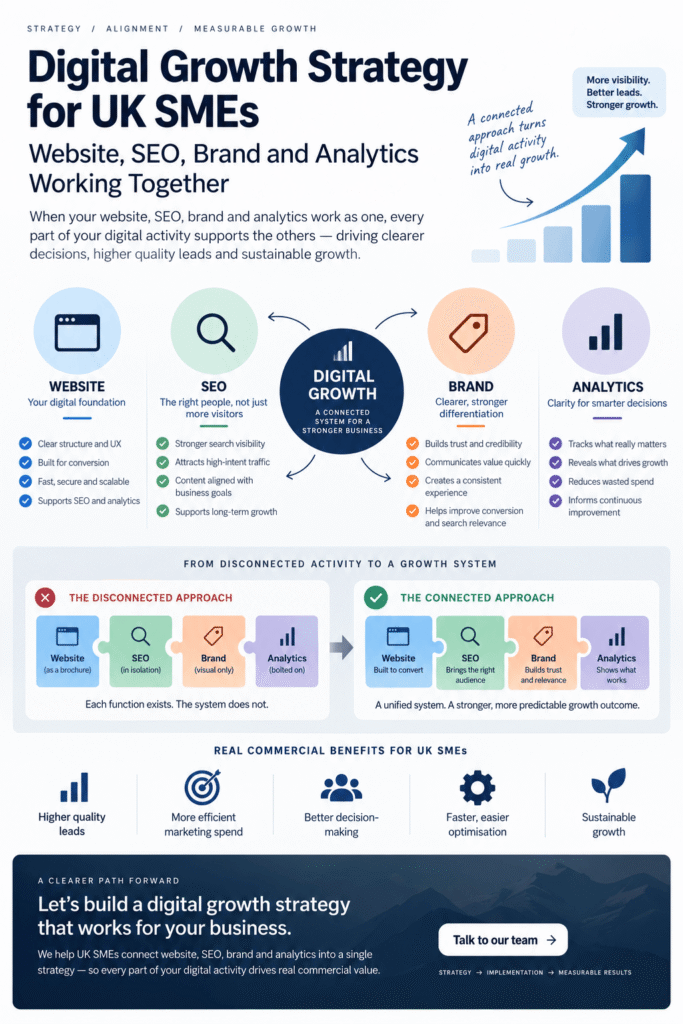
For many UK SMEs, digital growth does not fail because the market is too competitive or the budget is too small. It usually fails because the moving parts never properly connect. The website is treated as a brochure, SEO is handled as a separate channel, branding is seen as a visual exercise, and analytics is bolted on afterwards. Each function exists. The system does not.
That gap matters more than ever. Search visibility is harder won, user expectations are higher, and directors want clearer commercial accountability from digital investment. A business can spend steadily on design, content, paid media, development and reporting, yet still struggle to answer a basic question: what exactly is driving growth, and what is getting in the way?
Leave your details and our team will get back to you shortly to discuss your website, SEO or digital growth project.
A useful digital growth strategy for UK SMEs is not a list of tactics. It is an operating model. The website, SEO, brand and analytics need to work together closely enough that one improves the performance of the others. When that happens, decisions become sharper, waste becomes easier to spot, and growth feels less random.
Why the disconnected approach keeps underperforming
SMEs rarely choose fragmentation on purpose. It tends to happen gradually. A site gets launched to meet a deadline. SEO starts later, often after rankings stall. Brand work happens during a redesign or after the team realises the company looks inconsistent. Analytics is installed, but not always configured around meaningful business actions. On paper, every box has been ticked. In practice, each area has been developed with a different objective, by different people, at different times.
The result is predictable. A technically decent website may attract the wrong traffic. A strong-looking brand may not help users understand the offer quickly enough. SEO may bring visitors into pages that were never built to support commercial decision-making. Analytics may report plenty of activity but very little clarity. None of this looks catastrophic in isolation. Together, it creates drag.
This is one reason SMEs often feel they are working hard digitally without creating momentum. Traffic rises but enquiry quality stays flat. Engagement looks healthy but leads do not improve. The brand feels more polished but sales teams still spend too much time explaining basics. Those are not channel problems. They are coordination problems.
What “working together” really means
There is a tendency to speak about alignment in broad, comfortable terms. In reality, alignment is quite concrete. Your website should express the brand clearly, support search discoverability, and make measurable user actions visible in analytics. SEO should not just attract sessions; it should bring the right people into the right journeys. Branding should not sit on top of performance work; it should sharpen relevance, trust and differentiation at the moments users are deciding whether to continue. Analytics should not be an afterthought; it should tell you which combinations of audience, page type, message and user behaviour produce commercial value.
Once you view the system that way, individual decisions start to look different. A page layout is no longer just a design choice. It affects crawlability, content hierarchy, perceived credibility and conversion behaviour. A brand message is not just copy tone. It affects search intent matching, bounce risk and lead quality. Development considerations influence site speed, tracking accuracy, CMS flexibility and the cost of future optimisation.
That is why businesses planning a new site or a larger platform rebuild often run into the same issue: the technical build is treated as the project, when the real challenge is designing a growth system around it.
Why this matters commercially for SMEs
Larger organisations can sometimes absorb inefficiency for longer. SMEs usually cannot. They need digital activity to become cumulative. Every improvement should make the next improvement easier, cheaper or more effective.
If the website structure supports SEO properly, new content performs better. If the brand proposition is clearer, conversion rates often improve without proportional traffic growth. If analytics is configured around qualified actions rather than vanity metrics, budget allocation becomes more rational. If development choices are made with future change in mind, the business avoids expensive rebuild cycles and operational debt.
That last point is often underestimated. A site may look fine from the outside and still create ongoing friction internally. Teams struggle to update pages, campaign landing pages take too long to launch, tracking breaks after minor changes, or content teams cannot create search-focused pages without developer support. Over time, this slows the business down. A more considered website design and development approach is not simply about aesthetics; it affects responsiveness, measurement and commercial agility.
Where growth strategy usually breaks first
The first break is usually not traffic. It is interpretation.
Many SMEs are seeing enough data to feel informed but not enough structure to make confident decisions. Organic traffic may be rising, branded search may be flat, and conversions may fluctuate month to month. Without a joined-up strategy, every stakeholder reads the picture differently. The managing director sees cost. The marketing lead sees channel complexity. The sales team sees lead quality issues. The developer sees technical constraints. Everyone is looking at a real problem, but not necessarily the same one.
That is why analytics needs a more serious role in digital growth strategy. Reporting should connect user behaviour with business intent. Which page groups introduce new users? Which service pages move people towards contact? Which content topics attract research-stage traffic but rarely progress? Where do returning visitors behave differently from first-time visitors? Which lead sources produce the strongest downstream outcomes?
Without that layer, SEO becomes guesswork, brand decisions become subjective, and website improvements get prioritised by opinion or urgency rather than evidence.
The website is not the centrepiece. It is the operating environment.
 Calling the website the “hub” is common, but a bit too passive. For most SMEs, the website is the operating environment where discovery, trust, evaluation and conversion intersect. It houses the structure that search engines crawl, the brand cues that users interpret, the journeys that shape conversion behaviour, and the events that analytics needs to capture accurately.
That makes website decisions unusually consequential. Information architecture affects not only usability but also keyword mapping and topical depth. Template design affects readability, authority signals and content production speed. CMS choice affects governance, publishing workflow and how quickly teams can respond to new opportunities. In businesses with complex offers or multiple audiences, even seemingly small structural decisions can have long-term effects.
This is one reason some SMEs eventually outgrow a basic site build and need something closer to a more deliberate custom or CMS-led setup. Not because bespoke work is automatically better, but because growth often exposes limitations in off-the-shelf thinking. If the website cannot adapt to content strategy, tracking needs, audience segmentation or future integrations, performance work becomes more expensive than it should be.
Brand is doing more work than many SMEs realise
Brand is often discussed in ways that make it sound intangible. In digital growth terms, it is not. It shapes recognition, perceived legitimacy, message clarity and the emotional speed of decision-making. A weak brand does not only look forgettable; it makes acquisition less efficient. It asks the website and SEO to work harder to overcome uncertainty.
In many SME environments, the issue is not a total lack of branding. It is inconsistency. Different pages speak in different voices. Visual identity is uneven. The business promise is broad on one page, technical on another and vague on the next. This confuses users faster than most teams expect. Especially in B2B and local service markets, people often decide whether a company feels credible within seconds, long before a form is submitted.
That is why stronger brand identity systems can have measurable downstream effects. They can improve engagement quality, reduce hesitation on key pages and make organic search traffic more commercially useful. Proper branding work is not decoration. It is part of conversion infrastructure.
SEO is not a traffic layer added later
One of the more persistent SME mistakes is to view SEO as something that happens after the website is finished. That sequencing causes all sorts of avoidable problems: thin service pages, poor internal hierarchy, duplicated intent, weak metadata logic, clumsy URL structures and content that has to be rewritten around templates that were never designed for search visibility in the first place.
Search performance is shaped early. Site architecture, navigation logic, content depth, page purpose and technical stability all influence how well SEO can work later. Even when a business plans to rely heavily on referrals, paid media or outbound activity, organic search still plays a strategic role. It captures active demand, supports credibility checks and helps the business become easier to evaluate on its own terms.
For UK SMEs, the important question is not “should we do SEO?” It is whether the site, brand and analytics are built in ways that let SEO contribute commercially rather than cosmetically. Rankings alone do not settle that question. The right query mix, the right landing pages and the right conversion pathways matter more.
Three realistic SME scenarios
A regional professional services firm commissions a sleek new company site. The design is cleaner, but service pages are shorter than before, regional relevance is reduced, and enquiry tracking is limited to a single thank-you page. Six months later, branded search is stable, non-branded visibility is mixed, and the team cannot confidently explain why lead volume has not improved. The site launch created visual progress without strengthening the growth system.
An ecommerce-adjacent B2B supplier invests in content and sees organic traffic climb. Yet most of that growth comes from informational articles that attract early-stage visitors with little buying intent. Product and category pages remain thin, technical filters create indexation clutter, and reporting treats all conversions as equal. The business has “more SEO”, but not necessarily more commercial traction.
A local multi-service company undertakes a website redesign after several years of piecemeal updates. The refreshed site looks credible and mobile performance improves, but the deeper gain comes from rationalising page structure, clarifying brand language and redefining what counts as a meaningful lead in analytics. In that case, redesign works because it is used to reset the entire growth framework, not just the visual layer.
What SMEs most often misunderstand
The biggest misunderstanding is that digital growth comes from intensity. In practice, it comes from coherence. More channels, more campaigns and more publishing do not compensate for strategic disconnect.
Another common misconception is that every part of the system should optimise for the same immediate outcome. It should not. Some pages exist to earn visibility. Some exist to build trust. Some exist to simplify decision-making. Some exist to capture intent. Trying to make every page do everything usually produces vague content and unclear journeys.
There is also a tendency to treat analytics as validation rather than diagnosis. Teams look for evidence that work is performing, instead of using data to expose friction. That changes the tone of reporting. Instead of asking, “did traffic grow?”, better questions are often, “which journeys lost momentum?”, “where are high-intent users dropping out?”, and “which page types are over-attracting weak-fit traffic?”
The strategic model that tends to work better
The strongest SME digital growth strategies usually share a few characteristics. They start with business priorities rather than channel preferences. They define audience segments with enough clarity to shape content and page hierarchy. They build or refine the website so that search demand, brand messaging and conversion paths support each other. And they set up analytics to measure movement through those journeys, not just isolated events.
This is where platform and implementation choices begin to matter. A rigid site can become an obstacle surprisingly quickly. If publishing workflows are cumbersome or campaign pages need developer intervention every time, the business responds more slowly than competitors. In that context, sensible content-managed websites are not just a technical preference. They shape how fast the company learns and iterates.
The value is not in the platform label itself. It is in how well the site supports operational change, governance and reliable measurement over time.
The hidden friction inside implementation
This is the part many glossy articles skip. Even when leadership agrees on the strategy, implementation tends to create tension.
Brand teams want cleaner messaging. SEO teams want fuller topic coverage. Designers want simplicity. Sales teams want reassurance-heavy pages. Developers want stable scope. Directors want evidence that spend will lead somewhere measurable. All of those positions are reasonable. Problems arise when no one decides how trade-offs will be made.
That is why digital growth work often stalls at the messy middle. The strategy sounds right, but page templates are too restrictive, old content still ranks for outdated queries, the CRM is not fully connected, or stakeholders disagree about whether lead quantity or lead quality is the priority. None of this is unusual. It is the normal shape of implementation.
SMEs that navigate this well tend to be the ones that accept a simple truth: growth strategy is not a one-off document. It is a managed coordination exercise involving content, design, development, measurement and decision-making discipline.
When a redesign helps, and when it merely creates activity
Website redesign is one of the most overestimated growth moves in the SME market. It can absolutely be the right decision. But it only creates real value when underlying structural issues are being addressed as well.
If the current site suffers from poor mobile usability, weak content hierarchy, dated branding, limited CMS flexibility or broken measurement, a more serious website redesign can unlock progress across several layers at once. It can improve discoverability, sharpen trust signals and make testing easier. But if the redesign focuses mainly on appearance, the business often ends up with a cleaner version of the same problem.
The same applies to launching landing pages for campaigns. They can perform brilliantly when the message, targeting, offer and measurement model are clear. They perform badly when they are used as a workaround for a confused core site. Short-term pages cannot permanently fix structural incoherence.
How to think about the system in practical terms
A useful way to assess digital growth maturity is to ask whether the four pillars are reinforcing each other or compensating for each other.
- Website: Does the structure help users and search engines understand the offer quickly?
- SEO: Are you attracting the right mix of discovery, comparison and high-intent demand?
- Brand: Does the business feel credible, differentiated and coherent across the journey?
- Analytics: Can you see which behaviours and pages create commercial value?
If one pillar is constantly covering for another, the strategy is under strain. Strong branding should not be forced to compensate for weak site usability. SEO should not be relied on to overcome unclear service positioning. Analytics should not be expected to explain performance when key events were never properly defined.
The role of different website types in SME growth
Not every SME needs the same kind of site, and this is where a lot of generic advice becomes unhelpful. A straightforward local firm with a focused offer may gain plenty from a well-structured company site built around clear services, trust signals and local discoverability. A growing B2B organisation with multiple audiences, longer buying cycles and stakeholder-led decision-making may need deeper content pathways, stronger governance and more granular tracking.
Other businesses reach a point where bespoke website design becomes commercially sensible because templated decisions no longer match the complexity of the offer, the content model or the integration requirements. Again, the point is not that bigger or fancier always wins. It is that the website type should fit the business model, growth ambition and internal operating reality.
Analytics should change management behaviour, not just marketing reports
One sign of a mature digital growth strategy is that analytics starts influencing management choices, not just campaign summaries. When reporting is structured properly, it becomes easier to decide where to invest next, which audiences deserve more attention, and which parts of the funnel need fixing before further spend is justified.
That usually means moving past simplistic dashboards. SMEs benefit more from a reporting model that distinguishes between raw conversions and qualified intent, compares page groups rather than isolated URLs, and tracks whether users are progressing through expected journeys. Sometimes the most valuable insight is not that a campaign underperformed. It is that the wrong pages are receiving the right traffic, or the right pages are receiving the wrong traffic.
That level of clarity can save months of misdirected optimisation.
What better decision-making looks like in practice
Good decisions in this area rarely begin with “we need more leads” in isolation. They begin with sharper diagnosis.
If branded search is healthy but non-branded acquisition is weak, the issue may be discoverability and content structure. If traffic is rising but conversion quality is poor, the problem may sit in positioning, offer clarity or keyword intent alignment. If enquiry rates differ wildly across service pages, brand trust and page composition may be doing more work than teams realised. If user engagement looks strong on mobile but form completion lags, the friction may be technical rather than strategic.
In other words, the right next move depends on whether the bottleneck is structural, narrative, technical or behavioural. A joined-up digital strategy makes that easier to see.
Where the UK market adds extra pressure
UK SMEs are operating in a market where buyers often compare more thoroughly before making contact, particularly in professional services, B2B and higher-value local sectors. Search remains central to that process, but it is not the only lens. Prospects move between search results, websites, review environments, social signals, branded searches and direct return visits. That means a weak or inconsistent digital presence is rarely judged in one place only.
It also means credibility accumulates through small signals: page clarity, content relevance, trustworthy design, coherent branding, performance speed and frictionless user journeys. Businesses do not always lose trust dramatically. Often, they lose it quietly.
What the next few years are likely to reward
The direction of travel is fairly clear. Search is becoming more demanding in terms of content quality, technical coherence and demonstrable usefulness. Users are becoming less patient with generic claims. Measurement expectations are getting stricter. And AI-assisted content production, while useful in places, is making clarity, originality and operational substance more important, not less.
That should push SMEs towards stronger foundations rather than more noise. Businesses with coherent websites, distinct brand positioning, sensible search targeting and reliable analytics will be in a better position to adapt. They will know what is working, where trust is being won or lost, and which improvements genuinely affect commercial outcomes.
Those with fragmented systems will find it harder to interpret the market. They may still generate activity. But activity and growth are not the same thing.
The practical takeaway
If an SME wants more predictable digital growth, the question is not whether to improve the website, invest in SEO, refresh the brand or sort out analytics. The question is whether those efforts are being designed as one connected system.
That usually starts with an honest audit of how the current setup behaves in the real world. Not just how it looks in presentations. Can the site support the journeys the business needs? Does search traffic map to commercially meaningful pages? Does the brand help people understand why this company, not just what it does? Can analytics distinguish between motion and progress?
When the answers line up, growth becomes easier to manage. Not effortless. Just more legible, more strategic and less dependent on guesswork.
Final perspective
For UK SMEs, digital growth strategy is often framed as a matter of choosing channels or increasing output. That is too narrow. The more consequential task is integration: building a digital environment where the website, SEO, brand and analytics improve each other’s usefulness.
That is what turns digital from a set of expenses into a compounding business asset. And it is usually the difference between looking active online and becoming genuinely easier to find, trust and choose.