
SEO vs Google Ads in UK
For many UK businesses, this is still framed as a simple choice: invest in SEO or pay for Google Ads. In practice, that is rarely the real decision. The harder question is about timing, cash flow, lead quality, competitive pressure and how quickly a business needs demand to turn into measurable revenue.
That is why the usual “SEO is long term, Google Ads is short term” summary is true but not especially useful. It leaves out the operational detail that actually shapes outcomes. A company with weak conversion tracking, poor landing pages and no clear offer can waste money in both channels. A business with solid margins, a decent website and realistic expectations can often make both work together.
Leave your details and our team will get back to you shortly to discuss your website, SEO or digital growth project.
The comparison most articles oversimplify
SEO and Google Ads both sit inside the same search environment, but they behave very differently.
SEO is an asset-building channel. You are improving visibility in organic search by strengthening technical foundations, content quality, topical authority, internal relevance and off-site trust signals. Done well, it compounds. Done badly, it becomes months of activity with very little commercial movement.
Google Ads is a media-buying channel. You are paying for access to attention in search results. That creates speed, control and testability. It also creates dependency. Once spend stops, visibility usually stops with it.
The difference matters because these channels produce not only different traffic patterns, but different organisational behaviour. Teams tend to treat Ads as immediate and measurable, while SEO gets pushed into the vague category of “brand building” or “we should probably do that as well”. That is often where poor decisions begin.
Why the choice matters more than it first appears
Choosing between SEO and Google Ads affects more than lead generation. It influences budgeting, reporting cycles, stakeholder expectations and even how patient the business is prepared to be.
If a company needs pipeline this quarter, Google Ads can create visibility quickly. If it wants to reduce reliance on paid acquisition over the next 12 to 24 months, SEO becomes strategically important. If customer acquisition costs are already under pressure, the wrong channel mix can make that worse.
There is also a less obvious commercial issue: search intent is not evenly distributed across industries. In some sectors, paid results absorb a large share of clicks because users are in active comparison mode and the SERP is saturated with ads. In others, organic listings carry more trust and win attention more naturally. The question is not merely which channel is cheaper. It is which channel aligns with how buyers behave in that market.
Where SEO tends to win
SEO usually becomes more valuable when search demand is consistent, the buying journey includes research, and the website can support authority over time. Businesses with broad service categories, informational search demand, local intent, or product-led content opportunities often benefit disproportionately from organic growth.
It is especially strong where search journeys are messy. A user may begin with a broad query, refine the problem, compare options, and only convert later. Google Ads can capture some of that, but SEO lets a business occupy multiple moments in the decision cycle without paying for every click.
There is another advantage that gets ignored: SEO improves the whole site. Technical fixes, stronger landing pages, better information architecture, clearer metadata, stronger internal linking and more credible content often improve conversion efficiency beyond organic traffic alone. The work has second-order benefits.
That is why serious SEO is not just about rankings. It usually involves strategy, audits, technical cleanup, content planning and authority development. In practice, the work often resembles a structured search growth programme rather than a narrow optimisation task.
Where Google Ads has the edge
Google Ads tends to win when speed matters, when high-intent keywords convert well, or when the business needs immediate testing rather than slow build-up. A new service launch, a time-sensitive offer, a seasonal push, or a local campaign with urgent lead needs can all justify paid search.
It is also useful when the market is commercially clear. If you know which keywords bring enquiries, your margins are healthy, and conversion tracking is reliable, Ads can produce fast signal. That has value beyond lead generation. It helps reveal messaging gaps, pricing friction and landing page weaknesses sooner than SEO often can.
But this speed is not the same as simplicity. Many advertisers assume Google Ads is easy because traffic appears quickly. In reality, weak match type control, poor query filtering, thin landing pages and unclear attribution can turn “quick results” into expensive noise.
The real trade-off: compounding asset vs rented attention
The cleanest way to understand SEO vs Google Ads is this: SEO builds a compounding acquisition asset; Google Ads rents qualified attention on demand.
Neither model is inherently better. The right choice depends on constraints.
If the business can afford patience, SEO often becomes more efficient over time. If the business cannot wait, paid search may be necessary. If customer lifetime value is high, a business can tolerate more aggressive acquisition through Ads. If margins are tight, dependency on paid clicks becomes uncomfortable very quickly.
And then there is competition. In expensive sectors, Google Ads can become viable only for firms with strong conversion rates, excellent sales handling and enough margin to survive testing. In competitive organic markets, SEO may take longer than leadership expects, particularly if the site starts from a weak technical and content position.
What many businesses get wrong about the comparison
The first mistake is treating SEO and PPC as if they solve the same problem in the same way. They do not. SEO often expands discoverability across the full search journey. Google Ads is more selective and more immediate. When businesses compare them using one narrow metric, usually cost per lead over a short period, they miss the larger strategic picture.
The second mistake is assuming channel performance exists in isolation. It does not. A weak website damages both. Poor tracking distorts both. A vague offer depresses both. Slow pages, unclear service positioning and thin proof points create friction everywhere.
The third is underestimating implementation reality. SEO is not simply “write blogs and wait”. Google Ads is not “turn on campaigns and scale”. Both require process, judgement and regular correction. One fails slowly and quietly; the other can fail quickly and expensively.
Different business scenarios, different answers
A start-up with no search visibility, no historical data and pressure to generate enquiries within weeks will usually lean towards Google Ads first. That is not because SEO lacks value, but because the company needs signal now. It needs to know which messages attract clicks, which landing pages convert and whether the market responds at all.
A service business with established demand and a credible site may be better served by building SEO properly, especially if paid click costs are high and search behaviour includes research-led queries. In those cases, organic visibility can reduce long-term acquisition pressure.
An e-commerce business is often dealing with a more complicated version of the same decision. Shopping ads, branded search, category competition, organic product visibility and margin pressure all collide. The wrong answer is usually choosing one in isolation. Paid search can support testing and inventory movement, while SEO supports category depth, content discoverability and resilience against rising ad costs. That is where ecommerce SEO considerations become commercially important rather than merely technical.
Local businesses face another variation. If the map pack and local organic listings dominate the SERP, local search visibility becomes hard to ignore. But if the category is urgent and users click the first viable option, Google Ads may create faster lead flow. Emergency trades, for instance, rarely behave like considered B2B procurement.
Why measurement is often the hidden problem
Plenty of channel comparisons are distorted by poor measurement rather than poor marketing.
SEO can look weak if attribution is too narrow and only last-click conversions are counted. A user may discover the business organically, return through a branded ad, then convert later through direct traffic. That does not mean organic search failed. It means the reporting model is incomplete.
Google Ads can look strong for the opposite reason. If branded campaigns are capturing demand that would likely have arrived anyway, paid search may receive more credit than it deserves. This is common. Not always deliberate, but common.
Without sensible analytics, the debate becomes theatre. Paid looks precise, organic looks fuzzy, and budget decisions drift towards whatever appears easiest to report on. That is one reason robust SEO analytics and cleaner conversion tracking matter before channel decisions are treated as strategic truth.
Cost is not just budget
When people ask, “Is SEO better than Google Ads?”, they often mean, “Which is cheaper?” That is understandable, but shallow.
The actual cost includes time to impact, internal workload, agency or specialist capability, landing page quality, creative testing, reporting discipline and the commercial consequences of delay. A cheap channel that takes too long can be expensive. A fast channel that produces low-intent leads can also be expensive.
SEO usually carries higher patience requirements and often broader implementation demands. Technical fixes may need developers. Content quality needs subject understanding. Authority growth rarely happens by accident. On the other hand, a mature SEO programme can keep generating value long after a specific piece of work is completed.
Google Ads is easier to start spending on than to operate well. That distinction matters. The spend is visible; the waste is often buried in search terms, audience mismatches, weak copy, poor landing experiences or over-crediting branded demand.
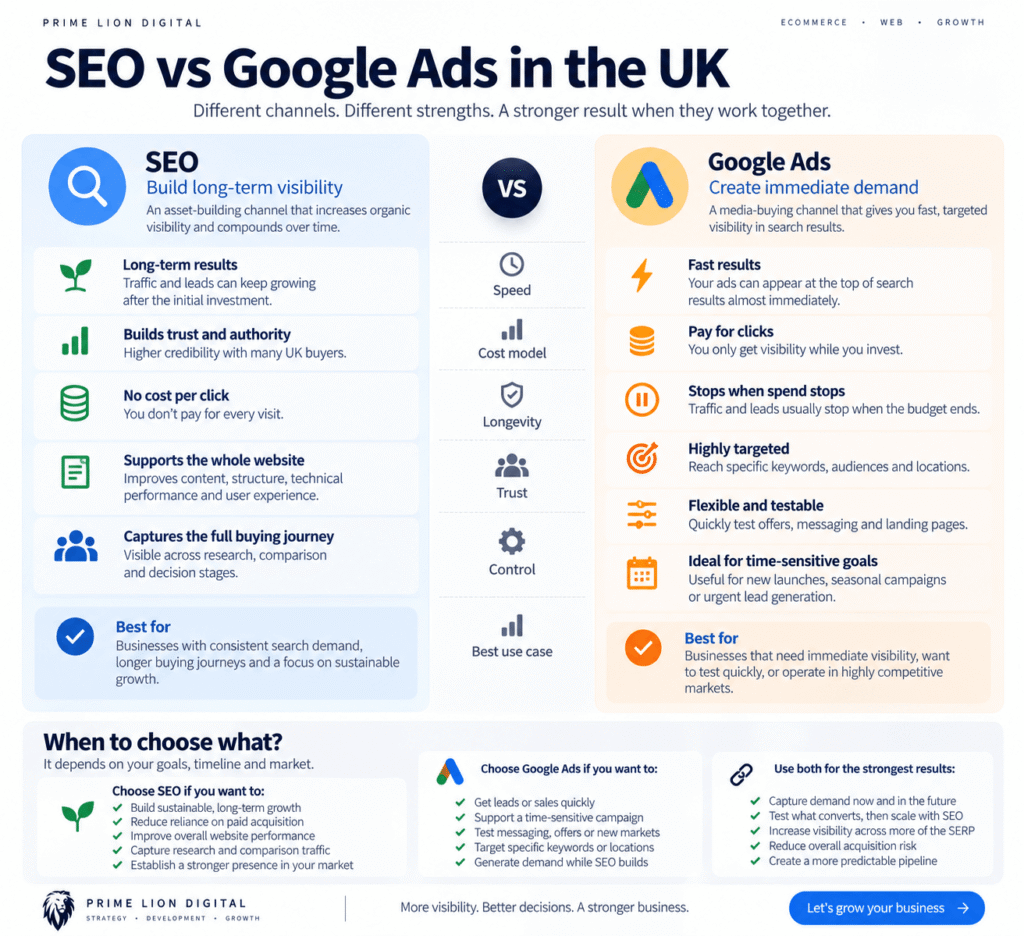
A brief side-by-side view
- SEO: slower to mature, broader search coverage, trust-led clicks, compounding value, more dependent on site quality and consistency.
- Google Ads: faster to launch, tighter control, easier to test, spend-dependent visibility, more vulnerable to wasted budget if management is weak.
What implementation actually looks like
From the outside, SEO vs Google Ads can sound like a channel decision. Internally, it is often a workflow decision.
SEO usually requires coordination across strategy, technical improvements, content production, page quality, internal linking, crawl health and off-page authority. That means different stakeholders. Marketing wants growth, leadership wants timelines, developers want prioritisation clarity, and content teams want direction that is more useful than “target better keywords”.
Google Ads requires a different kind of operational discipline. Campaign structure, search intent segmentation, negative keywords, bidding logic, ad testing, landing page alignment and conversion tracking all need attention. The work moves faster, but that often means mistakes scale faster too.
Neither channel rewards casual execution. The difference is that SEO tends to expose structural weaknesses in the website and content ecosystem, whereas Google Ads tends to expose weaknesses in offer clarity, conversion flow and cost tolerance.
Why combining SEO and Google Ads often works best
For many businesses, the strongest answer is not SEO or Google Ads. It is sequencing and integration.
Google Ads can be used to generate immediate data: which queries convert, which propositions attract attention, which landing pages fail, what geographic segments perform differently. That insight can improve organic strategy.
SEO can then build durable visibility around proven search themes, reduce overreliance on paid traffic and capture informational or mid-funnel demand that Ads may approach less efficiently.
There is also a brand effect. Appearing in both paid and organic positions can increase SERP presence, reinforce credibility and create more room for competitive defence. It does not guarantee better performance, but in some markets it strengthens perceived legitimacy.
The key is not running both for the sake of it. The key is understanding what each channel is doing in the wider acquisition system.
Failure patterns that show up again and again
One familiar pattern is launching Google Ads before the landing experience is ready. Traffic arrives, budgets burn, and the post-click journey is too weak to convert. Ads then get blamed for exposing a website problem.
Another is starting SEO with vague expectations and no prioritisation. A business publishes content, tweaks a few headings, waits three months and concludes that organic search does not work. In reality, there may have been no real strategy, no technical diagnosis and no authority plan behind the effort.
A third is stakeholder misalignment. Leadership wants short-term leads. Marketing wants long-term channel balance. Finance wants visible attribution. Without agreement on what success looks like, SEO vs PPC becomes an argument about reporting rather than growth.
And sometimes the failure is simpler: the market is harder than expected. Search demand is lower, competition is sharper, CPCs are higher, and the website is less persuasive than internal teams assumed. Search channels are very good at revealing uncomfortable truths.
How to decide without relying on generic advice
A useful decision starts with four questions.
How quickly do you need commercially meaningful results? If the answer is “within weeks”, Google Ads probably has to be part of the picture.
How strong is the current website? If technical quality, page depth, trust signals and conversion paths are weak, neither channel will perform as well as forecast.
What does the search landscape look like in your niche? Some markets are dominated by aggregators, comparison sites, heavy ad presence or entrenched organic publishers. That changes the economics.
What are you actually trying to build? Immediate lead volume, lower long-term acquisition costs, better local visibility, broader category authority, or a more resilient search presence? Different goals lead to different channel choices.
If the business is deciding between SEO or Google Ads for small business growth, the honest answer is often tied to cash flow and patience. Small firms usually cannot afford prolonged ambiguity. They need visible movement, but they also need to avoid permanent dependency on paid traffic.
The role of site maturity
Site maturity changes the answer more than many teams realise.
A well-structured site with clear service pages, strong copy, sound technical health and credible trust signals is in a much better position to benefit from SEO. The groundwork is already there. Technical foundations of SEO matter here, as do page refinement and a coherent content and on-page structure that matches real search intent.
A thin site with poor architecture and limited substance may struggle in organic search for longer than expected. In that situation, Google Ads might create useful short-term access to demand while the site is strengthened. Not as a substitute for fixing the underlying issues, but as a bridge.
This is where channel strategy becomes more than channel selection. It turns into sequencing: SEO audit work first, prioritise the biggest blockers, improve the pages that matter commercially, then decide how much to lean into organic growth versus paid demand capture.
How the UK market shapes the decision
UK search behaviour is not identical across sectors, and neither are cost dynamics. In some industries, especially legal, finance, home services and high-value B2B, Google Ads can become aggressively competitive. That raises the standard required for profitable management.
Organic search can also be difficult in mature verticals, particularly where large publishers, marketplaces or national brands dominate category terms. Still, local intent, specialist expertise and sharper service positioning often create room where broader category competition looks intimidating on the surface.
There is also a trust dimension in the UK market that should not be overlooked. For some buyers, particularly in considered purchases, strong organic presence still carries a different kind of credibility from a sponsored listing. Not always. But often enough to matter.
What the next few years may change
The SEO vs Google Ads debate is also shifting because search itself is changing. AI-generated overviews, richer SERP features, more zero-click behaviour and more aggressive competition for attention are altering both paid and organic visibility.
That does not make either channel obsolete. It does mean lazy execution will be punished faster. Organic search will demand more original value, stronger technical foundations and clearer evidence of expertise. Paid search will demand cleaner data, tighter intent management and more disciplined economics.
The businesses that adapt well will not be the ones asking whether SEO is better than Google Ads in abstract terms. They will be the ones treating search as a managed system: demand capture, demand shaping, conversion efficiency, measurement integrity and channel resilience working together.
What a sensible conclusion looks like
If you need a neat answer, there is one: Google Ads is usually better for speed; SEO is usually better for long-term efficiency and defensibility.
But the more honest answer is less tidy. SEO and Google Ads solve different problems, operate on different timescales and expose different weaknesses inside a business. The better question is not “SEO vs PPC: which wins?” It is “What are we trying to achieve, what constraints are real, and what does our current website and data setup allow us to do well?”
That is where experienced teams tend to land. Not in ideology. In sequence, economics and fit.
And once you look at it that way, the false binary starts to disappear.