

Why Your Website Gets Impressions but No Enquiries
Many businesses only start worrying about their website after the SEO reports begin to look better.
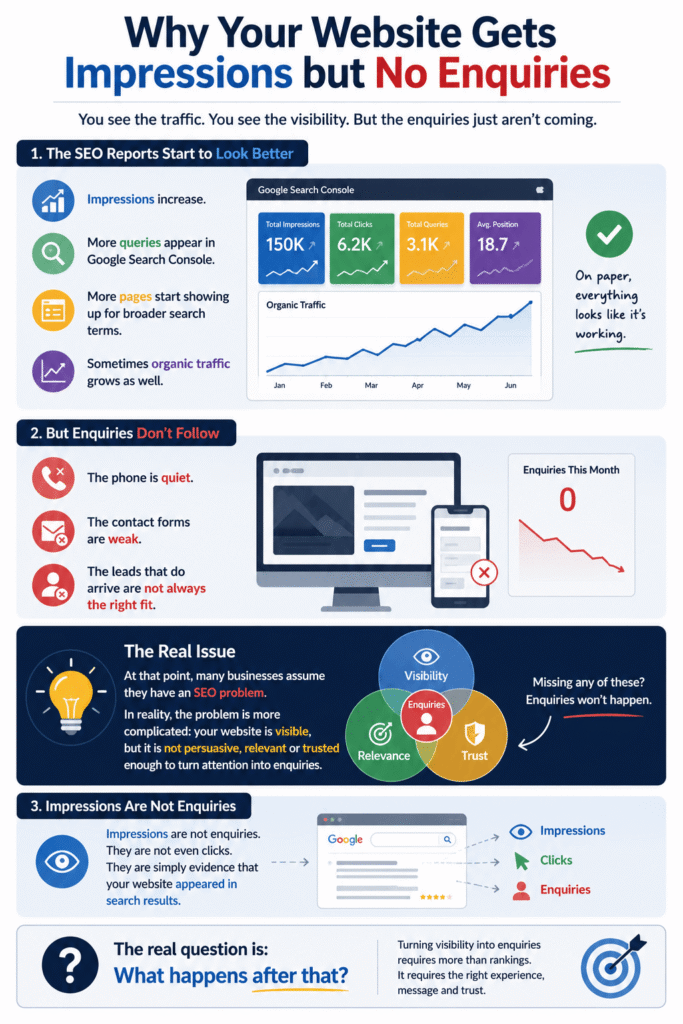
Impressions increase. More queries appear in Google Search Console. A few pages start showing up for broader search terms. Sometimes organic traffic grows as well.
But enquiries do not follow.
This is one of the most frustrating situations in digital marketing because, on paper, something appears to be working. The website is being seen. Google is testing it. Visibility is improving.
Yet the phone is quiet. The contact forms are weak. The leads that do arrive are not always the right fit.
At that point, many businesses assume they have an SEO problem. In reality, they often have a more complicated commercial problem: their website is visible, but it is not persuasive, relevant or trusted enough to turn attention into enquiries.
Impressions are not enquiries. They are not even clicks. They are simply evidence that your website appeared in search results.
The real question is what happens after that.
The Misleading Comfort of Growing Impressions
Impressions can be useful, but they can also create a false sense of progress.
A page may receive more impressions because Google is testing it across wider query sets. It may appear for searches that are loosely related to your service but not commercially valuable. It may be shown to users who are researching, comparing, learning, browsing or looking for something much cheaper than what your business actually offers.
That is why a website can look healthier in Search Console while the sales pipeline remains almost unchanged.
This is especially common when a business focuses on visibility before understanding intent.
Google may be showing the page more often, but that does not mean the page is being shown to the right people at the right stage of their decision-making process.
A business can rank for the right topic but the wrong buying moment.
Visibility Is Not the Same as Commercial Relevance
One of the biggest mistakes businesses make is treating all search visibility as equal.
It is not.
A website may generate impressions from people who are:
- researching general information;
- looking for free advice;
- comparing broad options;
- searching from outside the target location;
- too early in the buying journey;
- looking for a lower-cost provider;
- not yet ready to speak to a business.
From an SEO reporting perspective, these users may still look like progress.
From a commercial perspective, they may create very little value.
This is where many businesses experience what could be called query dilution: the page starts appearing for more searches, but the additional visibility is spread across weak, broad or poorly aligned intent.
The result is more impressions without more meaningful enquiries.
The Problem Often Starts in the Search Result
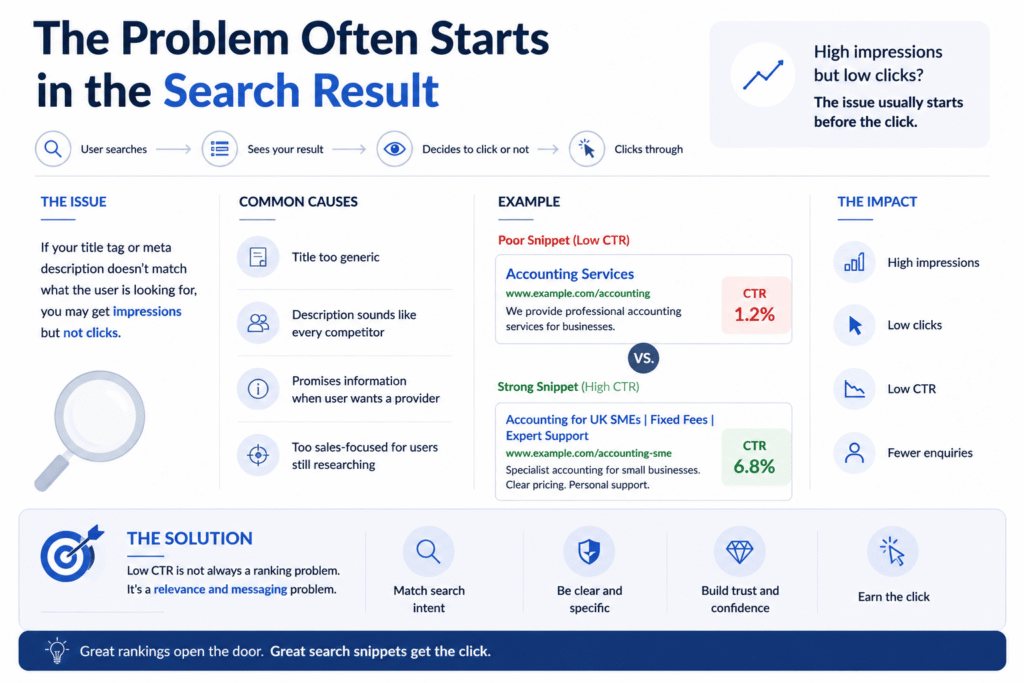
Before anyone reaches the website, they first see a search result.
If the title tag and meta description do not match what the user is really looking for, the page may receive impressions but not clicks.
This is a common problem with pages that are technically relevant but commercially unclear. They may rank for a query, but the search snippet does not give the user enough confidence that the page is worth opening.
Sometimes the page title is too generic. Sometimes the description sounds like every competitor. Sometimes the result promises information when the user wants a provider. Sometimes it sounds too sales-focused when the user is still trying to understand the problem.
Low CTR is not always a ranking problem. Often, it is a relevance and messaging problem.
Clicks Are Not the Finish Line Either
Even when users click, the website still has to earn the enquiry.
This is where many businesses lose people.
The user lands on the page and begins asking silent questions:
- Is this company relevant to my problem?
- Do they understand businesses like mine?
- Can they handle the level of project I need?
- Do they look credible?
- What makes them different?
- What happens if I contact them?
If those questions are not answered quickly and convincingly, the visitor may not convert.
They may not dislike the website. They may not even consciously decide against the business.
They simply continue searching.
Most Websites Do Not Lose Enquiries at the Contact Form
A common assumption is that conversion problems happen at the final step: the form is too long, the button is weak, or the call to action is not visible enough.
Sometimes that is true.
But many websites lose enquiries much earlier.
They lose them when the service page sounds generic. They lose them when the homepage does not explain the company’s position clearly. They lose them when the user cannot understand the process, the level of expertise or the type of client the business is best suited for.
They lose them when there is not enough proof.
They lose them when the website asks for trust before it has earned it.
A stronger button will not fix weak positioning.
Good Design Can Still Fail Commercially
A modern-looking website can still underperform.
This is one of the most common problems in website redesign projects.
The site may look cleaner, faster and more professional than before. But if the content structure, service architecture and conversion logic are weak, the business may still receive very few enquiries.
Design quality matters, but design alone does not create commercial clarity.
A high-performing website needs to explain:
- who the service is for;
- what problem the business solves;
- why the company is credible;
- how the process works;
- what kind of outcomes are realistic;
- why the user should choose this provider over another.
Without that, a website can look impressive while still failing to help people make a decision.
Many CRO Problems Are Actually Positioning Problems
 Conversion rate optimisation is often reduced to small interface changes: changing button text, moving forms, shortening fields or testing colours.
Those details can help, but they are rarely the whole issue.
For service businesses, conversion is usually driven by confidence.
That confidence comes from positioning, proof, relevance, clarity and perceived risk reduction.
If a user is comparing several providers, they are not only asking “Who has the best website?”
They are asking:
- Who feels safest?
- Who understands my situation?
- Who looks experienced enough?
- Who explains the process clearly?
- Who gives me confidence before I speak to them?
This is especially true in the UK professional services and B2B market, where buyers are often cautious, time-poor and comparing multiple providers before making contact.
If the website does not reduce perceived risk, impressions will rarely become strong enquiries.
The Blog-to-Service Gap
Many websites generate impressions through blog content but fail to convert because the blog is not connected to the commercial journey.
This happens when articles attract informational searches but do not guide users towards relevant service pages, case studies, consultation pages or next-step content.
The blog may rank. The article may be useful. The user may even read it.
But if there is no clear bridge from insight to service, the visit ends quietly.
This is a common issue for businesses that invest in content production without building a proper internal linking and conversion strategy.
Informational visibility can support enquiries, but only when the website helps users move from learning to decision-making.
Analytics Often Hide the Real Problem
 Many businesses assume analytics will explain why enquiries are not increasing.
In practice, analytics often show activity without explaining commercial quality.
A company may see more organic sessions, more impressions and acceptable engagement numbers while still lacking clarity on which visits produce serious enquiries.
This becomes more difficult when tracking is incomplete or disconnected.
Common issues include:
- GA4 events that track form submissions but not lead quality;
- Google Tag Manager setups that miss phone clicks or key interactions;
- contact forms that are counted as conversions even when the enquiries are irrelevant;
- CRM systems that do not connect leads back to landing pages or search channels;
- blog pages that influence decisions but receive no attribution credit;
- calls that are never linked back to organic search activity.
Many businesses only discover their analytics problem when marketing reports and sales reality stop matching.
At that point, optimisation becomes guesswork.
The business knows traffic exists, but it does not know which traffic matters.
More Leads Are Not Always the Right Goal
A website can increase enquiries and still create a business problem.
If the new enquiries are low-quality, poorly matched or outside the company’s ideal market, the website may increase operational noise rather than revenue.
This is why enquiry quality matters as much as enquiry volume.
A business does not need every possible visitor to convert. It needs the right visitors to understand the value, trust the company and take the next step with realistic expectations.
For many UK SMEs and service businesses, the real objective is not simply more leads.
It is better-qualified enquiries that match the company’s pricing, capability and service model.
The Real Problem Is Usually Structural
Websites rarely fail because of one isolated issue.
They usually fail because of accumulated friction.
The homepage may be too vague. The service pages may lack depth. The blog may attract the wrong audience. The internal links may not guide users towards commercial pages. The case studies may be weak. The tracking may be incomplete. The calls to action may appear before enough trust has been built.
None of these issues may look catastrophic on its own.
Together, they weaken the journey from impression to enquiry.
This is why businesses sometimes redesign their websites, rewrite a few pages, run more SEO activity and still see little commercial improvement.
The surface changes.
The conversion architecture remains weak.
How to Diagnose the Problem Before Buying More Traffic
 Before investing in more SEO, paid ads or content, it is worth diagnosing where the breakdown is happening.
Start with Google Search Console. Look at which pages receive impressions, which queries trigger them and whether those queries suggest buying intent, research intent or weak relevance.
Then review CTR. A page with strong impressions but poor clicks may have a search-result messaging problem. The title may be too broad, the meta description may lack commercial relevance, or the page may be appearing for queries that are too diluted.
Next, review the landing page itself. Does it immediately match the promise of the search result? Does it explain the service clearly? Does it build trust before asking for action?
After that, review the user journey. Can someone move naturally from a blog article to a relevant service page? Are internal links placed where they make sense? Does the website guide users towards the next useful step?
Then review conversion tracking. Are forms, phone clicks, email clicks and meaningful actions tracked properly? Are those enquiries connected to quality, not only volume?
Finally, review the commercial layer. Does the website make the business look like the right choice for the type of client it wants to attract?
This kind of review is more useful than simply asking for more traffic.
What a High-Performing Website Does Differently
A high-performing website is not only visible.
It is commercially coherent.
Its SEO strategy targets the right intent, not just the highest search volume. Its content supports decision-making, not just rankings. Its service pages explain real business value, not only service features. Its UX reduces uncertainty. Its analytics helps the business understand which visibility turns into real opportunity.
Most importantly, it treats SEO, CRO, UX, content and analytics as one system.
That system should answer three commercial questions:
- Are the right people finding the website?
- Do they understand and trust the business when they arrive?
- Can the business measure which activity creates meaningful enquiries?
If one of those questions is weak, impressions may grow without enquiries growing with them.
Why This Matters for UK Service Businesses
UK service markets are often highly competitive, especially in sectors such as web design, SEO, accountancy, legal services, consultancy, property, trades, healthcare and specialist B2B services.
Users compare quickly.
They open several websites. They scan. They look for signs of credibility. They check whether the provider understands their situation. They notice vague claims, weak proof and unclear pricing signals.
In that environment, a website cannot rely on visibility alone.
It has to create confidence faster than the competitor’s website does.
That confidence comes from clarity, relevance, evidence, structure and the feeling that the business understands the user’s real problem.
When the Website Needs a Strategic Review
If impressions are increasing but enquiries are not, the answer is not always a full redesign.
Sometimes the issue is metadata. Sometimes it is search intent. Sometimes it is weak service-page content. Sometimes it is poor internal linking. Sometimes it is tracking. Sometimes it is the offer, the positioning or the trust layer.
A proper review should connect the data and the user experience together.
That means looking at Search Console data, landing page behaviour, service architecture, conversion paths, technical performance, GA4 and GTM setup, CRM alignment and enquiry quality.
This is the difference between treating the issue as “more SEO needed” and treating it as a commercial performance problem.
For businesses that depend on qualified enquiries, that distinction matters.
Final Expert Perspective
A website that gets impressions but no enquiries is rarely failing in one simple way.
It may be visible but poorly aligned. It may attract traffic but not the right intent. It may look professional but fail to reduce uncertainty. It may generate data without producing useful commercial insight.
Sometimes the business has already been discovered.
The real question is whether the website gives the right people enough confidence to act.
Because impressions do not create enquiries by themselves.
Traffic does not guarantee trust.
And a website does not become commercially effective simply because Google starts showing it more often.
Enquiries happen when visibility, relevance, trust, UX, content and measurement work together.
That is the difference between a website that is seen and a website that sells.
About the Author
Serhii Kryvoviaz

Serhii Kryvoviaz is an IT entrepreneur, digital growth strategist, and the founder of Prime Lion Digital, with over 14 years of experience delivering high-impact digital solutions. He has led and executed more than 2,000 projects for businesses across the UK, Europe, and the United States, helping brands scale through advanced SEO, performance-driven websites, and strategic digital marketing. Serhii specialises in building robust digital ecosystems — combining technology, data, and content to generate sustainable growth, increased visibility, and measurable commercial results for clients in competitive markets.