

Business Website Inspiration: How to Build a Professional Website That Converts
A strong business website is no longer just an online brochure. For many UK companies, it is one of the most important tools for building trust, explaining services, generating enquiries, supporting sales conversations, and improving long-term visibility in Google.
Business website inspiration is useful when it helps you understand what makes high-performing websites effective. The goal is not to copy another company’s design. The goal is to identify proven patterns in structure, user experience, content, trust signals, SEO, and conversion strategy — then adapt them to your own business model.
The best business websites usually combine clear messaging, professional design, fast performance, mobile usability, helpful content, and a simple route for users to take action.
At Prime Lion Digital, we approach business website design as a commercial system. A website should look professional, but it should also help real users understand the business quickly and feel confident enough to make contact.
Why Business Website Design Matters
When a potential client visits your website, they begin judging your business almost immediately. Before they speak to your team, read your proposal, or compare your prices, they form an impression based on how your website looks, loads, explains information, and guides them through the journey.
For UK businesses operating in competitive sectors such as consulting, finance, construction, technology, ecommerce, healthcare, accounting, legal services, and marketing, this first impression can directly affect lead generation.
A weak business website can make a strong company look less credible. A clear, fast, well-structured website can help a smaller business compete with larger competitors by presenting expertise, trust, and value more effectively.
What Makes a Business Website High-Performing?
A high-performing business website does not rely on one design trend. It is built around user intent and commercial goals.
Most successful business websites include:
- a clear value proposition;
- simple navigation;
- strong homepage structure;
- well-organised service pages;
- fast loading speed;
- mobile-first usability;
- visible calls to action;
- trust signals such as reviews and case studies;
- helpful content that answers user questions;
- clear contact options.
These elements help visitors understand who you are, what you offer, why they should trust you, and what they should do next.
The Ideal Business Website Structure
A strong business website should guide visitors through a logical journey. The structure should not feel random. Each section should support the next stage of decision-making.
| Website Section | Purpose |
|---|---|
| Header | Helps users navigate quickly and access key pages |
| Hero section | Explains the business value proposition immediately |
| Service overview | Shows what the company offers |
| Benefits section | Explains why the service matters to the customer |
| Process section | Shows how the business works |
| Case studies | Provides proof of results |
| Testimonials | Builds trust and confidence |
| FAQ section | Removes objections before enquiry |
| CTA section | Encourages users to take the next step |
| Footer | Provides contact details, links, and reassurance |
Homepage Inspiration for Business Websites
 The homepage is often the most important page on a business website. It should quickly answer the questions users are already asking:
- What does this company do?
- Who does it help?
- Can I trust this business?
- Does this company understand my problem?
- What should I do next?
A strong homepage usually starts with a clear headline and supporting sentence. This is followed by key services, proof points, benefits, testimonials, and a direct call to action.
Many business websites fail because their homepage is too vague. Phrases such as “helping businesses grow” or “delivering digital excellence” may sound professional, but they often do not explain enough. Clear, specific messaging usually performs better.
Service Page Inspiration for Business Websites
Service pages should not simply list what you do. They should explain the service in a way that helps the user make a decision.
A strong service page usually includes:
- a clear service-specific headline;
- a short explanation of the problem being solved;
- who the service is suitable for;
- what is included;
- how the process works;
- benefits of the service;
- examples or case studies;
- frequently asked questions;
- a relevant call to action.
This is especially important for SEO. Google needs to understand the topic of the page, while users need to understand why the service is relevant to them.
Business Website Inspiration by Industry
Different industries need different website structures. A consulting website should not feel the same as an ecommerce website. A healthcare website should not use the same trust signals as a creative agency.
| Industry | Website Priority | Important Elements |
|---|---|---|
| Consulting | Authority and trust | Case studies, expert positioning, clear process |
| Marketing agency | Proof of capability | Portfolio, results, testimonials, service pages |
| Finance | Credibility and reassurance | Compliance signals, clear information, professional design |
| Technology | Clarity and scalability | Product explanation, integrations, demo CTAs |
| Healthcare | Accessibility and trust | Simple navigation, clear contact routes, patient-friendly content |
| Legal | Expertise and confidence | Practice areas, credentials, FAQs, enquiry options |
Trust Signals That Make Business Websites More Credible
Trust signals are essential because users rarely contact a business without some form of reassurance. They want to know that the company is real, capable, experienced, and safe to work with.
Useful trust signals include:
- client testimonials;
- case studies with measurable outcomes;
- client logos;
- industry certifications;
- awards;
- professional memberships;
- real team profiles;
- clear business contact details;
- privacy and security information;
- portfolio examples.
For service-based businesses, case studies are especially powerful because they show what was done, what problem was solved, and what result was achieved.
Lead Generation Design Inspiration
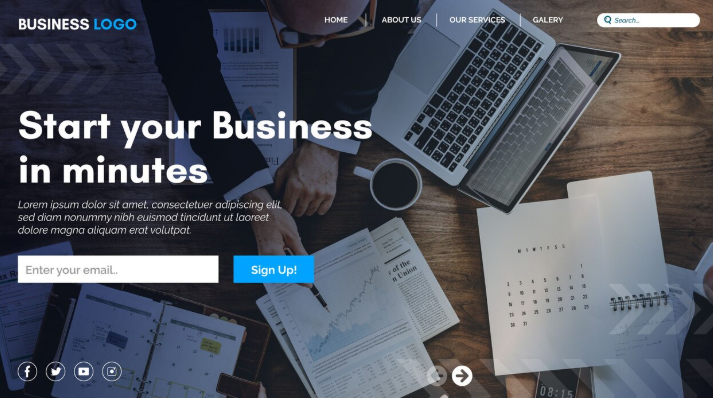 A business website should make it easy for users to enquire. If contact options are hidden, forms are too long, or CTAs are unclear, potential leads may leave without taking action.
Strong lead generation websites often include:
- a CTA above the fold;
- a short enquiry form;
- click-to-call functionality on mobile;
- clear contact details in the header or footer;
- consultation booking options;
- service-specific enquiry prompts;
- reassurance text near forms;
- supporting testimonials near conversion points.
The best CTA depends on the business model. “Contact us” may work for some companies, but more specific CTAs often perform better, such as “Book a Free Consultation”, “Request a Website Audit”, or “Discuss Your Project”.
UX Design Inspiration for Business Websites
User experience is not just about how a website looks. It is about how easy it is for visitors to understand, navigate, compare, and act.
Good UX usually includes:
- simple navigation;
- logical page structure;
- clear headings;
- short paragraphs;
- good spacing;
- readable typography;
- mobile-friendly layouts;
- consistent CTA placement;
- fast page loading;
- accessible design.
A visually impressive website can still perform badly if users feel confused. Clarity usually converts better than complexity.
Mobile-First Business Website Design
Many users will first visit your website on a mobile device. This is particularly common for local searches, service comparisons, social media traffic, and paid campaigns.
Mobile-first design should focus on:
- fast loading pages;
- easy-to-tap buttons;
- clear menu structure;
- readable text size;
- simple forms;
- visible phone and email options;
- reduced clutter;
- well-spaced content blocks.
If a website feels difficult to use on mobile, users may not wait until they reach a desktop. They may simply choose another provider.
SEO Structure for Business Websites
A business website should be designed for both users and search engines. Strong SEO structure helps Google understand what each page is about and how different pages connect to each other.
SEO-friendly business websites usually include:
- one clear H1 per page;
- logical H2 and H3 headings;
- dedicated service pages;
- helpful internal links;
- optimised title tags and meta descriptions;
- fast loading speed;
- mobile optimisation;
- structured content;
- FAQ sections where useful;
- clear image alt text.
Good design without SEO may look attractive but struggle to attract traffic. SEO without good UX may bring traffic that fails to convert. The strongest business websites combine both.
Content Strategy Inspiration for Business Websites
Content helps businesses build authority, answer user questions, and support organic search growth. A business website should not rely only on a homepage and a few service pages.
Useful content types include:
- service pages;
- case studies;
- blog articles;
- industry guides;
- FAQs;
- comparison pages;
- resources;
- process explainers;
- pricing guidance where appropriate.
The goal is to help users make better decisions while also showing Google that the website has depth, relevance, and expertise.
Performance Benchmarks to Track
A business website should be measured after launch. Design is only successful if it supports business performance.
| Metric | Why It Matters |
|---|---|
| Conversion rate | Shows how effectively the website turns visitors into leads |
| Bounce rate | Helps identify weak first impressions or poor relevance |
| Engagement time | Shows whether users are interacting with the content |
| Page speed | Affects SEO, UX, and conversions |
| Mobile usability | Shows whether mobile users can complete key actions |
| Form completion rate | Identifies friction in lead generation |
| Organic traffic | Shows SEO growth over time |
| Lead quality | Shows whether enquiries are commercially useful |
Common Business Website Design Mistakes
Many business websites underperform because they focus too much on appearance and not enough on clarity, trust, and conversion.
Common mistakes include:
- using vague messaging;
- hiding contact details;
- having too many menu items;
- using long paragraphs without structure;
- failing to explain services properly;
- not including case studies or testimonials;
- using weak CTAs;
- ignoring mobile experience;
- publishing thin service pages;
- having slow loading pages;
- using generic stock imagery;
- not tracking conversions.
Fixing these issues can often improve results without needing to rebuild the entire website from scratch.
Business Website Inspiration vs Template Websites
Template websites can be useful for speed and cost, but they often create limitations when a business needs stronger positioning, custom UX, SEO structure, or conversion-focused design.
| Template Website | Custom Business Website |
|---|---|
| Faster to launch | Built around specific business goals |
| Lower initial cost | Stronger UX and conversion strategy |
| Generic layout | Unique brand positioning |
| Limited flexibility | More scalable for growth |
| May need heavy adjustment | Designed around users and SEO from the start |
A template can be enough for a very small early-stage website. However, companies that rely on leads, SEO, credibility, and long-term growth usually benefit from a more strategic approach.
Realistic Business Website Structure Example
A strong service-based business website could follow this structure:
- Homepage with clear value proposition and primary CTA.
- Dedicated service pages for each core offer.
- About page showing experience, team, and credibility.
- Case studies showing measurable results.
- Blog or insights section for SEO and authority.
- Contact page with simple enquiry options.
- FAQ sections to answer common objections.
- Internal links connecting related services and articles.
This structure gives users a clear journey while helping search engines understand the website’s topical focus.
Case Study Example: Improving a Service Business Website
A UK-based service business had a professional-looking website but struggled to generate consistent enquiries. The design was clean, but the homepage did not clearly explain the value proposition, service pages were too short, and there were limited trust signals.
The improvement process included:
- rewriting the homepage headline and opening section;
- restructuring service pages around user intent;
- adding stronger calls to action;
- improving internal linking;
- adding testimonials and case study sections;
- improving mobile spacing and button visibility;
- optimising page speed.
After the redesign, the website created a clearer user journey and improved the quality of enquiries because visitors understood the business before making contact.
Business Website Design Checklist
Use this checklist when planning or reviewing a business website:
- Does the homepage explain the business clearly within a few seconds?
- Are the services easy to find and understand?
- Is there one clear primary CTA?
- Are contact details visible?
- Does the website include testimonials or case studies?
- Is the website fast on mobile?
- Are pages structured with clear headings?
- Does each important service have its own page?
- Are internal links used naturally?
- Is conversion tracking installed?
- Does the website feel trustworthy and current?
How Prime Lion Digital Helps Businesses Build Better Websites
 At Prime Lion Digital, we design and develop business websites that combine visual quality with commercial performance.
Our approach considers:
- business goals;
- user experience;
- SEO structure;
- conversion optimisation;
- mobile usability;
- technical performance;
- content clarity;
- long-term scalability.
We focus on building websites that do more than look professional. The aim is to create digital platforms that help businesses attract the right users, communicate value clearly, and generate measurable results.
Final Thoughts
Business website inspiration is valuable when it helps you understand what actually works: clear messaging, strong structure, user-friendly design, trust signals, fast performance, and simple conversion paths.
The best business websites are not built around design trends alone. They are built around real users, real business goals, and a clear strategy for turning attention into action.
Whether you are building a new website or improving an existing one, a strong business website should support credibility, SEO visibility, lead generation, and long-term growth.
Frequently Asked Questions
What should a business website include?
A business website should include a clear homepage, service pages, strong calls to action, trust signals, contact details, case studies or testimonials, mobile-friendly design, and SEO-friendly content structure.
Why is business website design important?
Design affects first impressions, trust, usability, and conversions. A professional website helps users understand the business and feel more confident about making contact.
What makes a business website convert better?
Clear messaging, simple navigation, strong CTAs, testimonials, case studies, fast loading speed, mobile usability, and low-friction contact forms all help improve conversions.
Should a business use a template website or custom design?
A template may be suitable for a simple early-stage website, but a custom design is usually better for businesses that need stronger branding, SEO, UX, and conversion performance.
How often should a business website be redesigned?
A website should be reviewed regularly. If it looks outdated, loads slowly, performs poorly on mobile, has weak conversions, or no longer reflects the business properly, a redesign or strategic improvement may be needed.
About the Author
Serhii Kryvoviaz

Serhii Kryvoviaz is an IT entrepreneur, digital growth strategist, and the founder of Prime Lion Digital, with over 14 years of experience delivering high-impact digital solutions. He has led and executed more than 2,000 projects for businesses across the UK, Europe, and the United States, helping brands scale through advanced SEO, performance-driven websites, and strategic digital marketing. Serhii specialises in building robust digital ecosystems — combining technology, data, and content to generate sustainable growth, increased visibility, and measurable commercial results for clients in competitive markets.