

When Does a UK Business Need Rebranding? Clear Signs, Risks and Costs
Most businesses do not decide to rebrand because they suddenly dislike their logo.
The conversation usually starts somewhere less obvious.
A company begins attracting the wrong type of enquiries. Competitors with weaker operational capability appear more credible online. Sales calls become slightly harder. The website no longer reflects the level the business actually operates at. Internal teams describe the company differently depending on who is speaking.
Nothing appears catastrophic initially.
That is partly why these problems often go unaddressed for too long.
In reality, many rebranding decisions begin long before anyone uses the word “rebrand” internally. The friction appears first. The diagnosis usually arrives later.
Across the UK market, this has become increasingly common as businesses evolve faster digitally than they did even five or six years ago. Companies expand services, reposition commercially, target larger contracts, enter new sectors or scale operationally — while the branding surrounding the business remains tied to an earlier stage of growth.
At some point, the gap becomes visible.
Not always visually. Commercially.
1. Editorial Hook / Market Context
One of the more interesting shifts in modern digital markets is how quickly perception now shapes commercial trust.
For many businesses, the first serious client interaction no longer begins during a meeting or phone call. It starts quietly through search results, website visits, LinkedIn profiles, review platforms and fragmented digital touchpoints that collectively form an impression before the company has an opportunity to explain itself properly.
That impression forms fast.
Often unfairly fast.
A technically capable business can still appear operationally behind if its positioning, website structure or branding ecosystem no longer reflects the level it operates at internally.
This becomes particularly visible in sectors where trust and authority influence decision-making heavily:
professional services, construction, finance, consultancy, B2B technology, legal support, healthcare, higher-value digital services.
In these environments, branding increasingly functions as a commercial filtering layer.
Businesses rarely lose opportunities purely because of visual design alone. They lose opportunities because perception affects confidence, and confidence affects commercial behaviour long before procurement conversations become rational.
That distinction matters.
A company can be highly capable operationally while unintentionally communicating the opposite.
2. What Is Actually Happening
Most rebranding conversations are triggered by symptoms rather than root causes.
Leadership teams often initially focus on surface-level concerns:
the website feels dated, competitors appear stronger online, conversions have softened, marketing feels inconsistent or the business simply no longer “looks right”.
Those observations are usually accurate. They are rarely the full explanation.
What is often happening underneath is more structural.
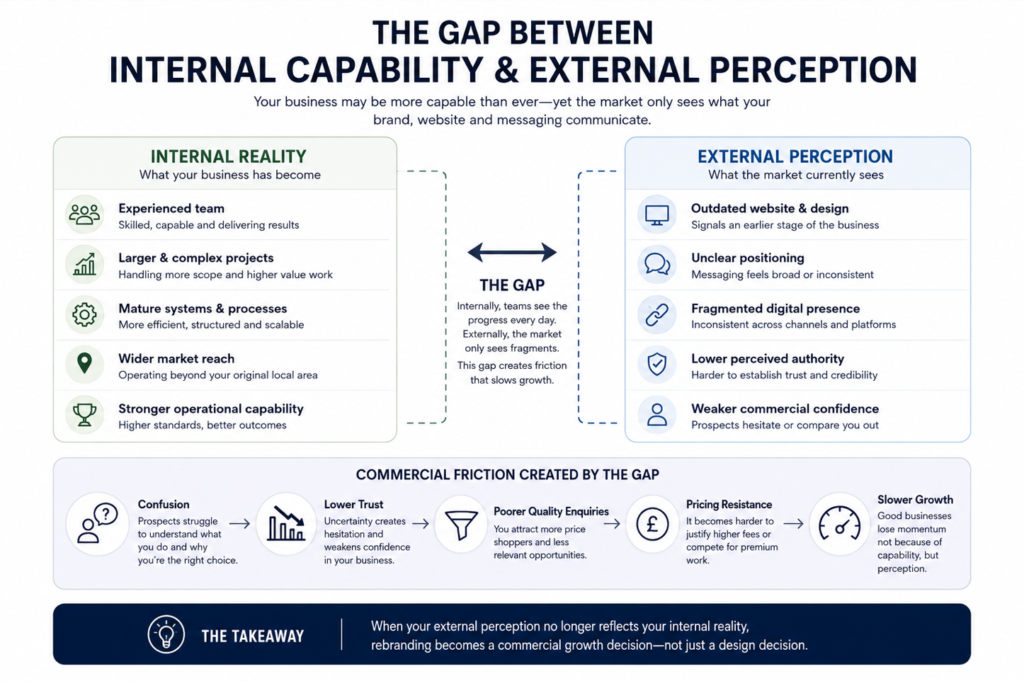
The business itself has evolved faster than the commercial identity surrounding it.
This tends to happen gradually. A company adds new services over several years. Teams grow. Processes mature. Pricing changes. Larger clients arrive. The operational side of the business becomes more sophisticated.
The branding, meanwhile, often remains anchored to an earlier version of the company.
That mismatch creates subtle friction across multiple areas simultaneously.
The website still communicates “small local supplier” while the business is trying to compete for national contracts. Messaging still reflects broad generalist positioning despite the company becoming increasingly specialised. Visual identity systems built years earlier begin looking disconnected across newer digital channels.
Internally, teams adapt naturally because they experience the operational reality every day.
Externally, prospects only see fragments.
That gap between internal capability and external perception is where many businesses quietly begin losing momentum.
3. Why This Matters Commercially
 Branding influences commercial behaviour far more than many businesses initially expect.
Not because buyers consciously analyse logos in detail, but because people interpret consistency, clarity and presentation quality as indicators of organisational maturity.
The process is often subconscious.
A business with fragmented positioning tends to create more hesitation. A business with stronger alignment between messaging, UX, visual consistency and market positioning tends to create confidence faster.
That confidence affects:
pricing tolerance, enquiry quality, conversion confidence, recruitment perception, stakeholder trust and overall authority within competitive markets.
Two companies can offer remarkably similar operational quality while generating entirely different levels of commercial trust online.
One appears established, structured and commercially coherent.
The other appears slightly unclear.
That ambiguity alone can weaken conversion performance before meaningful engagement even begins.
This becomes especially noticeable when businesses try to move into:
higher-ticket services, larger contracts, more specialised sectors or more commercially mature audiences.
The market expectations change.
The older branding often does not.
4. Real-World Business Scenarios
A Regional Business Expanding Beyond Its Original Market
A company initially built around local referrals starts competing nationally.
The operational capability exists. The team may already be delivering projects at significantly larger scale than before. Yet the website still feels heavily tied to its earlier local-business identity. Messaging remains narrow. Service positioning feels dated. The visual presentation lacks the authority expected within broader commercial environments.
The business then encounters an unusual problem.
It is capable of competing at a higher level operationally, but perception slows momentum before conversations properly begin.
A Business Trying to Move Upmarket
This happens frequently in B2B environments.
A company wants to move away from smaller, highly price-sensitive work and attract larger clients instead. Internally, the systems, processes and expertise already support that transition.
Externally, the branding still communicates lower-market positioning.
The website structure, tone of voice, visual presentation and service architecture unintentionally undermine commercial authority during the earliest trust-building stages.
The result is not always fewer enquiries.
Often it is the wrong enquiries.
That distinction matters more than traffic volume.
Service Expansion Creates Structural Confusion
Some businesses evolve organically for so long that the brand architecture eventually stops making coherent sense.
New services are added gradually. Different departments begin describing the business differently. The website navigation becomes bloated. Marketing materials lose consistency because the original positioning framework was never designed to support the broader operational reality that emerged later.
At this stage, rebranding becomes less about aesthetics and more about restoring strategic clarity.
5. The Core Problem Behind the Issue
The core problem is rarely visual deterioration alone.
More often, the business has changed fundamentally while the external positioning framework has not evolved alongside it.
That sounds straightforward in theory. In practice, it creates a surprisingly wide range of downstream problems.
Older branding systems are usually built around assumptions that no longer fully reflect how the business operates:
who the ideal client is, how services are structured, what differentiates the company, how authority is communicated and what type of market perception the business actually needs.
Over time, these inconsistencies accumulate quietly.
The website begins feeling fragmented. Sales conversations require more explanation than they should. Messaging becomes increasingly dependent on individual employees interpreting positioning in their own way. Marketing loses cohesion because there is no longer a clearly aligned commercial narrative underneath it.
Occasionally businesses try solving this incrementally for years.
A new homepage here. Slightly updated visuals there. Revised messaging. A few additional service pages.
Sometimes that works.
Sometimes the underlying structure has already drifted too far for incremental changes to restore coherence properly.
6. What Most Businesses Misunderstand
 Rebranding Is Not Primarily About Looking Modern
One of the more persistent misconceptions around rebranding is the assumption that the process is mainly visual.
In reality, visual identity is usually the visible output of deeper strategic decisions rather than the starting point itself.
Strong rebranding projects tend to begin with more difficult questions:
What market are we actually serving now? How are we perceived commercially? What level do we genuinely operate at? Where does trust break down during the buyer journey? What no longer aligns operationally?
The visual layer comes afterwards.
A Better Logo Rarely Solves Structural Positioning Problems
Some businesses redesign branding cosmetically while leaving deeper inconsistencies untouched.
The result often looks cleaner without materially improving conversion confidence, authority perception or market clarity.
That is why certain rebrands generate strong internal excitement while producing surprisingly little commercial impact six months later.
The underlying positioning problems were never properly addressed.
Branding, UX and Digital Trust Now Overlap Heavily
Buyers increasingly interpret UX quality as part of the brand itself.
Navigation clarity, mobile usability, content hierarchy, loading speed, consistency across touchpoints and overall website structure all influence how mature a business appears commercially.
This is partly why some businesses struggle despite technically offering strong services.
The operational quality exists.
The digital trust environment surrounding it does not fully support it.
7. Deep Expert Breakdown
Brand Refresh vs Full Rebrand
Not every business requires a complete repositioning exercise.
Sometimes a strategic refresh is enough.
A refresh generally focuses on refinement:
improved UX, clearer messaging, modernised presentation, stronger consistency, better website structure and updated visual systems.
The underlying commercial positioning remains broadly intact.
A full rebrand is significantly more structural.
That process may involve rethinking:
market positioning, audience targeting, service architecture, tone of voice, messaging frameworks, digital strategy, website hierarchy and broader commercial direction.
At that stage, branding starts intersecting with operational strategy itself.
The distinction matters because businesses occasionally attempt partial cosmetic updates while the underlying commercial structure already requires something deeper.
That tends to create temporary improvement rather than long-term alignment.
Timing Is More Complicated Than It Looks
Rebranding too late creates accumulated positioning debt.
Rebranding too early can create instability, inconsistency and unnecessary operational disruption.
The strongest timing usually appears when:
the future commercial direction is clearer, service positioning has matured, leadership alignment exists and the business understands what type of market perception it actually needs moving forward.
Businesses rebranding during periods of internal uncertainty often struggle afterwards because the underlying strategic foundation was never stable enough to support consistent implementation.
That problem is more common than many agencies openly admit.
8. Operational Examples / Mini Case Scenarios
The Website Authority Gap
A business may be technically excellent while operating with a website that still resembles an earlier-stage company.
Traffic exists. Visibility may even remain relatively stable.
The issue appears later in behaviour:
lower conversion confidence, weaker lead quality, shorter engagement sessions, higher hesitation before enquiry.
The website is not necessarily “bad”.
It simply no longer reflects the level the business actually operates at.
Pricing Resistance Starts Increasing
Some companies begin experiencing pricing pressure that initially appears sales-related.
Internally, leadership assumes proposals need improvement or competitors are simply undercutting more aggressively.
Occasionally the issue begins earlier.
The broader brand environment still communicates budget-market positioning while the business itself is attempting to move into more premium commercial territory.
Prospects subconsciously anchor expectations before conversations fully begin.
Once that perception settles, reversing it inside a proposal meeting becomes much harder.
Internal Messaging Divergence
One subtle warning sign appears when different departments describe the company differently.
Sales frames the business one way. Marketing presents it another way. Leadership discusses future positioning differently again.
At first this looks like communication inconsistency.
Sometimes it signals that the brand architecture itself no longer provides enough strategic clarity for the organisation that now exists.
9. Common Mistakes, Risks & Failure Patterns
 Rebranding Without Clear Commercial Direction
Some businesses pursue rebranding because something “feels outdated” without properly defining what the new positioning actually needs to achieve.
That usually produces visually cleaner branding without meaningful strategic improvement underneath it.
The company looks different.
The underlying commercial confusion survives intact.
Ignoring SEO Migration Complexity
Where rebranding overlaps with website redevelopment, SEO migration risk becomes substantial.
URL restructuring, content changes, redirects, internal linking adjustments and site architecture modifications can affect years of accumulated search visibility if handled poorly.
Businesses occasionally underestimate how interconnected branding and search infrastructure have become.
A poorly managed migration can erase significant organic momentum surprisingly quickly.
Overcorrecting Positioning
There is also a tendency for some companies to swing too aggressively towards “premium” positioning without considering whether the broader operational experience supports it consistently.
That creates another form of mismatch.
The branding promises one experience. The delivery environment communicates another.
Trust erosion follows fairly quickly once clients detect that inconsistency.
Stakeholder Misalignment
One of the least glamorous parts of rebranding is also one of the most disruptive.
Internal disagreement.
Leadership, sales, operations and marketing teams frequently hold very different assumptions about what the rebrand is supposed to solve. If those tensions are not addressed early, implementation becomes fragmented later.
That fragmentation usually appears publicly faster than businesses expect.
10. Strategic Industry Perspective
Branding has become increasingly operational over the past decade.
Historically, businesses could compensate for weaker digital positioning through referrals, reputation or offline relationships for long periods. In some sectors that still happens.
It is becoming less reliable.
Search behaviour changed. Buyer expectations changed. Competitive environments became more digitally visible.
Prospects now compare businesses side-by-side constantly, often within minutes.
That comparison rarely happens purely through rational evaluation of technical capability. Perception influences interpretation at every stage.
In practical terms, modern branding increasingly overlaps with:
UX quality, conversion behaviour, content structure, authority signals, search visibility, stakeholder confidence and long-term market positioning.
That does not mean every business requires expensive large-scale rebranding.
Some genuinely only need clearer structure and stronger digital consistency.
Others reach a stage where the original branding ecosystem actively limits future growth potential.
The difficult part is recognising the difference early enough.
11. Decision-Making Framework
Businesses considering rebranding usually benefit from stepping back before immediately redesigning anything visually.
The more useful questions often sit elsewhere:
Does the current positioning still reflect the business accurately? Has the target market changed? Does the website communicate the right level of authority? Is trust weaker than expected during early-stage enquiries? Are teams describing the company consistently? Is the commercial direction itself fully clear internally?
Sometimes the answer points towards a strategic refresh rather than full repositioning.
Sometimes the issue sits inside UX, conversion structure or website clarity rather than branding itself.
And occasionally the business genuinely reaches a stage where the external commercial identity no longer supports where the company is trying to go next.
That is usually when rebranding stops being cosmetic and starts becoming strategic.
12. Process / Workflow / Implementation Reality
Proper rebranding projects rarely behave like isolated design exercises.
In practice, they often become organisational alignment projects.
The process may involve market analysis, positioning workshops, messaging redevelopment, UX restructuring, SEO planning, technical migration work, internal stakeholder alignment and significant operational coordination afterwards.
For larger organisations, implementation is often harder than the strategy itself.
Sales documentation changes. Internal systems require updating. Marketing assets become inconsistent temporarily. Teams interpret positioning differently during rollout. Legacy content conflicts with newer messaging.
This is partly why rushed rebrands often create months of fragmentation afterwards.
The strongest implementations usually happen when businesses approach rebranding as:
a commercial alignment exercise rather than purely a visual redesign project.
That shift in mindset changes the quality of decisions made throughout the process.
13. Wider Business & SEO Implications
Branding and SEO are now far more interconnected than they initially appear.
Branding itself is not a direct ranking factor, although perception heavily influences behavioural signals surrounding search performance.
Stronger brand clarity can improve:
CTR, engagement quality, conversion confidence, return visits, trust formation and overall content credibility.
Weak positioning, meanwhile, can quietly reduce performance even where rankings remain relatively stable.
This becomes especially noticeable when websites receive impressions but struggle converting attention into meaningful engagement or enquiries.
Modern rebranding projects increasingly intersect with:
website redesign, semantic structure, UX architecture, conversion optimisation, technical SEO and content hierarchy.
For businesses rebuilding websites alongside rebranding, preserving search infrastructure becomes critically important.
Poor migrations still destroy visibility more often than most companies expect.
Not because Google “penalises” rebrands, but because technical inconsistency accumulates quickly when strategy, development, UX and SEO are handled separately without proper coordination.
14. Key Strategic Takeaways
Businesses rarely need rebranding simply because visuals become old-fashioned.
More often, rebranding becomes necessary because the organisation itself evolved while the external commercial identity surrounding it remained tied to an earlier stage.
That disconnect eventually affects:
trust, positioning clarity, conversion confidence, pricing perception, lead quality and broader commercial momentum.
Strong rebranding can improve alignment significantly.
Poorly executed rebranding can create operational confusion, search disruption and new trust problems entirely.
The difference usually comes down to whether the process is approached strategically or cosmetically.
15. Final Expert Perspective / Closing Position
One of the clearest signs a business may need rebranding is when the organisation internally no longer resembles the version presented externally.
That gap often develops slowly enough that teams stop noticing it while operating inside the business every day.
The market notices it sooner.
In increasingly competitive UK digital environments, branding now sits much closer to commercial infrastructure than many businesses still assume. It influences how authority is interpreted, how trust forms, how confidently pricing is accepted and how clearly the business understands itself internally.
Strong rebranding is rarely about becoming louder or trendier.
Usually, it is about restoring alignment between what the business actually became and what the market still thinks it is.